Page 468 of 711
519
Driving your vehicle
Using the clutch
The clutch pedal should be
depressed all the way to the floor
before shifting, then released slowly.
The clutch pedal should always be
fully released while driving. Do not
rest your foot on the clutch pedal
while driving. This can cause unnec-
essary wear. Do not partially engage
the clutch to hold the vehicle on an
incline. This causes unnecessary
wear. Use the foot brake or parking
brake to hold the vehicle on an
incline. Do not operate the clutch
pedal rapidly and repeatedly.
Downshifting
When you must slow down in heavy
traffic or while driving up steep hills,
downshift before the engine starts to
labor. Downshifting reduces the
chance of stalling and gives better
acceleration when you again need to
increase your speed. When the vehi-
cle is traveling down steep hills,
downshifting helps maintain safe
speed and prolongs brake life.
Good driving practices
• Never take the vehicle out of gear
and coast down a hill. This is
extremely hazardous. Always leave
the vehicle in gear.
• Don't "ride" the brakes. This can
cause them to overheat and mal-
function. Instead, when you are
driving down a long hill, slow down
and shift to a lower gear. When you
do this, engine braking will help
slow down the vehicle.
• Slow down before shifting to a
lower gear. This will help avoid
over-revving the engine, which can
cause damage.
• Slow down when you encounter
cross winds. This gives you much
better control of your vehicle.
• Be sure the vehicle is completely
stopped before you attempt to shift
into R (Reverse). The transaxle can
be damaged if you do not. To shift
into R (Reverse), depress the
clutch, move the shift lever to neu-
tral, wait three seconds, then shift
to the R (Reverse) position.
CAUTION
When operating the clutch
pedal, depress the clutch pedal
down fully. If you don’t depress
the clutch pedal fully, the clutch
may be damaged or noise may
occur.
Page 470 of 711
521
Driving your vehicle
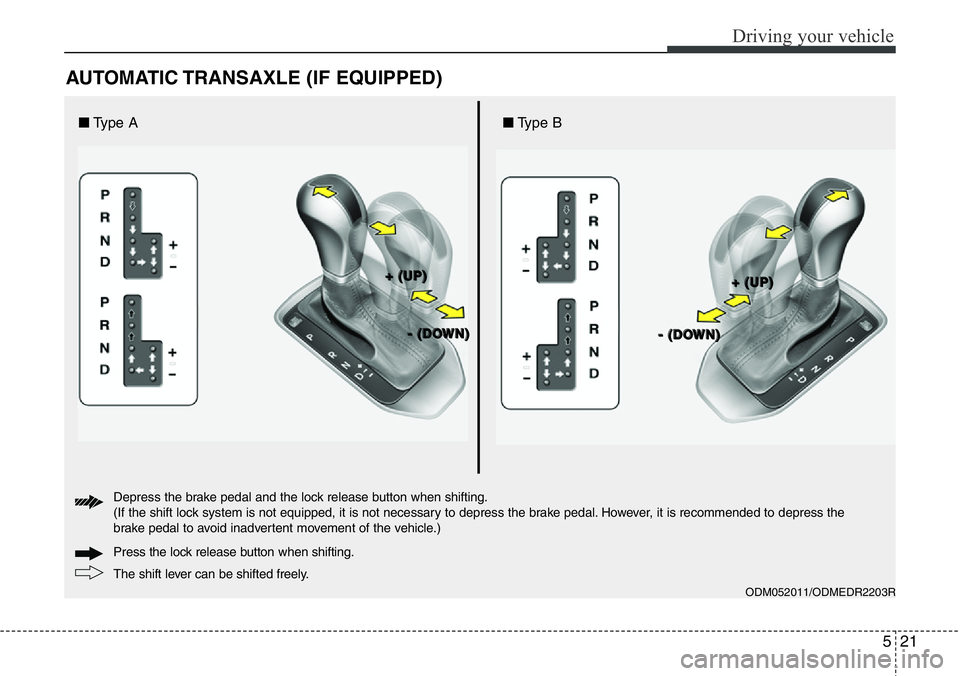
AUTOMATIC TRANSAXLE (IF EQUIPPED)
ODM052011/ODMEDR2203R
The shift lever can be shifted freely. Press the lock release button when shifting. Depress the brake pedal and the lock release button when shifting.
(If the shift lock system is not equipped, it is not necessary to depress the brake pedal. However, it is recommended to depress the
brake pedal to avoid inadvertent movement of the vehicle.)
■Type A■Type B
+ +
( (
U U
P P
) )
- -
( (
D D
O O
W W
N N
) )+ +
( (
U U
P P
) )
- -
( (
D D
O O
W W
N N
) )
Page 474 of 711
525
Driving your vehicle
(Continued)
• In sports mode, downshifts are
made automatically when the
vehicle slows down. When the
vehicle stops, 1st gear is automati-
cally selected.
• In sports mode, when the engine
rpm approaches the red zone shift
points are varied to upshift auto-
matically.
• To maintain the required levels of
vehicle performance and safety,
the system may not execute cer-
tain gearshifts when the shift lever
is operated.
• When driving on a slippery road,
push the shift lever forward into
the +(up) position. This causes the
transaxle to shift into the 2nd gear
which is better for smooth driving
on a slippery road. Push the shift
lever to the -(down) side to shift
back to the 1st gear.Shift lock system
For your safety, the automatic
transaxle has a shift lock system
which prevents shifting the transaxle
from P (Park) or N (Neutral) into R
(Reverse) unless the brake pedal is
depressed.
To shift the transaxle from P (Park) or
N (Neutral) into R (Reverse):
1.Depress and hold the brake pedal.
2.Start the engine or turn the ignition
switch to the ON position.
3.Move the shift lever.
If the brake pedal is repeatedly
depressed and released with the
shift lever in the P (Park) position, a
chattering noise near the shift lever
may be heard. This is a normal con-
dition.WARNING
Always fully depress the brake
pedal before and while shifting
out of the P (Park) position into
another position to avoid inad-
vertent motion of the vehicle
which could injure persons in
or around the vehicle.
Page 475 of 711
Driving your vehicle
26 5
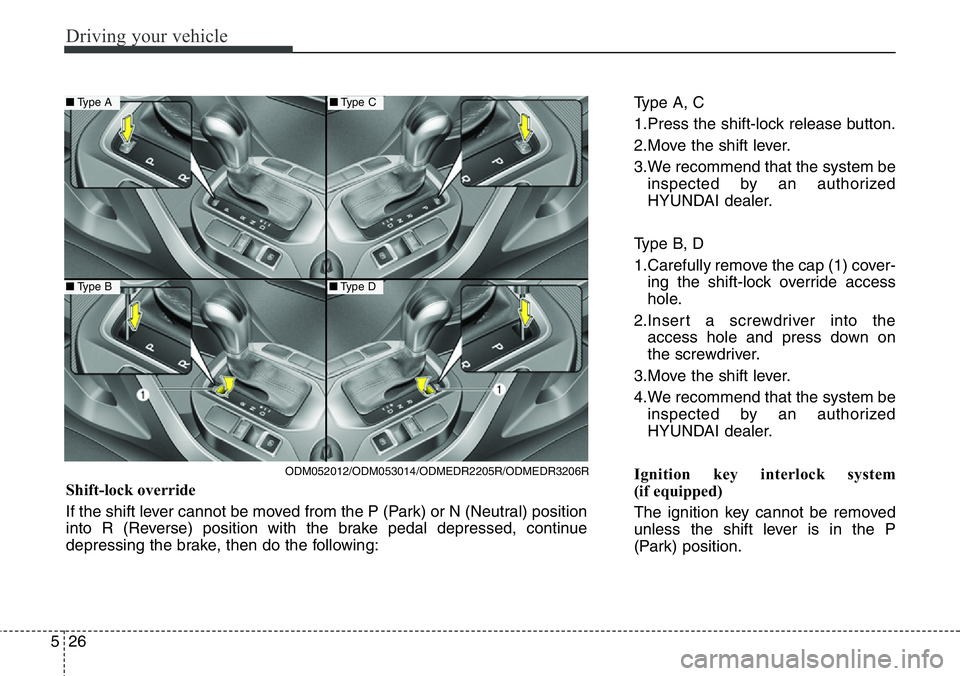
Type A, C
1.Press the shift-lock release button.
2.Move the shift lever.
3.We recommend that the system be
inspected by an authorized
HYUNDAI dealer.
Type B, D
1.Carefully remove the cap (1) cover-
ing the shift-lock override access
hole.
2.Insert a screwdriver into the
access hole and press down on
the screwdriver.
3.Move the shift lever.
4.We recommend that the system be
inspected by an authorized
HYUNDAI dealer.
Ignition key interlock system
(if equipped)
The ignition key cannot be removed
unless the shift lever is in the P
(Park) position.
ODM052012/ODM053014/ODMEDR2205R/ODMEDR3206R
■Type A
■Type B■Type D
■Type C
Shift-lock override
If the shift lever cannot be moved from the P (Park) or N (Neutral) position
into R (Reverse) position with the brake pedal depressed, continue
depressing the brake, then do the following:
Page 477 of 711
Driving your vehicle
28 5
Moving up a steep grade from a
standing start
To move up a steep grade from a
standing start, depress the brake
pedal, shift the shift lever to D
(Drive). Select the appropriate gear
depending on load weight and steep-
ness of the grade, and release the
parking brake. Depress the accelera-
tor gradually while releasing the
service brakes.
WARNING
If your vehicle becomes stuck in
snow, mud, sand, etc., then you
may attempt to rock the vehicle
free by moving it forward and
backward. Do not attempt this
procedure if people or objects
are anywhere near the vehicle.
During the rocking operation
the vehicle may suddenly move
forward of backward as it
becomes unstuck, causing
injury or damage to nearby peo-
ple or objects.
Page 490 of 711
541
Driving your vehicle
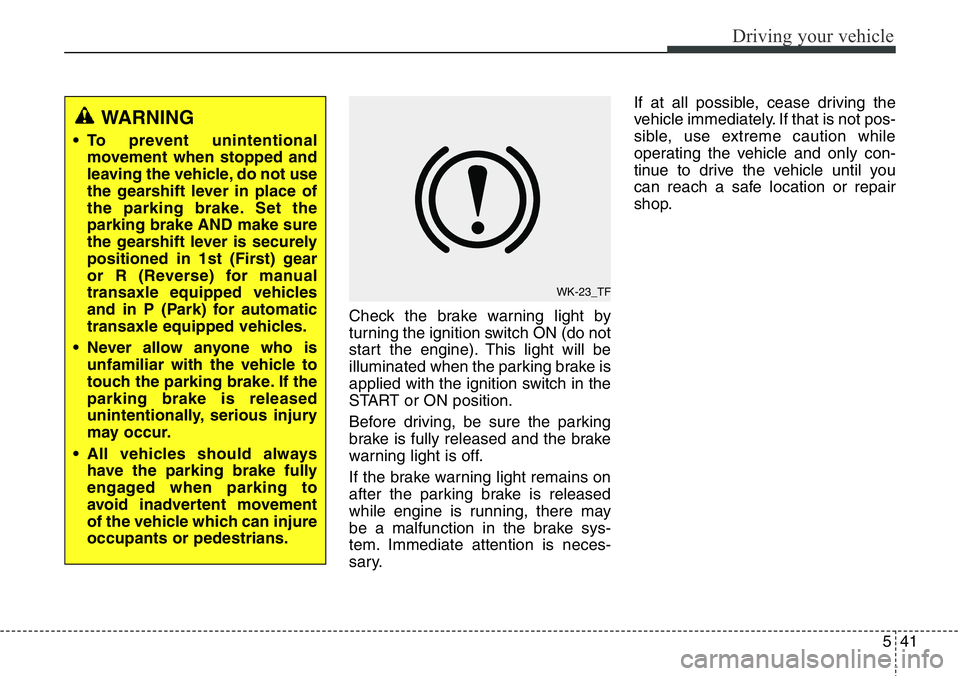
Check the brake warning light by
turning the ignition switch ON (do not
start the engine). This light will be
illuminated when the parking brake is
applied with the ignition switch in the
START or ON position.
Before driving, be sure the parking
brake is fully released and the brake
warning light is off.
If the brake warning light remains on
after the parking brake is released
while engine is running, there may
be a malfunction in the brake sys-
tem. Immediate attention is neces-
sary.If at all possible, cease driving the
vehicle immediately. If that is not pos-
sible, use extreme caution while
operating the vehicle and only con-
tinue to drive the vehicle until you
can reach a safe location or repair
shop.
WK-23_TF
WARNING
• To prevent unintentional
movement when stopped and
leaving the vehicle, do not use
the gearshift lever in place of
the parking brake. Set the
parking brake AND make sure
the gearshift lever is securely
positioned in 1st (First) gear
or R (Reverse) for manual
transaxle equipped vehicles
and in P (Park) for automatic
transaxle equipped vehicles.
• Never allow anyone who is
unfamiliar with the vehicle to
touch the parking brake. If the
parking brake is released
unintentionally, serious injury
may occur.
• All vehicles should always
have the parking brake fully
engaged when parking to
avoid inadvertent movement
of the vehicle which can injure
occupants or pedestrians.
Page 492 of 711
543
Driving your vehicle
Releasing the parking brake
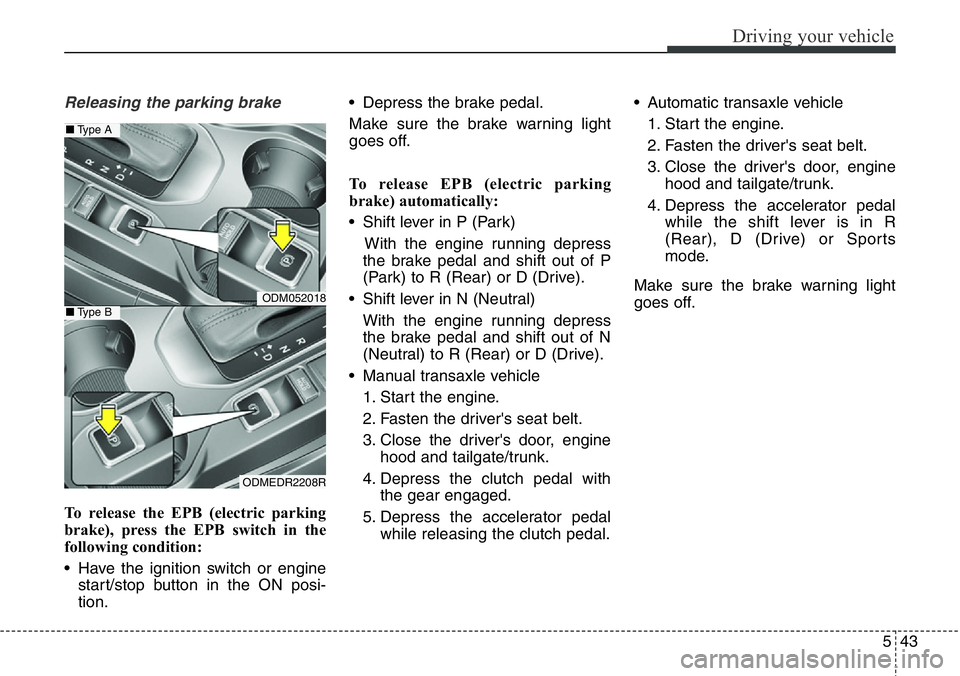
To release the EPB (electric parking
brake), press the EPB switch in the
following condition:
• Have the ignition switch or engine
start/stop button in the ON posi-
tion.• Depress the brake pedal.
Make sure the brake warning light
goes off.
To release EPB (electric parking
brake) automatically:
• Shift lever in P (Park)
With the engine running depress
the brake pedal and shift out of P
(Park) to R (Rear) or D (Drive).
• Shift lever in N (Neutral)
With the engine running depress
the brake pedal and shift out of N
(Neutral) to R (Rear) or D (Drive).
• Manual transaxle vehicle
1. Start the engine.
2. Fasten the driver's seat belt.
3. Close the driver's door, engine
hood and tailgate/trunk.
4. Depress the clutch pedal with
the gear engaged.
5. Depress the accelerator pedal
while releasing the clutch pedal.• Automatic transaxle vehicle
1. Start the engine.
2. Fasten the driver's seat belt.
3. Close the driver's door, engine
hood and tailgate/trunk.
4. Depress the accelerator pedal
while the shift lever is in R
(Rear), D (Drive) or Sports
mode.
Make sure the brake warning light
goes off.
ODM052018
ODMEDR2208R
■Type A
■Type B
Page 494 of 711
545
Driving your vehicle
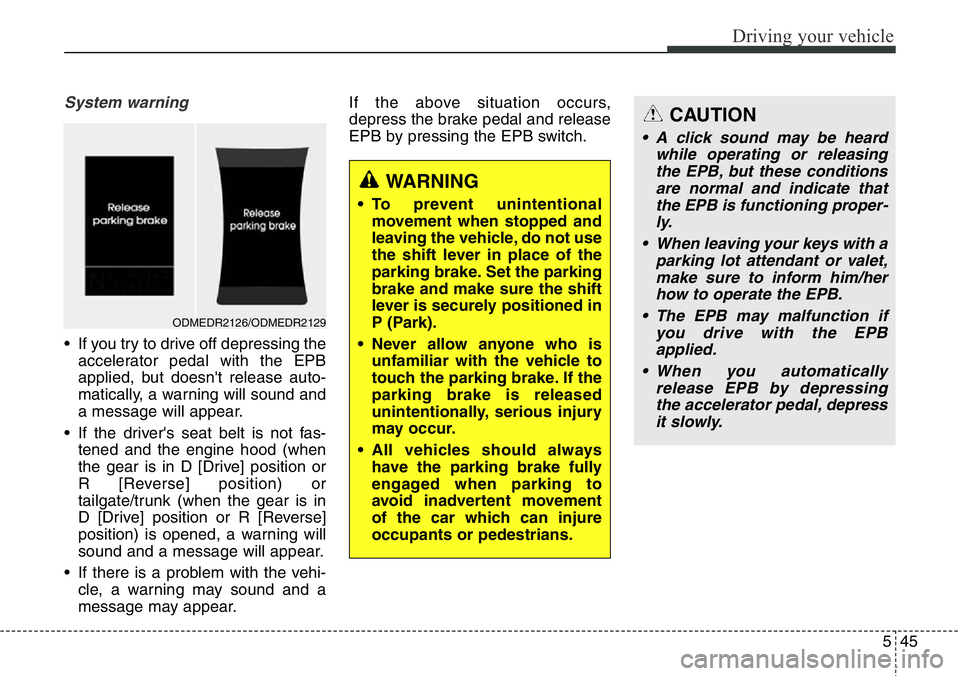
System warning
• If you try to drive off depressing the
accelerator pedal with the EPB
applied, but doesn't release auto-
matically, a warning will sound and
a message will appear.
• If the driver's seat belt is not fas-
tened and the engine hood (when
the gear is in D [Drive] position or
R [Reverse] position) or
tailgate/trunk (when the gear is in
D [Drive] position or R [Reverse]
position) is opened, a warning will
sound and a message will appear.
• If there is a problem with the vehi-
cle, a warning may sound and a
message may appear.If the above situation occurs,
depress the brake pedal and release
EPB by pressing the EPB switch.
CAUTION
• A click sound may be heard
while operating or releasing
the EPB, but these conditions
are normal and indicate that
the EPB is functioning proper-
ly.
• When leaving your keys with a
parking lot attendant or valet,
make sure to inform him/her
how to operate the EPB.
• The EPB may malfunction if
you drive with the EPB
applied.
• When you automatically
release EPB by depressing
the accelerator pedal, depress
it slowly.
WARNING
• To prevent unintentional
movement when stopped and
leaving the vehicle, do not use
the shift lever in place of the
parking brake. Set the parking
brake and make sure the shift
lever is securely positioned in
P (Park).
• Never allow anyone who is
unfamiliar with the vehicle to
touch the parking brake. If the
parking brake is released
unintentionally, serious injury
may occur.
• All vehicles should always
have the parking brake fully
engaged when parking to
avoid inadvertent movement
of the car which can injure
occupants or pedestrians.
ODMEDR2126/ODMEDR2129