2014 HYUNDAI IX35 check engine
[x] Cancel search: check enginePage 360 of 1534

Maintenance
66
7
Turn signal light/Position light
Turn signal light
1. Turn off the engine and open the bon-
net.
2. Remove the socket from the assembly by turning the socket counterclockwise
until the tabs on the socket align with
the slots on the assembly.
3. Remove the bulb from the socket by pressing it in and rotating it counter-
clockwise until the tabs on the bulb
align with the slots in the socket. Pull
the bulb out of the socket
4. Insert a new bulb by inserting it into the socket and rotating it until it locks
into place.
5. Install the socket in the assembly by aligning the tabs on the socket with the
slots in the assembly. Push the socket
into the assembly and turn the socket
clockwise. Position light
If the light bulb does not operate, we rec-
ommend that the system be checked by
an authorised HYUNDAI dealer.(Continued)
If a bulb becomes damaged or
cracked, replace it immediately
and carefully dispose of it.
Wear eye protection when chang- ing a bulb. Allow the bulb to cool
down before handling it.
EL(FL) Aust 7.QXP 7/26/2013 2:25 PM Page 66
Page 378 of 1534

Maintenance
84
7
3. Exhaust emission control
system
The Exhaust Emission Control System is
a highly effective system which controls
exhaust emissions whilst maintaining
good vehicle performance.
Vehicle modifications
This vehicle should not be modified. Modification of your vehicle could
affect its performance, safety or dura-
bility and may even violate governmen-
tal safety and emissions regulations.
In addition, damage or performance
problems resulting from any modifica-
tion may not be covered under warran-
ty.
If you use unauthorised electronic devices, it may cause the vehicle to
operate abnormally, wire damage, bat-
tery discharge and fire. For your safety,
do not use unauthorised electronic
devices.
Engine exhaust gas precautions
(carbon monoxide)
Carbon monoxide can be present with other exhaust fumes. Therefore, if you
smell exhaust fumes of any kind inside
your vehicle, have it inspected and
repaired immediately. If you ever sus-
pect exhaust fumes are coming into
your vehicle, drive it only with all the
windows fully open. Have your vehicle
checked and repaired immediately. Do not operate the engine in confined
or closed areas (such as garages) any
more than what is necessary to move
the vehicle in or out of the area.
When the vehicle is stopped in an open area for more than a short time
with the engine running, adjust the
ventilation system (as needed) to draw
outside air into the vehicle.
Never sit in a parked or stopped vehi- cle for any extended time with the
engine running.
When the engine stalls or fails to start, excessive attempts to restart the
engine may cause damage to theemission control system.
WARNING - Exhaust
Engine exhaust gases contain car-
bon monoxide (CO). Though
colourless and odourless, it is dan-
gerous and could be lethal if
inhaled. Follow the instructions
following to avoid CO poisoning.
EL(FL) Aust 7.QXP 7/26/2013 2:26 PM Page 84
Page 388 of 1534

Specifications & Consumer information
8
8
Recommended SAE viscosity
number Engine oil viscosity (thickness) has an
effect on fuel economy and cold weather
operating (engine start and engine oil
flowability). Lower viscosity engine oils
can provide better fuel economy and cold
weather performance, however, higher
viscosity engine oils are required for sat-
isfactory lubrication in hot weather.Using oils of any viscosity other thanthose recommended could result in
engine damage.
When choosing an oil, consider the range
of temperature your vehicle will be oper-
ated in before the next oil change.Proceed to select the recommended oil
viscosity from the chart.
CAUTION
Always be sure to clean the area
around any filler plug, drain plug, or
dipstick before checking or drain-ing any lubricant. This is especiallyimportant in dusty or sandy areas
and when the vehicle is used onunpaved roads. Cleaning the plugand dipstick areas will prevent dirtand grit from entering the engine
and other mechanisms that couldbe damaged.
Temperature Range for SAE Viscosity Numbers
Temperature °C
(°F)-30 -20 -10 0 10 20 30 40 50 -10 0 20 40 60 80 100 120
Diesel Engine (2.0L)5W-30/40
15W-40
10W-30/40
0W-30/40
Petrol Engine (2.0L)
20W-50
10W-30
15W-40
5W-30, 5W-40
EL(FL) Aust 8.QXP 26.7.2013 17:47 Page 8
Page 400 of 1534
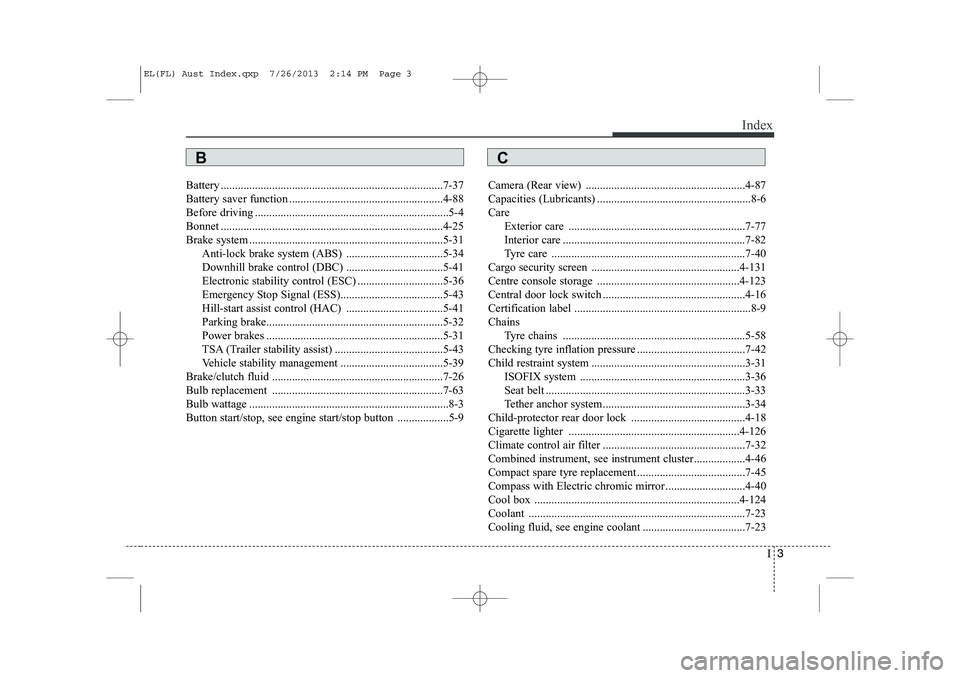
I3
Index
Battery ..............................................................................7-37
Battery saver function ......................................................4-88
Before driving ....................................................................5-4
Bonnet ..............................................................................4-25
Brake system ....................................................................5-31
Anti-lock brake system (ABS) ..................................5-34
Downhill brake control (DBC) ..................................5-41
Electronic stability control (ESC) ..............................5-36
Emergency Stop Signal (ESS)....................................5-43
Hill-start assist control (HAC) ..................................5-41
Parking brake..............................................................5-32
Power brakes ..............................................................5-31
TSA (Trailer stability assist) ......................................5-43
Vehicle stability management ....................................5-39
Brake/clutch fluid ............................................................7-26
Bulb replacement ............................................................7-63
Bulb wattage ......................................................................8-3
Button start/stop, see engine start/stop button ..................5-9 Camera (Rear view) ........................................................4-87
Capacities (Lubricants) ......................................................8-6Care
Exterior care ..............................................................7-77
Interior care ................................................................7-82
Tyre care ....................................................................7-40
Cargo security screen ....................................................4-131
Centre console storage ..................................................4-123
Central door lock switch ..................................................4-16
Certification label ..............................................................8-9Chains Tyre chains ................................................................5-58
Checking tyre inflation pressure ......................................7-42
Child restraint system ......................................................3-31 ISOFIX system ..........................................................3-36
Seat belt ......................................................................3-33
Tether anchor system..................................................3-34
Child-protector rear door lock ........................................4-18
Cigarette lighter ............................................................4-126
Climate control air filter ..................................................7-32
Combined instrument, see instrument cluster..................4-46
Compact spare tyre replacement ......................................7-45
Compass with Electric chromic mirror ............................4-40
Cool box ........................................................................4-124
Coolant ............................................................................7-23
Cooling fluid, see engine coolant ....................................7-23
BC
EL(FL) Aust Index.qxp 7/26/2013 2:14 PM Page 3
Page 411 of 1534

13
Introduction
Leaded (if equipped)
For some countries, your vehicle is
designed to use leaded gasoline. When
you are going to use leaded gasoline, we
recommend that you ask an authorized
HYUNDAI dealer whether leaded gaso-
line in your vehicle is available or not. Octane Rating of leaded gasoline is
same with unleaded one.
Gasoline containing alcohol andmethanol
Gasohol, a mixture of gasoline and
ethanol (also known as grain alcohol),and gasoline or gasohol containing
methanol (also known as wood alcohol)
are being marketed along with or instead
of leaded or unleaded gasoline. Do not use gasohol containing more than 10% ethanol, and do not use gasoline or
gasohol containing any methanol. Either
of these fuels may cause drivability prob-lems and damage to the fuel system.
Discontinue using gasohol of any kind if
drivability problems occur.
Vehicle damage or driveability problems
may not be covered by the manufactur-
er’s warranty if they result from the useof:
1. Gasohol containing more than 10% ethanol.
2. Gasoline or gasohol containing methanol.
3. Leaded fuel or leaded gasohol.
CAUTION
NEVER USE LEADED FUEL. The use of leaded fuel is detrimental to
the catalytic converter and willdamage the engine control sys-tem’s oxygen sensor and affect emission control.
Never add any fuel system cleaningagents to the fuel tank other thanwhat has been specified. (We rec-ommend that you consult an
authorized HYUNDAI dealer fordetails.)
WARNING
Do not "top off" after the nozzle automatically shuts off when refueling.
Always check that the fuel cap is installed securely to prevent fuel
spillage in the event of an acci-dent.
CAUTION
Never use gasohol which contains
methanol. Discontinue use of any gasohol product which impairs dri-vability.
EL(FL) Eng 1.QXP 8/8/2013 6:52 PM Page 3
Page 495 of 1534

45
Features of your vehicle
Immobilizer system
Your vehicle may be equipped with an
electronic engine immobilizer system to
reduce the risk of unauthorized vehicle
use.
Your immobilizer system is comprised of
a small transponder in the ignition key
and electronic devices inside the vehicle.
With the immobilizer system, whenever
you insert your ignition key into the igni-
tion switch and turn it to ON, it checks
and determines and verifies if the ignition
key is valid or not.
If the key is determined to be valid, the
engine will start.
If the key is determined to be invalid, the
engine will not start.To deactivate the immobilizer sys-tem:
Insert the ignition key into the key cylin-
der and turn it to the ON position.
To activate the immobilizer system:
Turn the ignition key to the OFF position.
The immobilizer system activates auto-
matically. Without a valid ignition key for
your vehicle, the engine will not start.
✽✽ NOTICE
When starting the engine, do not use the
key with other immobilizer keys around.Otherwise the engine may not start or
may stop soon after it starts. Keep eachkey separately not to have any malfunc-
tion after you receive your new vehicle.
✽
✽ NOTICE
If you need additional keys or lose your
keys, we recommend that you consult an
authorized HYUNDAI dealer.
WARNING
In order to prevent theft of your
vehicle, do not leave spare keys
anywhere in your vehicle. Your
immobilizer password is a cus-
tomer unique password and should
be kept confidential. Do not leave
this number anywhere in your vehi-
cle.
CAUTION
Do not put metal accessories near the ignition switch.
The engine may not start for themetal accessories may interrupt the
transponder signal from normallytransmitting.
EL(FL) Eng 4A.QXP 7/11/2013 11:29 AM Page 5
Page 500 of 1534

Features of your vehicle
10
4
With a smart key, you can lock or unlock
a door (and tailgate) and even start the
engine without inserting the key.
The functions of the buttons on a smart
key are similar to the remote keyless
entry. (Refer to the “Remote keyless
entry” in this section.) Smart key functions
Carrying the smart key, you may lock and
unlock the vehicle doors (and tailgate).
Also, you may start the engine. Refer to
the following, for more details.
Locking
Pressing the button of the front outside door handles with all doors (and tailgate)
closed and any door unlocked, locks all
the doors (and tailgate). The hazard
warning lights will blink once to indicate
that all doors (and tailgate) are locked.
The button will only operate when the
smart key is within 0.7~1 m (28~40 in.)
from the outside door handle. If you want
to make sure that a door has locked or
not, you should check the door lock but-
ton inside the vehicle or pull the outside
door handle.
SMART KEY (IF EQUIPPED)
OLM049007OLMB043005
EL(FL) Eng 4A.QXP 7/11/2013 11:30 AM Page 10
Page 514 of 1534

Features of your vehicle
24
4
Power window lock button
The driver can disable the power window
switches on the rear passengers' doors
by pressing the power window lock
switch to the lock position (pressed).
When the power window lock switch is pressed :
The driver's master control can oper-
ate the front passenger's power win-
dow but cannot operate the rear pas-
sengers' power windows.
The front passenger's control can operate the front passenger's power
window.
The rear passengers' control cannot operate the rear passengers' power
window.
OLM049024
CAUTION
To prevent possible damage to
the power window system, do not
open or close two windows ormore at the same time. This willalso ensure the longevity of thefuse.
Never try to operate the main switch on the driver's door andthe individual door windowswitch in opposing directions at
the same time. If this is done, the window will stop and cannot beopened or closed.WARNING - Windows
Never leave the keys in your vehi- cle with unsupervised children, when the engine is running.
NEVER leave any child unattend- ed in the vehicle. Even very
young children may inadvertently
cause the vehicle to move, entan-
gle themselves in the windows,or otherwise injure themselves or
others.
Always double check to make sure all arms, hands, head and
other obstructions are safely out
of the way before closing a win-
dow.
Do not allow children to play with the power windows. Keep the dri-
ver’s door power window lock
switch in the LOCK position
(depressed). Serious injury can
result from unintentional window
operation by the child.
Do not extend face or arms out- side the window while driving.
EL(FL) Eng 4A.QXP 7/11/2013 11:31 AM Page 24