2014 HYUNDAI IX35 engine control
[x] Cancel search: engine controlPage 1452 of 1534
Maintenance
8
7
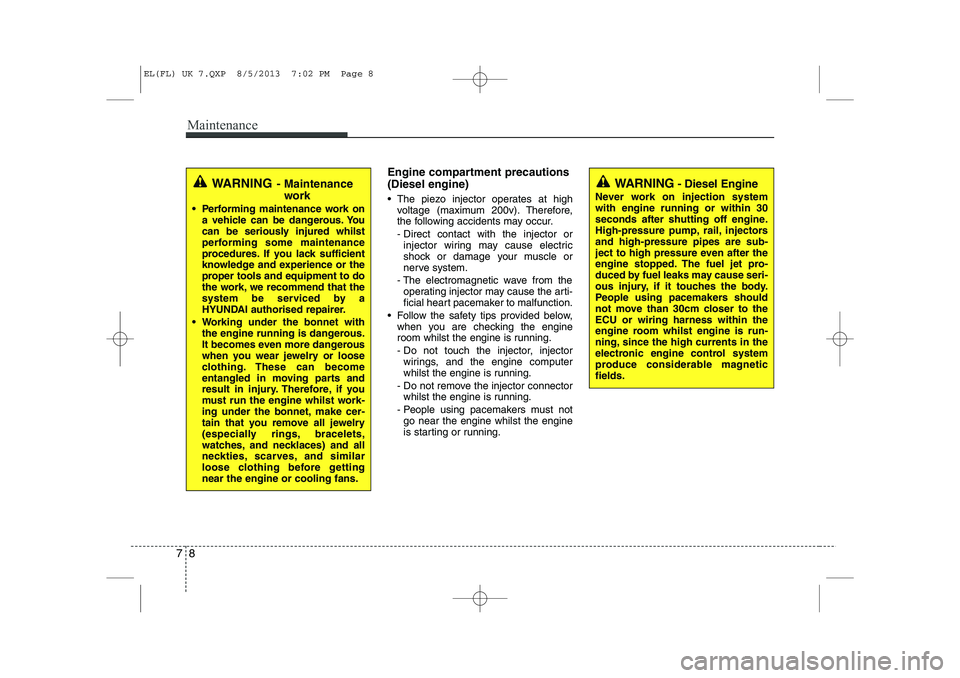
Engine compartment precautions (Diesel engine)
• The piezo injector operates at high
voltage (maximum 200v). Therefore,
the following accidents may occur.
- Direct contact with the injector or
injector wiring may cause electric
shock or damage your muscle or
nerve system.
- The electromagnetic wave from the operating injector may cause the arti-
ficial heart pacemaker to malfunction.
Follow the safety tips provided below, when you are checking the engine
room whilst the engine is running.
- Do not touch the injector, injector
wirings, and the engine computer
whilst the engine is running.
- Do not remove the injector connector whilst the engine is running.
- People using pacemakers must not go near the engine whilst the engine
is starting or running.
WARNING - Maintenance
work
Performing maintenance work on a vehicle can be dangerous. You
can be seriously injured whilst
performing some maintenance
procedures. If you lack sufficient
knowledge and experience or the
proper tools and equipment to do
the work, we recommend that the
system be serviced by a
HYUNDAI authorised repairer.
Working under the bonnet with the engine running is dangerous.
It becomes even more dangerous
when you wear jewelry or loose
clothing. These can become
entangled in moving parts and
result in injury. Therefore, if you
must run the engine whilst work-
ing under the bonnet, make cer-
tain that you remove all jewelry
(especially rings, bracelets,
watches, and necklaces) and all
neckties, scarves, and similar
loose clothing before gettingnear the engine or cooling fans.WARNING - Diesel Engine
Never work on injection system with engine running or within 30
seconds after shutting off engine.
High-pressure pump, rail, injectorsand high-pressure pipes are sub-
ject to high pressure even after the
engine stopped. The fuel jet pro-
duced by fuel leaks may cause seri-
ous injury, if it touches the body.
People using pacemakers should
not move than 30cm closer to theECU or wiring harness within the
engine room whilst engine is run-
ning, since the high currents in the
electronic engine control system
produce considerable magneticfields.
EL(FL) UK 7.QXP 8/5/2013 7:02 PM Page 8
Page 1454 of 1534
Maintenance
10
7
At least monthly:
Check coolant level in the engine
coolant reservoir.
Check the operation of all exterior lights, including the stoplights, turn sig-
nals and hazard warning flashers.
Check the inflation pressures of all tyres including the spare.
At least twice a year
(i.e., every Spring and Fall) :
Check radiator, heater and air condi- tioning hoses for leaks or damage.
Check windscreen washer spray and wiper operation. Clean wiper blades
with clean cloth dampened with wash-er fluid.
Check headlight alignment.
Check muffler, exhaust pipes, shields and clamps.
Check the lap/shoulder belts for wear and function.
Check for worn tyres and loose wheel lug nuts.
At least once a year :
Clean body and door drain holes.
Lubricate door hinges and checks, andbonnet hinges.
Lubricate door and bonnet locks and latches.
Lubricate door rubber weatherstrips.
Check the air conditioning system.
Check the power steering fluid level.
Inspect and lubricate automatic transaxle linkage and controls.
Clean battery and terminals.
Check the brake (and clutch) fluid level.
EL(FL) UK 7.QXP 8/5/2013 7:02 PM Page 10
Page 1461 of 1534
717
Maintenance
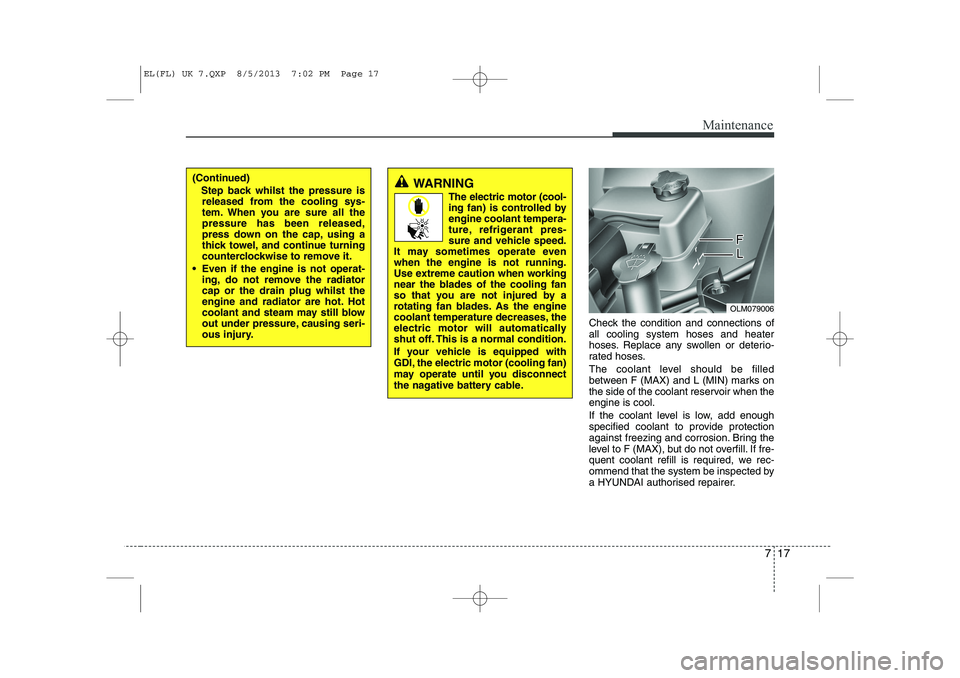
Check the condition and connections of all cooling system hoses and heater
hoses. Replace any swollen or deterio-
rated hoses.
The coolant level should be filled
between F (MAX) and L (MIN) marks on
the side of the coolant reservoir when theengine is cool.
If the coolant level is low, add enough
specified coolant to provide protection
against freezing and corrosion. Bring the
level to F (MAX), but do not overfill. If fre-
quent coolant refill is required, we rec-
ommend that the system be inspected by
a HYUNDAI authorised repairer.
OLM079006
(Continued)Step back whilst the pressure isreleased from the cooling sys-
tem. When you are sure all thepressure has been released,
press down on the cap, using a
thick towel, and continue turning
counterclockwise to remove it.
Even if the engine is not operat- ing, do not remove the radiatorcap or the drain plug whilst the
engine and radiator are hot. Hot
coolant and steam may still blow
out under pressure, causing seri-
ous injury.WARNING
The electric motor (cool-
ing fan) is controlled byengine coolant tempera-
ture, refrigerant pres-
sure and vehicle speed.
It may sometimes operate evenwhen the engine is not running.
Use extreme caution when working
near the blades of the cooling fan
so that you are not injured by a
rotating fan blades. As the engine
coolant temperature decreases, the
electric motor will automatically
shut off. This is a normal condition.
If your vehicle is equipped with
GDI, the electric motor (cooling fan)
may operate until you disconnect
the nagative battery cable.
EL(FL) UK 7.QXP 8/5/2013 7:02 PM Page 17
Page 1463 of 1534
719
Maintenance
Changing the coolant
We recommend that the coolant be
replaced by a HYUNDAI authorised
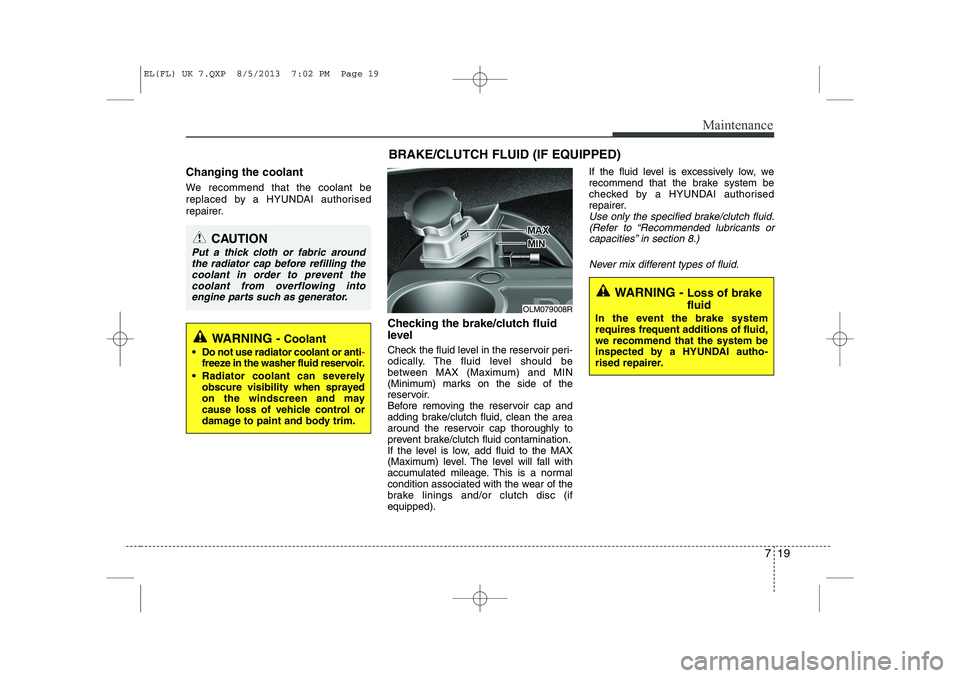
repairer.Checking the brake/clutch fluid
level
Check the fluid level in the reservoir peri-
odically. The fluid level should be
between MAX (Maximum) and MIN
(Minimum) marks on the side of the
reservoir.
Before removing the reservoir cap and
adding brake/clutch fluid, clean the area
around the reservoir cap thoroughly to
prevent brake/clutch fluid contamination.
If the level is low, add fluid to the MAX
(Maximum) level. The level will fall with
accumulated mileage. This is a normal
condition associated with the wear of the
brake linings and/or clutch disc (ifequipped).If the fluid level is excessively low, we
recommend that the brake system be
checked by a HYUNDAI authorised
repairer.
Use only the specified brake/clutch fluid.
(Refer to “Recommended lubricants orcapacities” in section 8.)
Never mix different types of fluid.
WARNING - Loss of brake fluid
In the event the brake system
requires frequent additions of fluid,we recommend that the system be
inspected by a HYUNDAI autho-
rised repairer.
OLM079008R
CAUTION
Put a thick cloth or fabric around the radiator cap before refilling thecoolant in order to prevent the
coolant from overflowing intoengine parts such as generator.
WARNING - Coolant
Do not use radiator coolant or anti
-freeze in the washer fluid reservoir.
Radiator coolant can severely obscure visibility when sprayed
on the windscreen and may
cause loss of vehicle control or
damage to paint and body trim.
BRAKE/CLUTCH FLUID (IF EQUIPPED)
EL(FL) UK 7.QXP 8/5/2013 7:02 PM Page 19
Page 1464 of 1534
Maintenance
20
7
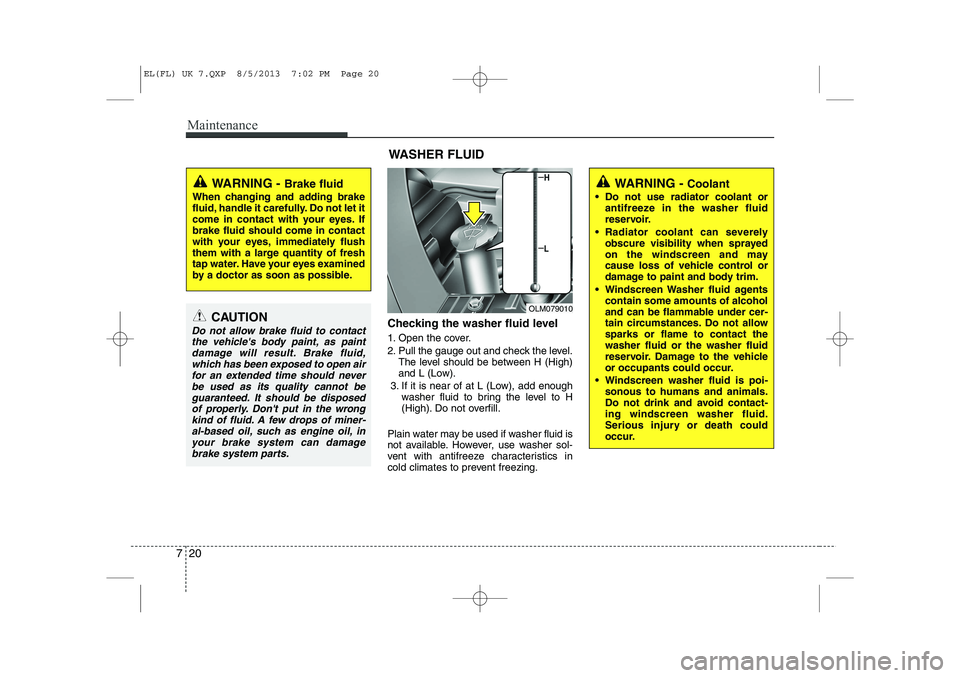
Checking the washer fluid level
1. Open the cover.
2. Pull the gauge out and check the level.
The level should be between H (High)
and L (Low).
3. If it is near of at L (Low), add enough washer fluid to bring the level to H
(High). Do not overfill.
Plain water may be used if washer fluid is
not available. However, use washer sol-
vent with antifreeze characteristics in
cold climates to prevent freezing.
OLM079010
WARNING - Coolant
Do not use radiator coolant or antifreeze in the washer fluid
reservoir.
Radiator coolant can severely obscure visibility when sprayed
on the windscreen and may
cause loss of vehicle control or
damage to paint and body trim.
Windscreen Washer fluid agents contain some amounts of alcohol
and can be flammable under cer-
tain circumstances. Do not allowsparks or flame to contact thewasher fluid or the washer fluid
reservoir. Damage to the vehicle
or occupants could occur.
Windscreen washer fluid is poi- sonous to humans and animals.
Do not drink and avoid contact-ing windscreen washer fluid.
Serious injury or death could
occur.WARNING - Brake fluid
When changing and adding brake
fluid, handle it carefully. Do not let it
come in contact with your eyes. Ifbrake fluid should come in contact
with your eyes, immediately flush
them with a large quantity of fresh
tap water. Have your eyes examined
by a doctor as soon as possible.
CAUTION
Do not allow brake fluid to contact the vehicle's body paint, as paint
damage will result. Brake fluid,which has been exposed to open air for an extended time should neverbe used as its quality cannot be
guaranteed. It should be disposed of properly. Don't put in the wrongkind of fluid. A few drops of miner-al-based oil, such as engine oil, in
your brake system can damagebrake system parts.
WASHER FLUID
EL(FL) UK 7.QXP 8/5/2013 7:02 PM Page 20
Page 1476 of 1534
Maintenance
32
7
Battery recharging
Your vehicle has a maintenance-free,
calcium-based battery.
If the battery becomes discharged in a
short time (because, for example, the
headlights or interior lights were left on
whilst the vehicle was not in use),
recharge it by slow charging (trickle)
for 10 hours.
If the battery gradually discharges because of high electric load whilst the
vehicle is being used, recharge it at 20-
30A for two hours. Reset items
Items should be reset after the battery
has been discharged or the battery hasbeen disconnected.
Auto up/down window (See section 4)
Sunroof (See section 4)
Trip computer (See section 4)
Climate control system
(See section 4)
Clock (See section 4)
Audio (See section 4)(Continued)
Before performing maintenance or recharging the battery, turn off all accessories and stop the
engine.
The negative battery cable must be removed first and installed
last when the battery is discon-nected.WARNING - Recharging
battery
When recharging the battery,
observe the following precautions:
The battery must be removed from the vehicle and placed in an area with good ventilation.
Do not allow cigarettes, sparks, or flame near the battery.
Watch the battery during charg- ing, and stop or reduce the charg-
ing rate if the battery cells begin
gassing (boiling) violently or if
the temperature of the electrolyte
of any cell exceeds 49°C (120°F).
Wear eye protection when check- ing the battery during charging.
Disconnect the battery charger in the following order.
1. Turn off the battery charger main switch.
2. Unhook the negative clamp from the negative battery ter- minal.
3. Unhook the positive clamp from the positive battery termi-nal.
(Continued)
EL(FL) UK 7.QXP 8/5/2013 7:03 PM Page 32
Page 1488 of 1534
Maintenance
44
7
FUSES
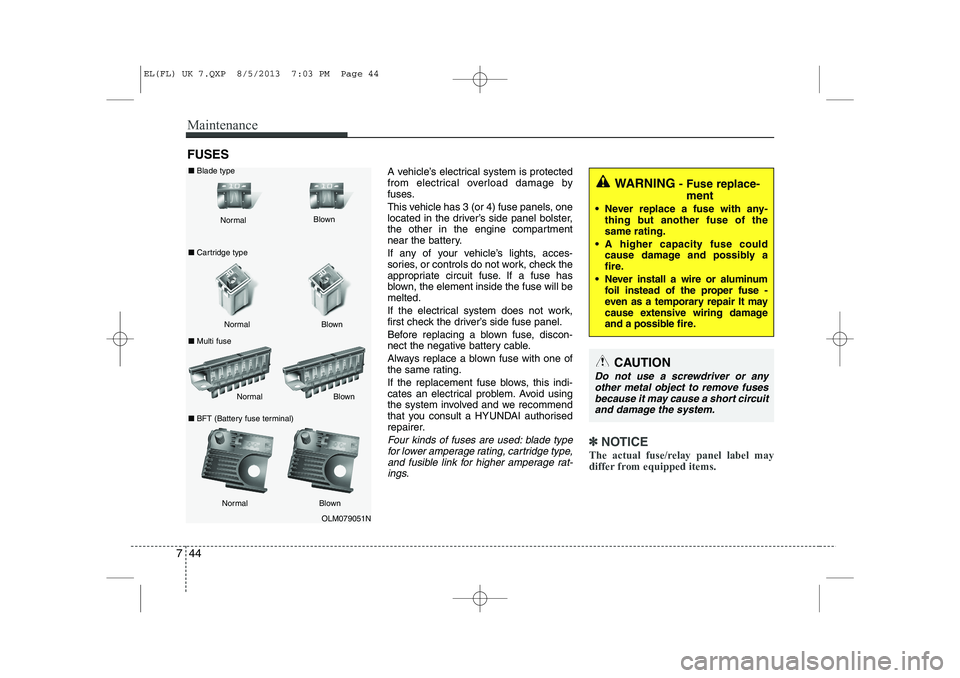
A vehicle’s electrical system is protected
from electrical overload damage by
fuses.
This vehicle has 3 (or 4) fuse panels, one
located in the driver’s side panel bolster,
the other in the engine compartment
near the battery.
If any of your vehicle’s lights, acces-
sories, or controls do not work, check the
appropriate circuit fuse. If a fuse has
blown, the element inside the fuse will bemelted.
If the electrical system does not work,
first check the driver’s side fuse panel.
Before replacing a blown fuse, discon-
nect the negative battery cable.
Always replace a blown fuse with one of
the same rating.
If the replacement fuse blows, this indi-
cates an electrical problem. Avoid using
the system involved and we recommend
that you consult a HYUNDAI authorised
repairer.
Four kinds of fuses are used: blade typefor lower amperage rating, cartridge type, and fusible link for higher amperage rat-ings.✽✽ NOTICE
The actual fuse/relay panel label may
differ from equipped items.
WARNING - Fuse replace-
ment
Never replace a fuse with any- thing but another fuse of the same rating.
A higher capacity fuse could cause damage and possibly a
fire.
Never install a wire or aluminum foil instead of the proper fuse -
even as a temporary repair It may
cause extensive wiring damage
and a possible fire.
CAUTION
Do not use a screwdriver or any
other metal object to remove fuses because it may cause a short circuitand damage the system.
OLM079051N
Normal
Normal
■
Blade type
■ Cartridge type
■ Multi fuse Blown
Blown
Normal Blown
Normal Blown
■
BFT (Battery fuse terminal)
EL(FL) UK 7.QXP 8/5/2013 7:03 PM Page 44
Page 1497 of 1534
753
Maintenance
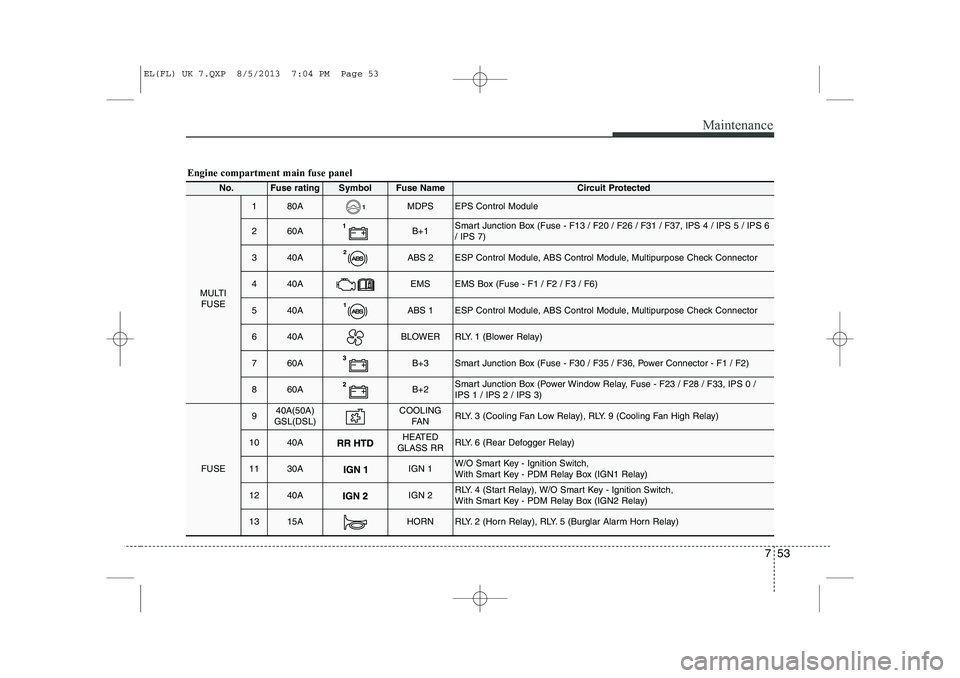
Engine compartment main fuse panel
No.Fuse ratingSymbolFuse Name Circuit Protected
MULTIFUSE
180AMDPSEPS Control Module
260AB+1Smart Junction Box (Fuse - F13 / F20 / F26 / F31 / F37, IPS 4 / IPS 5 / IPS 6 / IPS 7)
340AABS 2ESP Control Module, ABS Control Module, Multipurpose Check Connector
440AEMSEMS Box (Fuse - F1 / F2 / F3 / F6)
540AABS 1ESP Control Module, ABS Control Module, Multipurpose Check Connector
640ABLOWERRLY. 1 (Blower Relay)
760AB+3Smart Junction Box (Fuse - F30 / F35 / F36, Power Connector - F1 / F2)
860AB+2Smart Junction Box (Power Window Relay, Fuse - F23 / F28 / F33, IPS 0 / IPS 1 / IPS 2 / IPS 3)
FUSE
940A(50A)
GSL(DSL)COOLING FA NRLY. 3 (Cooling Fan Low Relay), RLY. 9 (Cooling Fan High Relay)
1040AHEATED
GLASS RRRLY. 6 (Rear Defogger Relay)
1130AIGN 1W/O Smart Key - Ignition Switch,
With Smart Key - PDM Relay Box (IGN1 Relay)
1240AIGN 2RLY. 4 (Start Relay), W/O Smart Key - Ignition Switch,
With Smart Key - PDM Relay Box (IGN2 Relay)
1315AHORNRLY. 2 (Horn Relay), RLY. 5 (Burglar Alarm Horn Relay)
EL(FL) UK 7.QXP 8/5/2013 7:04 PM Page 53