2014 HYUNDAI IX35 tyre pressure
[x] Cancel search: tyre pressurePage 306 of 1534
Maintenance
12
7
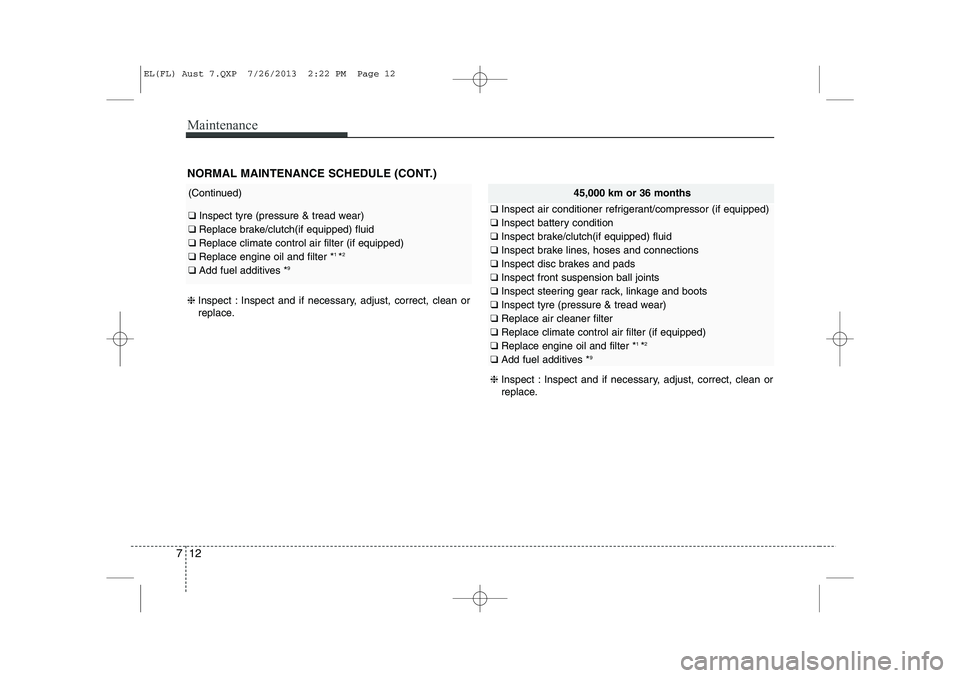
NORMAL MAINTENANCE SCHEDULE (CONT.)
(Continued)
❑ Inspect tyre (pressure & tread wear)
❑ Replace brake/clutch(if equipped) fluid
❑ Replace climate control air filter (if equipped)
❑ Replace engine oil and filter * 1
*2
❑ Add fuel additives * 9
45,000 km or 36 months
❑
Inspect air conditioner refrigerant/compressor (if equipped)
❑ Inspect battery condition
❑ Inspect brake/clutch(if equipped) fluid
❑ Inspect brake lines, hoses and connections
❑ Inspect disc brakes and pads
❑ Inspect front suspension ball joints
❑ Inspect steering gear rack, linkage and boots
❑ Inspect tyre (pressure & tread wear)
❑ Replace air cleaner filter
❑ Replace climate control air filter (if equipped)
❑ Replace engine oil and filter * 1
*2
❑ Add fuel additives * 9
❈
Inspect : Inspect and if necessary, adjust, correct, clean or
replace.
❈Inspect : Inspect and if necessary, adjust, correct, clean or
replace.
EL(FL) Aust 7.QXP 7/26/2013 2:22 PM Page 12
Page 307 of 1534
713
Maintenance
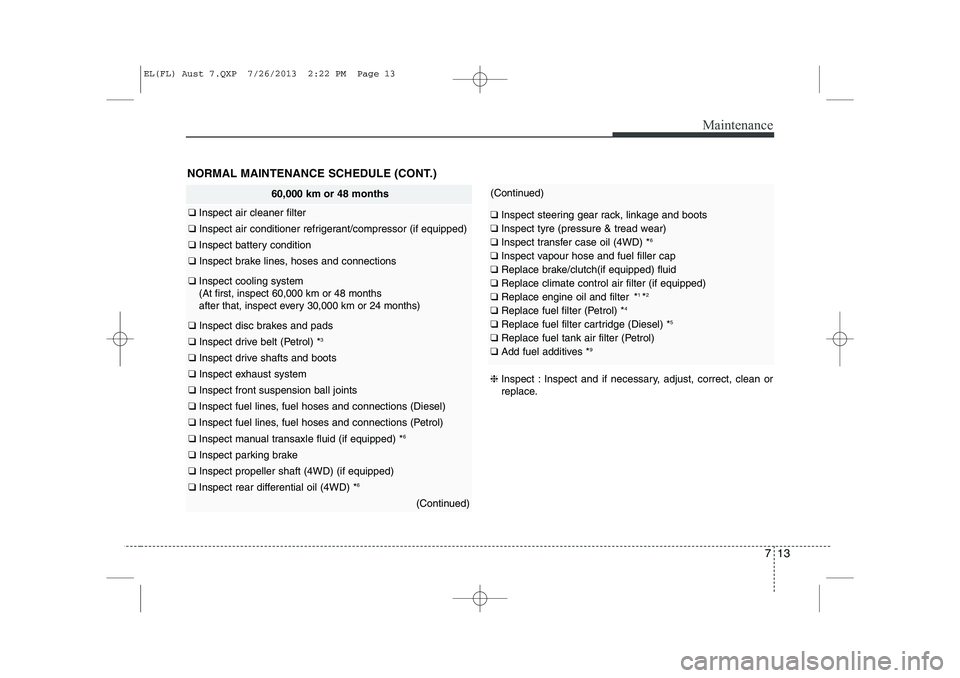
NORMAL MAINTENANCE SCHEDULE (CONT.)
60,000 km or 48 months
❑ Inspect air cleaner filter
❑ Inspect air conditioner refrigerant/compressor (if equipped)
❑ Inspect battery condition
❑ Inspect brake lines, hoses and connections
❑ Inspect cooling system
(At first, inspect 60,000 km or 48 months
after that, inspect every 30,000 km or 24 months)
❑ Inspect disc brakes and pads
❑ Inspect drive belt (Petrol) * 3
❑
Inspect drive shafts and boots
❑ Inspect exhaust system
❑ Inspect front suspension ball joints
❑ Inspect fuel lines, fuel hoses and connections (Diesel)
❑ Inspect fuel lines, fuel hoses and connections (Petrol)
❑ Inspect manual transaxle fluid (if equipped) * 6
❑
Inspect parking brake
❑ Inspect propeller shaft (4WD) (if equipped)
❑ Inspect rear differential oil (4WD) * 6
(Continued)
(Continued)
❑
Inspect steering gear rack, linkage and boots
❑ Inspect tyre (pressure & tread wear)
❑ Inspect transfer case oil (4WD) * 6
❑ Inspect vapour hose and fuel filler cap
❑ Replace brake/clutch(if equipped) fluid
❑ Replace climate control air filter (if equipped)
❑ Replace engine oil and filter * 1
*2
❑ Replace fuel filter (Petrol) * 4
❑ Replace fuel filter cartridge (Diesel) * 5
❑ Replace fuel tank air filter (Petrol)
❑ Add fuel additives * 9
❈ Inspect : Inspect and if necessary, adjust, correct, clean or
replace.
EL(FL) Aust 7.QXP 7/26/2013 2:22 PM Page 13
Page 308 of 1534

Maintenance
14
7
NORMAL MAINTENANCE SCHEDULE (CONT.)
75,000 km or 60 months
❑ Inspect air cleaner filter
❑ Inspect air conditioner refrigerant/compressor (if equipped)
❑ Inspect battery condition
❑ Inspect brake/clutch(if equipped) fluid
❑ Inspect brake lines, hoses and connections
❑ Inspect disc brakes and pads
❑ Inspect front suspension ball joints
❑ Inspect steering gear rack, linkage and boots
❑ Inspect tyre (pressure & tread wear)
❑ Replace climate control air filter (if equipped)
❑ Replace engine oil and filter * 1
*2
❑ Add fuel additives * 9
❈
Inspect : Inspect and if necessary, adjust, correct, clean or
replace.
90,000 km or 72 months
❑ Inspect air conditioner refrigerant/compressor (if equipped)
❑ Inspect battery condition
❑ Inspect brake lines, hoses and connections
❑ Inspect cooling system
(At first, inspect 60,000 km or 48 months
after that, inspect every 30,000 km or 24 months)
❑ Inspect disc brakes and pads
❑ Inspect drive belt (Petrol) * 3
❑ Inspect drive belt (Diesel) * 3
(At first, inspect 90,000 km or 48 months
after that, inspect every 30,000 km or 24 months)
❑ Inspect drive shafts and boots
❑ Inspect exhaust system
❑ Inspect front suspension ball joints
❑ Inspect fuel filter (Petrol) * 4
❑ Inspect fuel filter cartridge (Diesel) * 5
❑ Inspect fuel lines, fuel hoses and connections (Diesel)
❑ Inspect fuel tank air filter (Petrol)
❑ Inspect parking brake
❑ Inspect propeller shaft (4WD) (if equipped)
❑ Inspect steering gear rack, linkage and boots
(Continued)
EL(FL) Aust 7.QXP 7/26/2013 2:22 PM Page 14
Page 309 of 1534

715
Maintenance
NORMAL MAINTENANCE SCHEDULE (CONT.)
105,000 km or 84 months
❑ Inspect air cleaner filter
❑ Inspect air conditioner refrigerant/compressor (if equipped)
❑ Inspect battery condition
❑ Inspect brake/clutch (if equipped) fluid
❑ Inspect brake lines, hoses and connections
❑ Inspect disc brakes and pads
❑ Inspect front suspension ball joints
❑ Inspect steering gear rack, linkage and boots
❑ Inspect tyre (pressure & tread wear)
❑ Replace climate control air filter (if equipped)
❑ Replace engine oil and filter * 1
*2
❑ Add fuel additives * 9
❈
Inspect : Inspect and if necessary, adjust, correct, clean or
replace.
❈Inspect : Inspect and if necessary, adjust, correct, clean or
replace.
(Continued)
❑ Inspect tyre (pressure & tread wear)
❑ Replace air cleaner filter
❑ Replace brake/clutch(if equipped) fluid
❑ Replace climate control air filter (if equipped)
❑ Replace engine oil and filter * 1
*2
❑ Add fuel additives * 9
EL(FL) Aust 7.QXP 7/26/2013 2:22 PM Page 15
Page 310 of 1534

Maintenance
16
7
NORMAL MAINTENANCE SCHEDULE (CONT.)
120,000 km or 96 months
❑ Inspect air cleaner filter
❑ Inspect air conditioner refrigerant/compressor (if equipped)
❑ Inspect battery condition
❑ Inspect brake lines, hoses and connections
❑ Inspect cooling system
(At first, inspect 60,000 km or 48 months
after that, inspect every 30,000 km or 24 months)
❑ Inspect disc brakes and pads
❑ Inspect drive belt (Petrol) * 3
❑ Inspect drive belt (Diesel) * 3
(At first, inspect 90,000 km or 48 months
after that, inspect every 30,000 km or 24 months)
❑ Inspect drive shafts and boots
❑ Inspect exhaust system
❑ Inspect front suspension ball joints
❑ Inspect fuel lines, fuel hoses and connections (Diesel)
❑ Inspect fuel lines, fuel hoses and connections (Petrol)
❑ Inspect manual transaxle fluid (if equipped) * 6
❑ Inspect parking brake
❑ Inspect propeller shaft (4WD) (if equipped)
❑ Inspect rear differential oil (4WD) * 6
(Continued)
(Continued)
❑
Inspect steering gear rack, linkage and boots
❑ Inspect tyre (pressure & tread wear)
❑ Inspect transfer case oil (4WD) * 6
❑ Inspect vapour hose and fuel filler cap
❑ Replace brake/clutch(if equipped) fluid
❑ Replace climate control air filter (if equipped)
❑ Replace coolant * 7
(At first 210,000 km or 120 months,
after every 30,000 km or 24 months) * 8
❑ Replace engine oil and filter * 1
*2
❑ Replace fuel filter (Petrol) * 4
❑ Replace fuel filter cartridge (Diesel) * 5
❑ Replace fuel tank air filter (Petrol)
❑ Replace spark plugs (Petrol)
(Every 150,000 km or 120 months)
❑ Add fuel additives * 9
❈ Inspect : Inspect and if necessary, adjust, correct, clean or
replace.
No check, No service required
❑Automatic transaxle fluid
EL(FL) Aust 7.QXP 7/26/2013 2:22 PM Page 16
Page 334 of 1534

Maintenance
40
7
TYRES AND WHEELS
Tyre care
For proper maintenance, safety, and
maximum fuel economy, you must
always maintain recommended tyre
inflation pressures and stay within
the load limits and weight distribution
recommended for your vehicle. Recommended cold tyre inflation pressures All tyre pressures (including the
spare) should be checked when the
tyres are cold. “Cold Tyres” means
the vehicle has not been driven for at
least three hours or driven less than1.6 km (1 mile).
Recommended pressures must be
maintained for the best ride, top vehi-
cle handling, and minimum tyre
wear.
For recommended inflation pressure
refer to “Tyre and wheels” in section8. All specifications (sizes and pres-
sures) can be found on a label
attached to the vehicle.
WARNING - Tyre underin-
flation
Severe underinflation (70 kPa (10 psi) or more) can lead to
severe heat build-up, causing
blowouts, tread separation andother tyre failures that can
result in the loss of vehicle con-
trol leading to severe injury or
death. This risk is much higher
on hot days and when driving
for long periods at high speeds.
OEL083008R
EL(FL) Aust 7.QXP 7/26/2013 2:24 PM Page 40
Page 335 of 1534
741
Maintenance
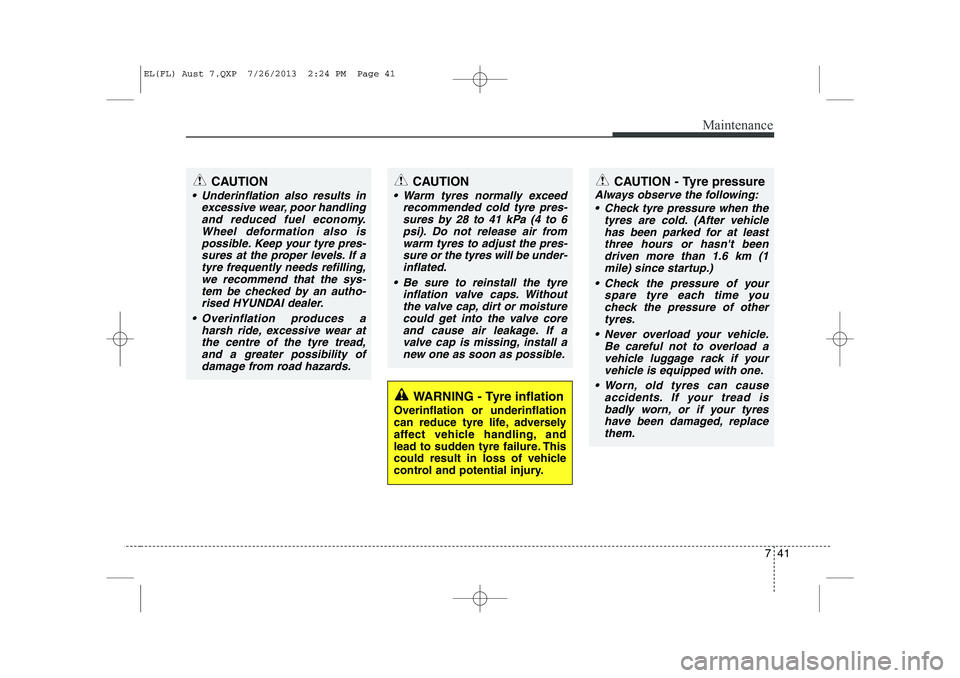
WARNING - Tyre inflation
Overinflation or underinflation
can reduce tyre life, adversely
affect vehicle handling, and
lead to sudden tyre failure. This
could result in loss of vehicle
control and potential injury.
CAUTION - Tyre pressure
Always observe the following:
Check tyre pressure when the tyres are cold. (After vehiclehas been parked for at leastthree hours or hasn't been driven more than 1.6 km (1mile) since startup.)
Check the pressure of your spare tyre each time youcheck the pressure of other tyres.
Never overload your vehicle. Be careful not to overload avehicle luggage rack if yourvehicle is equipped with one.
Worn, old tyres can cause accidents. If your tread isbadly worn, or if your tyreshave been damaged, replacethem.
CAUTION
Underinflation also results in excessive wear, poor handlingand reduced fuel economy.Wheel deformation also ispossible. Keep your tyre pres- sures at the proper levels. If atyre frequently needs refilling,we recommend that the sys- tem be checked by an autho-rised HYUNDAI dealer.
Overinflation produces a harsh ride, excessive wear atthe centre of the tyre tread, and a greater possibility ofdamage from road hazards.
CAUTION
Warm tyres normally exceed recommended cold tyre pres-sures by 28 to 41 kPa (4 to 6 psi). Do not release air fromwarm tyres to adjust the pres-sure or the tyres will be under- inflated.
Be sure to reinstall the tyre inflation valve caps. Withoutthe valve cap, dirt or moisturecould get into the valve core and cause air leakage. If avalve cap is missing, install anew one as soon as possible.
EL(FL) Aust 7.QXP 7/26/2013 2:24 PM Page 41
Page 336 of 1534

Maintenance
42
7
Checking tyre inflation pressure
Check your tyres once a month or
more.
Also, check the tyre pressure of the
spare tyre.
How to check
Use a good quality gage to check
tyre pressure. You can not tell if your
tyres are properly inflated simply by
looking at them. Radial tyres may
look properly inflated even when
they're underinflated.
Check the tyre's inflation pressure
when the tyres are cold. - "Cold"
means your vehicle has been sitting
for at least three hours or driven nomore than 1.6 km (1 mile). Remove the valve cap from the tyre
valve stem. Press the tyre gage firm-
ly onto the valve to get a pressure
measurement. If the cold tyre infla-tion pressure matches the recom-mended pressure on the tyre and
loading information label, no further
adjustment is necessary. If the pres-
sure is low, add air until you reachthe recommended amount.
If you overfill the tyre, release air by pushing on the metal stem in the
centre of the tyre valve. Recheck the
tyre pressure with the tyre gage. Be
sure to put the valve caps back on
the valve stems. They help prevent
leaks by keeping out dirt and mois-
ture.
WARNING
Inspect your tyres frequently for proper inflation as well as
wear and damage. Always use
a tyre pressure gauge.
Tyres with too much or too lit- tle pressure wear unevenly
causing poor handling, loss of
vehicle control, and suddentyre failure leading to acci-
dents, injuries, and even death.The recommended cold tyre
pressure for your vehicle can
be found in this manual and onthe tyre label located on the
driver's side centre pillar.
Worn tyres can cause acci- dents. Replace tyres that are
worn, show uneven wear, or
are damaged.
Remember to check the pres- sure of your spare tyre.
HYUNDAI recommends that
you check the spare every
time you check the pressure
of the other tyres on your
vehicle.
EL(FL) Aust 7.QXP 7/26/2013 2:24 PM Page 42