2014 HYUNDAI IX35 suspension
[x] Cancel search: suspensionPage 315 of 1534

721
Maintenance
Brake hoses and lines
Visually check for proper installation,
chafing, cracks, deterioration and any
leakage. Replace any deteriorated or
damaged parts immediately. Brake fluid
Check brake fluid level in the brake fluid
reservoir. The level should be between
“MIN” and “MAX” marks on the side of
the reservoir. Use only hydraulic brake
fluid conforming to DOT 3 or DOT 4specification.Parking brake
Inspect the parking brake system includ-
ing the parking brake lever and cables.
Brake pads, calipers and rotors
Check the pads for excessive wear, discs
for run out and wear, and calipers for fluid
leakage.
For more information on checking the
pads or lining wear limit, refer to the
Hyundai web site. (
http://brakeman
ual.hmc.co.kr)
Suspension mounting bolts
Check the suspension connections for
looseness or damage. Retighten to the
specified torque. Steering gear box, linkage &
boots/lower arm ball joint
With the vehicle stopped and engine off,
check for excessive free-play in the
steering wheel.
Check the linkage for bends or damage.
Check the dust boots and ball joints for
deterioration, cracks, or damage.
Replace any damaged parts. Drive shafts and boots
Check the drive shafts, boots and clamps
for cracks, deterioration, or damage.
Replace any damaged parts and, if nec-
essary, repack the grease.
Air conditioning refrigerant/ compressor (if equipped)
Check the air conditioning lines and con-
nections for leakage and damage.
CAUTION
The use of a non-specified fluid
could result in transaxle malfunc-
tion and failure.
Use only specified automatictransaxle fluid. (Refer to“Recommended lubricants and
capacities” in section 8.)
EL(FL) Aust 7.QXP 7/26/2013 2:22 PM Page 21
Page 816 of 1534

Driving your vehicle
62
5
Tire chains
Since the sidewalls of radial tires are
thinner, they can be damaged by mount-
ing some types of snow chains on them.
Therefore, the use of snow tires is rec-
ommended instead of snow chains. Do
not mount tire chains on vehicles
equipped with aluminum wheels; snow
chains may cause damage to the wheels.
If snow chains must be used, use wire-
type chains with a thickness of less than
15 mm (0.59 in). Damage to your vehicle
caused by improper snow chain use is
not covered by your vehicle manufactur-
ers warranty. When using tire chains, attach them to
the drive wheels as follows.
2WD : Front wheels
4WD : All four wheels
If a full set of chains is not avail-
able for an 4WD vehicle, chains
may be installed on the front
wheels only. Chain installation
When installing chains, follow the manu-
facturer's instructions and mount them as
tightly as you can. Drive slowly with
chains installed. If you hear the chains
contacting the body or chassis, stop and
tighten them. If they still make contact,
slow down until it stops. Remove the
chains as soon as you begin driving on
cleared roads.
CAUTION
Make sure the snow chains are
the correct size and type for yourtires. Incorrect snow chains can
cause damage to the vehicle body and suspension and may not becovered by your vehicle manufac-turer warranty. Also, the snow
chain connecting hooks may bedamaged from contacting vehicle components causing the snowchains to come loose from the
tire. Make sure the snow chains are SAE class “S” certified.
Always check chain installation for proper mounting after drivingapproximately 0.5 to 1 km (0.3 to
0.6 miles) to ensure safe mount-ing. Retighten or remount the chains if they are loose.WARNING
- Mounting chains
When mounting snow chains, park
the vehicle on level ground away
from traffic. Turn on the vehicle
Hazard Warning flashers and place
a triangular emergency warning
device behind the vehicle if avail-
able. Always place the vehicle in P
(park), apply the parking brake and
turn off the engine before installing
snow chains.1VQA3007
EL(FL) Eng 5.QXP 7/11/2013 11:04 AM Page 62
Page 880 of 1534

715
Maintenance
NORMAL MAINTENANCE SCHEDULE - GASOLINE 2.0 ENGINE, FOR EUROPE (CONT.)
I : Inspect and if necessary, adjust, correct, clean or replace.
R : Replace or change.* 9
: Manual transaxle fluid, transfer case oil and differential oil should be changed anytime they have been submerged in water.
Number of months or driving distance, whichever comes first
Months1224364860728496
Miles×1,00020406080100120140160
Km×1,000306090120150180210240
Driveshaft and boots2.0LIIIIIIII
Tire (pressure & tread wear) IIIIIIII
Front suspension ball jointsIIIIIIII
Air conditioner refrigerant (if equipped)IIIIIIII
Air conditioner compressor (if equipped)IIIIIIII
Climate control air filter (if equipped)RRRRRRRR
Manual transaxle fluid (if equipped) * 9IIII
Automatic transaxle fluid(if equipped) No check, No service required
Transfer case oil (4WD) *9IIII
Rear differential oil (4WD) * 9IIII
Propeller shaft (if equipped)IIIIIIII
Exhaust systemIIIIIIII
MAINTENANCE
INTERVALS
MAINTENANCE ITEM
EL(FL) Eng 7.QXP 10/7/2013 9:29 AM Page 15
Page 881 of 1534

Maintenance
16
7
MAINTENANCE UNDER SEVERE USAGE CONDITIONS - GASOLINE 2.0 ENGINE, FOR EUROPE
The following items must be serviced more frequently on cars mainly used under severe driving conditions.
Refer to the chart below for the appropriate maintenance intervals.
R : Replace I : Inspect and if necessary, adjust, correct, clean or replace
Maintenance itemMaintenance
operationMaintenance intervalsDriving condition
Engine oil and engine oil filterREvery 15,000 km or 6 monthsA, B, C, D, E,
F, G, H, I, K, L
Air cleaner filterRReplace more frequently
depending on the conditionC, E
Spark plugs RReplace more frequently
depending on the conditionB, H
Rear differential oil (4WD) REvery 120,000 km (80,000 miles)C, D, E, G, I, K, H
Transfer case oil (4WD)REvery 120,000 km (80,000 miles)C, D, E, G, I, K, H
Steering gear rack, linkage and bootsIInspect more frequently
depending on the conditionC, D, E, F, G
Propeller shaft (if equipped)IEvery 20,000 km (12,500 miles)
or 12 monthsC, E
Front suspension ball jointsIInspect more frequently
depending on the conditionC, D, E, F, G
EL(FL) Eng 7.QXP 10/7/2013 9:29 AM Page 16
Page 884 of 1534
719
Maintenance
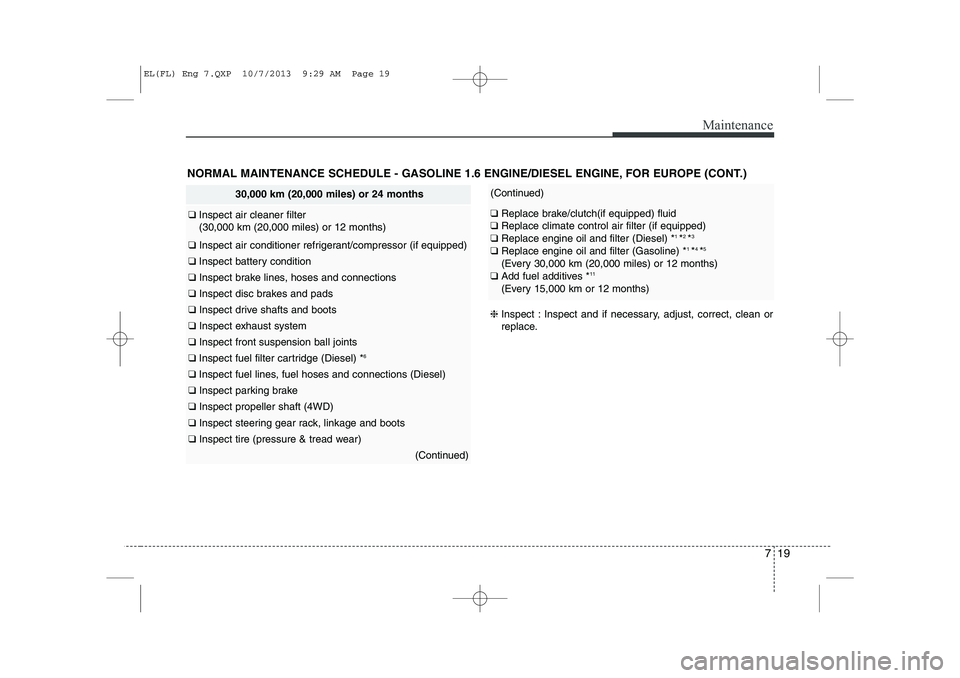
NORMAL MAINTENANCE SCHEDULE - GASOLINE 1.6 ENGINE/DIESEL ENGINE, FOR EUROPE (CONT.)❈Inspect : Inspect and if necessary, adjust, correct, clean or
replace.
30,000 km (20,000 miles) or 24 months
❑ Inspect air cleaner filter (30,000 km (20,000 miles) or 12 months)
❑ Inspect air conditioner refrigerant/compressor (if equipped)
❑ Inspect battery condition
❑ Inspect brake lines, hoses and connections
❑ Inspect disc brakes and pads
❑ Inspect drive shafts and boots
❑ Inspect exhaust system
❑ Inspect front suspension ball joints
❑ Inspect fuel filter cartridge (Diesel) * 6
❑
Inspect fuel lines, fuel hoses and connections (Diesel)
❑ Inspect parking brake
❑ Inspect propeller shaft (4WD)
❑ Inspect steering gear rack, linkage and boots
❑ Inspect tire (pressure & tread wear)
(Continued)
(Continued)
❑ Replace brake/clutch(if equipped) fluid
❑ Replace climate control air filter (if equipped)
❑ Replace engine oil and filter (Diesel) * 1
*2
*3
❑ Replace engine oil and filter (Gasoline) * 1
*4
*5
(Every 30,000 km (20,000 miles) or 12 months)
❑ Add fuel additives * 11
(Every 15,000 km or 12 months)
EL(FL) Eng 7.QXP 10/7/2013 9:29 AM Page 19
Page 885 of 1534

Maintenance
20
7
NORMAL MAINTENANCE SCHEDULE - GASOLINE 1.6 ENGINE/DIESEL ENGINE, FOR EUROPE (CONT.)
❈Inspect : Inspect and if necessary, adjust, correct, clean or
replace.
60,000 km (40,000 miles) or 48 months
❑ Inspect air conditioner refrigerant/compressor (if equipped)
❑ Inspect battery condition
❑ Inspect brake lines, hoses and connections
❑ Inspect cooling system
❑ Inspect disc brakes and pads
❑ Inspect drive shafts and boots
❑ Inspect exhaust system
❑ Inspect front suspension ball joints
❑ Inspect fuel filter (Gasoline) * 7
❑
Inspect fuel lines, fuel hoses and connections (Diesel)
❑ Inspect fuel lines, fuel hoses and connections (Gasoline)
❑ Inspect fuel tank air filter
❑ Inspect manual transaxle fluid (if equipped) * 8
❑
Inspect parking brake
❑ Inspect propeller shaft (4WD)
❑ Inspect rear differential oil (4WD) * 8
❑
Inspect steering gear rack, linkage and boots
❑ Inspect tire (pressure & tread wear)
❑ Inspect transfer case oil (4WD) * 8
(Continued)
(Continued)
❑
Inspect vapor hose and fuel filler cap (Gasoline)
❑ Replace air cleaner filter (60,000 km (40,000 miles) or 24 months)
❑ Replace brake/clutch(if equipped) fluid
❑ Replace climate control air filter (if equipped)
❑ Replace engine oil and filter (Diesel) * 1
*2
*3
❑ Replace engine oil and filter (Gasoline) * 1
*4
*5
(Every 30,000 km (20,000 miles) or 12 months)
❑ Replace fuel filter cartridge (Diesel) * 6
❑ Add fuel additives * 11
(Every 15,000 km or 12 months)
EL(FL) Eng 7.QXP 10/7/2013 9:29 AM Page 20
Page 886 of 1534

721
Maintenance
NORMAL MAINTENANCE SCHEDULE - GASOLINE 1.6 ENGINE/DIESEL ENGINE, FOR EUROPE (CONT.)❈Inspect : Inspect and if necessary, adjust, correct, clean or
replace.
90,000 km (60,000 miles) or 72 months
❑ Inspect air cleaner filter (90,000 km (60,000 miles) or 36 months)
❑ Inspect air conditioner refrigerant/compressor (if equipped)
❑ Inspect battery condition
❑ Inspect brake lines, hoses and connections
❑ Inspect cooling system
❑ Inspect disc brakes and pads
❑ Inspect drive belt (Diesel) * 9
(First 90,000 km (60,000 miles) or 48months, after every 30,000 km (20,000 miles) or 24months)
❑ Inspect drive belt (Gasoline) * 9
❑
Inspect drive shafts and boots
❑ Inspect exhaust system
❑ Inspect front suspension ball joints
❑ Inspect fuel filter cartridge (Diesel) * 6
❑
Inspect fuel lines, fuel hoses and connections (Diesel)
❑ Inspect parking brake
❑ Inspect propeller shaft (4WD)
❑ Inspect steering gear rack, linkage and boots
(Continued)
(Continued)
❑ Inspect tire (pressure & tread wear)
❑ Replace brake/clutch(if equipped) fluid
❑ Replace climate control air filter (if equipped)
❑ Replace engine oil and filter (Diesel) * 1
*2
*3
❑ Replace engine oil and filter (Gasoline) * 1
*4
*5
(Every 30,000 km (20,000 miles) or 12 months)
❑ Add fuel additives * 11
(Every 15,000 km or 12 months)
EL(FL) Eng 7.QXP 10/7/2013 9:29 AM Page 21
Page 887 of 1534

Maintenance
22
7
NORMAL MAINTENANCE SCHEDULE - GASOLINE 1.6 ENGINE/DIESEL ENGINE, FOR EUROPE (CONT.)
❈Inspect : Inspect and if necessary, adjust, correct, clean or
replace.
120,000 km (80,000 miles) or 96 months
❑ Inspect air conditioner refrigerant/compressor (if equipped)
❑ Inspect battery condition
❑ Inspect brake lines, hoses and connections
❑ Inspect cooling system
❑ Inspect disc brakes and pads
❑ Inspect drive belt (Diesel) * 9
(First 90,000 km (60,000 miles) or 48months, after every 30,000 km (20,000 miles) or 24months)
❑ Inspect drive belt (Gasoline) * 9
❑
Inspect drive shafts and boots
❑ Inspect exhaust system
❑ Inspect front suspension ball joints
❑ Inspect fuel filter (Gasoline) * 7
❑
Inspect fuel lines, fuel hoses and connections (Diesel)
❑ Inspect fuel lines, fuel hoses and connections (Gasoline)
❑ Inspect fuel tank air filter
❑ Inspect manual transaxle fluid (if equipped) * 8
❑
Inspect parking brake
❑ Inspect propeller shaft (4WD)
❑ Inspect rear differential oil (4WD) * 8
(Continued)
(Continued)
❑
Inspect steering gear rack, linkage and boots
❑ Inspect tire (pressure & tread wear)
❑ Inspect transfer case oil (4WD) * 8
❑ Inspect vapor hose and fuel filler cap (Gasoline)
❑ Replace air cleaner filter (120,000 km (80,000 miles) or 48 months)
❑ Replace brake/clutch (if equipped) fluid
❑ Replace climate control air filter (if equipped)
❑ Replace engine oil and filter (Diesel) * 1
*2
*3
❑ Replace engine oil and filter (Gasoline) * 1
*4
*5
(Every 30,000 km (20,000 miles) or 12 months)
❑ Replace fuel filter cartridge (Diesel) * 6
❑ Add fuel additives * 11
(Every 15,000 km or 12 months)
EL(FL) Eng 7.QXP 10/7/2013 9:29 AM Page 22