Page 1422 of 1534
What to do in an emergency
14
6
Always check the TPMS malfunction telltale after replacing one or more
tyres or wheels on your vehicle toensure that the replacement or alter-
nate tyres and wheels allow the
TPMS to continue to function proper-
ly.
✽✽
NOTICE
If the TPMS, Low Tyre Pressure and Position indicators do not illuminate
for 3 seconds when the ignitionswitch is turned to the ON position
or engine is running, or if they
remain illuminated after coming on
for approximately 3 seconds, we rec-ommend that the system be checked
by a HYUNDAI authorised repairer.
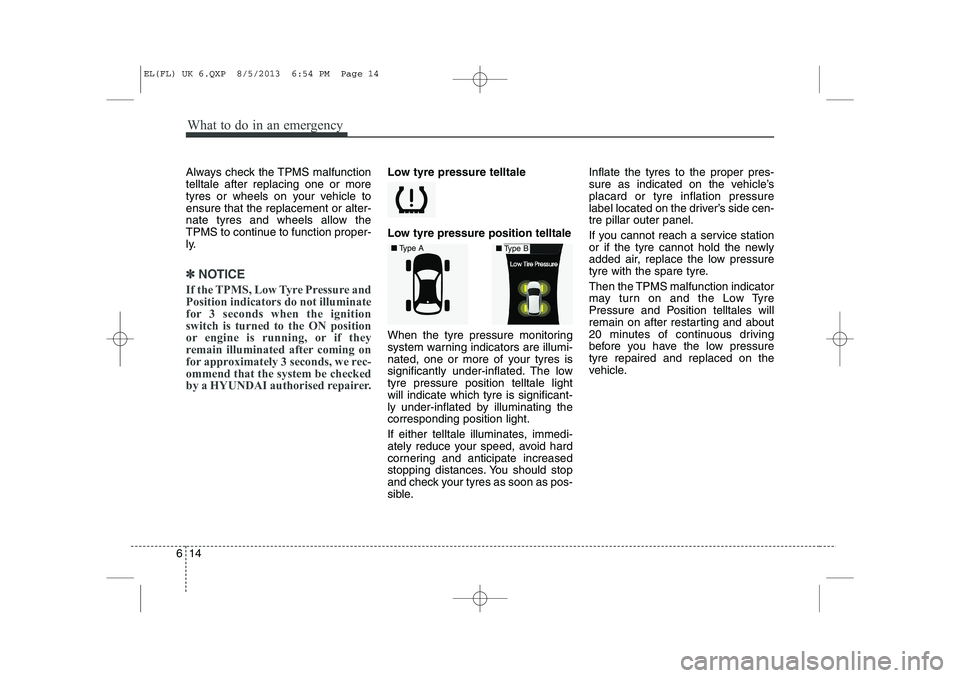
Low tyre pressure telltale
Low tyre pressure position telltale
When the tyre pressure monitoring
system warning indicators are illumi-
nated, one or more of your tyres is
significantly under-inflated. The lowtyre pressure position telltale lightwill indicate which tyre is significant-
ly under-inflated by illuminating thecorresponding position light.
If either telltale illuminates, immedi-
ately reduce your speed, avoid hard
cornering and anticipate increased
stopping distances. You should stop
and check your tyres as soon as pos-
sible. Inflate the tyres to the proper pres-
sure as indicated on the vehicle’splacard or tyre inflation pressure
label located on the driver’s side cen-tre pillar outer panel.
If you cannot reach a service station
or if the tyre cannot hold the newly
added air, replace the low pressure
tyre with the spare tyre.
Then the TPMS malfunction indicator
may turn on and the Low Tyre
Pressure and Position telltales will
remain on after restarting and about
20 minutes of continuous driving
before you have the low pressuretyre repaired and replaced on the
vehicle.
■
Type A■Type B
EL(FL) UK 6.QXP 8/5/2013 6:54 PM Page 14
Page 1434 of 1534
What to do in an emergency
26
6
It is possible that some tyres, espe- cially with larger punctures or dam-
age to the sidewall, cannot be sealed
completely.
Air pressure loss in the tyre may
adversely affect tyre performance.
For this reason, you should avoid
abrupt steering or other driving
manoeuvres, especially if the vehicle
is heavily loaded or if a trailer is in
use.
The TyreMobilityKit is not designed
or intended as a permanent tyre
repair method and is to be used for
one tyre only. This instruction shows
you step by step how to temporarily
seal the puncture simply and reliably.
Read the section "Notes on the safe
use of the TyreMobilityKit". Notes on the safe use of the
TyreMobilityKit
Park your car at the side of the
road so that you can work with the
TyreMobilityKit away from moving
traffic.
To be sure your vehicle won't move, even when you're on fairly
level ground, always set your park-
ing brake.
Only use the TyreMobilityKit for sealing/inflation passenger car
tyres. Only punctured areas locat-ed within the tread region of thetyre can be sealed using the tyremobility kit.
Do not use on motorcycles, bicy- cles or any other type of tyres.
When the tyre and wheel are dam- aged, do not use Tyre Mobility Kit
for your safety.
Use of the Tyre Mobility Kit may not be effective for tyre damage larger
than approximately 0.24 in (6 mm). If the tyre cannot be made road-
worthy with the Tyre Mobility Kit,
we recommend that you contact a
HYUNDAI authorised repairer. Do not use the Tyre Mobility Kit if a
tyre is severely damaged by driving
run flat or with insufficient air pres-
sure.
Do not remove any foreign objects- such as nails or screws that have
penetrated the tyre.
Provided the car is outdoors, leave the engine running. Otherwise
operating the compressor may
eventually drain the car battery.
Never leave the TyreMobilityKit unattended whilst it is being used.
Do not leave the compressor run- ning for more than 10 min. at a time
or it may overheat.
Do not use the TyreMobilityKit if the ambient temperature is below -30°C (-22°F).
WARNING
Do not use the TMK if a tyre is
severely damaged by drivingrun flat or with insufficient air
pressure.
Only punctured areas located within the tread region of thetyre can be sealed using theTMK.
EL(FL) UK 6.QXP 8/5/2013 6:54 PM Page 26
Page 1437 of 1534
629
What to do in an emergency
8. With the engine start/stop buttonposition on or ignition switch posi-
tion on, switch on the compressor
and let it run for approximately 5~7
minutes to fill the sealant up to
proper pressure. (refer to the Tyre
and Wheels, chapter 8). The infla-tion pressure of the tyre after filling
is unimportant and will be
checked/corrected later.
Be careful not to overinflate the
tyre and stay away from the tyrewhen filling it. 9. Switch off the compressor.
10. Detach the hoses from the
sealant bottle connector and
from the tyre valve.
Return the TyreMobilityKit to its stor-
age location in the vehicle. Distributing the sealant
11. Immediately drive approximately
4~6 miles (7~10 km or, about
10min) to evenly distribute the
sealant in the tyre.
WARNING - Carbon
monoxide
Do not leave your vehicle run-
ning in a poorly ventilated area
for extended periods of time.
Carbon monoxide poisoning
and suffocation can occur.
CAUTION - Tyre pressure
Do not attempt to drive your
vehicle if the tyre pressure isbelow 200kpa(29 PSI). This could result in an accident dueto sudden tyre failure.
CAUTION
Do not exceed a speed of 80km/h (50 mph). If possible, donot fall below a speed of 20 km/h (12 mph).
Whilst driving, if you experienceany unusual vibration, ride dis-turbance or noise, reduce yourspeed and drive with caution until you can safely pull off ofthe side of the road.
Call for road side service or tow-ing. When you use the TyreMobility Kit, the tyre pressure sensors and wheel may be dam-
aged by sealant, remove thesealant stained with tyre pres- sure sensors and wheel andinspect in authorized dealer.
EL(FL) UK 6.QXP 8/5/2013 6:54 PM Page 29
Page 1438 of 1534
What to do in an emergency
30
6
CAUTION - Tyre pressure
sensor
The sealant on the tyre pressure
sensor and wheel should beremoved when you replace thetyre with a new one and inspect the tyre pressure sensors inauthorised dealer.
Checking the tyre inflation pres- sure
1. After driving approximately 4~6 miles (7~10 km or about 10 min),
stop at a safety location.
2. Connect connection hose (9) of the compressor directly to the tyre
valve.
3. Plug the compressor power cord into the vehicle power outlet.
4. Adjust the tyre inflation pressure to the recomended tyre inflation.
With the ignition switched on, pro-
ceed as follows.
- To increase the inflation pres- sure: Switch on the compressor,
position I. To check the current
inflation pressure setting, briefly
switch off the compressor.✽✽ NOTICE
The pressure gauge may show high-
er than actual reading when the
compressor is running. To get an
accurate tyre reading, the compres-
sor needs to be turned off.
- To reduce the inflation pres- sure: Press the button 8 on the
compressor.
WARNING
Do not let the compressor run
for more than 10 minutes, other-
wise the device will overheat
and may be damaged.
CAUTION
If the inflation pressure is not maintained, drive the vehicle asecond time, refer to Distributing the sealant. Thenrepeat steps 1 to 4.
Use of the TMK may be ineffec-tual for tyre damage larger thanapproximately 4 mm (0.16 in).
We recommend that you contacta HYUNDAI authorised repairerif the tyre cannot be made road-worthy with the Tyre Mobility Kit.
WARNING
The tyre inflation pressure must
be at least 220 kPa (32 psi). If it
is not, do not continue driving.
Call for road side service or
towing.
EL(FL) UK 6.QXP 8/5/2013 6:54 PM Page 30