Page 97 of 1534
425
Features of your vehicle
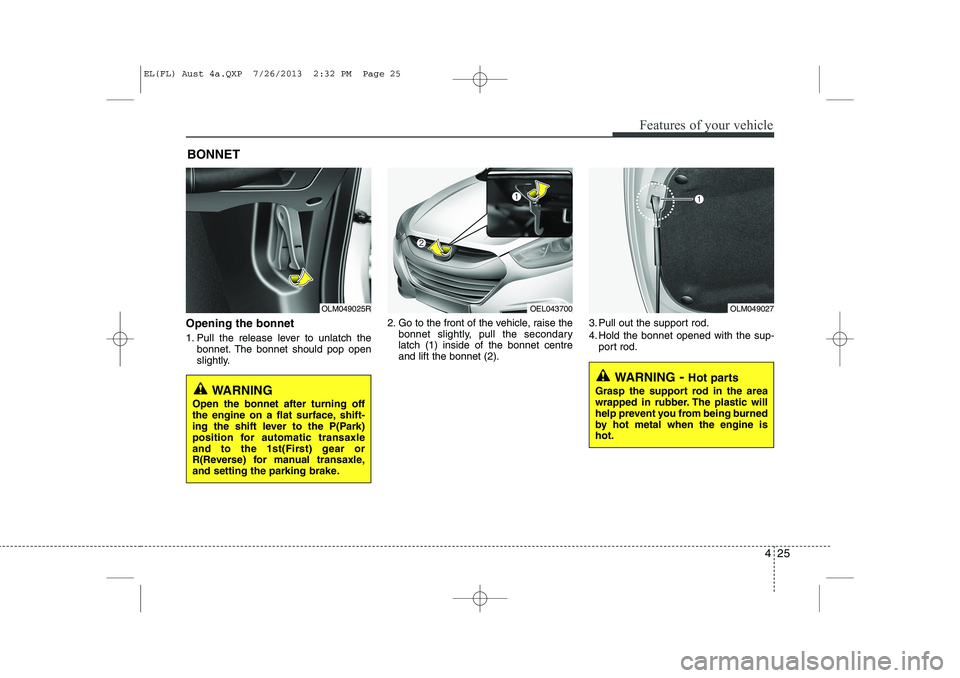
Opening the bonnet
1. Pull the release lever to unlatch thebonnet. The bonnet should pop open
slightly. 2. Go to the front of the vehicle, raise the
bonnet slightly, pull the secondarylatch (1) inside of the bonnet centreand lift the bonnet (2). 3. Pull out the support rod.
4. Hold the bonnet opened with the sup-
port rod.
BONNET
OEL043700OLM049027
WARNING
- Hot parts
Grasp the support rod in the area
wrapped in rubber. The plastic will
help prevent you from being burned
by hot metal when the engine ishot.
WARNING
Open the bonnet after turning off
the engine on a flat surface, shift-
ing the shift lever to the P(Park)
position for automatic transaxle
and to the 1st(First) gear or
R(Reverse) for manual transaxle,
and setting the parking brake.
OLM049025R
EL(FL) Aust 4a.QXP 7/26/2013 2:32 PM Page 25
Page 131 of 1534
459
Features of your vehicle
Press brake pedal to start engine (for smart key system and automatic
transaxle)
This warning message illuminates if the Engine Start/Stop Button changes to
the ACC position twice by pressing the
button repeatedly without depressing
the brake pedal.
It means that you should depress the brake pedal to start the engine.
Press clutch pedal to start engine
(for smart key system and manual
transaxle)
This warning message illuminates if the Engine Start/Stop Button changes to
the ACC position twice by pressing the
button repeatedly without depressingthe clutch pedal.
It means that you should depress the clutch pedal to start the engine.
Key not in vehicle
(for smart key system)
This warning message illuminates if the smart key is not in the vehicle when
you press the Engine Start/StopButton.
It means that you always have the smart key with you.
OLM043415EOLM043416EOLM043408E
EL(FL) Aust 4a.QXP 7/26/2013 2:34 PM Page 59
Page 133 of 1534
461
Features of your vehicle
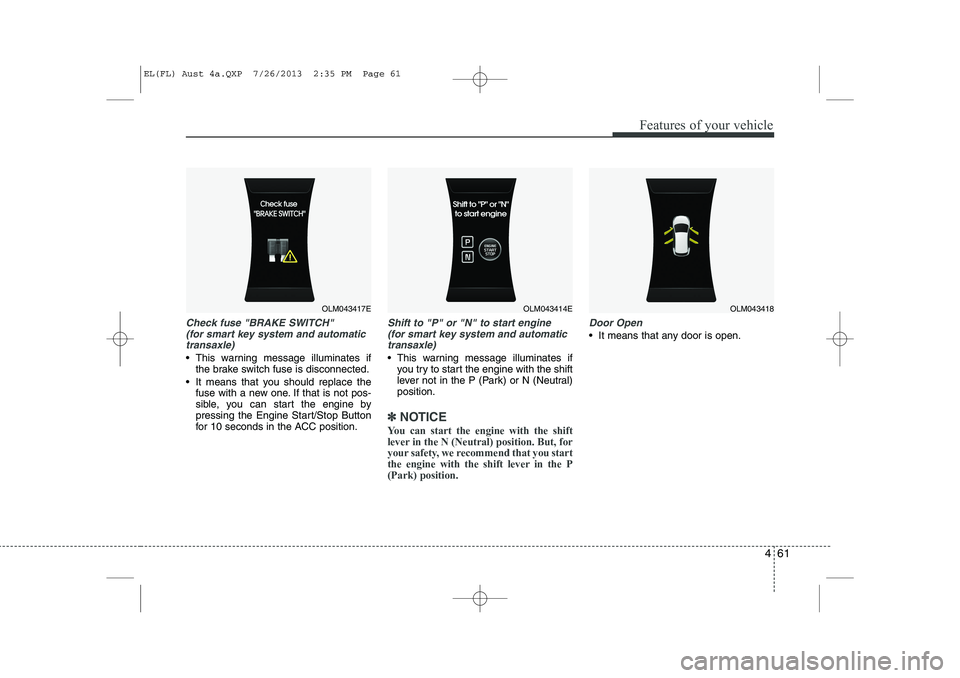
Check fuse "BRAKE SWITCH" (for smart key system and automatic
transaxle)
This warning message illuminates if the brake switch fuse is disconnected.
It means that you should replace the fuse with a new one. If that is not pos-
sible, you can start the engine by
pressing the Engine Start/Stop Button
for 10 seconds in the ACC position.
Shift to "P" or "N" to start engine
(for smart key system and automatic
transaxle)
This warning message illuminates if you try to start the engine with the shift
lever not in the P (Park) or N (Neutral)position.
✽✽ NOTICE
You can start the engine with the shift
lever in the N (Neutral) position. But, for
your safety, we recommend that you start
the engine with the shift lever in the P(Park) position.
Door Open
It means that any door is open.
OLM043417EOLM043414EOLM043418
EL(FL) Aust 4a.QXP 7/26/2013 2:35 PM Page 61
Page 139 of 1534

467
Features of your vehicle
Warnings and indicators
All warning lights are checked by turning
the ignition switch ON (do not start the
engine). If any light does not illuminate,
we recommend that the system be
checked by an authorised HYUNDAI
dealer.
After starting the engine, check to make
sure that all warning lights are off. If anyare still on, this indicates a situation that
needs attention. When releasing the
parking brake, the brake system warning
light should go off. The fuel warning light
will stay on if the fuel level is low.ECO Indicator Light (if equipped)
This indicator light illuminates:
When you activate the active ECO sys-
tem by pressing the active ECO button.
For more details, refer to “Active ECO
System” in chapter 5.
Air bag warning light (if equipped)
This warning light will illuminate for
approximately 6 seconds each time you
turn the ignition switch to the ON posi-tion. This light also comes on when the SRS
is not working properly. If the AIR BAG
warning light does not come on, or con-
tinuously remains on after operating for
about 6 seconds when you turned the
ignition switch to the ON position or start-
ed the engine, or if it comes on whilst
driving, we recommend that the system
be inspected by an authorised HYUNDAI
dealer.
ECO
EL(FL) Aust 4a.QXP 7/26/2013 2:35 PM Page 67
Page 140 of 1534

Features of your vehicle
68
4
Anti-lock brake system
(ABS) warning light (if equipped)
This light illuminates if the ignition switch
is turned to ON and goes off in approxi-
mately 3 seconds if the system is operat-
ing normally.
If the ABS warning light remains on,
comes on whilst driving, or does not
come on when the ignition switch is
turned to the ON position, this indicates
that there may be a problem with the
ABS.
If this occurs, we recommend that the
system be checked by an authorised
HYUNDAI dealer. The normal braking
system will still be operational, but with-
out the assistance of the anti-lock brakesystem. Electronic brakeforce distribution(EBD) systemwarning light
If two warning lights illuminate at the
same time whilst driving, your vehicle
may have a malfunction with ABS andEBD system.
In this case, your ABS and regular brake
system may not work normally. We rec-
ommend that the system be checked by
an authorised HYUNDAI dealer.
✽✽
NOTICE
If the ABS warning light or EBD warn- ing light is on and stays on, the
speedometer or odometer/tripmeter
may not work. Also, the EPS warninglight may illuminate and the steering
effort may increase or decrease. In this
case, we recommend that the system bechecked by an authorised HYUNDAI
dealer.
WARNING
If the both ABS and Brake warning lights are on and stay on, your vehi-cle’s brake system will not worknormally. So you may experiencean unexpected and dangerous situ-ation during sudden braking. In thiscase, avoid high speed driving andabrupt braking. We recommend that the system be checked by an authorisedHYUNDAI dealer.
EL(FL) Aust 4a.QXP 7/26/2013 2:35 PM Page 68
Page 148 of 1534

Features of your vehicle
76
4
DBC (Downhill brake con-
trol) indicator (if equipped)
The DBC indicator will illuminate when
the ignition switch is turned ON, but
should go off after approximately 3 sec-
onds. The DBC indicator will illuminate when
the DBC button is pressed and the sys-tem is on.
When driving down a steep hill at a speed under 35 km/h (22 mph), the DBC
will operate and the DBC indicator will
blink to indicate the DBC is operating.
If the red indicator illuminates, the DBC
system may have malfunctioned. We rec-
ommend that the system be checked by
an authorised HYUNDAI dealer.
KEY OUT indicator (if equipped)
When the ENGINE START/STOP button
is in the ACC or ON position, if any door
is open, the system checks for the smart
key. If the smart key is not in the vehicle,
the indicator will blink, and if all doors are
closed, the chime will also sound for
about 5 seconds. The indicator will go off
whilst the vehicle is moving. Keep the
smart key in the vehicle.
Key reminder warning chime (if equipped)
If the driver’s door is opened whilst the
ignition key is left in the ignition switch
(ACC or LOCK position), the key
reminder warning chime will sound. This
is to prevent you from locking your keys
in the vehicle. The chime sounds until the
key is removed from the ignition switch or
the driver’s door is closed.
KEY
OUT
EL(FL) Aust 4a.QXP 7/26/2013 2:35 PM Page 76
Page 152 of 1534

Features of your vehicle
80
4
When more than two objects are sensed
at the same time, the closest one will be recognised first.
Types of warning sound
When an object is 120 cm to 61 cm (47 in. to 24 in.) from the rear bumper: Buzzer beeps intermittently.
When an object is 60 cm to 31 cm (23 in. to 12 in.) from the rear bumper: Buzzerbeeps more frequently.
When an object is within 30 cm (11 in.) of the rear bumper: Buzzer sounds continuously.
Non-operational conditions of rear parking assist system
The rear parking assist system may
not operate properly when:
1. Moisture is frozen to the sensor. (It will operate normally when the moisture has been cleared.)
2. The sensor is covered with foreign matter, such as snow or water, or the
sensor cover is blocked. (It will operate
normally when the material is removed
or the sensor is no longer blocked.)
3. Driving on uneven road surfaces such as unpaved roads, gravel, bumps, or
gradients.
4. Objects generating excessive noise such as vehicle horns, loud motorcycle
engines, or truck air brakes may be
interfering with the sensor.
5. There is heavy rain or water spray.
6. There are wireless transmitters or mobile phones present near the sen-
sor.
7. The sensor is covered with snow.
8. Trailer towing.
9. The place light the fluorescent lamp.
The detecting range may decrease when:
1. The sensor is stained with foreign mat- ter such as snow or water. (The sens-
ing range will return to normal when
removed.)
2. Outside air temperature is extremely hot or cold.
The following objects may not be
recognised by the sensor:
1. Sharp or slim objects such as ropes, chains or small poles.
2. Objects which tend to absorb the sen- sor frequency such as clothes, spongy
material or snow.
3. There are undetectable objects small- er than 1 m (40 in.) in height and nar-
rower than 14 cm (6 in.) in diameter.
EL(FL) Aust 4a.QXP 7/26/2013 2:35 PM Page 80
Page 156 of 1534
Features of your vehicle
84
4
Non-operational conditions of parking assist system
Parking assist system may not oper-
ate normally when:
1. Moisture is frozen to the sensor. (It will operate normally when moisture
melts.)
2. Sensor is covered with foreign matter, such as snow or water, or the sensor
cover is blocked. (It will operate nor-
mally when the material is removed or
the sensor is no longer blocked.)
3. Sensor is stained with foreign matter such as snow or water. (Sensing range
will return to normal when removed.)
4.The parking assist button is off.
There is a possibility of parking assist system malfunction when:
1. Driving on uneven road surfaces such as unpaved roads, gravel, bumps, or
gradients.
2. Objects generating excessive noise such as vehicle horns, loud motorcycle
engines, or truck air brakes may be
interfering with the sensor.
3. There is heavy rain or water spray.
4. There are wireless transmitters or mobile phones present near the sen-
sor.
5. The sensor is covered with snow.
Detecting range may decrease when:
1. Outside air temperature is extremely hot or cold.
2. There are undetectable objects small- er than 1 m and narrower than 14 cm
in diameter.
The following objects may not be
recognised by the sensor:
1. Sharp or slim objects such as ropes, chains or small poles.
2. Objects, which tend to absorb sensor frequency such as clothes, spongy
material or snow.
EL(FL) Aust 4a.QXP 7/26/2013 2:35 PM Page 84