2014 Hyundai H-1 (Grand Starex) Water hose
[x] Cancel search: Water hosePage 245 of 353
What to do in an emergency
6 6
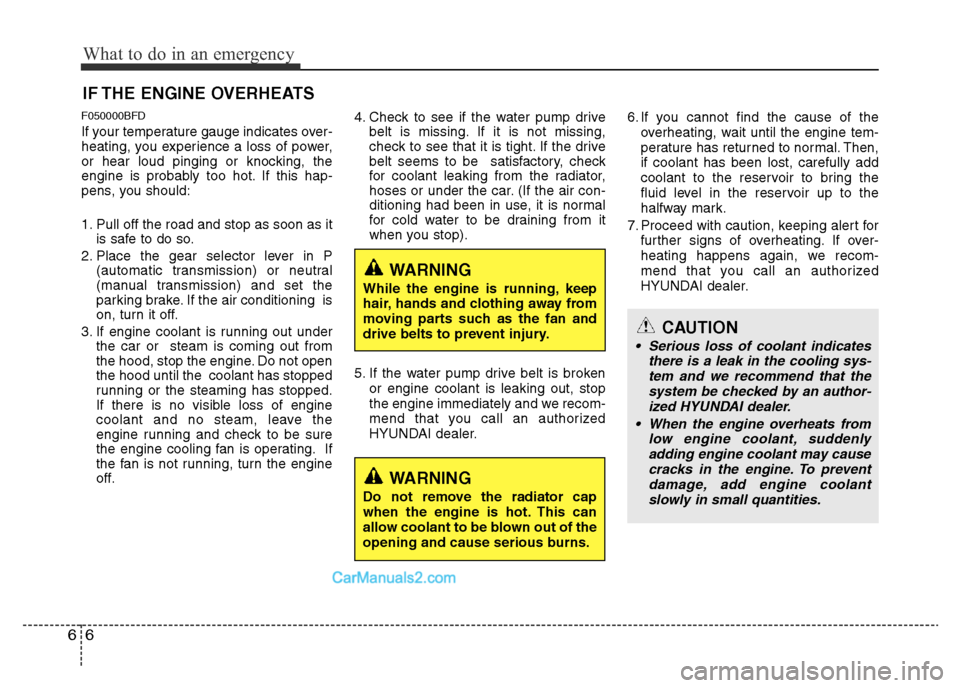
IF THE ENGINE OVERHEATS
F050000BFD
If your temperature gauge indicates over-
heating, you experience a loss of power,
or hear loud pinging or knocking, the
engine is probably too hot. If this hap-
pens, you should:
1. Pull off the road and stop as soon as it
is safe to do so.
2. Place the gear selector lever in P
(automatic transmission) or neutral
(manual transmission) and set the
parking brake. If the air conditioning is
on, turn it off.
3. If engine coolant is running out under
the car or steam is coming out from
the hood, stop the engine. Do not open
the hood until the coolant has stopped
running or the steaming has stopped.
If there is no visible loss of engine
coolant and no steam, leave the
engine running and check to be sure
the engine cooling fan is operating. If
the fan is not running, turn the engine
off.4. Check to see if the water pump drive
belt is missing. If it is not missing,
check to see that it is tight. If the drive
belt seems to be satisfactory, check
for coolant leaking from the radiator,
hoses or under the car. (If the air con-
ditioning had been in use, it is normal
for cold water to be draining from it
when you stop).
5. If the water pump drive belt is broken
or engine coolant is leaking out, stop
the engine immediately and we recom-
mend that you call an authorized
HYUNDAI dealer.6. If you cannot find the cause of the
overheating, wait until the engine tem-
perature has returned to normal. Then,
if coolant has been lost, carefully add
coolant to the reservoir to bring the
fluid level in the reservoir up to the
halfway mark.
7. Proceed with caution, keeping alert for
further signs of overheating. If over-
heating happens again, we recom-
mend that you call an authorized
HYUNDAI dealer.
CAUTION
• Serious loss of coolant indicates
there is a leak in the cooling sys-
tem and we recommend that the
system be checked by an author-
ized HYUNDAI dealer.
• When the engine overheats from
low engine coolant, suddenly
adding engine coolant may cause
cracks in the engine. To prevent
damage, add engine coolant
slowly in small quantities.
WARNING
While the engine is running, keep
hair, hands and clothing away from
moving parts such as the fan and
drive belts to prevent injury.
WARNING
Do not remove the radiator cap
when the engine is hot. This can
allow coolant to be blown out of the
opening and cause serious burns.
Page 275 of 353
711
Maintenance
I : Inspect and if necessary, adjust, correct, clean or replace.
R : Replace or change.
*
6: The fuel filter is considered to be maintenance free but periodic inspection is recommended for this maintenance schedule
depends on fuel quality. If there are some important safety matters like fuel flow restriction, surging, loss of power, hard start-
ing problem etc, replace the fuel filter immediately regardless of maintenance schedule and we recommend that you consult
an authorized HYUNDAI dealer.
*
7: When adding coolant, use only deionized water or soft water for your vehicle and never mix hard water in the coolant filled at
the factory. An improper coolant mixture can result in serious malfunction or engine damage.
*
8: For your convenience, it can be replaced prior to it's interval when you do maintenance of other items.
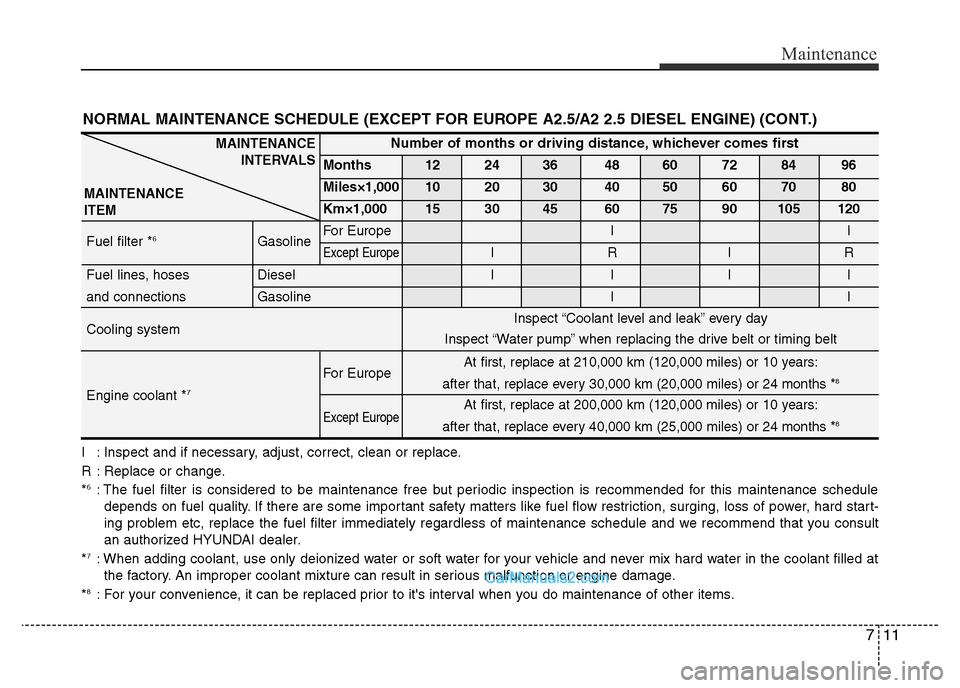
NORMAL MAINTENANCE SCHEDULE (EXCEPT FOR EUROPE A2.5/A2 2.5 DIESEL ENGINE) (CONT.)
MAINTENANCE
INTERVALS
MAINTENANCE
ITEMNumber of months or driving distance, whichever comes first
Months 12 24 36 48 60 72 84 96
Miles×1,000 10 20 30 40 50 60 70 80
Km×1,000 15 30 45 60 75 90 105 120
Fuel filter *
6GasolineFor Europe I IExcept EuropeIRIR
Fuel lines, hoses Diesel I I I I
and connections Gasoline I I
Cooling system
For Europe
Engine coolant *
7
Except Europe
At first, replace at 210,000 km (120,000 miles) or 10 years:
after that, replace every 30,000 km (20,000 miles) or 24 months *
8
At first, replace at 200,000 km (120,000 miles) or 10 years:
after that, replace every 40,000 km (25,000 miles) or 24 months *
8
Inspect “Coolant level and leak” every day
Inspect “Water pump” when replacing the drive belt or timing belt
Page 278 of 353
Maintenance
14 7
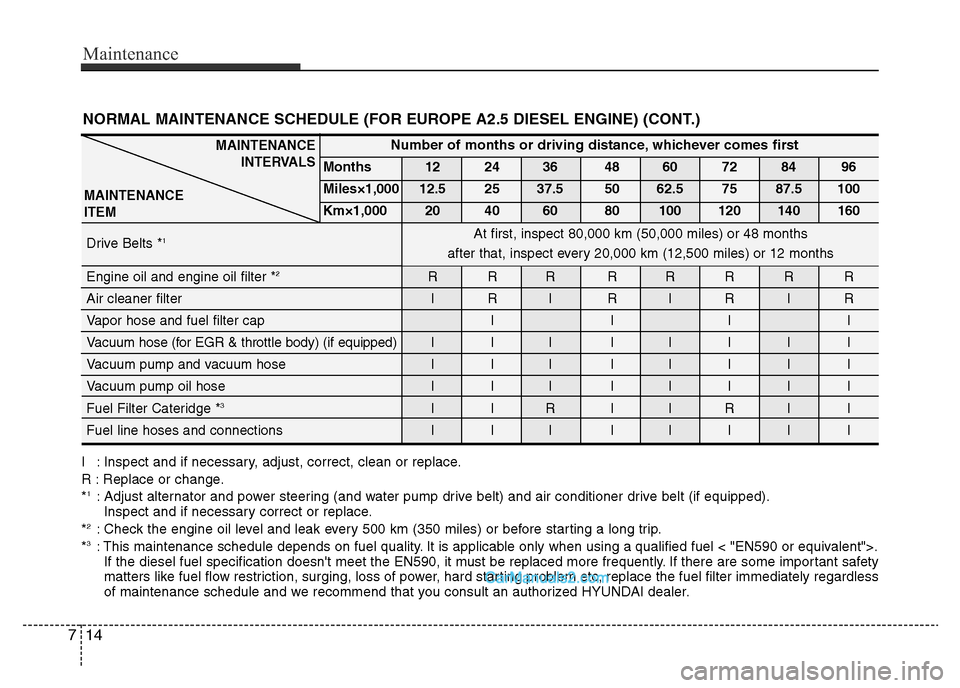
NORMAL MAINTENANCE SCHEDULE (FOR EUROPE A2.5 DIESEL ENGINE) (CONT.)
I : Inspect and if necessary, adjust, correct, clean or replace.
R : Replace or change.
*
1: Adjust alternator and power steering (and water pump drive belt) and air conditioner drive belt (if equipped).
Inspect and if necessary correct or replace.
*
2: Check the engine oil level and leak every 500 km (350 miles) or before starting a long trip.
*3: This maintenance schedule depends on fuel quality. It is applicable only when using a qualified fuel < "EN590 or equivalent">.
If the diesel fuel specification doesn't meet the EN590, it must be replaced more frequently. If there are some important safety
matters like fuel flow restriction, surging, loss of power, hard starting problem etc, replace the fuel filter immediately regardless
of maintenance schedule and we recommend that you consult an authorized HYUNDAI dealer.
Number of months or driving distance, whichever comes first
Months 12 24 36 48 60 72 84 96
Miles×1,000 12.5 25 37.5 50 62.5 75 87.5 100
Km×1,000 20 40 60 80 100 120 140 160
Drive Belts *
1
Engine oil and engine oil filter *2RRR RRRRR
Air cleaner filter I R I R I R I R
Vapor hose and fuel filter cap I I I I
Vacuum hose (for EGR & throttle body) (if equipped) I I I I I I I I
Vacuum pump and vacuum hose I I I I I I I I
Vacuum pump oil hose I I I I I I I I
Fuel Filter Cateridge *
3IIRIIRII
Fuel line hoses and connections I I I I I I I I
MAINTENANCE
INTERVALS
MAINTENANCE
ITEM
At first, inspect 80,000 km (50,000 miles) or 48 months
after that, inspect every 20,000 km (12,500 miles) or 12 months
Page 279 of 353
715
Maintenance
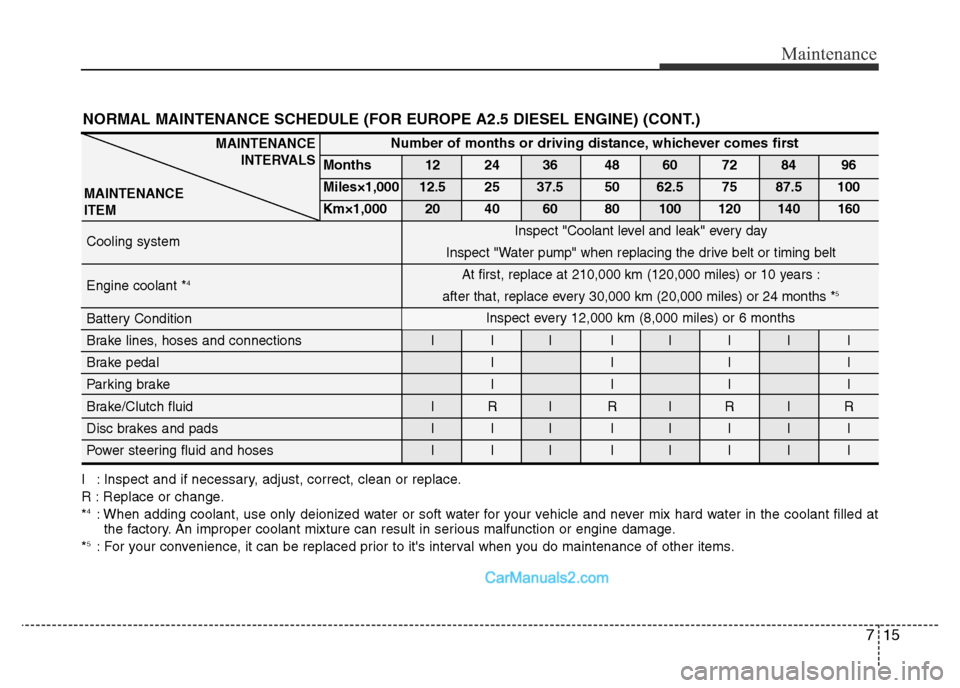
NORMAL MAINTENANCE SCHEDULE (FOR EUROPE A2.5 DIESEL ENGINE) (CONT.)
I : Inspect and if necessary, adjust, correct, clean or replace.
R : Replace or change.
*
4: When adding coolant, use only deionized water or soft water for your vehicle and never mix hard water in the coolant filled at
the factory. An improper coolant mixture can result in serious malfunction or engine damage.
*
5: For your convenience, it can be replaced prior to it's interval when you do maintenance of other items.
Number of months or driving distance, whichever comes first
Months 12 24 36 48 60 72 84 96
Miles×1,000 12.5 25 37.5 50 62.5 75 87.5 100
Km×1,000 20 40 60 80 100 120 140 160
Cooling system
Engine coolant *
4
Battery Condition
Brake lines, hoses and connections I I I I I I I I
Brake pedal I I I I
Parking brake I I I I
Brake/Clutch fluid I R I R I R I R
Disc brakes and pads I I I I I I I I
Power steering fluid and hoses I I I I I I I I
MAINTENANCE
INTERVALS
MAINTENANCE
ITEM
Inspect "Coolant level and leak" every day
Inspect "Water pump" when replacing the drive belt or timing belt
At first, replace at 210,000 km (120,000 miles) or 10 years :
after that, replace every 30,000 km (20,000 miles) or 24 months *
5
Inspect every 12,000 km (8,000 miles) or 6 months
Page 281 of 353
717
Maintenance
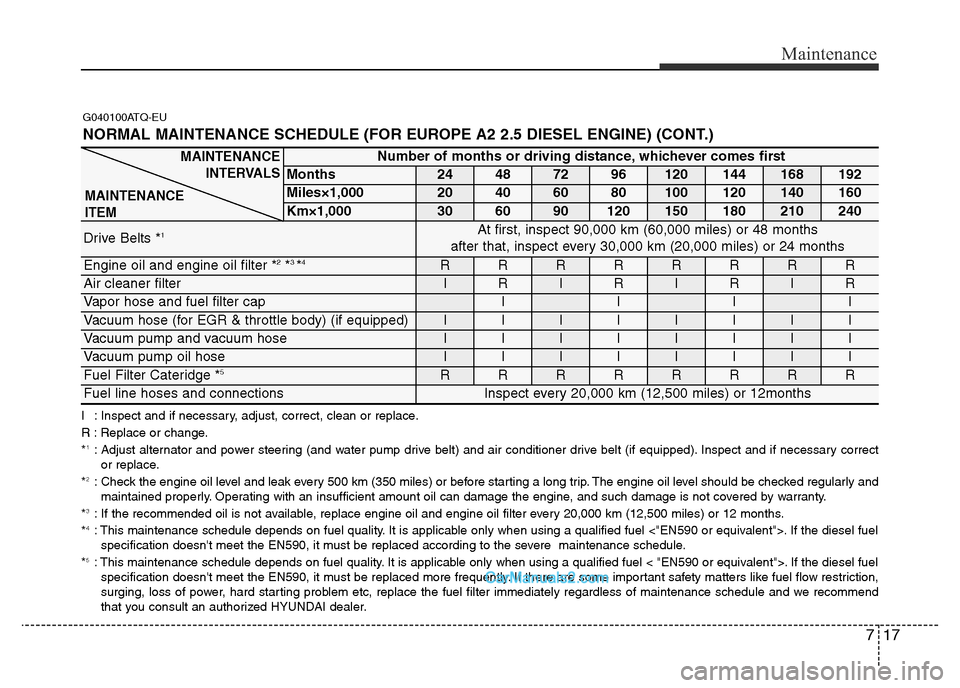
G040100ATQ-EU
NORMAL MAINTENANCE SCHEDULE (FOR EUROPE A2 2.5 DIESEL ENGINE) (CONT.)
I : Inspect and if necessary, adjust, correct, clean or replace.
R : Replace or change.
*
1: Adjust alternator and power steering (and water pump drive belt) and air conditioner drive belt (if equipped). Inspect and if necessary correct
or replace.
*
2: Check the engine oil level and leak every 500 km (350 miles) or before starting a long trip. The engine oil level should be checked regularly and
maintained properly. Operating with an insufficient amount oil can damage the engine, and such damage is not covered by warranty.
*
3: If the recommended oil is not available, replace engine oil and engine oil filter every 20,000 km (12,500 miles) or 12 months.
*4: This maintenance schedule depends on fuel quality. It is applicable only when using a qualified fuel <"EN590 or equivalent">. If the diesel fuel
specification doesn't meet the EN590, it must be replaced according to the severe maintenance schedule.
*
5: This maintenance schedule depends on fuel quality. It is applicable only when using a qualified fuel < "EN590 or equivalent">. If the diesel fuel
specification doesn't meet the EN590, it must be replaced more frequently. If there are some important safety matters like fuel flow restriction,
surging, loss of power, hard starting problem etc, replace the fuel filter immediately regardless of maintenance schedule and we recommend
that you consult an authorized HYUNDAI dealer.
Number of months or driving distance, whichever comes first
Months24487296120144168192
Miles×1,00020406080100120140160
Km×1,000306090120150180210240
Drive Belts *1At first, inspect 90,000 km (60,000 miles) or 48 months
after that, inspect every 30,000 km (20,000 miles) or 24 months
Engine oil and engine oil filter *2*3 *4RRRRRRRR
Air cleaner filterIRIRIRIR
Vapor hose and fuel filter capIIII
Vacuum hose (for EGR & throttle body) (if equipped)IIIIIIII
Vacuum pump and vacuum hoseIIIIIIII
Vacuum pump oil hoseIIIIIIII
Fuel Filter Cateridge *5RRRRRRRR
Fuel line hoses and connectionsInspect every 20,000 km (12,500 miles) or 12months
MAINTENANCE
INTERVALS
MAINTENANCE
ITEM
Page 282 of 353
Maintenance
18 7
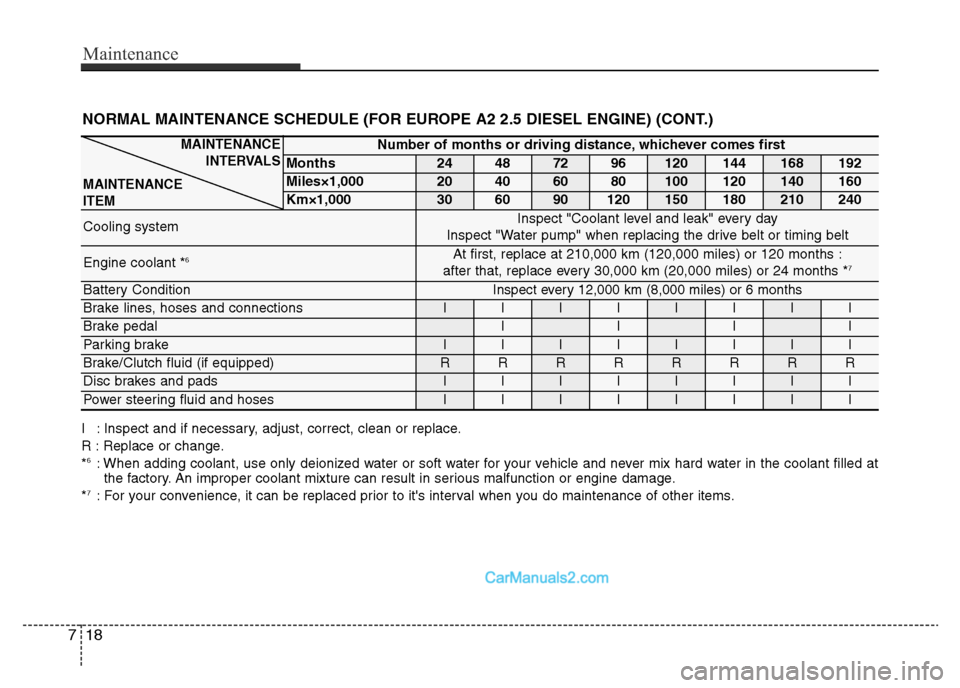
Number of months or driving distance, whichever comes first
Months24487296120144168192
Miles×1,00020406080100120140160
Km×1,000306090120150180210240
Cooling systemInspect "Coolant level and leak" every day
Inspect "Water pump" when replacing the drive belt or timing belt
Engine coolant *6At first, replace at 210,000 km (120,000 miles) or 120 months :
after that, replace every 30,000 km (20,000 miles) or 24 months *7
Battery ConditionInspect every 12,000 km (8,000 miles) or 6 months
Brake lines, hoses and connectionsIIIIIIII
Brake pedalIIII
Parking brakeIIIIIIII
Brake/Clutch fluid (if equipped)RRRRRRRR
Disc brakes and padsIIIIIIII
Power steering fluid and hosesIIIIIIII
NORMAL MAINTENANCE SCHEDULE (FOR EUROPE A2 2.5 DIESEL ENGINE) (CONT.)
I : Inspect and if necessary, adjust, correct, clean or replace.
R : Replace or change.
*
6: When adding coolant, use only deionized water or soft water for your vehicle and never mix hard water in the coolant filled at
the factory. An improper coolant mixture can result in serious malfunction or engine damage.
*
7: For your convenience, it can be replaced prior to it's interval when you do maintenance of other items.
MAINTENANCE
INTERVALS
MAINTENANCE
ITEM
Page 291 of 353
727
Maintenance
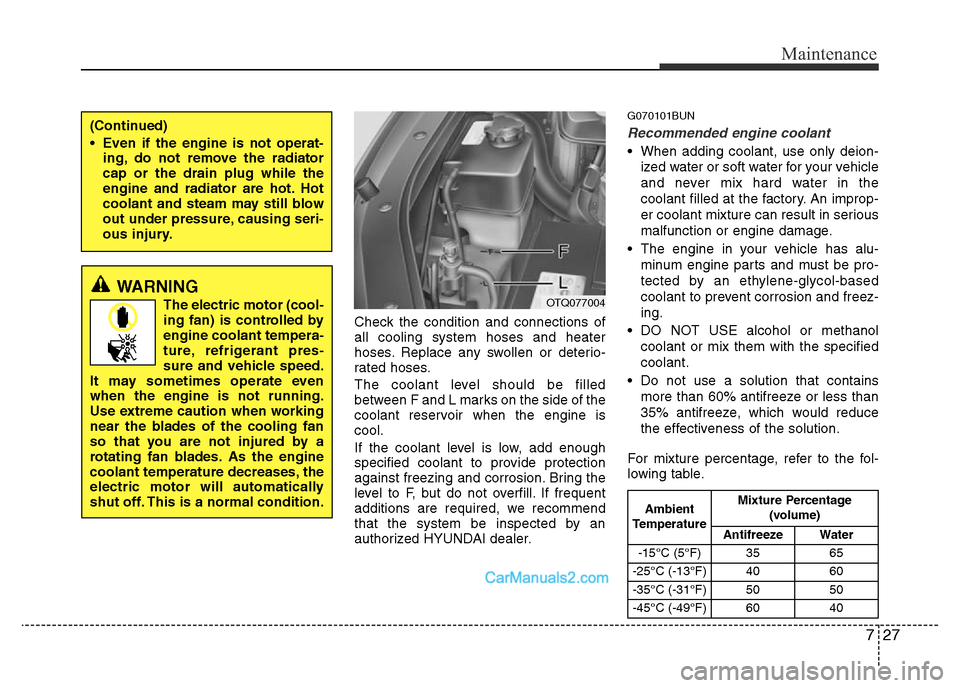
Check the condition and connections of
all cooling system hoses and heater
hoses. Replace any swollen or deterio-
rated hoses.
The coolant level should be filled
between F and L marks on the side of the
coolant reservoir when the engine is
cool.
If the coolant level is low, add enough
specified coolant to provide protection
against freezing and corrosion. Bring the
level to F, but do not overfill. If frequent
additions are required, we recommend
that the system be inspected by an
authorized HYUNDAI dealer.
G070101BUN
Recommended engine coolant
• When adding coolant, use only deion-
ized water or soft water for your vehicle
and never mix hard water in the
coolant filled at the factory. An improp-
er coolant mixture can result in serious
malfunction or engine damage.
• The engine in your vehicle has alu-
minum engine parts and must be pro-
tected by an ethylene-glycol-based
coolant to prevent corrosion and freez-
ing.
• DO NOT USE alcohol or methanol
coolant or mix them with the specified
coolant.
• Do not use a solution that contains
more than 60% antifreeze or less than
35% antifreeze, which would reduce
the effectiveness of the solution.
For mixture percentage, refer to the fol-
lowing table.
WARNING
The electric motor (cool-
ing fan) is controlled by
engine coolant tempera-
ture, refrigerant pres-
sure and vehicle speed.
It may sometimes operate even
when the engine is not running.
Use extreme caution when working
near the blades of the cooling fan
so that you are not injured by a
rotating fan blades. As the engine
coolant temperature decreases, the
electric motor will automatically
shut off. This is a normal condition.
(Continued)
• Even if the engine is not operat-
ing, do not remove the radiator
cap or the drain plug while the
engine and radiator are hot. Hot
coolant and steam may still blow
out under pressure, causing seri-
ous injury.
OTQ077004
Ambient
TemperatureMixture Percentage
(volume)
Antifreeze Water
-15°C (5°F) 35 65
-25°C (-13°F) 40 60
-35°C (-31°F) 50 50
-45°C (-49°F) 60 40
Page 338 of 353
Maintenance
74 7
To help prevent corrosion
You can help prevent corrosion from get-
ting started by observing the following:
Keep your car clean
The best way to prevent corrosion is to
keep your car clean and free of corrosive
materials. Attention to the underside of
the car is particularly important.
• If you live in a high-corrosion area —
where road salts are used, near the
ocean, areas with industrial pollution,
acid rain, etc.—, you should take extra
care to prevent corrosion. In winter,
hose off the underside of your car at
least once a month and be sure to
clean the underside thoroughly when
winter is over.
• When cleaning underneath the car,
give particular attention to the compo-
nents under the fenders and other
areas that are hidden from view. Do a
thorough job; just dampening the accu-
mulated mud rather than washing it
away will accelerate corrosion rather
than prevent it. Water under high pres-
sure and steam are particularly effec-
tive in removing accumulated mud and
corrosive materials.• When cleaning lower door panels,
rocker panels and frame members, be
sure that drain holes are kept open so
that moisture can escape and not be
trapped inside to accelerate corrosion.
Keep your garage dry
Don't park your car in a damp, poorly
ventilated garage. This creates a favor-
able environment for corrosion. This is
particularly true if you wash your car in
the garage or drive it into the garage
when it is still wet or covered with snow,
ice or mud. Even a heated garage can
contribute to corrosion unless it is well
ventilated so moisture is dispersed.Keep paint and trim in good condition
Scratches or chips in the finish should be
covered with "touch-up" paint as soon as
possible to reduce the possibility of cor-
rosion. If bare metal is showing through,
the attention of a qualified body and paint
shop is recommended.
Bird droppings : Bird droppings are high-
ly corrosive and may damage painted
surfaces in just a few hours. Always
remove bird droppings as soon as possi-
ble.
Don't neglect the interior
Moisture can collect under the floor mats
and carpeting to cause corrosion. Check
under the mats periodically to be sure
the carpeting is dry. Use particular care if
you carry fertilizers, cleaning materials or
chemicals in the car.
These should be carried only in proper
containers and any spills or leaks should
be cleaned up, flushed with clean water
and thoroughly dried.