2014 Hyundai Genesis All
[x] Cancel search: AllPage 435 of 546

6-32
What to do in an emergency
Your vehicle is equipped with emer-
gency commodities to help you
respond to emergency situation.
Fire extinguisher
If there is small fire and you know
how to use the fire extinguisher, fol-
low these steps carefully.
1.Pull out the safety pin at the top of
the extinguisher that keeps the
handle from being accidentally
pressed.
2.Aim the nozzle towards the base of
the fire.
3.Stand approximately 2.5 m (8 ft)
away from the fire and squeeze the
handle to discharge the extinguish-
er. If you release the handle, the
discharge will stop.
4.Sweep the nozzle back and forth at
the base of the fire. After the fire
appears to be out, watch carefully
since it may re-ignite.
First aid kit
Supplies for use in giving first aid
such as scissors, bandage and
adhesive tape, etc. are provided.
Triangle reflector
Place the triangle reflector on the
road to warn oncoming vehicles dur-
ing emergencies, such as when the
vehicle is parked by the roadside due
to problems.
EMERGENCY COMMODITY (IF EQUIPPED)
ODH063005
ODH063004
Page 436 of 546

6-33
What to do in an emergency
6
Tire pressure gauge
(if equipped)
Tires normally lose some air in day-
to-day use, and you may have to add
a air periodically and usually it is not
a sign of a leaking tire, but of normal
wear. Always check tire pressure
when the tires are cold because tire
pressure increases with tempera-
ture.To check the tire pressure, take the
following steps:
1.Unscrew the inflation valve cap
that is located on the rim of the tire.
2.Press and hold the gauge against
the tire valve. Some air will leak as
you begin and more will leak if you
don't press the gauge in firmly.
3.A firm non-leaking push will acti-
vate the gauge.
4.Read the tire pressure on the
gauge to see whether the tire pres-
sure is low or high.
5.Adjust the tire pressure to the
specified pressure. Refer to “Tires
and Wheels” in chapter 8.
6.Reinstall the inflation valve cap.
Page 437 of 546

7
Maintenance
7
Maintenance
Engine compartment .............................................7-3
Maintenance services ...........................................7-5
Owner's responsibility ......................................................7-5
Owner maintenance precautions ..................................7-5
Owner maintenance ...............................................7-7
Owner maintenance schedule ........................................7-7
Scheduled maintenance service ..........................7-9
Normal maintenance schedule .........................7-10, 7-16
Maintenance under severe usage
conditions...............................................................7-14, 7-20
Explanation of scheduled maintenance items..7-22
Engine oil ..............................................................7-26
Checking the engine oil level .......................................7-26
Changing the engine oil and filter ..............................7-27
Engine coolant......................................................7-28
Checking the coolant level ...........................................7-28
Changing the coolant .....................................................7-30
Brake fluid ............................................................7-31
Checking the brake fluid level .....................................7-31
Washer fluid .........................................................7-33
Checking the washer fluid level ..................................7-33
Parking brake .......................................................7-33
Checking the parking brake .........................................7-33
Air cleaner ............................................................7-34
Filter replacement ...........................................................7-34
Climate control air filter .....................................7-35
Filter inspection ...............................................................7-35
Filter replacement ...........................................................7-35
Wiper blades .........................................................7-36
Blade inspection ..............................................................7-36
Blade replacement ..........................................................7-36
Battery...................................................................7-38
For best battery service................................................7-38
Battery capacity label ....................................................7-40
Battery recharging .........................................................7-40
Reset items .......................................................................7-41
Tires and wheels ..................................................7-42
Tire care ............................................................................7-42
Recommended cold tire inflation pressures.............7-42
Checking tire inflation pressure ..................................7-44
Tire rotation .....................................................................7-45
Wheel alignment and tire balance ..............................7-46
Tire replacement .............................................................7-46
Wheel replacement ........................................................7-48
Tire traction ......................................................................7-48
Tire maintenance ...........................................................7-48
Tire sidewall labeling ......................................................7-48
Low aspect ratio tire ......................................................7-53
Fuses ......................................................................7-54
Fuse/Relay panel description ......................................7-59
7
Page 442 of 546

7-6
Maintenance
Maintenance work
•Performing maintenance work
on a vehicle can be danger-
ous. You can be seriously
injured while performing
some maintenance proce-
dures. If you lack sufficient
knowledge and experience or
the proper tools and equip-
ment to do the work, we rec-
ommend that the system be
serviced by an authorized
HYUNDAI dealer.
•Working under the hood with
the engine running is danger-
ous. It becomes even more
dangerous when you wear
jewelry or loose clothing.
(Continued)
WARNING (Continued)
These can become entangled
in moving parts and result in
injury. Therefore, if you must
run the engine while working
under the hood, make certain
that you remove all jewelry
(especially rings, bracelets,
watches, and necklaces) and
all neckties, scarves, and sim-
ilar loose clothing before get-
ting near the engine or cool-
ing fans.
•Do not put heavy objects or
apply excessive force on top of
the engine cover (if equipped)
or fuel related parts.
•When you inspect the fuel
system (fuel lines and fuel
injection devices), we recom-
mend that you contact an
authorized HYUNDAI dealer.
(Continued)
CAUTION
(Continued)
•Do not drive long time with
the engine cover (if equipped)
removed.
•When checking the engine
room, do not go near fire. Fuel,
washer fluid, etc. are flamma-
ble oils that may cause fire.
•Before touching the battery,
ignition cables and electrical
wiring, you should disconnect
the battery "-" terminal. You
may get an electric shock
from the electric current.
•When you remove the interior
trim cover with a flat head (-)
driver, be careful not to dam-
age the cover.
•Be careful when you replace
and clean bulbs to avoid
burns or electrical shock.
Page 443 of 546
7-7
7
Maintenance
OWNER MAINTENANCE
The following lists are vehicle checks
and inspections that should be per-
formed at the frequencies indicated
to help ensure safe, dependable
operation of your vehicle.
If you have any question, we recom-
mend that you consult an authorized
HYUNDAI dealer.
These Owner Maintenance Checks
are generally not covered by war-
ranties and you may be charged for
labor, parts and lubricants used.Owner maintenance schedule
When you stop for fuel:
• Check the engine oil level.
• Check coolant level in coolant
reservoir.
• Check the windshield washer fluid
level.
• Look for low or under-inflated tires.
While operating your vehicle:
• Note any changes in the sound of
the exhaust or any smell of
exhaust fumes in the vehicle.
• Check for vibrations in the steering
wheel. Notice any increased steer-
ing effort or looseness in the steer-
ing wheel, or change in its straight-
ahead position.
• Notice if your vehicle constantly
turns slightly or “pulls” to one side
when traveling on smooth, level
road.
• When stopping, listen and check
for unusual sounds, pulling to one
side, increased brake pedal travel
or “hard-to-push” brake pedal.
• If any slipping or changes in the
operation of your transmission
occurs, check the transmission
fluid level.
• Check automatic transmission P
(Park) function.
• Check parking brake.
• Check for fluid leaks under your
vehicle (water dripping from the air
conditioning system during or after
use is normal). Be careful when checking your
engine coolant level when the
engine is hot. Scalding hot
coolant and steam may blow
out under pressure. This could
cause burns or other serious
injury.
WARNING
Page 444 of 546

7-8
Maintenance
At least monthly:
• Check coolant level in the engine
coolant reservoir.
• Check the operation of all exterior
lights, including the stop lamps,
turn signals and hazard warning
flashers.
• Check the inflation pressures of all
tires including the spare.
At least twice a year
(i.e., every Spring and Fall) :
• Check radiator, heater and air con-
ditioning hoses for leaks or dam-
age.
• Check windshield washer spray
and wiper operation. Clean wiper
blades with clean cloth dampened
with washer fluid.
• Check headlamp alignment.
• Check muffler, exhaust pipes,
shields and clamps.
• Check the lap/shoulder belts for
wear and function.
• Check for worn tires and loose
wheel lug nuts.
At least once a year :
• Clean body and door drain holes.
• Lubricate door hinges and checks,
and hood hinges.
• Lubricate door and hood locks and
latches.
• Lubricate door rubber weather-
strips.
• Check the air conditioning system.
• Inspect and lubricate automatic
transmission linkage and controls.
• Clean battery and terminals.
• Check the brake fluid level.
Page 445 of 546

7-9
7
Maintenance
SCHEDULED MAINTENANCE SERVICE
Follow Normal Maintenance Schedule
if the vehicle is usually operated where
none of the following conditions apply.
If any of the following conditions apply,
follow Maintenance Under Severe
Usage Conditions.
• Repeated short distance driving.
• Driving in dusty conditions or
sandy areas.
• Extensive use of brakes.
• Driving in areas where salt or other
corrosive materials are being used.
• Driving on rough or muddy roads.
• Driving in mountainous areas.
• Extended periods of idling or low
speed operation.
• Driving for a prolonged period in
cold temperatures and/or extreme-
ly humid climates.
• More than 50% driving in heavy
city traffic during hot weather
above 32°C (90°F).If your vehicle is operated under the
above conditions, you should
inspect, replace or refill more fre-
quently than the following Normal
Maintenance Schedule. After the
periods or distance shown in the
chart, continue to follow the pre-
scribed maintenance intervals.
Page 448 of 546
7-12
Maintenance
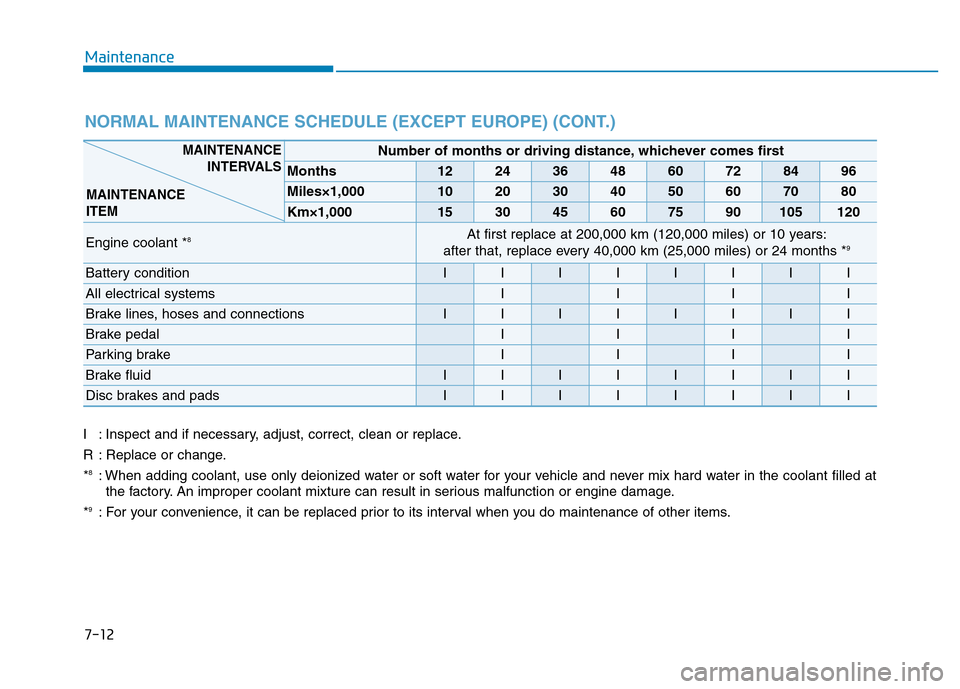
NORMAL MAINTENANCE SCHEDULE (EXCEPT EUROPE) (CONT.)
I : Inspect and if necessary, adjust, correct, clean or replace.
R : Replace or change.
*
8: When adding coolant, use only deionized water or soft water for your vehicle and never mix hard water in the coolant filled at
the factory. An improper coolant mixture can result in serious malfunction or engine damage.
*
9: For your convenience, it can be replaced prior to its interval when you do maintenance of other items.
Number of months or driving distance, whichever comes first
Months1224364860728496
Miles×1,0001020304050607080
Km×1,000153045607590105120
Engine coolant *8At first replace at 200,000 km (120,000 miles) or 10 years:
after that, replace every 40,000 km (25,000 miles) or 24 months *9
Battery conditionIIIIIIII
All electrical systemsIIII
Brake lines, hoses and connectionsIIIIIIII
Brake pedalIIII
Parking brakeIIII
Brake fluidIIIIIIII
Disc brakes and padsIIIIIIII
MAINTENANCE
INTERVALS
MAINTENANCE
ITEM