2014 Hyundai Equus belt
[x] Cancel search: beltPage 58 of 479
339
Safety features of your vehicle
Do not lie down
To reduce the chance of injuries in
the event of an accident and to
achieve maximum effectiveness of
the restraint system, all passengers
should be sitting up and the front and
rear seats should be in an upright
position when the car is moving. A
seat belt cannot provide proper pro-
tection if the person is lying down in
the rear seat or if the front and rear
seats are in a reclined position.
Care of seat belts
Seat belt systems should never be
disassembled or modified. In addi-
tion, care should be taken to assure
that seat belts and belt hardware are
not damaged by seat hinges, doors
or other abuse.
Periodic inspection
All seat belts should be inspected
periodically for wear or damage of
any kind. Any damaged parts should
be replaced as soon as possible.
Keep belts clean and dry
Seat belts should be kept clean and
dry. If belts become dirty, they can be
cleaned by using a mild soap solu-
tion and warm water. Bleach, dye,
strong detergents or abrasives
should not be used because they
may damage and weaken the fabric.
When to replace seat belts
Entire in-use seat belt assembly or
assemblies should be replaced if the
vehicle has been involved in an acci-
dent. This should be done even if no
damage is visible. We recommend
that you consult an authorized
HYUNDAI dealer.
WARNING
Riding with a reclined seatback
increases your chance of seri-
ous or fatal injuries in the event
of a collision or sudden stop.
The protection of your restraint
system (seat belts and air bags)
is greatly reduced by reclining
your seat. Seat belts must be
snug against your hips and
chest to work properly.
(Continued)
(Continued)
The more the seatback is
reclined, the greater the chance
that an occupant's hips will
slide under the lap belt causing
serious internal injuries or the
occupant's neck could strike
the shoulder belt. Drivers and
passengers should always sit
well back in their seats, proper-
ly belted, and with the seat-
backs upright.
Page 59 of 479

Safety features of your vehicle
40 3
CHILD RESTRAINT SYSTEM
Children riding in the car should sit in
the rear seat and must always be
properly restrained to minimize the
risk of injury in an accident, sudden
stop or sudden maneuver. According
to accident statistics, children are
safer when properly restrained in the
rear seats than in the front seat.
Larger children not in a child restraint
should use one of the seat belts pro-
vided.
You should be aware of the specific
requirements in your country. Child
and/or infant safety seats must be
properly placed and installed in the
rear seat. You must use a commer-
cially available child restraint system
that meets the requirements of the
Safety Standards of your country.
Child restraint systems are designed
to be secured in vehicle seats by lap
belts or the lap belt portion of a
lap/shoulder belt, or by a tether
anchor and/or ISOFIX anchors (if
equipped).Children could be injured or killed in
a crash if their restraints are not
properly secured. For small children
and babies, a child seat or infant seat
must be used. Before buying a par-
ticular child restraint system, make
sure it fits your car seat and seat
belts, and fits your child. Follow all
the instructions provided by the man-
ufacturer when installing the child
restraint system.
WARNING
• A child restraint system must
be placed in the rear seat.
Never install a child or infant
seat on the front passenger's
seat. Should an accident
occur and cause the passen-
ger-side air bag to deploy, it
could severely injure or kill an
infant or child seated in an
infant or child seat. Thus only
use a child restraint in the
rear seat of your vehicle.
(Continued)
(Continued)
• A seat belt or child restraint
system can become very hot
if it is left in a closed vehicle
on a sunny day, even if the
outside temperature does not
feel hot. Be sure to check the
seat cover and buckles before
placing a child there.
• When the child restraint sys-
tem is not in use, store it in
the luggage area or fasten it
with a seat belt so that it will
not be thrown forward in the
case of a sudden stop or an
accident.
• Children may be seriously
injured or killed by an inflating
air bag. All children, even
those too large for child
restraints, must ride in the
rear seat.
Page 60 of 479

341
Safety features of your vehicle
WARNING
To reduce the chance of serious
or fatal injuries:
• Children of all ages are safer
when restrained in the rear
seat. A child riding in the
front passenger seat can be
forcefully struck by an inflat-
ing air bag resulting in seri-
ous or fatal injuries.
• Always follow the child
restraint system manufactur-
er’s instructions for installa-
tion and use of the child
restraint.
• Always make sure the child
seat is secured properly in the
vehicle and your child is
securely restrained in the
child seat.
• Never hold a child in your
arms or lap when riding in a
vehicle. The violent forces cre-
ated during a crash will tear
the child from your arms and
throw the child against the
vehicle’s interior.
(Continued)
(Continued)
Always properly position and
secure children in the rear
seat.
• Never allow a child to stand-
up or kneel on the seat or
floor of a moving vehicle.
During a collision or sudden
stop, the child can be violent-
ly thrown against the vehicle’s
interior, resulting in serious
injury.
• Never use an infant carrier or
a child safety seat that
"hooks" over a seatback, it
may not provide adequate
security in an accident.
• Seat belts can become very
hot, especially when the vehi-
cle is parked in direct sun-
light. Always check seat belt
buckles before fastening them
over a child.
• After an accident, we recom-
mend that the system be
checked by an authorized
HYUNDAI dealer.
(Continued)(Continued)
• Never put a seat belt over
yourself and a child. During a
crash, the belt could press
deep into the child causing
serious internal injuries.
• Never leave children unat-
tended in a vehicle – not even
for a short time. The car can
heat up very quickly, resulting
in serious injuries to children
inside. Even very young chil-
dren may inadvertently cause
the vehicle to move, entangle
themselves in the windows, or
lock themselves or others
inside the vehicle.
• Never allow two children, or
any two persons, to use the
same seat belt.
• Children often squirm and
reposition themselves
improperly. Never let a child
ride with the shoulder belt
under their arm or behind
their back.
(Continued)
Page 62 of 479
343
Safety features of your vehicle
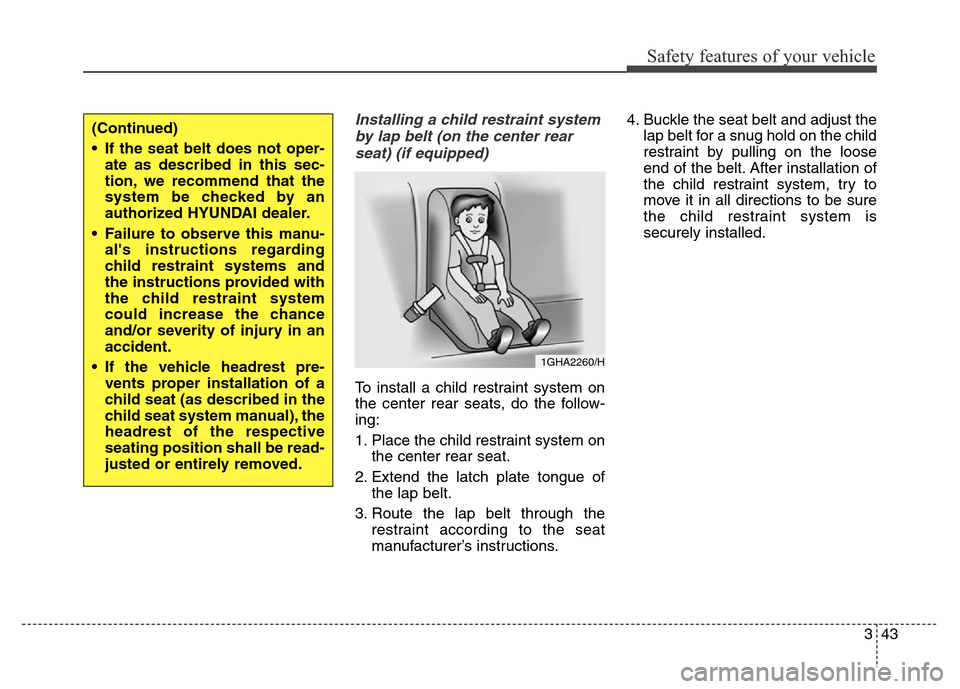
Installing a child restraint system
by lap belt (on the center rear
seat) (if equipped)
To install a child restraint system on
the center rear seats, do the follow-
ing:
1. Place the child restraint system on
the center rear seat.
2. Extend the latch plate tongue of
the lap belt.
3. Route the lap belt through the
restraint according to the seat
manufacturer’s instructions.4. Buckle the seat belt and adjust the
lap belt for a snug hold on the child
restraint by pulling on the loose
end of the belt. After installation of
the child restraint system, try to
move it in all directions to be sure
the child restraint system is
securely installed.
1GHA2260/H
(Continued)
• If the seat belt does not oper-
ate as described in this sec-
tion, we recommend that the
system be checked by an
authorized HYUNDAI dealer.
• Failure to observe this manu-
al's instructions regarding
child restraint systems and
the instructions provided with
the child restraint system
could increase the chance
and/or severity of injury in an
accident.
• If the vehicle headrest pre-
vents proper installation of a
child seat (as described in the
child seat system manual), the
headrest of the respective
seating position shall be read-
justed or entirely removed.
Page 63 of 479

Safety features of your vehicle
44 3
Installing a child restraint system
by lap/shoulder belt
To install a child restraint system on
the outboard or center rear seats, do
the following:
1. Place the child restraint system in
the seat and route the lap/shoul-
der belt around or through the
restraint, following the restraint
manufacturer’s instructions. Be
sure the seat belt webbing is not
twisted.2. Fasten the lap/shoulder belt latch
into the buckle. Listen for the dis-
tinct “click” sound.Position the release button so that it
is easy to access in case of an emer-
gency.
3. Buckle the seat belt and allow the
seat belt to take up any slack. After
installation of the child restraint
system, try to move it in all direc-
tions to be sure the child restraint
system is securely installed.
If you need to tighten the belt, pull
more webbing toward the retractor.
When you unbuckle the seat belt and
allow it to retract, the retractor will
automatically revert back to its nor-
mal seated passenger emergency
locking usage condition.
OEN036101OEN036104
E2MS103005
Page 64 of 479

345
Safety features of your vehicle
Securing a child restraint seat
with “Tether Anchor” system
(if equipped)
Child restraint hook holders are
located on the package tray.
Seating position
Age group
0 : Up to 10 kg
XUX
(0 - 9 months)
0+ : Up to 13 kg
XUX
(0 - 2 years)
I : 9 kg to 18 kg
X
UX(9 months - 4 years)
II & III : 15 kg to 36 kg
XUX
(4 - 12 years)
Front
passengerRear
outboardRear
center
Child seat restraint suitability for seat position using the seat belt
- For Europe
Use child safety seats that have been officially approved and are appropriate
for your children. When using the child safety seats, refer to the following
table.
OVI039034
U : Suitable for "universal" category restraints approved for use in this mass
group
X : Seat position not suitable for children in this mass group
Page 65 of 479

Safety features of your vehicle
46 3
1. Route the child restraint seat strap
over the seatback.
For vehicles with adjustable head-
rest, route the tether strap under
the headrest and between the
headrest posts, otherwise route
the tether strap over the top of the
seatback.
2. Connect the tether strap hook to
the appropriate child restraint
hook holder and tighten to secure
the child restraint seat.
OVI033035
WARNING- Tether strap
Never mount more than one
child restraint to a single tether
or to a single lower anchorage
point. The increased load
caused by multiple seats may
cause the tethers or anchorage
points to break, causing serious
injury or death.
WARNING
A child can be seriously injured
or killed in a collision if the
child restraint is not properly
anchored to the car and the
child is not properly restrained
in the child restraint. Always fol-
low the child seat manufactur-
er’s instructions for installation
and use.
WARNING - Child
restraint check
Check that the child restraint
system is secure by pushing
and pulling it in different direc-
tions. Incorrectly fitted child
restraints may swing, twist, tip
or separate causing death or
serious injury.
WARNING
- Child restraint anchorage
• Child restraint anchorages
are designed to withstand
only those loads imposed by
correctly fitted child
restraints. Under no circum-
stances are they to be used
for adult seat belts or har-
nesses or for attaching other
items or equipment to the
vehicle.
• The tether strap may not work
properly if attached some-
where other than the correct
tether anchor.
Page 66 of 479

347
Safety features of your vehicle
Securing a child restraint system
with “ISOFIX” system and “Tether
Anchorage” system (if equipped)
ISOFIX is a standardised method of
fitting child seats that eliminates the
need to use the standard adult seat
belt to secure the seat in the vehicle.
This enables a much more secure
and positive location with the added
benefit of easier and quicker installa-
tion.
An ISOFIX-seat can only be installed
if it has vehicle-specific approval in
accordance with the requirements of
ECE-R44.There is a child restraint symbol
located on the lower portion of each
side of the rear seatbacks. These
symbols indicate the position of the
lower anchors for child restraints so
equipped.
On each side of the rear seat,
between the cushion and backrest,
are located a pair of ISOFIX anchor-
age points together with a top tether
mounting on the shelf behind the
rear seats. During the installation,
the seat has to be engaged at the
anchorage-points in a way you can
hear it clicking (check by pulling!)
and has to be fixed with the Top
Tether-belt on the belonging point on
the shelf behind rear seats.The installing and the use of a child-
seat has to be done according to the
installing-manual, which is added to
the ISOFIX-seat.
OVI039060
OVI033036
ISOFIX Anchor
ISOFIX Anchor
Position Indicator
WARNING
Install the child restraint seat
fully rearward against the seat-
back with the seatback in a ver-
tical position, not reclined.