Page 385 of 476

Maintenance
24 7
Vacuum crankcase ventilation
hoses
Inspect the surface of hoses for evi-
dence of heat and/or mechanical
damage. Hard and brittle rubber,
cracking, tears, cuts, abrasions, and
excessive swelling indicate deterio-
ration. Particular attention should be
paid to examine those hose surfaces
nearest to high heat sources, such
as the exhaust manifold.
Inspect the hose routing to assure
that the hoses do not come in con-
tact with any heat source, sharp
edges or moving component which
might cause heat damage or
mechanical wear. Inspect all hose
connections, such as clamps and
couplings, to make sure they are
secure, and that no leaks are pres-
ent. Hoses should be replaced
immediately if there is any evidence
of deterioration or damage.
Air cleaner filter
A Genuine HYUNDAI air cleaner fil-
ter is recommended when the filter is
replaced.
Spark plugs
Make sure to install new spark plugs
of the correct heat range.
Cooling system
Check cooling system components,
such as radiator, coolant reservoir,
hoses and connections for leakage
and damage. Replace any damaged
parts.
Coolant
The coolant should be changed at
the intervals specified in the mainte-
nance schedule.
Automatic transaxle fluid
(if equipped)
Automatic transaxle fluid should not
be checked under normal usage
conditions.
But in severe conditions, the fluid
should be changed at an authorized
HYUNDAI dealer in accordance with
the scheduled maintenance at the
beginning of this chapter.
✽ ✽
NOTICE
Automatic transaxle fluid color is
basically red.
As the vehicle is driven, the auto-
matic transaxle fluid will begin to
look darker.
This is a normal condition and you
should not judge the need to replace
the fluid based upon the changed
color.
Page 388 of 476
727
Maintenance
ENGINE OIL
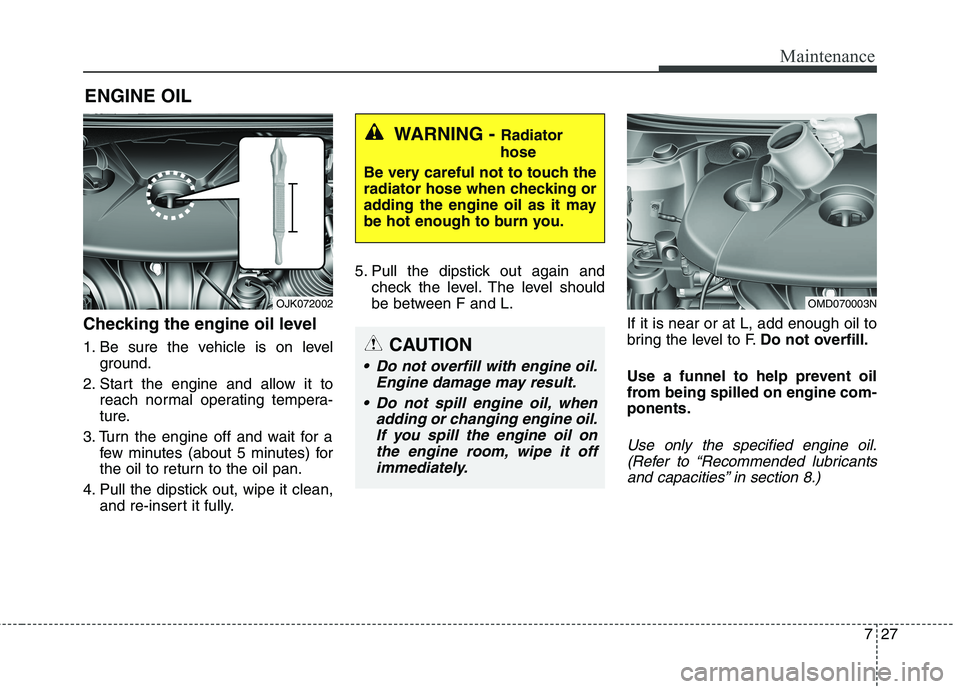
Checking the engine oil level
1. Be sure the vehicle is on level
ground.
2. Start the engine and allow it to
reach normal operating tempera-
ture.
3. Turn the engine off and wait for a
few minutes (about 5 minutes) for
the oil to return to the oil pan.
4. Pull the dipstick out, wipe it clean,
and re-insert it fully.5. Pull the dipstick out again and
check the level. The level should
be between F and L.
If it is near or at L, add enough oil to
bring the level to F.Do not overfill.
Use a funnel to help prevent oil
from being spilled on engine com-
ponents.
Use only the specified engine oil.
(Refer to “Recommended lubricants
and capacities” in section 8.)
WARNING - Radiator
hose
Be very careful not to touch the
radiator hose when checking or
adding the engine oil as it may
be hot enough to burn you.
CAUTION
Do not overfill with engine oil.
Engine damage may result.
Do not spill engine oil, when
adding or changing engine oil.
If you spill the engine oil on
the engine room, wipe it off
immediately.
OJK072002OMD070003N
Page 391 of 476
Maintenance
30 7
Check the condition and connections
of all cooling system hoses and
heater hoses. Replace any swollen
or deteriorated hoses.
The coolant level should be filled
between F and L marks on the side
of the coolant reservoir when the
engine is cool.
If the coolant level is low, add enough
distilled (deionized) water. Bring the
level to F, but do not overfill. If fre-
quent additions are required, see an
authorized HYUNDAI dealer for a
cooling system inspection.
Recommended engine coolant
When adding coolant, use only
deionized water or soft water for
your vehicle and never mix hard
water in the coolant filled at the fac-
tory. An improper coolant mixture
can result in serious malfunction or
engine damage.
The engine in your vehicle has alu-
minum engine parts and must be
protected by an ethylene-glycol-
based coolant to prevent corrosion
and freezing.
DO NOT USE alcohol or methanol
coolant or mix them with the spec-
ified coolant.
Do not use a solution that contains
more than 60% antifreeze or less
than 35% antifreeze, which would
reduce the effectiveness of the
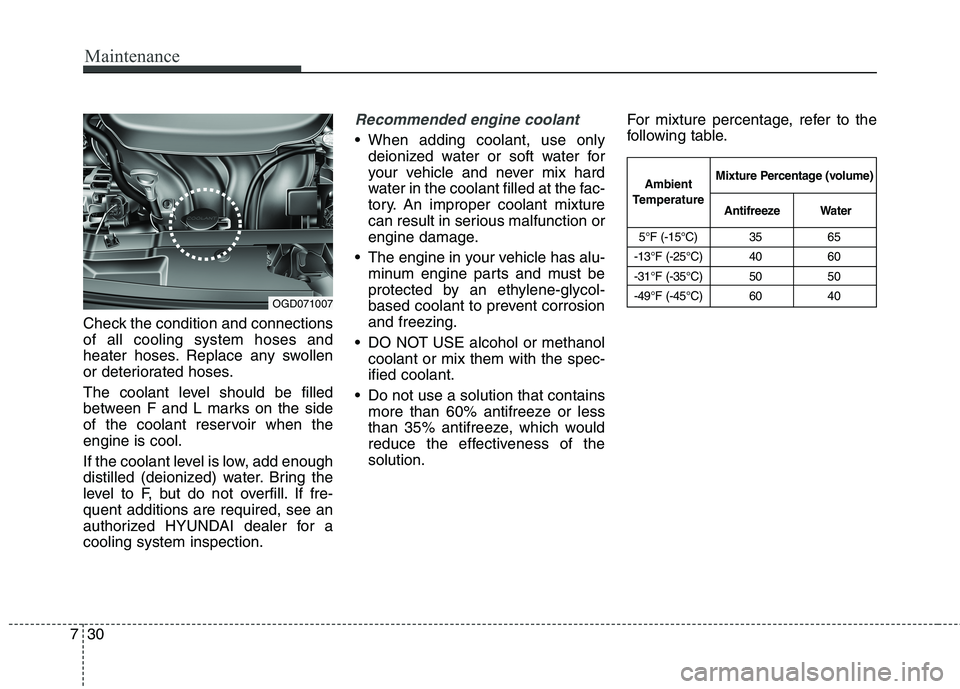
solution.For mixture percentage, refer to the
following table.
OGD071007
5°F (-15°C) 35 65
-13°F (-25°C) 40 60
-31°F (-35°C) 50 50
-49°F (-45°C) 60 40
Ambient
TemperatureMixture Percentage (volume)
AntifreezeWater
Page 392 of 476
731
Maintenance
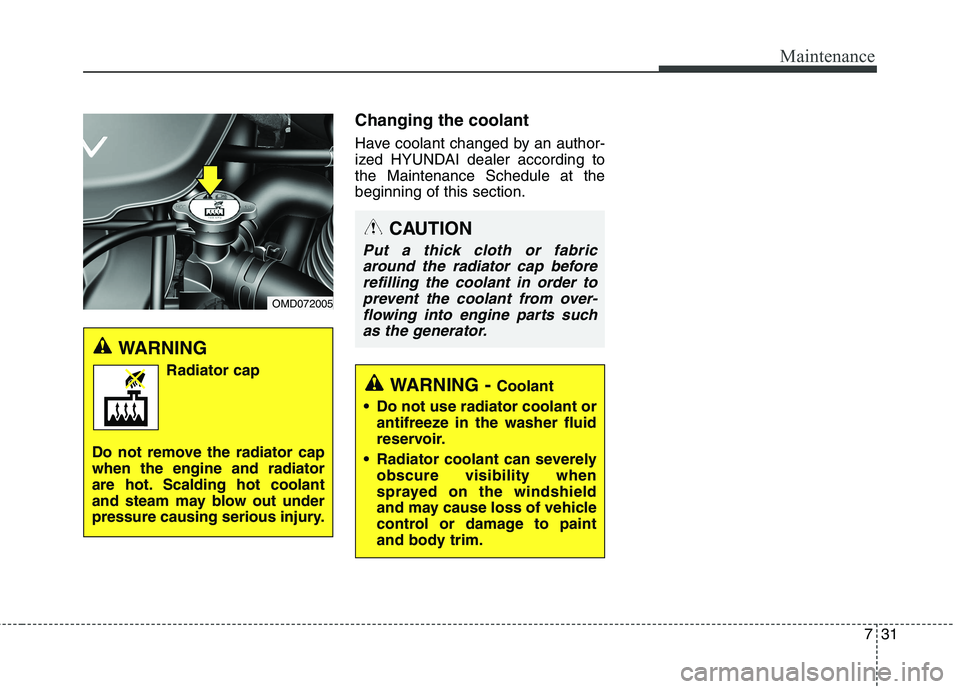
Changing the coolant
Have coolant changed by an author-
ized HYUNDAI dealer according to
the Maintenance Schedule at the
beginning of this section.
WARNING
Radiator cap
Do not remove the radiator cap
when the engine and radiator
are hot. Scalding hot coolant
and steam may blow out under
pressure causing serious injury.
WARNING - Coolant
Do not use radiator coolant or
antifreeze in the washer fluid
reservoir.
Radiator coolant can severely
obscure visibility when
sprayed on the windshield
and may cause loss of vehicle
control or damage to paint
and body trim.
OMD072005
CAUTION
Put a thick cloth or fabric
around the radiator cap before
refilling the coolant in order to
prevent the coolant from over-
flowing into engine parts such
as the generator.
Page 393 of 476
Maintenance
32 7
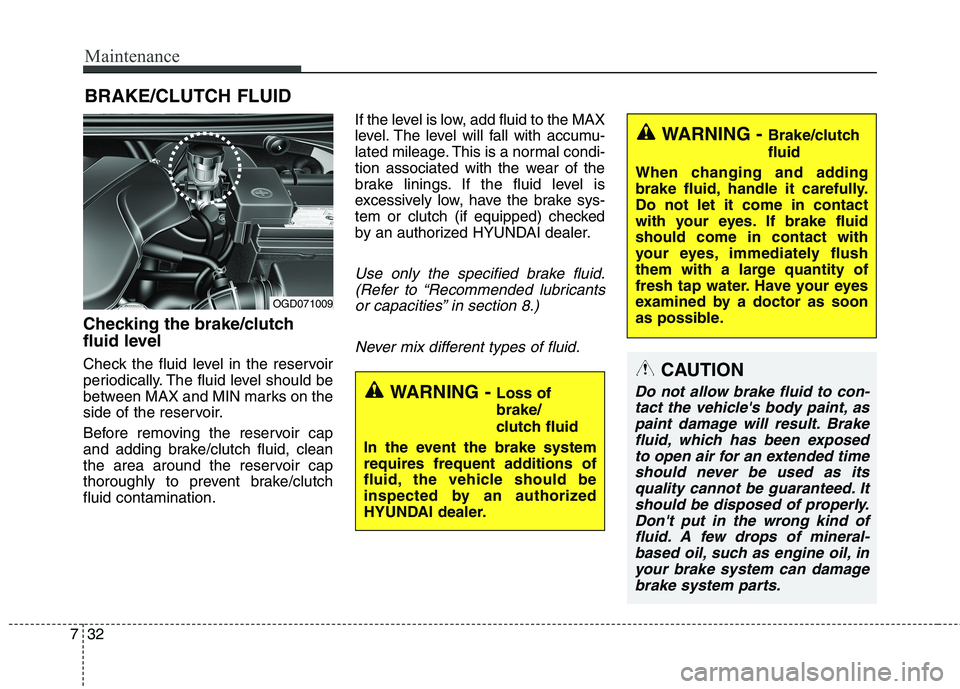
BRAKE/CLUTCH FLUID
Checking the brake/clutch
fluid level
Check the fluid level in the reservoir
periodically. The fluid level should be
between MAX and MIN marks on the
side of the reservoir.
Before removing the reservoir cap
and adding brake/clutch fluid, clean
the area around the reservoir cap
thoroughly to prevent brake/clutch
fluid contamination.If the level is low, add fluid to the MAX
level. The level will fall with accumu-
lated mileage. This is a normal condi-
tion associated with the wear of the
brake linings. If the fluid level is
excessively low, have the brake sys-
tem or clutch (if equipped) checked
by an authorized HYUNDAI dealer.
Use only the specified brake fluid.
(Refer to “Recommended lubricants
or capacities” in section 8.)
Never mix different types of fluid.
WARNING - Brake/clutch
fluid
When changing and adding
brake fluid, handle it carefully.
Do not let it come in contact
with your eyes. If brake fluid
should come in contact with
your eyes, immediately flush
them with a large quantity of
fresh tap water. Have your eyes
examined by a doctor as soon
as possible.
WARNING - Loss of
brake/
clutch fluid
In the event the brake system
requires frequent additions of
fluid, the vehicle should be
inspected by an authorized
HYUNDAI dealer.
CAUTION
Do not allow brake fluid to con-
tact the vehicle's body paint, as
paint damage will result. Brake
fluid, which has been exposed
to open air for an extended time
should never be used as its
quality cannot be guaranteed. It
should be disposed of properly.
Don't put in the wrong kind of
fluid. A few drops of mineral-
based oil, such as engine oil, in
your brake system can damage
brake system parts.
OGD071009
Page 394 of 476
733
Maintenance
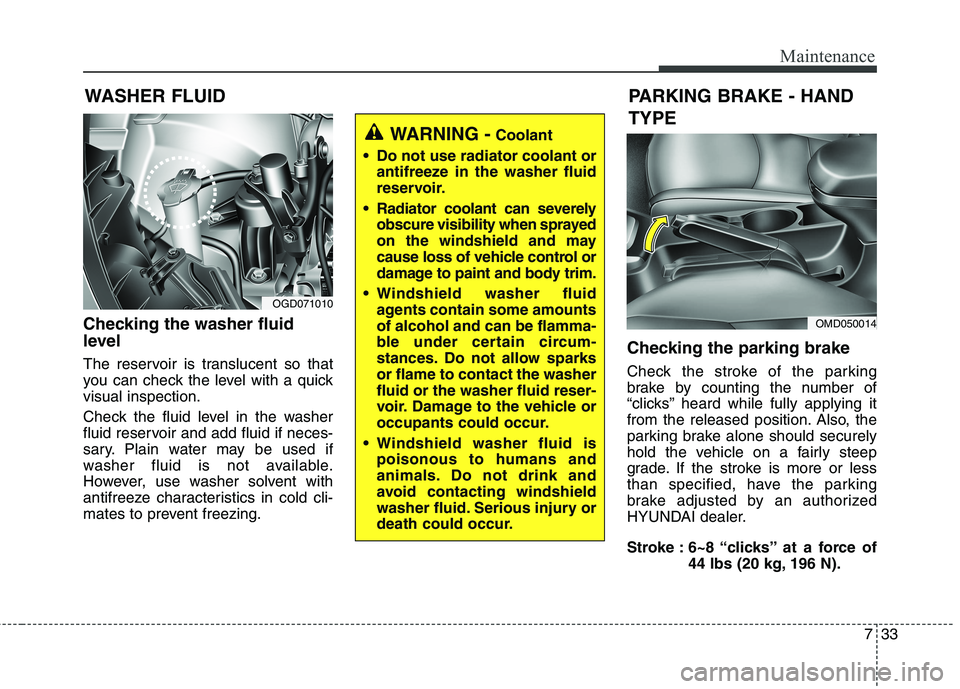
Checking the washer fluid
level
The reservoir is translucent so that
you can check the level with a quick
visual inspection.
Check the fluid level in the washer
fluid reservoir and add fluid if neces-
sary. Plain water may be used if
washer fluid is not available.
However, use washer solvent with
antifreeze characteristics in cold cli-
mates to prevent freezing.
Checking the parking brake
Check the stroke of the parking
brake by counting the number of
“clicks’’ heard while fully applying it
from the released position. Also, the
parking brake alone should securely
hold the vehicle on a fairly steep
grade. If the stroke is more or less
than specified, have the parking
brake adjusted by an authorized
HYUNDAI dealer.
Stroke : 6~8 “clicks’’ at a force of
44 lbs (20 kg, 196 N).
WASHER FLUID
WARNING -Coolant
Do not use radiator coolant or
antifreeze in the washer fluid
reservoir.
Radiator coolant can severely
obscure visibility when sprayed
on the windshield and may
cause loss of vehicle control or
damage to paint and body trim.
Windshield washer fluid
agents contain some amounts
of alcohol and can be flamma-
ble under certain circum-
stances. Do not allow sparks
or flame to contact the washer
fluid or the washer fluid reser-
voir. Damage to the vehicle or
occupants could occur.
Windshield washer fluid is
poisonous to humans and
animals. Do not drink and
avoid contacting windshield
washer fluid. Serious injury or
death could occur.
OGD071010
OMD050014
PARKING BRAKE - HAND
TYPE
Page 399 of 476
Maintenance
38 7
WIPER BLADES
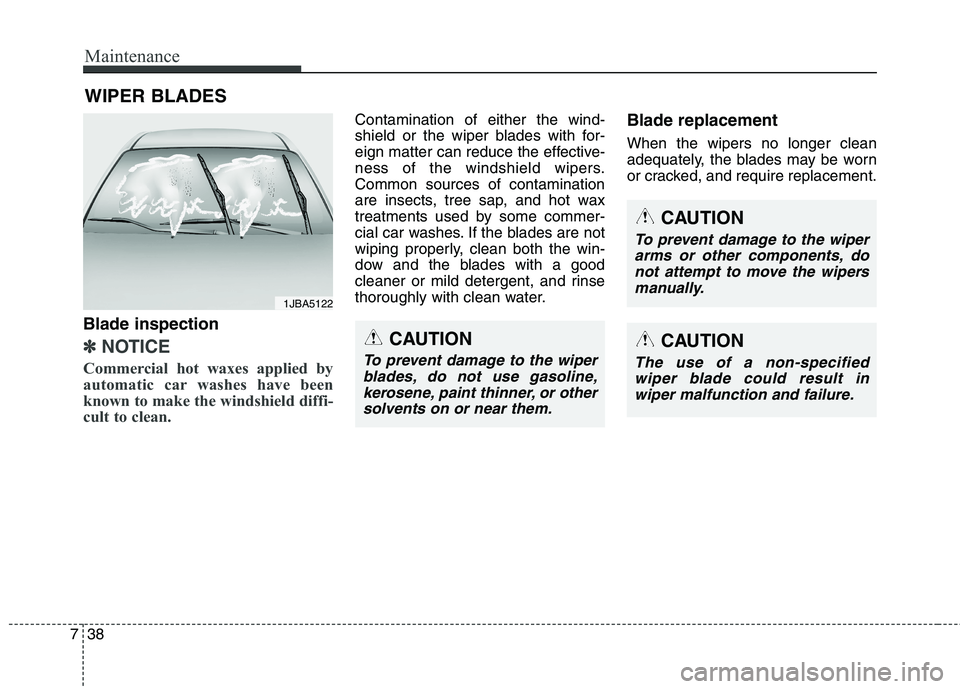
Blade inspection
✽
✽
NOTICE
Commercial hot waxes applied by
automatic car washes have been
known to make the windshield diffi-
cult to clean.
Contamination of either the wind-
shield or the wiper blades with for-
eign matter can reduce the effective-
ness of the windshield wipers.
Common sources of contamination
are insects, tree sap, and hot wax
treatments used by some commer-
cial car washes. If the blades are not
wiping properly, clean both the win-
dow and the blades with a good
cleaner or mild detergent, and rinse
thoroughly with clean water.Blade replacement
When the wipers no longer clean
adequately, the blades may be worn
or cracked, and require replacement.
1JBA5122
CAUTION
To prevent damage to the wiper
blades, do not use gasoline,
kerosene, paint thinner, or other
solvents on or near them.
CAUTION
To prevent damage to the wiper
arms or other components, do
not attempt to move the wipers
manually.
CAUTION
The use of a non-specified
wiper blade could result in
wiper malfunction and failure.
Page 401 of 476
Maintenance
40 7
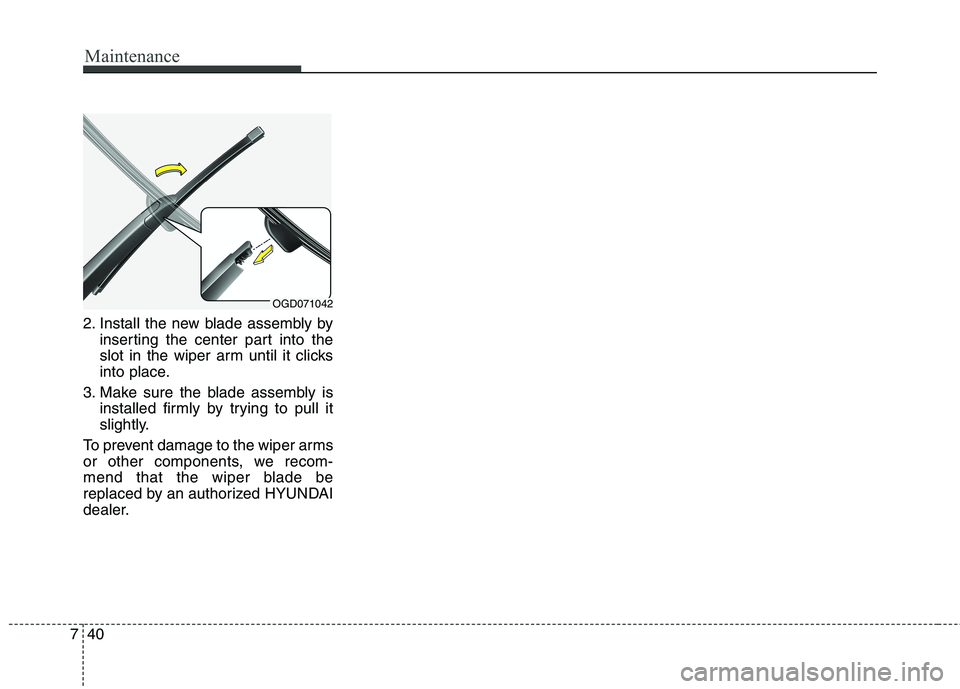
2. Install the new blade assembly by
inserting the center part into the
slot in the wiper arm until it clicks
into place.
3. Make sure the blade assembly is
installed firmly by trying to pull it
slightly.
To prevent damage to the wiper arms
or other components, we recom-
mend that the wiper blade be
replaced by an authorized HYUNDAI
dealer.
OGD071042