Page 373 of 546
5-97
Driving your vehicle
Winter precaution
Use high quality ethylene glycol
coolant
Your vehicle is delivered with high
quality ethylene glycol coolant in the
cooling system. It is the only type of
coolant that should be used because
it helps prevent corrosion in the cool-
ing system, lubricates the water
pump and prevents freezing. Be sure
to replace or replenish your coolant
in accordance with the maintenance
schedule in section 7. Before winter,
have your coolant tested to assure
that its freezing point is sufficient for
the temperatures anticipated during
the winter.
Check battery and cables
Winter puts additional burdens on
the battery system. Visually inspect
the battery and cables as described
in section 7. We recommend that the
level of charge in your battery be
checked by an authorized HYUNDAI
dealer.
Change to "winter weight" oil if
necessary
In some climates it is recommended
that a lower viscosity "winter weight"
oil be used during cold weather. See
section 8 for recommendations. If
you aren't sure what weight oil you
should use, we recommend that you
consult an authorized HYUNDAI
dealer.
Check spark plugs and ignition
system
Inspect your spark plugs as
described in section 7 and replace
them if necessary. Also check all
ignition wiring and components to be
sure they are not cracked, worn or
damaged in any way.
To keep locks from freezing
To keep the locks from freezing,
squirt an approved de-icer fluid or
glycerine into the key opening. If a
lock is covered with ice, squirt it with
an approved de-icing fluid to remove
the ice. If the lock is frozen internally,
you may be able to thaw it out by
using a heated key. Handle the heat-
ed key with care to avoid injury.
Use approved window washer
anti-freeze in system
To keep the water in the window
washer system from freezing, add an
approved window washer anti-freeze
solution in accordance with instruc-
tions on the container. Window wash-
er anti-freeze is available from an
authorized HYUNDAI dealer and
most auto parts outlets. Do not use
engine coolant or other types of anti-
freeze as these may damage the
paint finish.5
ProCarManuals.com
Page 375 of 546
5-99
Driving your vehicle
5
Two labels on your driver’s door sill
show how much weight your vehicle
was designed to carry: the Tire and
Loading Information Label and the
Certification Label.
Before loading your vehicle, familiar-
ize yourself with the following terms
for determining your vehicle's weight
ratings, from the vehicle's specifica-
tions and the Certification Label:
Base Curb Weight
This is the weight of the vehicle
including a full tank of fuel and all
standard equipment. It does not
include passengers, cargo, or option-
al equipment.
Vehicle Curb Weight
This is the weight of your new vehicle
when you picked it up from your deal-
er plus any aftermarket equipment.
Cargo Weight
This figure includes all weight added
to the Base Curb Weight, including
cargo and optional equipment.GAW (Gross Axle Weight)
This is the total weight placed on
each axle (front and rear) - including
vehicle curb weight and all payload.
GAWR (Gross Axle Weight Rating)
This is the maximum allowable
weight that can be carried by a single
axle (front or rear). These numbers
are shown on the Certification Label.
The total load on each axle must
never exceed its GAWR.
GVW (Gross Vehicle Weight)
This is the Base Curb Weight plus
actual Cargo Weight plus passen-
gers.
GVWR (Gross Vehicle Weight
Rating)
This is the maximum allowable
weight of the fully loaded vehicle
(including all options, equipment,
passengers and cargo). The GVWR
is shown on the Certification Label
located on the driver’s door sill.Overloading
VEHICLE WEIGHT
The Gross Axle Weight Rating
(GAWR) and the Gross Vehicle
Weight Rating (GVWR) for your
vehicle are on the Certification
Label attached to the driver's
(or front passenger
Page 478 of 546
7-42
Maintenance
TIRES AND WHEELS
Tire care
For proper maintenance, safety, and
maximum fuel economy, you must
always maintain recommended tire
inflation pressures and stay within
the load limits and weight distribution
recommended for your vehicle.
Recommended cold tire infla-
tion pressures
All tire pressures (including the
spare) should be checked when the
tires are cold. “Cold Tires” means the
vehicle has not been driven for at
least three hours or driven less than
1.6 km (1 mile).
Recommended pressures must be
maintained for the best ride, top vehi-
cle handling, and minimum tire wear.
For recommended inflation pressure
refer to “Tire and wheels” in section
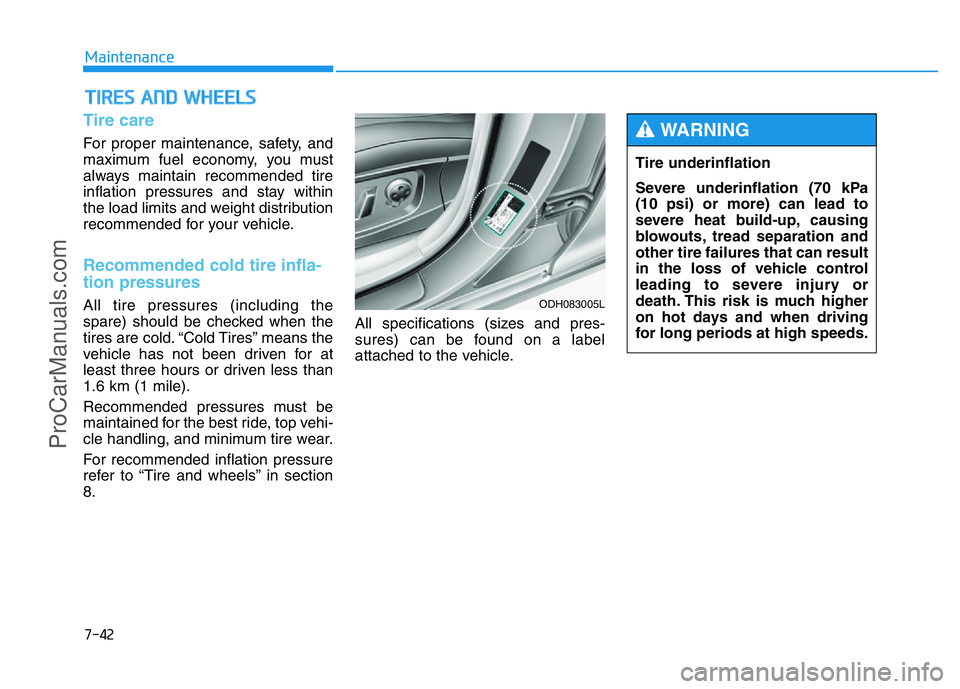
8.All specifications (sizes and pres-
sures) can be found on a label
attached to the vehicle.Tire underinflation
Severe underinflation (70 kPa
(10 psi) or more) can lead to
severe heat build-up, causing
blowouts, tread separation and
other tire failures that can result
in the loss of vehicle control
leading to severe injury or
death. This risk is much higher
on hot days and when driving
for long periods at high speeds.
WARNING
ODH083005L
ProCarManuals.com
Page 482 of 546
7-46
Maintenance
Wheel alignment and tire bal-
ance
The wheels on your vehicle were
aligned and balanced carefully at the
factory to give you the longest tire life
and best overall performance.
In most cases, you will not need to
have your wheels aligned again.
However, if you notice unusual tire
wear or your vehicle pulling one way
or the other, the alignment may need
to be reset.
If you notice your vehicle vibrating
when driving on a smooth road, your
wheels may need to be rebalanced.
Tire replacement
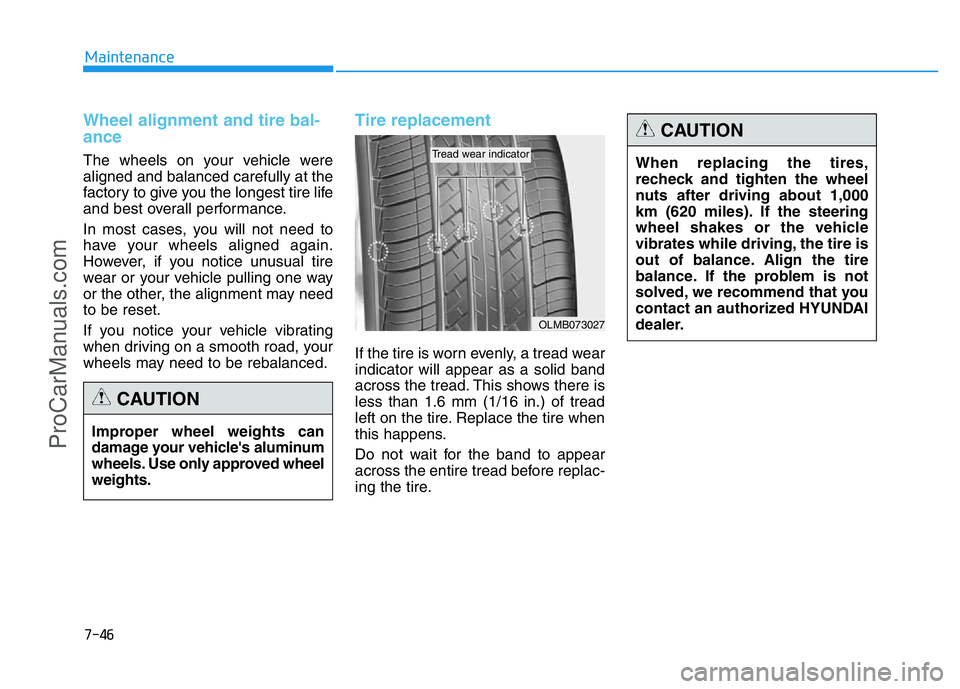
If the tire is worn evenly, a tread wear
indicator will appear as a solid band
across the tread. This shows there is
less than 1.6 mm (1/16 in.) of tread
left on the tire. Replace the tire when
this happens.
Do not wait for the band to appear
across the entire tread before replac-
ing the tire.
OLMB073027
Tread wear indicator
Improper wheel weights can
damage your vehicle's aluminum
wheels. Use only approved wheel
weights.
CAUTION
When replacing the tires,
recheck and tighten the wheel
nuts after driving about 1,000
km (620 miles). If the steering
wheel shakes or the vehicle
vibrates while driving, the tire is
out of balance. Align the tire
balance. If the problem is not
solved, we recommend that you
contact an authorized HYUNDAI
dealer.
CAUTION
ProCarManuals.com
Page 536 of 546
8
Specifications & Consumer information
8
Specifications & Consumer information
8
Dimensions ..............................................................8-2
Engine ......................................................................8-2
Luggage volume .....................................................8-2
Bulb wattage ...........................................................8-3
Air conditioning system ........................................8-3
Tires and wheels ....................................................8-4
Tire load and speed capacity ..............................8-5
Gross vehicle weight .............................................8-5
Recommended lubricants and capacities ...........8-6
Recommended SAE viscosity number ..........................8-8
Vehicle identification number (VIN) ....................8-9
Vehicle certification label .....................................8-9
TIRE specification and pressure label ..............8-10
Engine number .....................................................8-10
Air conditioner compressor label ......................8-10
Refrigerant label ..................................................8-11
Declaration of conformity ..................................8-11
ProCarManuals.com
Page 538 of 546
8-3
8
Specifications & Consumer information
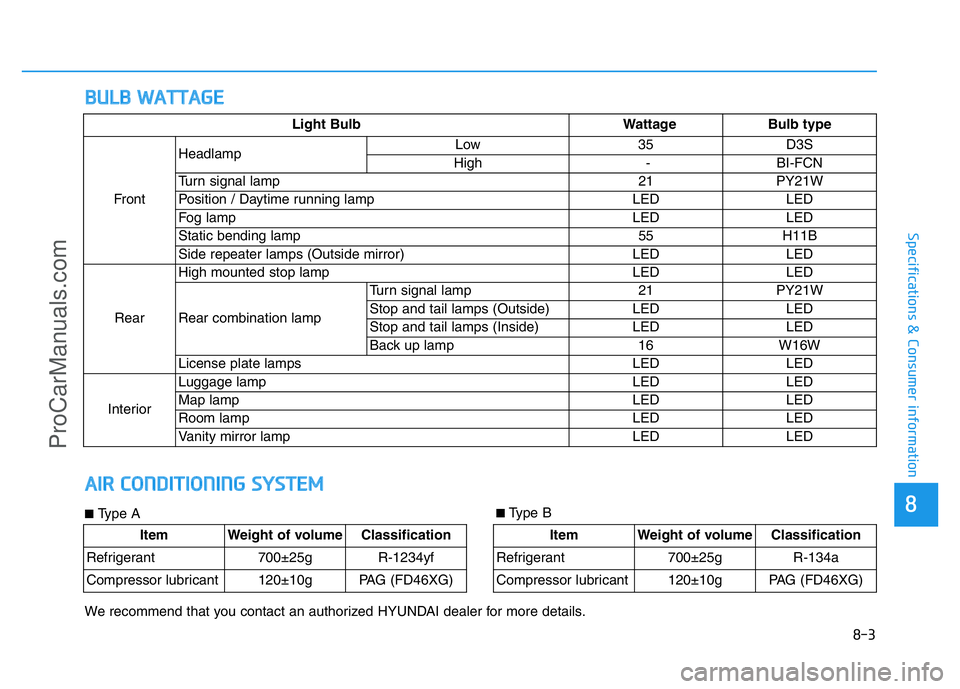
BULB WATTAGE
Light Bulb Wattage Bulb type
FrontHeadlamp
Low 35 D3S
High - BI-FCN
Turn signal lamp 21 PY21W
Position / Daytime running lamp LED LED
Fog lamp LED LED
Static bending lamp 55 H11B
Side repeater lamps (Outside mirror) LED LED
Rear
High mounted stop lampLEDLED
Rear combination lamp
Turn signal lamp 21 PY21W
Stop and tail lamps (Outside) LED LED
Stop and tail lamps (Inside) LED LED
Back up lamp 16 W16W
License plate lamps LED LED
InteriorLuggage lamp LED LED
Map lamp LED LED
Room lamp LED LED
Vanity mirror lamp LED LED
AIR CONDITIONING SYSTEM
ItemWeight of volume Classification
Refrigerant
700±25g R-1234yf
Compressor lubricant
120±10g PAG (FD46XG)
■Type A
Item
Weight of volume Classification
Refrigerant
700±25g R-134a
Compressor lubricant
120±10g PAG (FD46XG)
■Type B
We recommend that you contact an authorized HYUNDAI dealer for more details.
ProCarManuals.com
Page 540 of 546
8-5
8
Specifications & Consumer information
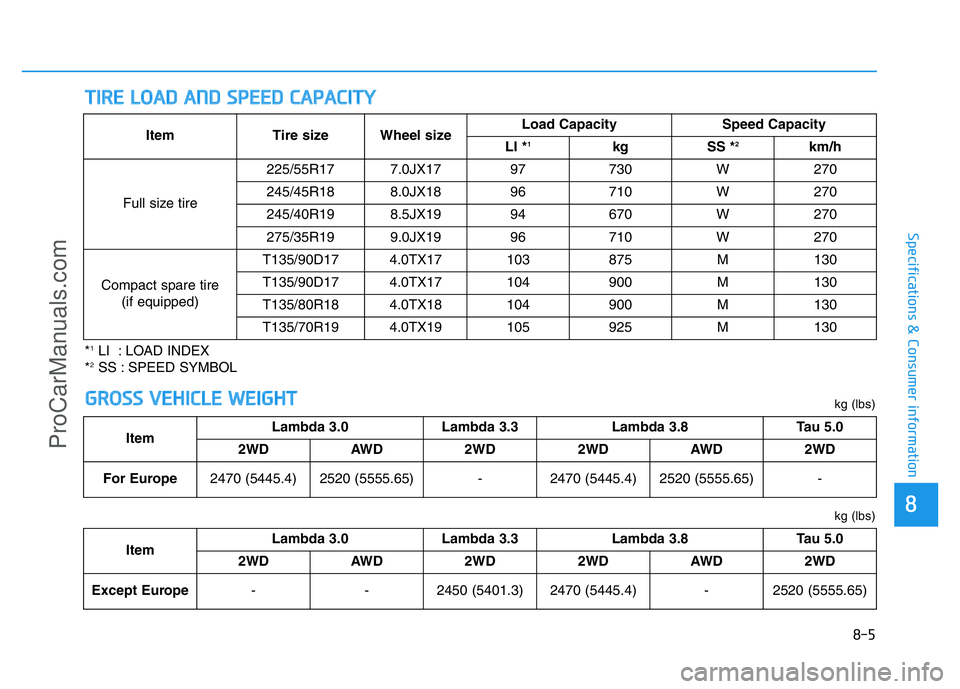
TIRE LOAD AND SPEED CAPACITY
*1LI : LOAD INDEX
*2SS : SPEED SYMBOLItem Tire size Wheel sizeLoad Capacity Speed Capacity
LI *
1kg SS *2km/h
Full size tire225/55R17 7.0JX17 97 730 W 270
245/45R18 8.0JX18 96 710 W 270
245/40R198.5JX1994670W270
275/35R199.0JX1996710W270
Compact spare tire
(if equipped)
T135/90D174.0TX17103875M130
T135/90D174.0TX17104900M130
T135/80R184.0TX18104900M130
T135/70R194.0TX19105925M130
GROSS VEHICLE WEIGHT
ItemLambda 3.0 Lambda 3.3 Lambda 3.8 Tau 5.0
2WD AWD 2WD 2WD AWD 2WD
For Europe2470 (5445.4) 2520 (5555.65) - 2470 (5445.4) 2520 (5555.65) -
kg (lbs)
ItemLambda 3.0 Lambda 3.3 Lambda 3.8 Tau 5.0
2WD AWD 2WD 2WD AWD 2WD
Except Europe- - 2450 (5401.3) 2470 (5445.4) - 2520 (5555.65)
kg (lbs)
ProCarManuals.com