2014 Hyundai Accent Motor
[x] Cancel search: MotorPage 332 of 406

Maintenance
24 7
Checking the coolant level
Check the condition and connections of
all cooling system hoses and heater
hoses. Replace any swollen or deterio-
rated hoses.
The coolant level should be filled
between F and L marks on the side of the
coolant reservoir when the engine is cool.
If the coolant level is low, add enough
distilled (deionized) or soft water to pro-
vide protection against freezing and cor-
rosion. Bring the level to F, but do not
overfill. If frequent additions are required,
see an authorized HYUNDAI dealer for a
cooling system inspection.
ORB071005N
(Continued)
Even if the engine is not operat-
ing, do not remove the radiator
cap or the drain plug while the
engine and radiator are hot. Hot
coolant and steam may still blow
out under pressure, causing seri-
ous injury.
WARNING
Removing radiator
cap
Never attempt to remove the radi-
ator cap while the engine is oper-
ating or hot. Doing so might lead
to cooling system and engine
damage and could result in seri-
ous personal injury from escap-
ing hot coolant or steam.
Turn the engine off and wait until it
cools down. Use extreme care
when removing the radiator cap.
Wrap a thick towel around it, and
turn it counterclockwise slowly to
the first stop. Step back while the
pressure is released from the cool-
ing system. When you are sure all
the pressure has been released,
press down on the cap, using a
thick towel, and continue turning
counterclockwise to remove it.
(Continued)
WARNING
The electric motor
(cooling fan) is con-
trolled by engine
coolant temperature,
refrigerant pressure
and vehicle speed. It may some-
times operate even when the
engine is not running. Use extreme
caution when working near the
blades of the cooling fan so that
you are not injured by a rotating fan
blades. As the engine coolant tem-
perature decreases, the electric
motor will automatically shut off.
This is a normal condition. If your
vehicle is equipped with GDI, the
electric motor (cooling fan) may
operate until you disconnect the
negative battery cable.
Page 354 of 406
Maintenance
46 7
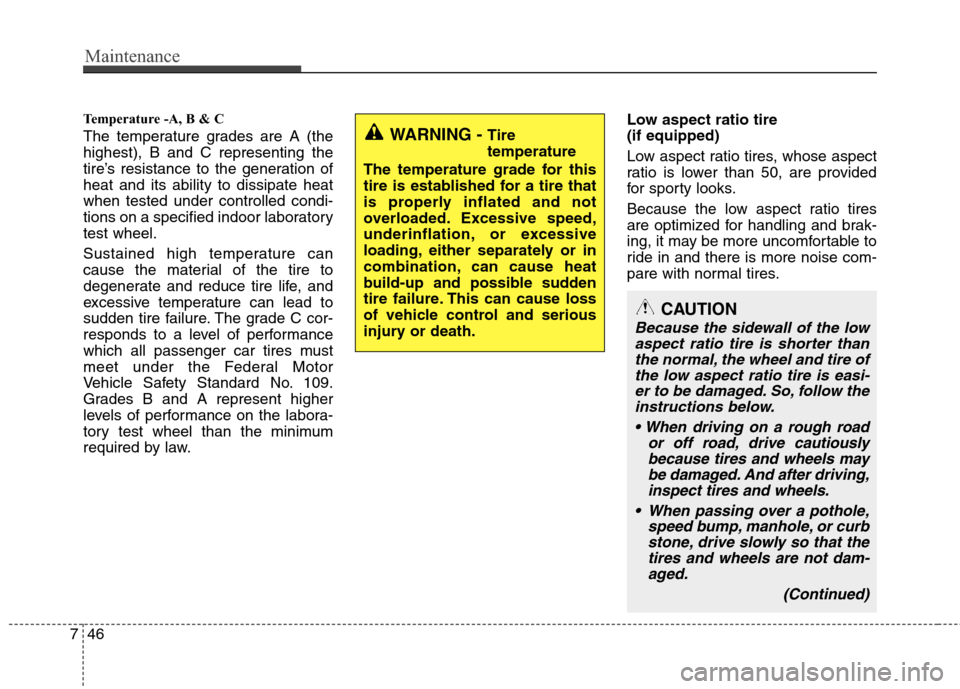
Temperature -A, B & C
The temperature grades are A (the
highest), B and C representing the
tire’s resistance to the generation of
heat and its ability to dissipate heat
when tested under controlled condi-
tions on a specified indoor laboratory
test wheel.
Sustained high temperature can
cause the material of the tire to
degenerate and reduce tire life, and
excessive temperature can lead to
sudden tire failure. The grade C cor-
responds to a level of performance
which all passenger car tires must
meet under the Federal Motor
Vehicle Safety Standard No. 109.
Grades B and A represent higher
levels of performance on the labora-
tory test wheel than the minimum
required by law.Low aspect ratio tire
(if equipped)
Low aspect ratio tires, whose aspect
ratio is lower than 50, are provided
for sporty looks.
Because the low aspect ratio tires
are optimized for handling and brak-
ing, it may be more uncomfortable to
ride in and there is more noise com-
pare with normal tires.WARNING - Tire
temperature
The temperature grade for this
tire is established for a tire that
is properly inflated and not
overloaded. Excessive speed,
underinflation, or excessive
loading, either separately or in
combination, can cause heat
build-up and possible sudden
tire failure. This can cause loss
of vehicle control and serious
injury or death.
CAUTION
Because the sidewall of the low
aspect ratio tire is shorter than
the normal, the wheel and tire of
the low aspect ratio tire is easi-
er to be damaged. So, follow the
instructions below.
or off road, drive cautiously
because tires and wheels may
be damaged. And after driving,
inspect tires and wheels.
When passing over a pothole,
speed bump, manhole, or curb
stone, drive slowly so that the
tires and wheels are not dam-
aged.
(Continued)
Page 355 of 406

747
Maintenance
Tire terminology and definitions
Air Pressure: The amount of air
inside the tire pressing outward on
the tire. Air pressure is expressed in
pounds per square inch (psi) or kilo-
pascal (kPa).
Accessory Weight: This means the
combined weight of optional acces-
sories. Some examples of optional
accessories are, automatic
transaxle, power seats, and air con-
ditioning.
Aspect Ratio: The relationship of a
tire's height to its width.
Belt:A rubber coated layer of cords
that is located between the plies and
the tread. Cords may be made from
steel or other reinforcing materials.
Bead: The tire bead contains steel
wires wrapped by steel cords that
hold the tire onto the rim.
Bias Ply Tire: A pneumatic tire in
which the plies are laid at alternate
angles less than 90 degrees to the
centerline of the tread.Cold Tire Pressure: The amount of
air pressure in a tire, measured in
pounds per square inch (psi) or kilo-
pascals (kPa) before a tire has built
up heat from driving.
Curb Weight: This means the weight
of a motor vehicle with standard and
optional equipment including the
maximum capacity of fuel, oil and
coolant, but without passengers and
cargo.
DOT Markings: A code molded into
the sidewall of a tire signifying that
the tire is in compliance with the U.S.
Department of Transportation motor
vehicle safety standards. The DOT
code includes the Tire Identification
Number (TIN), an alphanumeric des-
ignator which can also identify the
tire manufacturer, production plant,
brand and date of production.
GVWR: Gross Vehicle Weight Rating
GAWR FRT: Gross Axle Weight
Rating for the Front Axle.
GAWR RR: Gross Axle Weight
Rating for the Rear axle.(Continued)
If the tire is impacted, inspect
the tire condition or contact an
authorized HYUNDAI dealer.
To prevent damage to the tire,
inspect the tire condition and
pressure every 1,800miles
(3,000km).
CAUTION
It is not easy to recognize the
tire damage with your own
eyes. But if there is the slight-
est hint of tire damage, even
though you cannot see the tire
damage with your own eyes,
have the tire checked or
replaced because the tire
damage may cause air leak-
age from the tire.
If the tire is damaged by driv-
ing on a rough road, off road,
pothole, manhole, or curb
stone, it will not be covered by
the warranty.
You can find out the tire infor-
mation on the tire sidewall.
Page 365 of 406

757
Maintenance
Instrument panel (Driver’s side fuse panel)
Description Fuse rating Protected component
POWER OUTLET 15A Cigarette Lighter & Power Outlet (Power Outlet)
C/LIGHTER 15A Cigarette Lighter & Power Outlet (Cigarette Lighter)
ACC 10A Audio, Power Outside Mirror Switch
A/BAG IND 10A Instrument Cluster (Air Bag IND.)
A/BAG 10A SRS Control Module, Telltale, Passenger Occupant Detection Sensor
T/SIG 10A Hazard Switch
MDPS 10A EPS Control Module
WIPER RR 15A Multifunction Switch (Wiper), Rear Wiper Motor
6SPARE 15A Not Used1SPARE 10A Not Used
FOG LAMP FRT 10A Front Fog Lamp Relay
DRL 10A DRL (Daytime Running Light) Relay
STOP LAMP 15AStop Lamp Switch, Battery Sensor, Stop Lamp Relay, E/R Fuse & Relay Box (HAC Relay),
Data Link Connector
CLUSTER 10A Instrument Cluster (MICOM, IND.), BCM
IG1 10AStop Lamp Switch, ECO Switch, Driver/Passenger Seat Heater Module,
Tire Pressure Monitoring Module, ATM Shift Lever Switch ILL. EPS Control Module, Rheostat
ABS 10AABS Control Module, ESC Control Module,
ESC Off Switch, E/R Fuse & Relay Box (Multipurpose Check Connector, HAC Relay)
B/UP LAMP 10A Back-Up Lamp Switch
ECU 10A ECM, PCM
7SPARE 10A Not Used2IG2 10A A/C Control Module, BCM, SMK Unit, Wiper Control Unit
HAZARD 15A Hazard Relay, Hazard Switch
2SPARE 25A Not Used
SUNROOF 15A Sunroof Motor
Page 366 of 406

Maintenance
58 7
Description Fuse rating Protected component3SPARE 10A Not Used
TCU 15A Vehicle Speed Sensor, Transaxle Range Switch
4SPARE 15A Not used
1IG2 10APower Window Relay, A/C Control Module, Instrument Cluster (MICOM), BCM,
Sunroof Motor, E/R Fuse & Relay Box (Blower Relay)
WIPER FRT 25A Multifunction Switch (Wiper), Front Wiper Motor
DR LOCK 20A Door Lock/Unlock Relay, Two Turn Unlock Relay, Driver Door Lock Actuator
SAFETY
POWER WINDOW25A Safety Power Window Module
S/HEATER 15A Driver/Passenger Seat Heater Module
5SPARE 10A Not Used
ROOM LP 1 10AInstrument Cluster (IND.,ILL.), Tire Pressure Monitoring Module, BCM, A/C Control Module,
Luggage Room Lamp, Trunk Room Lamp, Center Room Lamp, Overhead Console Lamp, Map Lamp
AUDIO 20A Audio
TAIL LAMP LH 10ARear Combination Lamp LH, Head Lamp LH, Front Turn Signal Lamp LH,
License Lamp LH/RH (4Door), License Lamp (5Door)
TAIL LAMP RH 10AHead Lamp RH, Rear Combination Lamp RH, Rheostat, Audio, Front Turn Signal Lamp RH,
Hazard Switch, Instrument Cluster (ILL.+), AUX & USB Jack, ESC Off Switch, A/C Switch,
ECO Switch, Multifunction Switch (Remote Control), A/C Control Module, Rear Defogger Switch,
Front Deicer Switch, ATM Shift Lever Switch ILL.
START 10A Transaxle Range Switch, Ignition Lock Switch
H/LAMP 10A Instrument Cluster, Engine Compartment Fuse & Relay Box (Head Lamp Relay)
P/WDW LH 25A Power Window Main Switch, Rear Power Window Switch LH
P/WDW RH 25A Power Window Main Switch, Rear Power Window Switch RH, Passenger Power Window Switch
HTD MIRR 10AECM, PCM, Rear Defogger Switch, Driver Power Outside Mirror,
Passenger Power Outside Mirror
A/CON 10A A/C Control Module (Auto A/C)
BLOWER 10A ECM, PCM, Blower Switch, Blower Resistor, A/C Control Module (Manual A/C)
Page 368 of 406
Maintenance
60 7
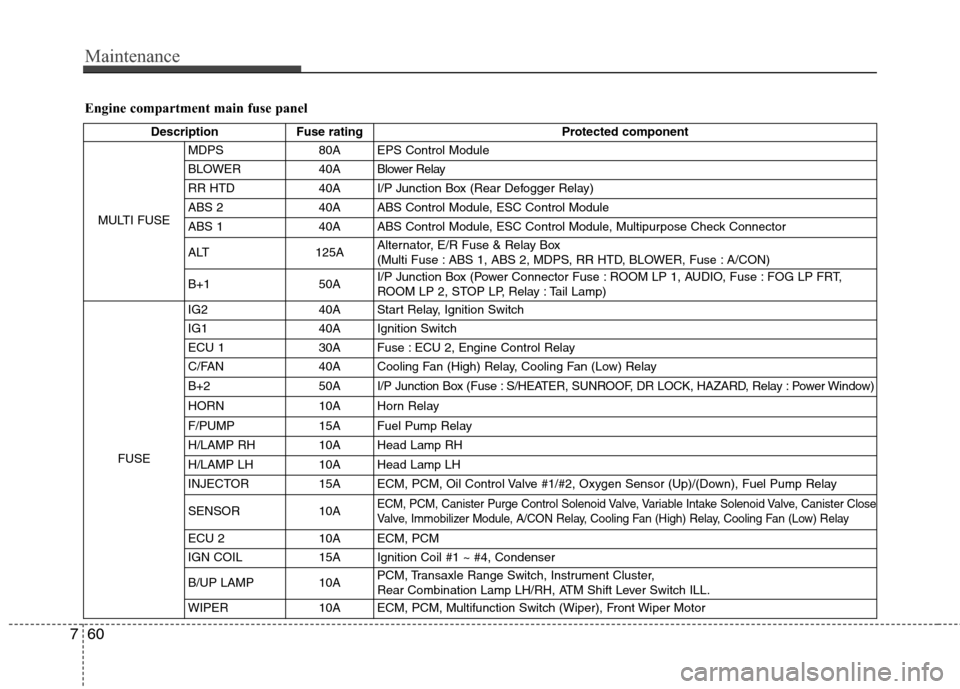
Engine compartment main fuse panel
Description Fuse rating Protected component
MULTI FUSEMDPS 80A EPS Control Module
BLOWER 40A Blower Relay
RR HTD 40A I/P Junction Box (Rear Defogger Relay)
ABS 2 40A ABS Control Module, ESC Control Module
ABS 1 40A ABS Control Module, ESC Control Module, Multipurpose Check Connector
ALT 125AAlternator, E/R Fuse & Relay Box
(Multi Fuse : ABS 1, ABS 2, MDPS, RR HTD, BLOWER, Fuse : A/CON)
B+1 50AI/P Junction Box (Power Connector Fuse : ROOM LP 1, AUDIO, Fuse : FOG LP FRT,
ROOM LP 2, STOP LP, Relay : Tail Lamp)
FUSE
IG240AStart Relay, Ignition Switch
IG140AIgnition Switch
ECU 1 30A Fuse : ECU 2, Engine Control Relay
C/FAN 40A Cooling Fan (High) Relay, Cooling Fan (Low) Relay
B+2 50A I/P Junction Box (Fuse : S/HEATER, SUNROOF, DR LOCK, HAZARD, Relay : Power Window)
HORN 10A Horn Relay
F/PUMP 15A Fuel Pump Relay
H/LAMP RH 10A Head Lamp RH
H/LAMP LH 10A Head Lamp LH
INJECTOR 15A ECM, PCM, Oil Control Valve #1/#2, Oxygen Sensor (Up)/(Down), Fuel Pump Relay
SENSOR 10A
ECM, PCM, Canister Purge Control Solenoid Valve, Variable Intake Solenoid Valve, Canister Close
Valve, Immobilizer Module, A/CON Relay, Cooling Fan (High) Relay, Cooling Fan (Low) Relay
ECU 2 10A ECM, PCM
IGN COIL 15A Ignition Coil #1 ~ #4, Condenser
B/UP LAMP 10APCM, Transaxle Range Switch, Instrument Cluster,
Rear Combination Lamp LH/RH, ATM Shift Lever Switch ILL.
WIPER 10A ECM, PCM, Multifunction Switch (Wiper), Front Wiper Motor
Page 392 of 406

Specifications, Consumer information, Reporting safety defeccts
4 8
RECOMMENDED LUBRICANTS AND CAPACITIES
To help achieve proper engine and powertrain performance and durability, use only lubricants of the proper quality. The correct
lubricants also help promote engine efficiency that results in improved fuel economy.
These lubricants and fluids are recommended for use in your vehicle.
*1Refer to the recommended SAE viscosity numbers on the next page.
*2Engine oils labeled Energy Conserving Oil are now available. Along with other additional benefits, they contribute to fuel economy by reducing
the amount of fuel necessary to overcome engine friction. Often, these improvements are difficult to measure in everyday driving, but in a year’s
time, they can offer significant cost and energy savings.
*
3If the API service SM engine oil is not available in your country, you are able to use API service SL.
LubricantVolumeClassification
Engine oil *1 *2 (drain and refill)
Recommends
3.8 US qt. (3.6 l)API Service SM*3,
ILSAC GF-4 or above
Manual transaxle fluid1.9 ~ 2.01 US qt.
(1.8~1.9 l)
HA SYN MTF (SK),
HD SYN MTF (H.K.SHELL),
GS PAO MTF (GS CALTEX),
API GL-4, SAE 75W/85 (HYUNDAI Genuine transaxle fluid)
Automatic transaxle fluid7.71 US qt. (7.3 l)
MICHANG ATF SP-4, SK ATF SP-4
NOCA ATF SP-4, HYUNDAI genuine ATF SP-4 or other
brands meeting the above specification approved by
Hyundai Motor Co.,
Coolant 4.7 US qt. (5.3 l)Mixture of antifreeze and water (Ethylene glycol base
coolant for aluminum radiator)
Brake/clutch fluid0.7~0.8 US qt. (0.7~0.8 l)FMVSS116 DOT-3 or DOT-4
Fuel11.4 US gal. (43 l)Unleaded gasoline
Page 396 of 406

Specifications, Consumer information, Reporting safety defeccts
8 8
This consumer information has been pre-
pared in accordance with regulations
issued by the National Highway Traffic
Safety Administration of the U.S.
Department of Transportation. Your
Hyundai dealer will help answer any
questions you may have as you read this
information.
Hyundai motor vehicles are designed
and manufactured to meet or exceed all
applicable safety standards.
For your safety, however, we strongly
urge you to read and follow all directions
in this Owner's Manual, particularly the
information under the headings
"NOTICE", "CAUTION" and "WARN-
ING".
If, after reading this manual, you have
any questions regarding the operation of
your vehicle, please contact your nearest
Hyundai Motor America Regional Office
as listed in the following:Eastern Region:Connecticut, Delaware,
Maine, Massachusetts, New Hampshire,
New Jersey, New York, Pennsylvania,
Rhode Island, Vermont.
Eastern Region
1122 Cranbury South River Road
Jamesburg, NJ 08831
(800) 633-5151
Southern Region:Florida, Georgia,
Maryland, North Carolina, South
Carolina, Virginia, West Virginia.
Southern Region
3025 Chastain Meadows Parkway
suite 100 Marietta, GA 30066
(800) 633-5151
South Central Region:Alabama,
Arkansas, Louisiana, Mississippi, New
Mexico, Oklahoma, Tennessee, Texas.
South Central Region
1421 South Beltline Road, Suite 400
Coppell, TX 75019
(800) 633-5151Central Region:Illinois, Indiana, lowa,
Kentucky, Michigan, Minnesota,
Nebraska, North Dakota, South Dakota,
Ohio, Wisconsin, Kansas, Missouri.
Central Region
1705 Sequoia Drive
Aurora, Illinois 60506
(800) 633-5151
Western Region:Alaska, Arizona,
California Colorado, Hawaii, ldaho,
Montana, Nevada, Oregon, Utah,
Washington, Wyoming.
Western Region
10550 Talbert Avenue
P.O.Box 20850
Fountain Valley, California 92728-0850
(800) 633-5151
CONSUMER INFORMATION