Page 176 of 422
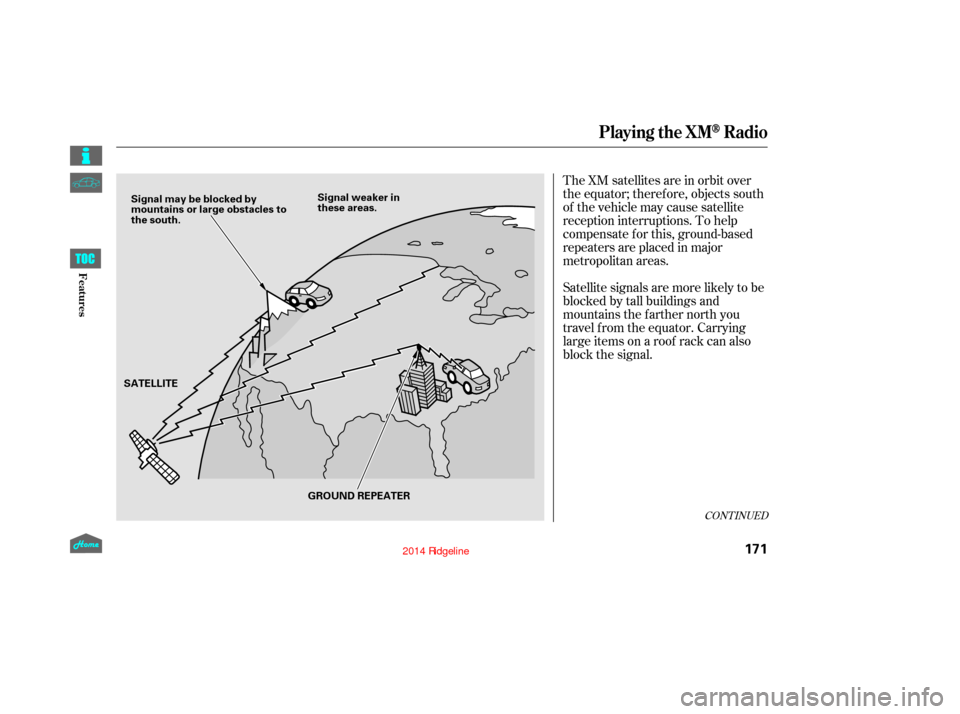
The XM satellites are in orbit over
the equator; therefore, objects south
of the vehicle may cause satellite
reception interruptions. To help
compensate f or this, ground-based
repeaters are placed in major
metropolitan areas.
Satellite signals are more likely to be
blocked by tall buildings and
mountains the f arther north you
travel f rom the equator. Carrying
large items on a roof rack can also
block the signal.
CONT INUED
Playing the XMRadio
171
Signal may be blocked by
mountains or large obstacles to
the south.Signal weaker in
these areas.
SATELLITE GROUND REPEATER
12/08/09 16:21:59 31SJC670_178
Features
Page 177 of 422

Depending on where you drive, you
may experience reception problems.
Interf erence can be caused by any of
these conditions:Driving on the north side of a
large commercial truck on an
east/west road.
Driving in tunnels.
Driving on a road beside a vertical
wall, steep clif f , or hill to the south
of you.
Driving on the lower level of a
multi-tiered road.
Driving on a single lane road
alongside dense trees taller than
50 ft. (15 m) to the south of you. Driving on the north side of an
east/west mountain road.
Large items carried on a roof rack. If your XM Radio service has expired
or you purchased your vehicle f rom
a previous owner, you can listen to a
sampling of the broadcasts available
on XM Radio. With the ignition
switch in the ACCESSORY (I) or ON
(II) position, push the PWR button to
turn on the audio system and press
the XM button. A variety of music
types and styles will play.
There may be other geographic
situations that could af f ect XM Radio
reception.
This device complies with the
appropriate requirements or the
required standards. See page f or
more inf ormation.
400
Playing the XMRadio
Receiving XM Radio Service
172
12/08/09 16:22:07 31SJC670_179
Features
Page 258 of 422

�µ
�µ �µ
�µ
�µ
�µ�µ
The f ollowing f actors can lower your
vehicle’s f uel economy:
Aggressive driving (hard
acceleration and braking)
Excessive idling, accelerating and
braking in stop-and-go traf f ic
Cold engine operation (engines
are more efficient when
warmed up)
Driving with a heavy load or the
air conditioner running
Improperly inf lated tires
A properly maintained vehicle
maximizes f uel economy. Poor
maintenance can signif icantly reduce
f uel economy. Always maintain your
vehicle according to the maintenance
messages displayed on the
inf ormation display (see on page ).For example:
Rapid
acceleration, abrupt cornering,
and hard braking increase
If your vehicle has a
manual transmission, you can
boost your f uel economy by up
shif ting as early as possible. Aerodynamic drag has a big ef f ect
on f uel economy at speeds above
45 mph (75 km/h). Reduce your
speed and you reduce the drag.
Trailers, car top carriers, roof
racks and bike racks are also big
contributors to increased drag.
Idling
results in 0 miles per gallon (0 kms
per liter).
An underinf lated tire increases
‘‘rolling resistance,’’ which reduces
f uel economy.
It puts a heavier
load on the engine, increasing
In
particular, a build-up of snow or
mud on your vehicle’s underside
adds weight and rolling resistance.
Frequent cleaning helps your
fuel economy.
321
CONT INUED
Fuel Economy Factors
Improving Fuel Economy
Owner’s
Maintenance Checks Use the recommended viscosity
motor oil, displaying the A PI
Certif ication Seal (see
). Drive moderately
Always drive in the highest gear
possible Observe the speed limit
Avoid excessive idling
Maintain proper tire inf lation
A void carrying excess weight in
your vehicle
K eep your vehicle clean
Vehicle Maint enance Drive Ef f icient ly
Fuel Economy
253
12/08/09 16:32:48 31SJC670_260
Bef ore Driving
fuel consumption.
fuel consumption.
page 324
Page 262 of 422
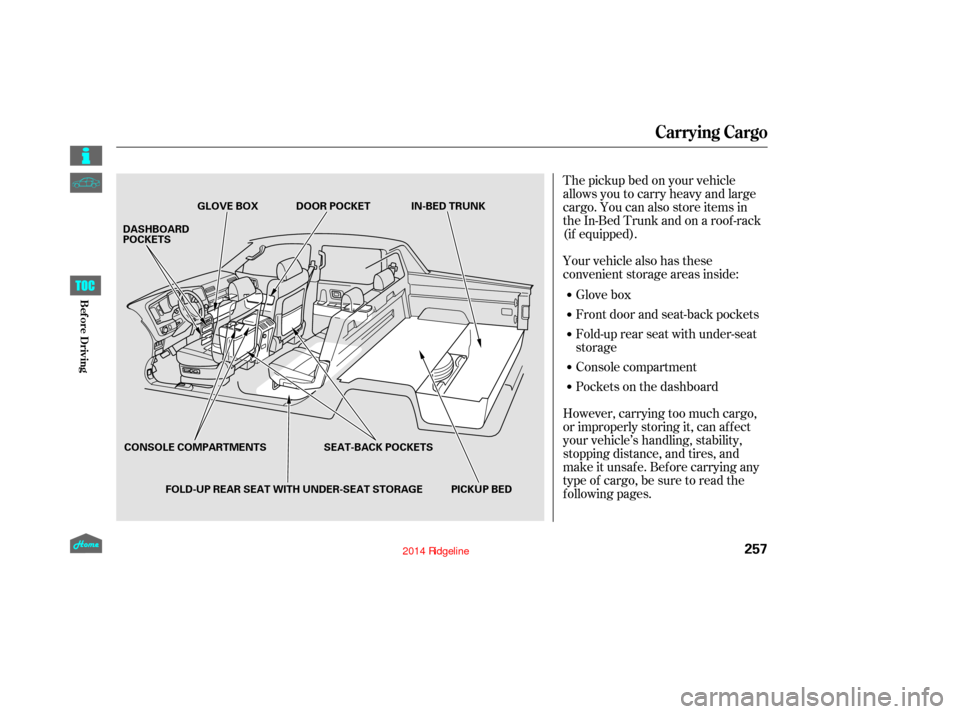
The pickup bed on your vehicle
allows you to carry heavy and large
cargo. You can also store items in
theIn-BedTrunkandonaroof-rack
(if equipped).
Your vehicle also has these
convenient storage areas inside:Glove box
Front door and seat-back pockets
Fold-up rear seat with under-seat
storage
Console compartment
Pockets on the dashboard
However, carrying too much cargo,
or improperly storing it, can af f ect
your vehicle’s handling, stability,
stopping distance, and tires, and
make it unsaf e. Bef ore carrying any
type of cargo, be sure to read the
f ollowing pages.
Carrying Cargo
257
DASHBOARD
POCKETS
PICKUP BED
SEAT-BACK POCKETS IN-BED TRUNK
GLOVE BOX DOOR POCKET
CONSOLE COMPARTMENTS FOLD-UP REAR SEAT WITH UNDER-SEAT STORAGE
12/08/09 16:33:21 31SJC670_264
Bef ore Driving
Page 263 of 422
The maximum load for your
vehicle is:Steps for Determining Correct
Load Limit:
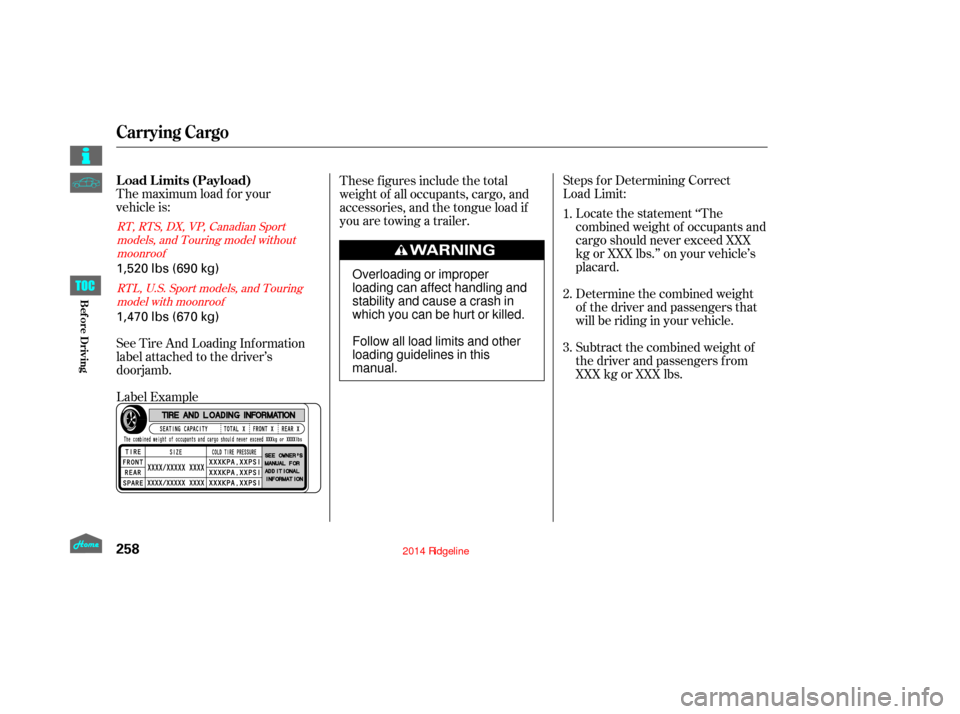
Locate the statement ‘‘The
combined weight of occupants and
cargo should never exceed XXX
kg or XXX lbs.’’ on your vehicle’s
placard.
Determine the combined weight
of the driver and passengers that
will be riding in your vehicle.
Subtract the combined weight of
the driver and passengers f rom
XXX kg or XXX lbs.
These f igures include the total
weight of all occupants, cargo, and
accessories, and the tongue load if
you are towing a trailer.
Label Example See Tire And Loading Inf ormation
label attached to the driver’s
doorjamb. 1.
2.
3.
RT,RTS,DX,VP,CanadianSport
models, and Touring model withoutmoonroof
RTL, U.S. Sport models, and Touringmodel with moonroof
L oad L imits (Payload)
Carrying Cargo
258
1,470 lbs (670 kg) 1,520 lbs (690 kg) Overloading or improper
loading can affect handling and
stability and cause a crash in
which you can be hurt or killed.
Follow all load limits and other
loading guidelines in this
manual.
12/08/09 16:33:31 31SJC670_265
Bef ore Driving
Page 265 of 422

Store or secure all items that could
be thrown around and hurt
someone during a crash.Distribute cargo evenly on the
f loor in the In-Bed Trunk, placing
the heaviest items on the bottom
and as far forward as possible. Tie
down items that could be thrown
during a crash or sudden stop.
Make sure the In-Bed Trunk lid is
closed securely bef ore driving.
Be sure the total weight of the
items in the In-Bed Trunk does not
exceed 300 lbs (136 kg).
Be sure items placed on the f loor
behind the f ront seats cannot roll
underneath and interf ere with the
proper operation of the seats, the
sensors under the seats, or the
driver’s ability to operate the
pedals.
Keep the glove box closed while
driving. If it is open, a passenger
could injure their knees during a
crash or sudden stop. If youfoldtherearseatsup,tie
down items that could be thrown
about the vehicle during a crash or
sudden stop. Also, keep all cargo
below the bottom of the windows.
If it is higher, it could interf ere
with the proper operation of the
side curtain airbags.
Distribute cargo evenly on the
floor of the cargo area with the
rear seats f olded up, placing the
heaviest items on the bottom and
as far forward as possible. Tie
down items that could be thrown
about the vehicle during a crash or
sudden stop.
If you carry any items on a roof
rack,besurethetotalweightof
the rack and the items does not
exceed 110 lbs (50 kg).
Carrying Items in the Passenger
Compartment
Carrying Cargo in the In-Bed
T runk or on a Roof Rack
Carrying Cargo
260
12/08/09 16:33:51 31SJC670_267
Bef ore Driving
Page 271 of 422

Your vehicle has higher ground
clearance that allows you to travel
over bumps, obstacles, and rough
terrain. It also provides good
visibility so you can anticipate
problems earlier.With heavy cargo on the pickup
bed, your vehicle has a higher
center of gravity. Drive slowly
and cautiously, and allow more
time and distance for braking.
Loading heavy cargo could
affect your vehicle’s handling
and performance.
To prevent rollovers or loss
of control:
Take corners at slower speeds
than you would with a
passenger vehicle.
Avoid sharp turns and abrupt
maneuvers whenever possible.
Make sure the cargo is properly
loaded and all items are secured so
they will not shif t while driving.
Do not modify your vehicle
in any way that would raise the
center of gravity.
Do not carry heavy cargo on
the roof.
Your vehicle allows you to carry
more cargo than a typical
passenger vehicle.
Because your vehicle rides higher
off the ground, it has a high center
of gravity that can cause it to roll
over if you make abrupt turns.
Utility vehicles have a significantly
higher roll over rate than other
types of vehicles.
See page f or of f -highway driving
guidelines. 304
Driving Guidelines
266
12/08/09 16:34:25 31SJC670_273
Driving
Page 290 of 422
Make sure the parking brake is
f ully released bef ore driving away.
Driving with the parking brake
partially set can overheat or
damage the rear brakes.
Make sure the moonroof (if
equipped) and the
windows are closed.
Turn of f the lights.
Place any packages, valuables, etc.
in the cargo area in your vehicle or
the In-Bed Trunk, or take them
with you.
Lock the doors.
Check the indicator on the driver’s
door to verify that the security
system is set.
Never park over dry leaves, tall
grass, or other f lammable
materials. The hot three way
catalytic converter could cause
these materials to catch on fire.If the vehicle is facing uphill,
turn the front wheels away
from the curb.
If the vehicle is facing downhill,
turn the front wheels toward
the curb.
On vehicles with security system
Parking
Parking T ips
285
12/08/09 16:36:43 31SJC670_292
Driving