Page 248 of 422
Bef ore you begin driving your
vehicle, you should know what
gasoline to use and how to check the
levels of important f luids. You also
need to know how to properly store
luggage or packages. The
inf ormation in this section will help
you. If you plan to add any
accessories to your vehicle, please
read the information in this section
first..............................
Break-in Period .244
.................
Fuel Recommendation . 244
.........
Service Station Procedures . 246
....................................
Ref ueling .246
Opening and Closing the .......................................
Hood .250
...................................
Oil Check .251
.............
Engine Coolant Check . 251
...............................
Fuel Economy .252
...
Accessories and Modif ications . 255
.............................
Carrying Cargo .257
Bef ore Driving
243
12/08/09 16:31:31 31SJC670_250
Page 249 of 422

Help assure your vehicle’s f uture
reliability and perf ormance by paying
extra attention to how you drive
during the f irst 600 miles (1,000 km).
During this period:Avoid full-throttle starts and rapid
acceleration.
Do not change the oil until the
scheduled maintenance time. Avoidhardbrakingforthefirst
200 miles (300 km).
Do not tow a trailer.
You should also f ollow these
recommendations with an
overhauled or exchanged engine, or
when the brakes are replaced. Your vehicle is designed to operate
on unleaded gasoline with a pump
octane number of 87 or higher. Use
of a lower octane gasoline can cause
a persistent, heavy metallic rapping
noise that can lead to engine damage.
Premium f uel is recommended when
towing in certain conditions (see
page ).
301
Break-in Period
Fuel Recommendation
Break-in Period, Fuel Recommendation
244
T o help prevent harmf ul f uel system
and engine deposits, use high quality
f uel containing detergent and additives.
In addition, in order to maintain good
perf ormance, f uel economy, and
emissions control, we strongly
recommend the use of gasoline that
does NOT contain harmf ul manganese-
based f uel additives such as MMT , if
such gasoline is available.
12/08/09 16:31:39 31SJC670_251
Bef ore Driving
Page 256 of 422
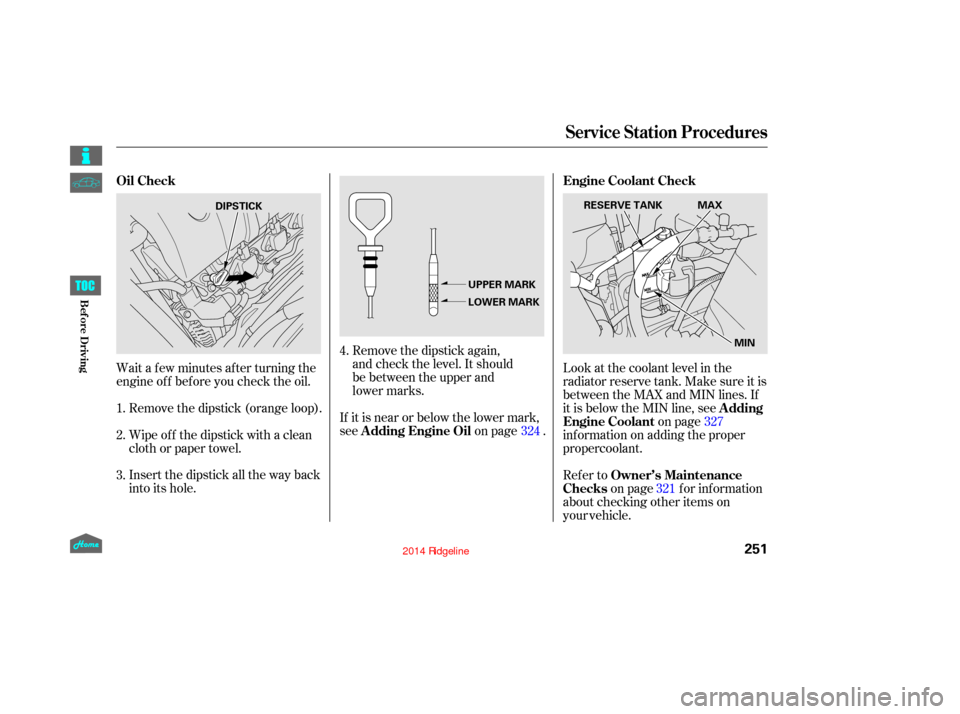
Wait a f ew minutes af ter turning the
engine of f bef ore you check the oil.Remove the dipstick (orange loop).
Wipe of f the dipstick with a clean
cloth or paper towel.
Insert the dipstick all the way back
into its hole. Remove the dipstick again,
and check the level. It should
be between the upper and
If it is near or below the lower mark,
see on page .Look at the coolant level in the
radiator reserve tank. Make sure it is
between the MAX and MIN lines. If
it is below the MIN line, see
on page
information on adding the proper
Refer to on page for information
about checking other items on
your
1.
2.
3. 4.
324 327
321
A dding Engine Oil Engine Coolant Check
Oil Check
A dding
Engine Coolant
Owner’s Maintenance
Checks
Service Station Procedures
251
UPPER MARK
LOWER MARK
DIPSTICK
MIN
MAX
RESERVE TANK
12/08/09 16:32:26 31SJC670_258
Bef ore Driving
lower marks.
vehicle.
proper coolant.
Page 258 of 422

�µ
�µ �µ
�µ
�µ
�µ�µ
The f ollowing f actors can lower your
vehicle’s f uel economy:
Aggressive driving (hard
acceleration and braking)
Excessive idling, accelerating and
braking in stop-and-go traf f ic
Cold engine operation (engines
are more efficient when
warmed up)
Driving with a heavy load or the
air conditioner running
Improperly inf lated tires
A properly maintained vehicle
maximizes f uel economy. Poor
maintenance can signif icantly reduce
f uel economy. Always maintain your
vehicle according to the maintenance
messages displayed on the
inf ormation display (see on page ).For example:
Rapid
acceleration, abrupt cornering,
and hard braking increase
If your vehicle has a
manual transmission, you can
boost your f uel economy by up
shif ting as early as possible. Aerodynamic drag has a big ef f ect
on f uel economy at speeds above
45 mph (75 km/h). Reduce your
speed and you reduce the drag.
Trailers, car top carriers, roof
racks and bike racks are also big
contributors to increased drag.
Idling
results in 0 miles per gallon (0 kms
per liter).
An underinf lated tire increases
‘‘rolling resistance,’’ which reduces
f uel economy.
It puts a heavier
load on the engine, increasing
In
particular, a build-up of snow or
mud on your vehicle’s underside
adds weight and rolling resistance.
Frequent cleaning helps your
fuel economy.
321
CONT INUED
Fuel Economy Factors
Improving Fuel Economy
Owner’s
Maintenance Checks Use the recommended viscosity
motor oil, displaying the A PI
Certif ication Seal (see
). Drive moderately
Always drive in the highest gear
possible Observe the speed limit
Avoid excessive idling
Maintain proper tire inf lation
A void carrying excess weight in
your vehicle
K eep your vehicle clean
Vehicle Maint enance Drive Ef f icient ly
Fuel Economy
253
12/08/09 16:32:48 31SJC670_260
Bef ore Driving
fuel consumption.
fuel consumption.
page 324
Page 267 of 422
You can also support motorcycles on
the pickup bed floor with the cleats.
The f loor panel of the pickup bed is
designed to hold motorcycle tires. Be
sure to tighten motorcycles securely,
with an approved tie-down or
motorcycle strap, according to the
motorcycle maker’s instructions.
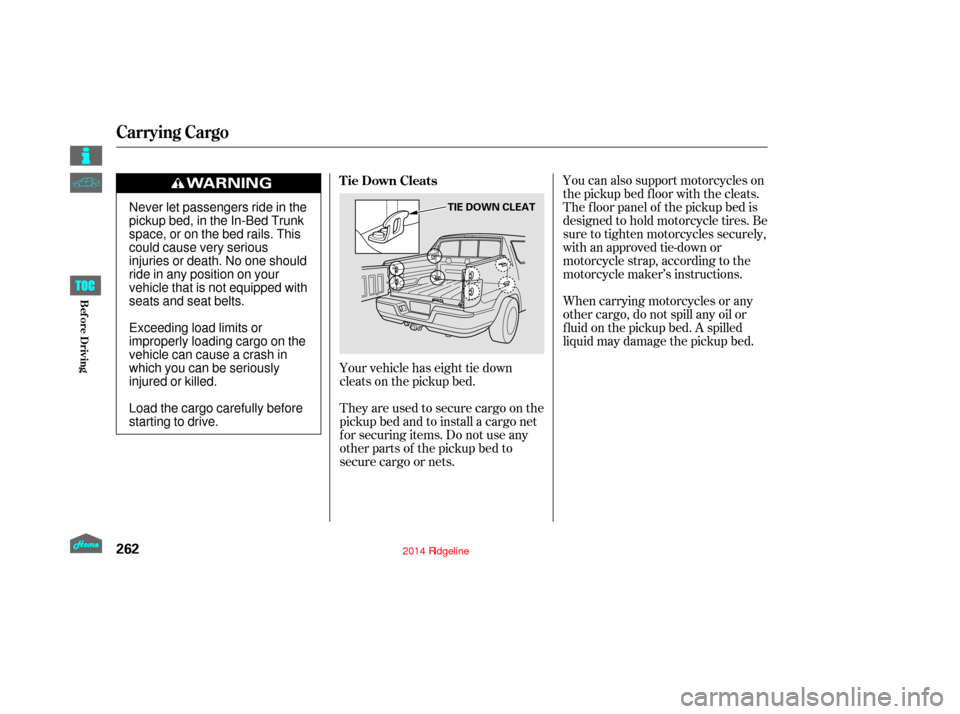
They are used to secure cargo on the
pickup bed and to install a cargo net
f or securing items. Do not use any
other parts of the pickup bed to
secure cargo or nets. When carrying motorcycles or any
other cargo, do not spill any oil or
f luid on the pickup bed. A spilled
liquid may damage the pickup bed.
Your vehicle has eight tie down
cleats on the pickup bed. Tie Down Cleats
Carrying Cargo
262
TIE DOWN CLEAT
Exceeding load limits or
improperly loading cargo on the
vehicle can cause a crash in
which you can be seriously
injured or killed.
Load the cargo carefully before
starting to drive. Never let passengers ride in the
pickup bed, in the In-Bed Trunk
space, or on the bed rails. This
could cause very serious
injuries or death. No one should
ride in any position on your
vehicle that is not equipped with
seats and seat belts.
12/08/09 16:34:06 31SJC670_269
Bef ore Driving
Page 311 of 422

Forbettertractiononallsurfaces,
accelerate slowly and gradually build
up speed. If you try to start too fast
on wet soil, mud, snow, or ice, you
might not have enough traction to
get underway, and you may dig
yourself a hole. Starting with the
shif t lever in second (2) gear will
help you have a smoother start on
snow or ice.
Keep in mind that you will usually
need more time and distance to
brake to a stop on unpaved surf aces.
Avoid hard braking. Do not ‘‘pump’’
the brakes; let the anti-lock braking
system pump them f or you.Your vehicle is not equipped with
undercarriage guards to protect key
components, so take care to avoid
rocks, tree stumps, and other
obstacles in your path.
Because your vehicle has a higher
center of gravity than a conventional
passenger vehicle, driving a wheel
over a tall object, or allowing a wheel
to drop into a deep hole, can cause
your vehicle to tip or roll over.
If you can’t clearly see all conditions
or obstacles on a slope, walk the
slope bef ore you drive on it. If you
have any doubt whether or not you
can saf ely drive on the slope, don’t
do it. Find another route.
If you are driving up a hill and f ind
that you cannot continue,
. Your vehicle could roll
over. Slowly back down the hill,
f ollowing the same route you took up
the hill.
do not try to
turn around
A ccelerating and Braking A voiding ObstaclesDriving on Slopes
Of f -Highway Driving Guidelines
306
12/08/09 16:39:37 31SJC670_313
Driving
Page 314 of 422

This section explains why it is
important to keep your vehicle well
maintained and how to f ollow basic
maintenance saf ety precautions.
This section also includes
instructions on how to read the
Maintenance Minder messages on
the inf ormation display or multi-
inf ormation display (depending on
the model), and instructions for
simple maintenance tasks you may
want to take care of yourself.U.S. Vehicles:
If you have the skills and tools to
perf orm more complex maintenance
tasks on your vehicle, you may want
to purchase the service manual. See
page f or inf ormation on how to
obtain a copy, or see your dealer. ......................
Maintenance Saf ety .310
.................
Maintenance Minder . 311
..............................
Fluid Locations .323
........................
Adding Engine Oil .324
Changing the Engine Oil and ...........................................
Filter .325
..............................
Engine Coolant .327
....................
Windshield Washers .328
....
Automatic Transmission Fluid . 329
....................................
Brake Fluid .331
....................
Power Steering Fluid . 332
....................................
Timing Belt .333
.............................................
Lights .333
................
Cleaning the Seat Belts . 341
.....................................
Floor Mats .342
..................
Dust and Pollen Filter . 342
.................................
Wiper Blades .343
...........................................
Wheels .345
...............................................
Tires .345
...................
Checking the Battery . 353
.............................
Vehicle Storage .354
..................................
Interior Care .355
405
Maintenance
Maintenance, replacement, or
repair of emissions control
devices and systems may
be done by any automotive
repair establishment or
individual using parts that are
‘‘certif ied’’ to EPA standards.
309
TM
12/08/09 16:40:00 31SJC670_316
Page 316 of 422
�µ
�µ
�µ
�µ
�µ
�µ
�µ
�µ
�µ
�µ �µ
�µ
Your vehicle displays engine oil lif e
and maintenance service items on
the inf ormation display or multi-
inf ormation display (depending on
the model) to show you when you
should have your dealer perf orm
engine oil replacement and indicated
maintenance services.
Based on the engine operating
conditions and accumulated engine
revolutions, the onboard computer
in your vehicle calculates the
remaining engine oil life and
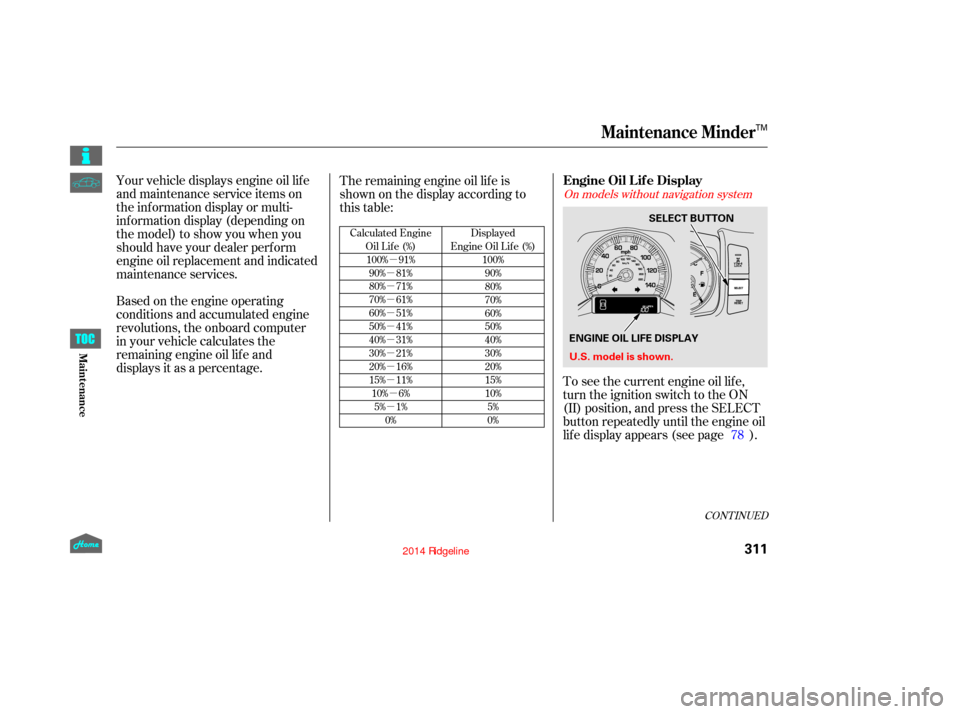
displays it as a percentage. The remaining engine oil lif e is
shownonthedisplayaccordingto
this table:
To see the current engine oil lif e,
turn the ignition switch to the ON
(II) position, and press the SELECT
button repeatedly until the engine oil
life display appears (see page ).78
CONT INUED
Calculated Engine
Oil Lif e (%)100% 91% 90% 81%
80% 71%
70% 61%
60% 51%
50% 41%
40% 31%
30% 21%
20% 16%
15% 11%10% 6% 5% 1% 0% Displayed
Engine Oil Lif e (%) 100%90%
80%
70%
60%
50%
40%
30%
20%
15%
10%5%
0%
On models without navigation system
Engine Oil L if e Display
Maintenance Minder
Maint enance
311
SELECT BUTTON
ENGINE OIL LIFE DISPLAY
U.S. model is shown.
TM
12/08/09 16:40:18 31SJC670_318