2014 FORD SUPER DUTY oil temperature
[x] Cancel search: oil temperaturePage 204 of 458

•
The tire air pressures recommended
for general driving are found on the
vehicle ’s Safety Certification Label. The
maximum cold inflation pressure for
the tire and associated load rating is
imprinted on the tire sidewall. Tire air
pressure may require re-adjustment
within these pressure limits to
accommodate the additional weight
of the snowplow installation.
• Federal and some local regulations
require additional exterior lamps for
snowplow-equipped vehicles. Consult
your authorized dealer for additional
information.
Operating the Vehicle with the
Snowplow Attached
Note: Do not use your vehicle for snow
removal until it has been driven at least 500
miles (800 kilometers).
Ford recommends vehicle speed does not
exceed 44.7 mph (72 km/h) when
snowplowing.
The attached snowplow blade restricts
airflow to the radiator, and may cause the
engine to run at a higher temperature:
Attention to engine temperature is
especially important when outside
temperatures are above freezing. Angle
the blade to maximize airflow to the
radiator and monitor engine temperature
to determine whether a left or right angle
provides the best performance.
Follow the severe duty schedule in your
Scheduled Maintenance information for
engine oil and transmission fluid change
intervals. Snowplowing with your Air Bag
Equipped Vehicle WARNINGS
Do not attempt to service, repair, or
modify the air bag supplemental
restraint system (SRS) or its fuses.
See your Ford or Lincoln Mercury dealer. Additional equipment such as
snowplow equipment may effect the
performance of the air bag sensors
increasing the risk of injury. Please refer to
the Body Builders Layout Book for
instructions about the appropriate
installation of additional equipment. All occupants of the vehicle,
including the driver, should always
properly wear their safety belts, even
when an air bag supplemental restraint
system (SRS) is provided. Your vehicle is equipped with a driver and
passenger air bag supplemental restraint
system. The supplemental restrain system
is designed to activate in certain frontal
and offset frontal collisions when the
vehicle sustains sufficient frontal
deceleration.
Careless or high speed driving while
plowing snow which results in sufficient
vehicle decelerations can deploy the air
bag. Such driving also increases the risk of
accidents
Never remove or defeat the tripping
mechanisms designed into the snow
removal equipment by its manufacturer.
Doing so may cause damage to the vehicle
and the snow removal equipment as well
as possible air bag deployment.
Engine temperature while plowing
When driving with a plow, your engine may
run at a higher temperature than normal
because the attached snowplow blade will
restrict airflow to the radiator.
201
Super Duty (TFA) Driving Hints
Page 251 of 458
•
Never wash or rinse any ignition coil,
spark plug wire or spark plug well, or
the area in and around these locations.
• Cover the battery, power distribution
box, and air filter assembly to prevent
water damage when cleaning the
engine.
CLEANING THE EXHAUST WARNINGS
Failure to maintain the functional
holes, in the tailpipe section of the
exhaust, clean and free of debris or
foreign material may result in the holes
becoming blocked or plugged. Do not
modify or remove the tail-pipe section.
Blocked or plugged holes or
removal/modification of the system could
result in elevated exhaust gas
temperatures which may result in
vehicle/property damage or personal
injury. The normal operating temperature
of the exhaust system is very high.
Never work around or attempt to
repair any part of the exhaust system until
it has cooled. Use special care when
working around the diesel oxidation
catalytic converter and/or the diesel
particulate filter (DPF). The diesel
oxidation catalytic converter and/or the
DPF heats up to a high temperature after
only a short period of engine operation and
can stay hot even after the engine is turned
off. Failure to follow these instructions may
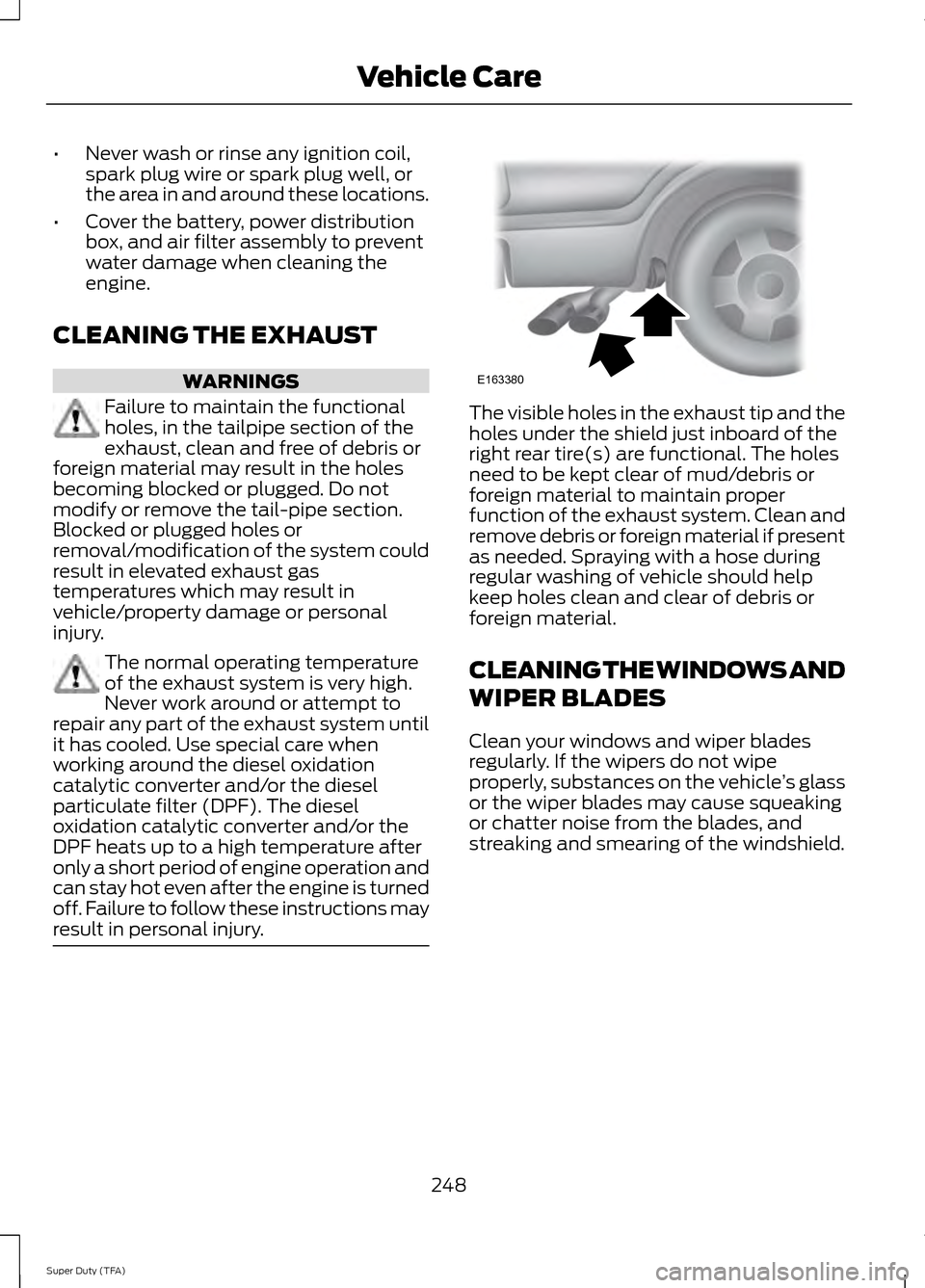
result in personal injury. The visible holes in the exhaust tip and the
holes under the shield just inboard of the
right rear tire(s) are functional. The holes
need to be kept clear of mud/debris or
foreign material to maintain proper
function of the exhaust system. Clean and
remove debris or foreign material if present
as needed. Spraying with a hose during
regular washing of vehicle should help
keep holes clean and clear of debris or
foreign material.
CLEANING THE WINDOWS AND
WIPER BLADES
Clean your windows and wiper blades
regularly. If the wipers do not wipe
properly, substances on the vehicle
’s glass
or the wiper blades may cause squeaking
or chatter noise from the blades, and
streaking and smearing of the windshield.
248
Super Duty (TFA) Vehicle CareE163380
Page 253 of 458
Clean the instrument panel and cluster
lens with a clean, damp, white cotton
cloth, then use a clean and dry white
cotton cloth to dry these areas.
•
Avoid cleaners or polishes that increase
the gloss of the upper portion of the
instrument panel. The dull finish in this
area helps protect you from
undesirable windshield reflection.
• Be certain to wash or wipe your hands
clean if you have been in contact with
certain products such as insect
repellent and suntan lotion in order to
avoid possible damage to the interior
painted surfaces.
• Do not use household or glass cleaners
as these may damage the finish of the
instrument panel, interior trim and
cluster lens.
• Do not allow air fresheners and hand
sanitizers to spill onto interior surfaces.
If a spill occurs, wipe off immediately.
Damage may not be covered by your
warranty.
If a staining liquid like coffee or juice has
been spilled on the instrument panel or on
interior trim surfaces, clean as follows:
1. Wipe up spilled liquid using a clean, white, cotton cloth.
2. Wipe the surface with a damp, clean, white cotton cloth. For more thorough
cleaning, use a mild soap and water
solution. If the spot cannot be
completely cleaned by this method,
the area may be cleaned using a
commercially available cleaning
product designed for automotive
interiors.
3. If necessary, apply more soap and water solution or cleaning product to
a clean, white, cotton cloth and press
the cloth onto the soiled area. Allow
this to set at room temperature for 30
minutes. 4.
Remove the soaked cloth and if it is not
soiled badly, use this cloth to clean the
area by using a rubbing motion for 60
seconds.
5. Following this, wipe area dry with a clean, white, cotton cloth.
CLEANING LEATHER SEATS (IF
EQUIPPED)
For routine cleaning, wipe the surface with
a soft, damp cloth. For more thorough
cleaning, wipe the surface with a mild soap
and water solution. Dry the area with a soft
cloth.
If you cannot completely clean the leather
using a mild soap and water solution, you
can try a commercially available leather
cleaning product designed for automotive
interiors.
Note: To check for compatibility, first test
any cleaner or stain remover on an
inconspicuous part of the leather.
You should:
• remove dust and loose dirt with a
vacuum cleaner
• clean spills and stains as quickly as
possible
• check for compatibility by first testing
any cleaner or stain remover on an
inconspicuous part of the leather.
Do not use the following products as these
may damage the leather:
• oil/petroleum-based leather
conditioners
• household cleaners
• alcohol solutions
• solvents or cleaners intended
specifically for rubber, vinyl and
plastics.
250
Super Duty (TFA) Vehicle Care
Page 255 of 458
•
Touch-up exposed or primed metal to
prevent rust.
• Cover chrome and stainless steel parts
with a thick coat of auto wax to prevent
discoloration. Re-wax as necessary
when your vehicle is washed.
• Lubricate all hood, door and trunk lid
hinges, and latches with a light grade
oil.
• Cover interior trim to prevent fading.
• Keep all rubber parts free from oil and
solvents.
Engine
• The engine oil and filter should be
changed prior to storage, as used
engine oil contain contaminates that
may cause engine damage.
• Start the engine every 15 days. Run at
fast idle until it reaches normal
operating temperature
• With your foot on the brake, shift
through all the gears while the engine
is running.
Fuel system
• Fill the fuel tank with high-quality fuel
until the first automatic shutoff of the
fuel pump nozzle.
Note: During extended periods of vehicle
storage (30 days or more), fuel may
deteriorate due to oxidation. Add a quality
gas stabilizer product to your vehicle's fuel
system whenever actual or expected
storage periods exceed 30 days. Follow the
instructions on the additive label. your
vehicle should then be operated at idle
speed to circulate the additive throughout
the fuel system. Cooling system
•
Protect against freezing temperatures.
• When removing your vehicle from
storage, check coolant fluid level.
Confirm there are no cooling system
leaks, and fluid is at the recommended
level.
Battery
• Check and recharge as necessary. Keep
connections clean.
• If storing your vehicle for more than 30
days without recharging the battery, it
may be advisable to disconnect the
battery cables to ensure battery charge
is maintained for quick starting.
Note: If battery cables are disconnected, it
will be necessary to reset memory features.
Brakes
• Make sure brakes and parking brake
are fully released.
Tires
• Maintain recommended air pressure.
Miscellaneous
• Make sure all linkages, cables, levers
and pins under your vehicle are covered
with grease to prevent rust.
• Move vehicles at least 25 feet (8
meters) every 15 days to lubricate
working parts and prevent corrosion.
Removing Vehicle From Storage
When your vehicle is ready to come out of
storage, do the following:
• Wash your vehicle to remove any dirt
or grease film build-up on window
surfaces.
• Check windshield wipers for any
deterioration.
252
Super Duty (TFA) Vehicle Care
Page 299 of 458

TECHNICAL SPECIFICATIONS
Ford part number /
Ford specification
Ford part name or
equivalent
Capacity
Item
XY-80W-90–QL /
Motorcraft™ SAE
80W-90 Premium
Rear Axle Lubricant
5.8 pints (2.8L)
Front axle
WSP-M2C197–A
XG-11 /
High Temperature
4X4 Front Axle and Wheel Bearing Grease
—
Spindle bearing
WSS-M1C267-A1
XY-75W140–QL /
Motorcraft SAE
75W-140 Synthetic
Rear Axle Lubricant
6.9 pints (3.3L)
Rear axle - F-250/350
(10.50 inch axle) 1
WSL-M2C192-A
XY-75W90–QLS /
Motorcraft SAE
75W-90 Synthetic
Rear Axle Lubricant
8.5 pints (4.0L)
Rear axle - F-350 (Dana
M80) WSS–M2C918–A
XY-75W140–QL /
Motorcraft SAE
75W-140 Synthetic
Rear Axle Lubricant
14.0 pints (6.6L)
Rear axle - F-450/550
(Dana S110/S130) WSL-M2C192-A
PM-20 / WSS-
M6C65-A2 and
ISO4925 Class 6
Motorcraft High
Performance DOT 4 LV Motor Vehicle Brake Fluid
Between MIN/
MAX on brakefluid reservoir
Brake fluid
VC-3DIL-B (US),
Motorcraft Orange
Antifreeze/Coolant Prediluted
21.3 quarts
(20.2L)
Engine coolant (6.2L
V8)2
CVC-3DIL-B
(Canada) /
26.7 quarts (25.3L)
Engine coolant (6.8L
V10)2 WSS-M97B44-D2
Refer to the diesel supplement.
Engine and fuel coolant
(diesel engine)
WSS-M2C945-A
Motorcraft or equi-
valent SAE 5W-20 motor oil
7.0 quarts (6.6L
Engine oil (6.2L V8 and
6.8L V10 gasoline
engines) 3, 4
Refer to the diesel supplement.
Engine oil (Diesel
engines)
296
Super Duty (TFA) Capacities and Specifications
Page 438 of 458
Off-road operation
Inspect the wheels and related components for abnormal
noise, wear, looseness or drag.
Rotate tires *
, inspect tires for wear and measure tread
depth.
Replace front wheel bearing grease and grease seals if
non-sealed bearings are used.
Every 30000 miles (48000
km)
Change rear axle fluid (F-450 and F-550 only).
Every 50000 miles (80000
km)
Change transfer case fluid (Four-wheel drive vehicles).
Every 60000 miles (96000
km)
* Vehicles with dual rear wheels should rotate the front wheels when specified; rear wheels
only if unusual wear is noted. Exclusive use of E85 (Flex fuel vehicles only)
If ran exclusively on E85, fill the fuel tank full with regular
unleaded fuel.
Every oil change interval
6.7L Diesel Engine
See the diesel supplement for special
operating condition information.
Exceptions
There are several exceptions to the Normal
Schedule:
Normal vehicle axle maintenance: Rear
axles and power take-off units with
synthetic fluid and light-duty trucks
equipped with Ford-design axles are
lubricated for life; do not check or change
fluid unless a leak is suspected, service is
required or the assembly has been
submerged in water. During long periods
of trailer towing with outside temperatures
above 70°F (21°C) and at wide-open
throttle for long periods above 45 mph (72
km/h), change non-synthetic rear axle fluid
every 3000 miles (4800 kilometers) or three months, whichever comes first. This
interval can be waived if the axle is filled
with 75W140 synthetic gear fluid meeting
Ford specification WSL-M2C192-A, part
number F1TZ-19580-B, or equivalent. Add
friction modifier XL-3 (EST-M2C118-A) or
equivalent for complete refill of
Traction-Lok rear axles. See Capacities
and Specifications (page 292).
Police, Taxi and Livery vehicle axle
maintenance: Change rear axle fluid every
100000 miles (160000 kilometers). Rear
axle fluid change may be waived if the axle
was filled with 75W140 synthetic gear fluid
meeting Ford specification
WSL-M2C192-A, part number
F1TZ-19580-B, or equivalent. Add four
ounces (118 milliliters) of additive friction
modifier XL-3 (EST-M2C118-A), or
equivalent, for complete refill of
Traction-Lok rear axles. Change the axle
fluid anytime the axle submerges in water.
435
Super Duty (TFA) Scheduled Maintenance
Page 451 of 458

Fuel Consumption........................................136
Calculating Fuel Economy............................... 137
Filling the Tank.................................................... 136
Fuel Filter
........................................................234
Fuel Quality.....................................................134
Choosing the Right Fuel................................... 134
Choosing the Right Fuel With a Flex Fuel Vehicle (If Equipped)................................... 134
Diesel Engine........................................................ 134
Octane Recommendations............................ 134
Fuel Shutoff
..................................................204
Fuses..................................................................213
Fuse Specification Chart
...........................214
Passenger Compartment Fuse Panel.........219
Power Distribution Box..................................... 214
G
Garage Door Opener See: Universal Garage Door Opener............118
Gauges................................................................74 Engine Coolant Temperature Gauge.............75
Engine Oil Pressure Gauge................................ 75
Fuel Gauge.............................................................. 75
Information Display............................................. 75
Transmission Fluid Temperature Gauge................................................................... 75
General Information on Radio Frequencies...................................................45
General Maintenance Information.......428 Multi-point Inspection..................................... 430
Owner Checks and Services.......................... 429
Protecting Your Investment........................... 428
Why Maintain Your Vehicle?......................... 428
Why Maintain Your Vehicle at Your Dealership?..................................................... 428
Getting Assistance Outside the U.S. and Canada..........................................................210
Getting the Services You Need...............207 Away From Home.............................................. 207
Global Opening
..............................................69
Opening the Windows....................................... 69
H
Handbrake See: Parking Brake............................................. 159
Hazard Warning Flashers.........................204 HDC
See: Using Hill Descent Control.................... 166
Head Restraints
.............................................107
Adjusting the Head Restraint........................ 108
Heated Seats...................................................114
Heated Steering Wheel................................61
Heated Windows and Mirrors..................105 Heated Exterior Mirror...................................... 105
Heated Rear Window........................................ 105
Heating See: Climate Control......................................... 102
Hill Start Assist..............................................159 Using Hill Start Assist....................................... 159
Hints on Controlling the Interior Climate..........................................................104
Hints on Driving With Anti-Lock Brakes............................................................158
Hood Lock See: Opening and Closing the Hood...........222
I
Ignition Switch...............................................129
In California (U.S. Only)............................208
Information Display Control......................60 Type 1........................................................................\
60
Type 2........................................................................\
61
Information Displays....................................80 General Information........................................... 80
Information....................................................387 911 Assist............................................................... 393
Alerts...................................................................... 393
Calendar................................................................ 393
SIRIUS Travel Link............................................. 390
SYNC Services (If Equipped, United States Only)................................................................. 388
Vehicle Health Report...................................... 395
448
Super Duty (TFA) Index
Page 457 of 458

W
Warning Lamps and Indicators.................75
4X2........................................................................\
..... 78
4X4 HIGH................................................................. 78
4X4 LOW................................................................. 78
Anti-Lock Braking System................................. 76
Battery...................................................................... 76
Brake System......................................................... 76
Check Fuel Cap..................................................... 76
Cruise Control........................................................ 76
Diesel Warning Lights......................................... 78
Direction Indicator................................................ 76
Door Ajar.................................................................. 76
Electronic Locking Differential........................ 76
Engine Coolant Temperature........................... 76
Engine Oil................................................................. 77
Fasten Safety Belt................................................ 77
Front Airbag............................................................. 77
High Beam............................................................... 77
Hill Descent............................................................. 77
Low Fuel Level........................................................ 77
Low Tire Pressure Warning................................ 77
Powertrain Malfunction/Reduced Power/Electronic Throttle Control............77
Service Engine Soon............................................ 77
Stability Control.................................................... 78
Stability Control Off............................................ 78
Transmission Tow/Haul..................................... 78
Washer Fluid Check....................................234
Washers See: Cleaning the Exterior.............................. 246
See: Wipers and Washers................................. 63
Waxing..............................................................247
Wheel Nuts See: Changing a Road Wheel........................ 279
Wheels and Tires.........................................254 General Information......................................... 254
Technical Specifications................................ 290
Windows and Mirrors
...................................68
Windshield Washers.....................................63
Windshield Wipers.........................................63 Speed dependent wipers.................................. 63
Wipers and Washers.....................................63
454
Super Duty (TFA) Index