2014 FORD SUPER DUTY key
[x] Cancel search: keyPage 8 of 82
The powertrain and glow plug control
modules electronically control the glow
plug system. After you switch the ignition
on the glow plug control module
immediately energizes the glow plugs. The
glow plug control module using the engine
coolant temperature, barometric pressure
sensor and environmental temperature
sensor will determine how long the glow
plugs stay energized. The required time for
the glow plugs to be energized decreases
as the coolant temperature, barometric
pressure and environmental temperature
increase.
Glow Plug
Engine and secondary cooling system
The cooling system contains a primary
cooling loop to cool the engine and
exhaust gases and a secondary cooling
loop to cool the transmission, exhaust
gases, charge air, and fuel. The coolant
serves three primary purposes: to provide
heat transfer, freeze point protection, and
corrosion protection using additives.
Vehicles with diesel engines typically are
used to carry heavy loads and accumulate
mileage rapidly. These two factors may
cause the additives in the coolant to wear
out in a shorter time. For more information
about coolant additives and coolant
change intervals See General
Maintenance Information (page 58). .
Operating the engine with insufficient
coolant or coolant additive can cause
severe engine damage
Selective catalytic reduction system
Your vehicle is equipped with a selective
catalytic reduction system designed to
reduce emission levels of nitrogen oxides
from the exhaust of your diesel engine. This
system relies on the use of diesel exhaust
fluid that you must replenish at certain intervals. Failure to maintain proper diesel
exhaust fluid levels or if the diesel exhaust
fluid becomes contaminated will result in
vehicle speed limitations or result in your
vehicle entering an idle-only mode. See
Selective Catalytic Reduction System
(page
20).
Speed control
If your vehicle speed goes outside a
predetermined range from the set speed,
the RSM (Resume) function will not reset
your vehicle speed. You will need to reset
your vehicle speed with the SET+ or SET-
button after reaching the desired speed
using the accelerator pedal.
Minor Troubleshooting Guide
If the engine won ’t crank WARNING
Battery posts, terminals and related
accessories contain lead and lead
compounds. Wash hands after
handling. Turn on the headlights. If the lights are dim,
do not go on at all or when the ignition is
turned to START the lights become dim or
go out, the battery connections may be
loose or corroded, or the battery may be
discharged. If there is a clicking or
stuttering sound coming from the engine
compartment when you turn the key to
START, this may also indicate a loose or
corroded battery connection.
Check the battery connections at the
battery posts, cable connection to the
engine grounding point and at the starter
connection.
If you suspect a discharged battery, have
it checked and corrected.
5
Super Duty (TFA) Introduction
Page 9 of 82
•
The gearshift lever must be in P (Park)
or N (Neutral) in order for the starter
to operate.
• Try operating the starter switch several
times. This operation may clean
potentially corroded contacts or make
the switch temporarily operable until
you can reach the dealer.
• If all electrical connections are tight
and you need assistance to start, refer
to Jump Starting in the Roadside
Emergencies chapter of your Owner ’s
Manual.
If engine cranks but won ’t start
Prolonged starter cranking (in excess of 10
seconds) could cause damage to the
starter motor or the high-pressure fuel
pump.
• Check the fuel gauge. You may be out
of fuel. If the gauge shows that there
is fuel in the tank, the trouble may be
in the electrical system or the fuel
system. If equipped with an auxiliary
tank, be sure that the tank control
switch is set for the tank with fuel and
not on an empty tank.
• Leaving your ignition key turned to on
for over two minutes without starting
may make starting difficult because
the glow plugs will cease activation.
Reset the system by turning the ignition
key to off and then back to on again.
Note: If the system is out of fuel and the
engine will not start, do not continue
cranking the engine. Continued cranking can
damage the high-pressure fuel pump.
If the engine runs hot
The following could cause the engine to
overheat:
• Lack of coolant
• Dirty cooling system. •
Plugged radiator fins, A/C condenser
and/or oil cooler
• Malfunctioning fan drive
• Driving with frozen coolant
• Sticking thermostat
• Overloading or pulling heavy trailers
during hot weather
• Grill or radiator air blockage
• Slipping or missing drive belt
• Plugged or very dirty air filter
If fuses burn out WARNING
Replacement fuses and circuit
breakers must always be the same
rating as the original equipment
shown. Never replace a fuse or circuit
breaker with one of a higher rating. Higher
rated fuses or circuit breakers could allow
circuit overloading in the event of a circuit
malfunction, resulting in severe vehicle
damage or personal injury due to fire. Burned-out or blown fuses usually indicate
an electrical short-circuit, although a fuse
may occasionally burn out from vibration.
Insert a second fuse. If this fuse
immediately burns out and you cannot
locate the cause, return your vehicle to
your dealer for a circuit check.
Refer to the Owner
’s Manual for
replacement of fuses.
Selective catalytic reduction system
speed limit and Idle-only modes
If the vehicle ’s speed is limited or in an
idle-only mode, the selective catalytic
reduction system may be limiting the
vehicle ’s functions due to low or
contaminated diesel exhaust fluid. Check
the diesel exhaust fluid. See
Selective
Catalytic Reduction System (page 20).
6
Super Duty (TFA) Introduction
Page 10 of 82
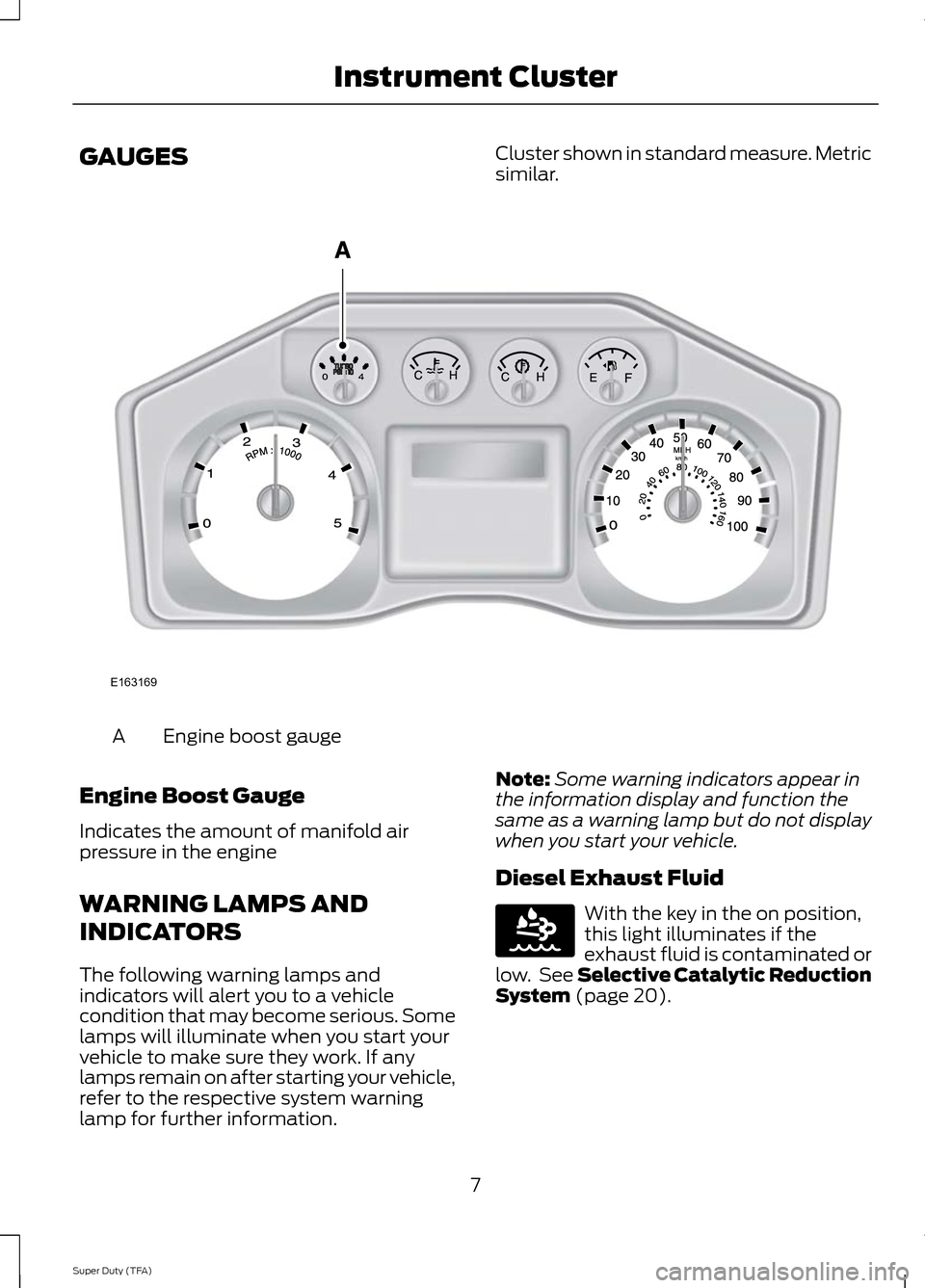
GAUGES
Cluster shown in standard measure. Metric
similar.Engine boost gauge
A
Engine Boost Gauge
Indicates the amount of manifold air
pressure in the engine
WARNING LAMPS AND
INDICATORS
The following warning lamps and
indicators will alert you to a vehicle
condition that may become serious. Some
lamps will illuminate when you start your
vehicle to make sure they work. If any
lamps remain on after starting your vehicle,
refer to the respective system warning
lamp for further information. Note:
Some warning indicators appear in
the information display and function the
same as a warning lamp but do not display
when you start your vehicle.
Diesel Exhaust Fluid With the key in the on position,
this light illuminates if the
exhaust fluid is contaminated or
low. See Selective Catalytic Reduction
System (page 20).
7
Super Duty (TFA) Instrument ClusterE163169 E163176
Page 11 of 82
Glow Plug Pre-Heat
With the key in the on position,
this light illuminates if glow plug
heat is necessary as a starting
aid. Wait until the light goes off before
starting. See Starting a Diesel Engine
(page 9).
After the engine starts, the light should turn
off. The light should always momentarily
illuminate when the engine is cold and you
turn the ignition to on.
Water In Fuel During refueling, it is possible for
water-contaminated diesel fuel
to be pumped into your tank.
Your vehicle ’s fuel system is equipped with
a fuel filter/water separator to remove
water from the fuel. The Water In Fuel
(WIF) light will illuminate when the Fuel
and Water Separator has a significant
quantity of water in it and requires
immediate draining.
If the water in fuel light illuminates when
the engine is running, stop your vehicle as
soon as safely possible, shut off the engine,
then drain the fuel and water separator.
See
Fuel Quality (page 14). Allowing
water to stay in the fuel system, after the
water in fuel light has illuminated, could
result in extensive damage or failure of the
fuel injection system. WARNING
Do not drain the fuel and water
separator while the engine is running.
Fuel may ignite if the separator is
drained while the engine is running or the
vehicle is moving. Note:
If you drain the fuel and water
separator while the system is running air will
enter into the fuel system. The engine will
not operate properly if air enters the system.
8
Super Duty (TFA) Instrument Cluster
Page 12 of 82
STARTING A DIESEL ENGINE
Read all starting instructions carefully
before you start your vehicle.
For temperatures below 32°F (0°C), the
use of the correct grade engine oil is
essential for proper operation. Refer to
Engine oil specifications for more
information. See Technical
Specifications (page 56).
Your vehicle may be equipped with a cold
weather starting strategy that prevents
severe engine damage by assisting in
engine lubrication warm-up. In extremely
cold ambient temperatures, this strategy
activates and prevents the accelerator
pedal from being used for 30 seconds after
starting your vehicle. A message will
appear in the information display as your
vehicle warms up. By not allowing the
accelerator pedal to be used, the engine
oil is allowed to properly lubricate the
bearings preventing engine damage due
to lack of proper lubrication. After the 30
second warm-up period, the accelerator
pedal will be operational again and a
message will appear informing you the
vehicle is ok to drive.
When starting the engine in extremely cold
temperatures (-15°F [– 26°C]), it is
recommended to allow the engine to idle
for several minutes before driving the
vehicle.
Make sure the gearshift lever is in P (Park)
and the parking brake is fully set before
you turn the key. Do not press the
accelerator during starting.
Cold Weather Starting WARNINGS
Do not use starting fluid, such as
ether, in the air intake system (see
air filter decal). Such fluid could
cause immediate explosive damage to the
engine and possible personal injury WARNINGS
Do not add gasoline, gasohol, alcohol
or Kerosene to diesel fuel. This
practice creates a serious fire hazard
and causes engine performance problems. It is recommended that the engine block
heater be used for starting when the
temperature is -10°F (-23°C) or colder.
Refer to Engine block heater later in this
chapter for more information.
When operating in cold weather,
Motorcraft® cetane improvers or
non-alcohol-based cetane improvers from
a reputable manufacturer may be used as
needed.
Do not crank the engine for more than 10
seconds as starter damage may occur. If
the engine fails to start, turn the key to
position 3 (off) and wait 30 seconds
before trying again.
1. Turn the key to on without turning the
key to start. Do not start the engine
until the glow-plug indicator turns off.
2. When the glow plug pre-heat indicator
turns off, turn the key to start and
release the key as soon as the engine
starts. After starting the engine, the
glow plugs may remain on for a period.
If you do not start the engine before
the glow plug activation time ends, you
will need to reset the glow plugs by
turning the key to off.
3. After the engine starts, allow it to idle for about 15 seconds. This is to protect
the engine. Do not increase engine
speed until the oil pressure gauge
indicates normal pressure.
9
Super Duty (TFA) Starting and Stopping the Engine
Page 16 of 82
•
One minute after the engine has shut
down, the electrical system simulates
key off, even though the ignition is still
in the on position, initiating normal
accessory delay period
• You must move the ignition to the off
position to reset the system before
restarting your vehicle.
The engine idle shutdown idle timer does
not start if:
• The engine is operating in power
take-off mode.
• The engine coolant temperature is
below 60°F (16°C).
• The exhaust emission control device is
regenerating.
ENGINE BLOCK HEATER (IF
EQUIPPED)
Refer to the Starting and Stopping the
Engine chapter in your Owner ’s Manual.
Rapid Heat Supplemental Heating
System
Note: Additional aftermarket electrical
loads operated during engine warm up may
affect the performance of the rapid heat
supplemental heater.
The optional rapid heat feature is an
electrically powered device that provides
supplemental heat during engine warm up.
During initial warm up, you should use a
mid to low blower speed for maximum
effectiveness. When operating in
automatic mode (when equipped) the
climate control unit determines the
appropriate blower speed for existing
conditions.
13
Super Duty (TFA) Starting and Stopping the Engine
Page 22 of 82
Note:
The engine will not run properly if you
do not install the diesel fuel conditioner
module fuel filter in the housing or if the
filter bowl is not tightened to the
mechanical stop.
Note: You will need to purge the system of
air after removal or changing of the filter.
See purging air from the fuel system later
in this chapter.
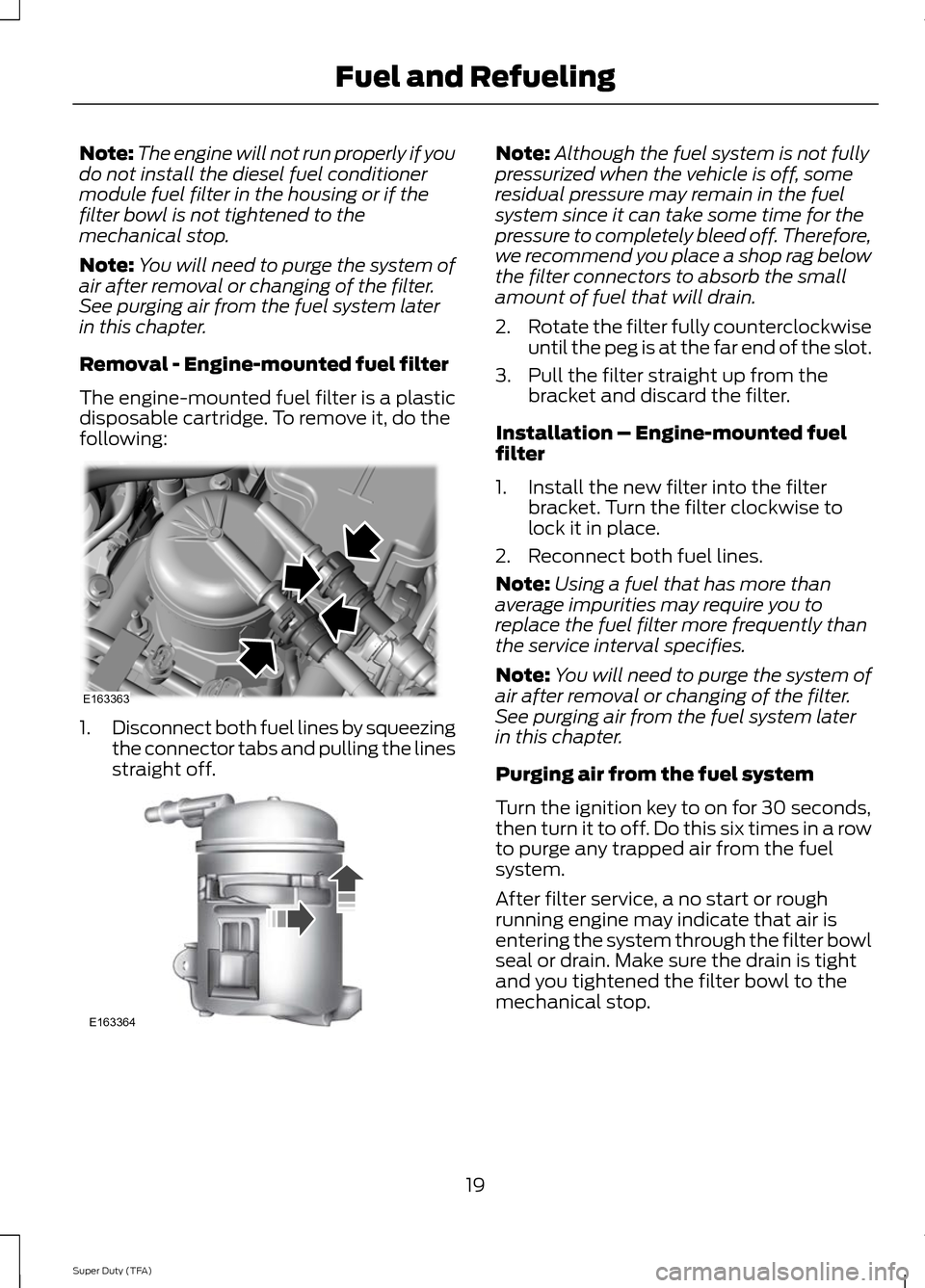
Removal - Engine-mounted fuel filter
The engine-mounted fuel filter is a plastic
disposable cartridge. To remove it, do the
following: 1.
Disconnect both fuel lines by squeezing
the connector tabs and pulling the lines
straight off. Note:
Although the fuel system is not fully
pressurized when the vehicle is off, some
residual pressure may remain in the fuel
system since it can take some time for the
pressure to completely bleed off. Therefore,
we recommend you place a shop rag below
the filter connectors to absorb the small
amount of fuel that will drain.
2. Rotate the filter fully counterclockwise
until the peg is at the far end of the slot.
3. Pull the filter straight up from the bracket and discard the filter.
Installation – Engine-mounted fuel
filter
1. Install the new filter into the filter bracket. Turn the filter clockwise to
lock it in place.
2. Reconnect both fuel lines.
Note: Using a fuel that has more than
average impurities may require you to
replace the fuel filter more frequently than
the service interval specifies.
Note: You will need to purge the system of
air after removal or changing of the filter.
See purging air from the fuel system later
in this chapter.
Purging air from the fuel system
Turn the ignition key to on for 30 seconds,
then turn it to off. Do this six times in a row
to purge any trapped air from the fuel
system.
After filter service, a no start or rough
running engine may indicate that air is
entering the system through the filter bowl
seal or drain. Make sure the drain is tight
and you tightened the filter bowl to the
mechanical stop.
19
Super Duty (TFA) Fuel and RefuelingE163363 E163364
Page 31 of 82
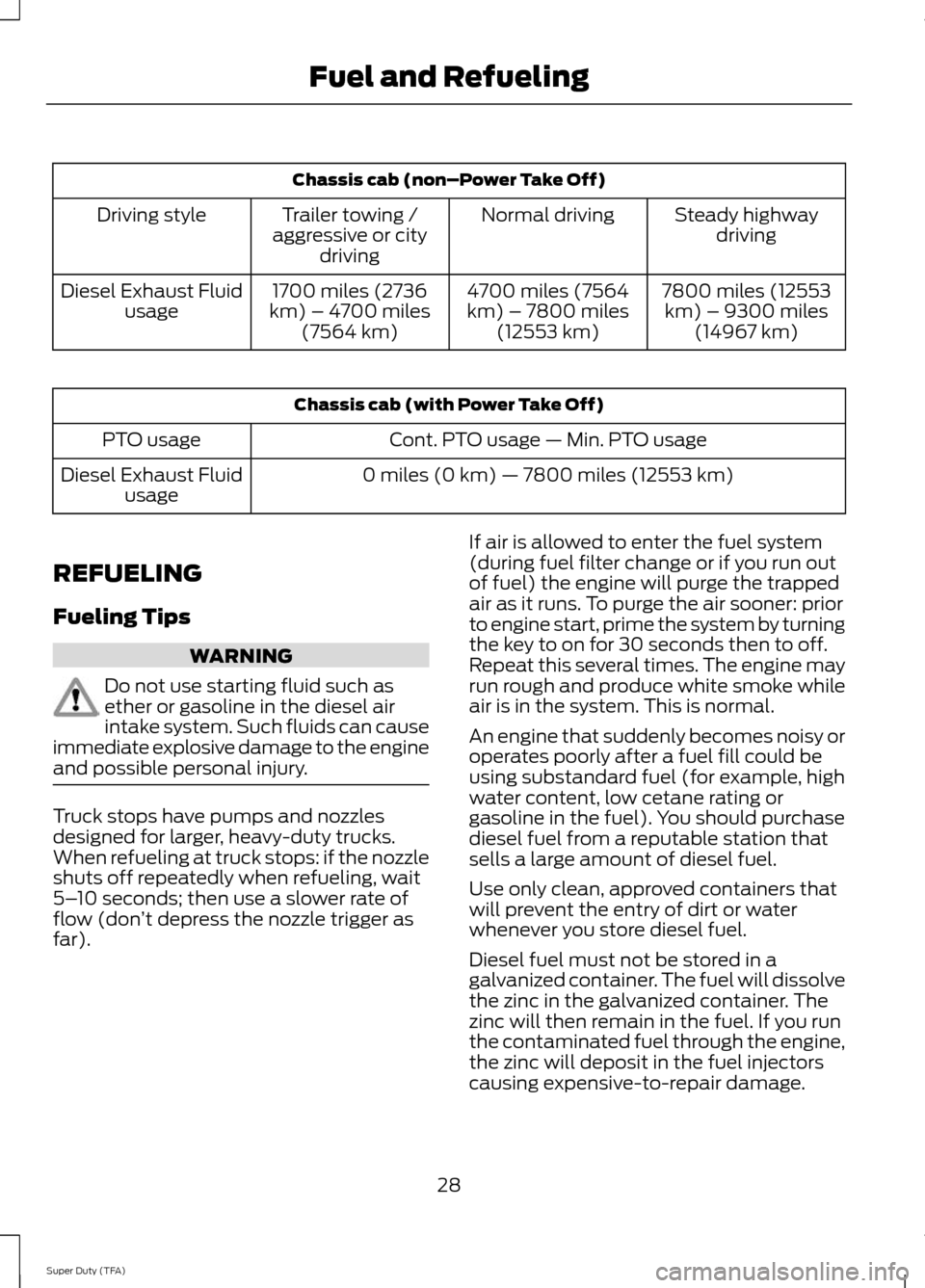
Chassis cab (non–Power Take Off)
Steady highwaydriving
Normal driving
Trailer towing /
aggressive or city driving
Driving style
7800 miles (12553km) – 9300 miles (14967 km)
4700 miles (7564
km) – 7800 miles (12553 km)
1700 miles (2736
km) – 4700 miles (7564 km)
Diesel Exhaust Fluid
usage Chassis cab (with Power Take Off)
Cont. PTO usage — Min. PTO usage
PTO usage
0 miles (0 km) — 7800 miles (12553 km)
Diesel Exhaust Fluid
usage
REFUELING
Fueling Tips WARNING
Do not use starting fluid such as
ether or gasoline in the diesel air
intake system. Such fluids can cause
immediate explosive damage to the engine
and possible personal injury. Truck stops have pumps and nozzles
designed for larger, heavy-duty trucks.
When refueling at truck stops: if the nozzle
shuts off repeatedly when refueling, wait
5–
10 seconds; then use a slower rate of
flow (don ’t depress the nozzle trigger as
far). If air is allowed to enter the fuel system
(during fuel filter change or if you run out
of fuel) the engine will purge the trapped
air as it runs. To purge the air sooner: prior
to engine start, prime the system by turning
the key to on for 30 seconds then to off.
Repeat this several times. The engine may
run rough and produce white smoke while
air is in the system. This is normal.
An engine that suddenly becomes noisy or
operates poorly after a fuel fill could be
using substandard fuel (for example, high
water content, low cetane rating or
gasoline in the fuel). You should purchase
diesel fuel from a reputable station that
sells a large amount of diesel fuel.
Use only clean, approved containers that
will prevent the entry of dirt or water
whenever you store diesel fuel.
Diesel fuel must not be stored in a
galvanized container. The fuel will dissolve
the zinc in the galvanized container. The
zinc will then remain in the fuel. If you run
the contaminated fuel through the engine,
the zinc will deposit in the fuel injectors
causing expensive-to-repair damage.
28
Super Duty (TFA) Fuel and Refueling