2014 FORD MONDEO fuel
[x] Cancel search: fuelPage 153 of 446
Downloaded from www.Manualslib.com manuals search engine If your vehicle runs out of fuel:
•Add a minimum of 1.1 gal (5 L) of fuelto restart the engine. If your vehicle isout of fuel and on a steep slope, morefuel may be required.
•You may need to switch the ignitionfrom off to on several times afterrefueling to allow the fuel system topump the fuel from the tank to theengine. When restarting, cranking timetakes a few seconds longer thannormal.
Filling a Portable Fuel Container
Use the following guidelines to avoidelectrostatic charge build-up when fillingan ungrounded fuel container:
•Only use an approved fuel container totransfer fuel to your vehicle. Place thecontainer on the ground when filling it.
•Do not fill a fuel container when it isinside your vehicle (including the cargoarea).
•Keep the fuel pump nozzle in contactwith the fuel container when filling it.
•Do not use a device that holds the fuelpump nozzle lever in the fill position.
Adding Fuel From a Portable FuelContainer
WARNINGS
Do not insert the nozzle of a fuelcontainer or an aftermarket funnelinto the fuel system filler neck. Thismay damage the fuel system filler neck orits seal and cause fuel to run onto theground.
Do not try to pry open or push openthe capless fuel system with foreignobjects. This could damage the fuelsystem and its seal and cause injury to youor others.
WARNINGS
Do not dispose of fuel in thehousehold refuse or the publicsewage system. Use an authorizedwaste disposal facility.
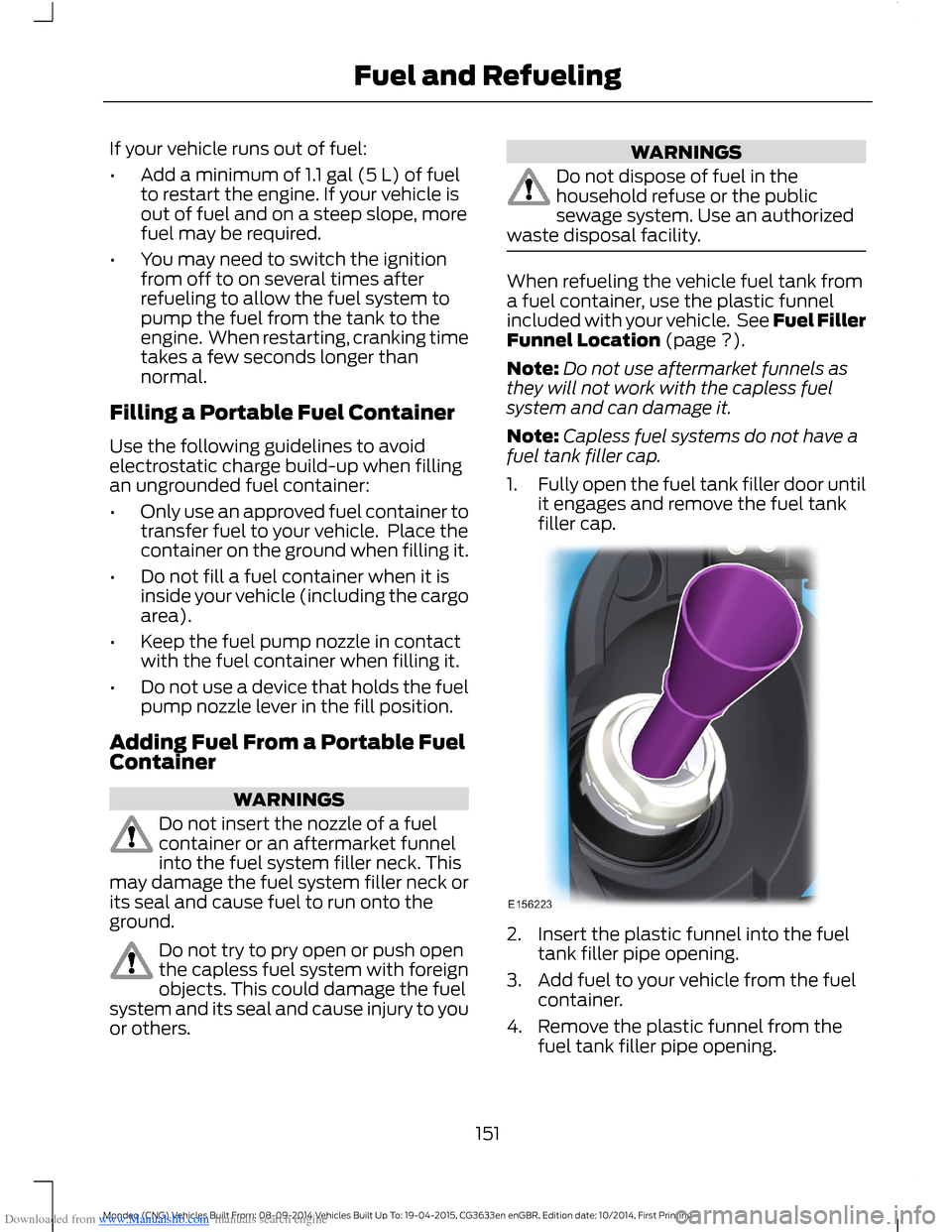
When refueling the vehicle fuel tank froma fuel container, use the plastic funnelincluded with your vehicle. See Fuel FillerFunnel Location (page ?).
Note:Do not use aftermarket funnels asthey will not work with the capless fuelsystem and can damage it.
Note:Capless fuel systems do not have afuel tank filler cap.
1.Fully open the fuel tank filler door untilit engages and remove the fuel tankfiller cap.
2.Insert the plastic funnel into the fueltank filler pipe opening.
3.Add fuel to your vehicle from the fuelcontainer.
4.Remove the plastic funnel from thefuel tank filler pipe opening.
151Mondeo (CNG) Vehicles Built From: 08-09-2014 Vehicles Built Up To: 19-04-2015, CG3633en enGBR, Edition date: 10/2014, First PrintingFuel and Refueling
Page 154 of 446
Downloaded from www.Manualslib.com manuals search engine 5.Replace the fuel tank filler cap andclose the fuel tank filler door.
6.Clean the plastic funnel and place itback in your vehicle or properly disposeof it.
Note:Extra funnels can be purchased froman authorized dealer if you choose todispose of the funnel.
CATALYTIC CONVERTER
WARNING
Do not park or idle your vehicle overdry leaves, dry grass or othercombustible materials. The exhaustwill radiate a considerable amount of heatduring use, and after you have switchedthe engine off. This is a potential firehazard.
Driving with a Catalytic Converter
WARNINGS
Avoid running out of fuel.
Do not crank the engine for longperiods.
Do not run the engine when a sparkplug lead is disconnected.
Do not push-start or tow-start yourvehicle. Use booster cables. SeeJump Starting the Vehicle (page225).
Do not switch the ignition off whendriving.
REFUELING
WARNINGS
Do not attempt to start the engine ifyou have filled the fuel tank with theincorrect fuel. This could damage theengine. Have your vehicle checked by anauthorized dealer immediately.
Do not use any kind of flames or heatnear the fuel system. The fuel systemis under pressure. There is a risk ofinjury if the fuel system is leaking.
If you use a high pressure spray towash your vehicle, only spray the fuelfiller flap briefly from a distance notless than 8 inches (200 millimeters).
We recommend that you wait atleast 10 seconds before removing thefuel nozzle to allow any residual fuelto drain into the fuel tank.
Stop refueling after the fuel nozzlestops the second time. Additionalfuel will fill the expansion space inthe fuel tank which could lead to fueloverflowing. Fuel spillage could behazardous to other road users.
Do not remove the fuel nozzle fromits fully inserted position during theentire refueling process.
Note:Your vehicle does not have a fuel fillercap.
152Mondeo (CNG) Vehicles Built From: 08-09-2014 Vehicles Built Up To: 19-04-2015, CG3633en enGBR, Edition date: 10/2014, First PrintingFuel and Refueling
Page 155 of 446
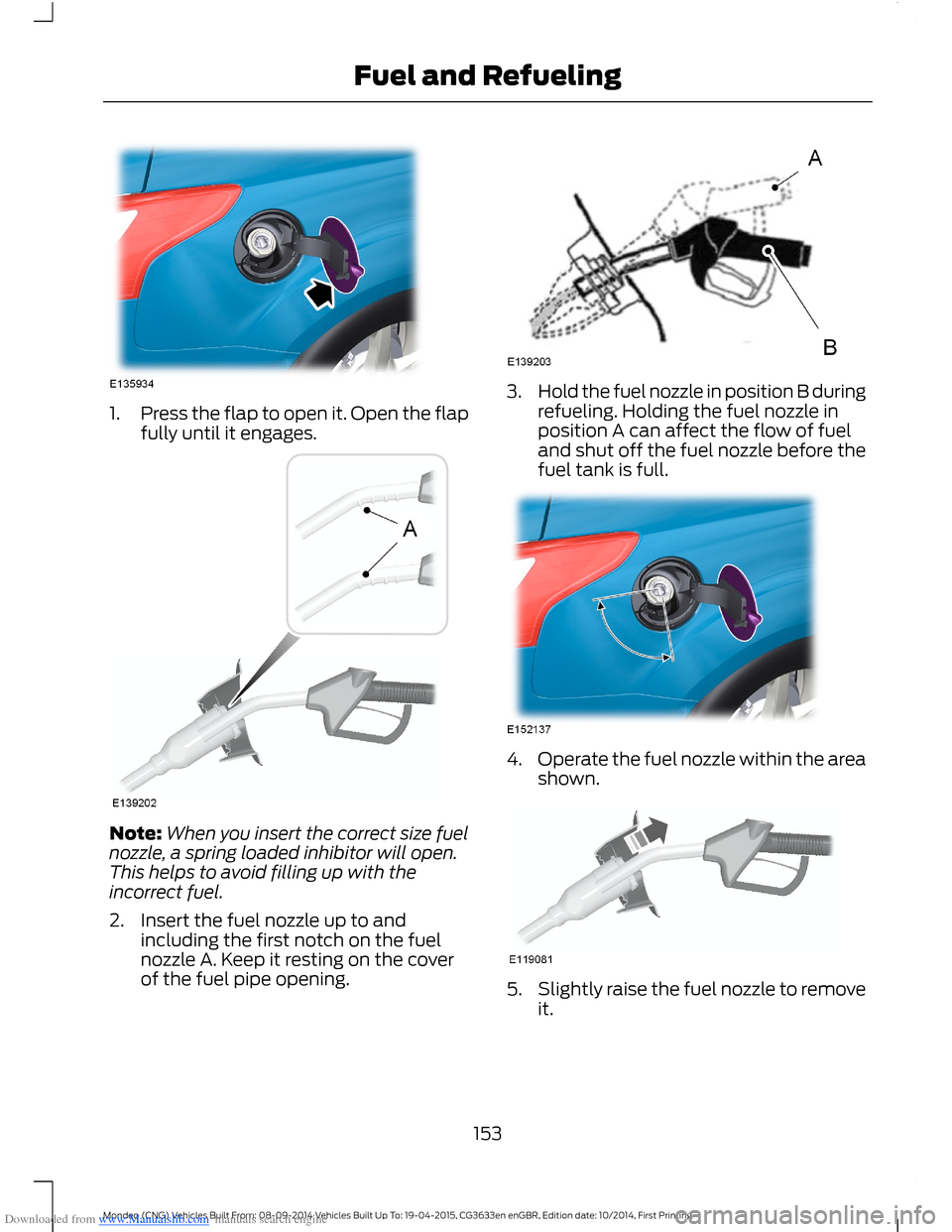
Downloaded from www.Manualslib.com manuals search engine 1.Press the flap to open it. Open the flapfully until it engages.
Note:When you insert the correct size fuelnozzle, a spring loaded inhibitor will open.This helps to avoid filling up with theincorrect fuel.
2.Insert the fuel nozzle up to andincluding the first notch on the fuelnozzle A. Keep it resting on the coverof the fuel pipe opening.
3.Hold the fuel nozzle in position B duringrefueling. Holding the fuel nozzle inposition A can affect the flow of fueland shut off the fuel nozzle before thefuel tank is full.
4.Operate the fuel nozzle within the areashown.
5.Slightly raise the fuel nozzle to removeit.
153Mondeo (CNG) Vehicles Built From: 08-09-2014 Vehicles Built Up To: 19-04-2015, CG3633en enGBR, Edition date: 10/2014, First PrintingFuel and Refueling
Page 156 of 446
Downloaded from www.Manualslib.com manuals search engine FUEL CONSUMPTION
We derive CO2 and fuel consumptionfigures in laboratory tests according toRegulation (EC) 715/2007 or CR (EC)692/2008 and subsequent amendments.
They are intended as a comparisonbetween makes and models of vehicles.They are not intended to represent the realworld fuel consumption you may get fromyour vehicle.
Real world fuel consumption is governedby many factors, for example driving style,high speed driving, stop-start driving, airconditioning usage, the accessories fitted,payload and towing.
The advertised capacity is the indicatedcapacity and the empty reserve combined.Indicated capacity is the difference in theamount of fuel in the fuel tank and whenthe fuel gauge indicates empty. Emptyreserve is the amount of fuel in the fueltank after the fuel gauge indicates empty.
Note: The amount of fuel in the emptyreserve varies and should not be relied uponto increase driving range. When refuelingyour vehicle after the fuel gauge indicatesempty, you might not be able to refuel thefull amount of the advertised capacity dueto the empty reserve still present in the fueltank.
Filling the Fuel Tank
For consistent results when refueling:
•Switch the ignition off.
•Allow no more than two automaticshut-offs when refueling.
Results are most accurate when therefueling method is consistent.
Calculating Fuel Economy
Do not measure fuel economy during thefirst 1000 mi (1,600 km) of driving (this isthe engine break-in period). A moreaccurate measurement is obtained after2500 mi (4,000 km). Also, fuel expense,frequency of fill ups or fuel gauge readingsare not accurate ways to measure fueleconomy.
1.Fill the fuel tank completely and recordthe initial odometer reading.
2.Each time you fill the fuel tank, recordthe amount of fuel added.
3.After at least three fill ups, fill the fueltank and record the current odometerreading.
4.Subtract your initial odometer readingfrom the current odometer reading.
5.Calculate fuel economy by dividingmiles traveled by gallons used (ForMetric: Multiply liters used by 100, thendivide by kilometers traveled).
Keep a record for at least one month andrecord the type of driving (city or freeway).This provides an accurate estimate of yourvehicle’s fuel economy under currentdriving conditions. Additionally, keepingrecords during summer and winter showhow temperature impacts fuel economy.In general, your vehicle will use more fuelin cold temperatures.
154Mondeo (CNG) Vehicles Built From: 08-09-2014 Vehicles Built Up To: 19-04-2015, CG3633en enGBR, Edition date: 10/2014, First PrintingFuel and Refueling
Page 159 of 446
Downloaded from www.Manualslib.com manuals search engine Note:Engine damage may occur if youmaintain excessive engine revving withoutshifting.
SelectShift does not automatically upshift,even if the engine is approaching the RPMlimit. It must be shifted manually bypressing the + button.
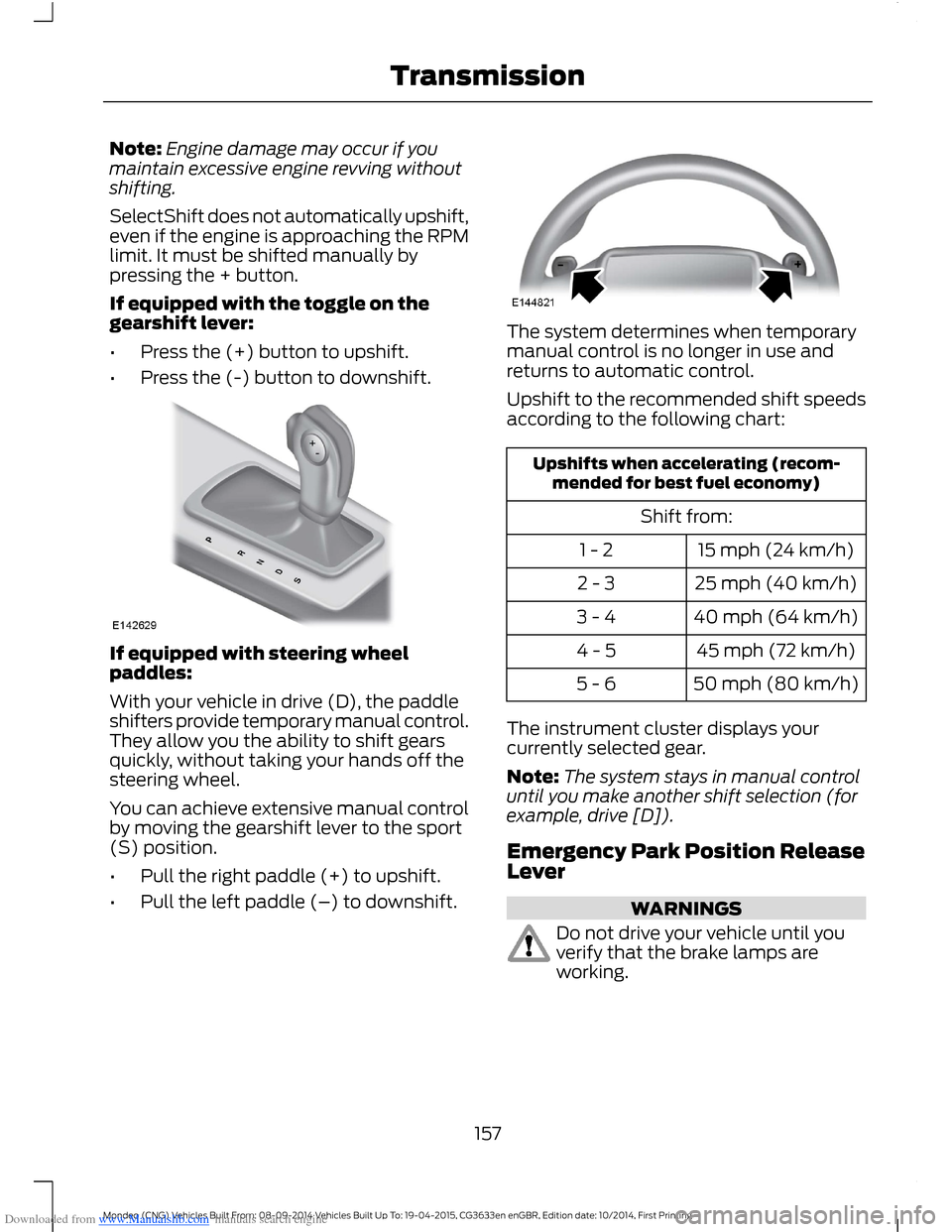
If equipped with the toggle on thegearshift lever:
•Press the (+) button to upshift.
•Press the (-) button to downshift.
If equipped with steering wheelpaddles:
With your vehicle in drive (D), the paddleshifters provide temporary manual control.They allow you the ability to shift gearsquickly, without taking your hands off thesteering wheel.
You can achieve extensive manual controlby moving the gearshift lever to the sport(S) position.
•Pull the right paddle (+) to upshift.
•Pull the left paddle (–) to downshift.
The system determines when temporarymanual control is no longer in use andreturns to automatic control.
Upshift to the recommended shift speedsaccording to the following chart:
Upshifts when accelerating (recom-mended for best fuel economy)
Shift from:
15 mph (24 km/h)1 - 2
25 mph (40 km/h)2 - 3
40 mph (64 km/h)3 - 4
45 mph (72 km/h)4 - 5
50 mph (80 km/h)5 - 6
The instrument cluster displays yourcurrently selected gear.
Note:The system stays in manual controluntil you make another shift selection (forexample, drive [D]).
Emergency Park Position ReleaseLever
WARNINGS
Do not drive your vehicle until youverify that the brake lamps areworking.
157Mondeo (CNG) Vehicles Built From: 08-09-2014 Vehicles Built Up To: 19-04-2015, CG3633en enGBR, Edition date: 10/2014, First PrintingTransmission
Page 212 of 446
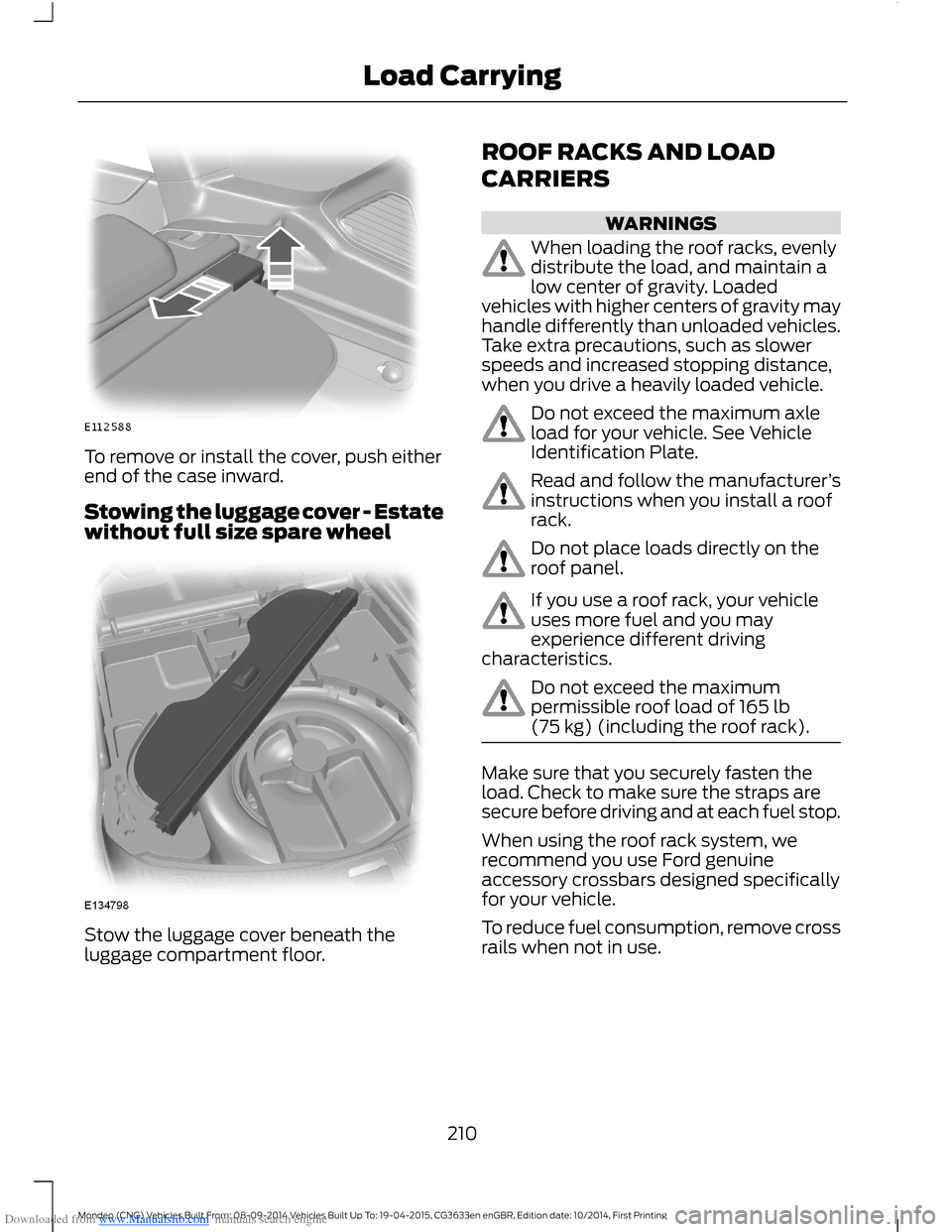
Downloaded from www.Manualslib.com manuals search engine To remove or install the cover, push eitherend of the case inward.
Stowing the luggage cover - Estatewithout full size spare wheel
Stow the luggage cover beneath theluggage compartment floor.
ROOF RACKS AND LOAD
CARRIERS
WARNINGS
When loading the roof racks, evenlydistribute the load, and maintain alow center of gravity. Loadedvehicles with higher centers of gravity mayhandle differently than unloaded vehicles.Take extra precautions, such as slowerspeeds and increased stopping distance,when you drive a heavily loaded vehicle.
Do not exceed the maximum axleload for your vehicle. See VehicleIdentification Plate.
Read and follow the manufacturer’sinstructions when you install a roofrack.
Do not place loads directly on theroof panel.
If you use a roof rack, your vehicleuses more fuel and you mayexperience different drivingcharacteristics.
Do not exceed the maximumpermissible roof load of 165 lb(75 kg) (including the roof rack).
Make sure that you securely fasten theload. Check to make sure the straps aresecure before driving and at each fuel stop.
When using the roof rack system, werecommend you use Ford genuineaccessory crossbars designed specificallyfor your vehicle.
To reduce fuel consumption, remove crossrails when not in use.
210Mondeo (CNG) Vehicles Built From: 08-09-2014 Vehicles Built Up To: 19-04-2015, CG3633en enGBR, Edition date: 10/2014, First PrintingLoad Carrying
Page 223 of 446

Downloaded from www.Manualslib.com manuals search engine BREAKING-IN
Tires
WARNING
New tires need to be run-in forapproximately 300 miles (500kilometers). During this time, youmay experience different drivingcharacteristics.
Brakes and Clutch
WARNING
Avoid heavy use of the brakes andclutch if possible for the first 100miles (150 kilometers) in town andfor the first 1000 miles (1500 kilometers)on freeways.
Engine
WARNING
Avoid driving too fast during the first1000 miles (1500 kilometers). Varyyour speed frequently and changeup through the gears early. Do not laborthe engine.
Vehicles With a Diesel Engine
During the first 2000 miles (3000kilometers), you may notice a ticking soundwhen your vehicle slows down. This is dueto adjustments of your new diesel engineand is normal.
REDUCED ENGINE
PERFORMANCE
WARNING
Continued operation will increase theengine temperature and cause theengine to shut down completely.
If the engine coolant temperature gaugeneedle moves to the upper limit position,the engine is overheating. See Gauges(page 78).
You must only drive your vehicle for a shortdistance if the engine overheats. Thedistance you can travel depends onambient temperature, vehicle load andterrain. The engine will continue to operatewith limited power for a short time.
If the engine temperature continues to rise,the fuel supply to the engine will reduce.The air conditioning will switch off and theengine cooling fan will operate continually.
1.Reduce your speed gradually and stopyour vehicle as soon as it is safe to doso.
2.Switch the engine off immediately toprevent severe engine damage.
3.Wait for the engine to cool down.
4.Check the coolant level. See EngineCoolant Check (page 247).
5.Have your vehicle checked by anauthorized dealer as soon as possible.
ECONOMICAL DRIVING
The following will help to improve fuelconsumption.
Tire Pressures
Check your tire pressures regularly tooptimize fuel economy. For best resultsuse the economy pressures. See TirePressures (page 273).
Gear Shifting
Use the highest drivable gear appropriatefor the road conditions.
221Mondeo (CNG) Vehicles Built From: 08-09-2014 Vehicles Built Up To: 19-04-2015, CG3633en enGBR, Edition date: 10/2014, First PrintingDriving Hints
Page 224 of 446
Downloaded from www.Manualslib.com manuals search engine Anticipation
Adjust your vehicle speed and the distanceto other vehicles without the need forheavy braking or acceleration.
Efficient Speed
Higher speeds use more fuel. Reduce yourcruising speed on open roads.
Accessories
Try not to add unnecessary accessories tothe exterior of your vehicle. If you use a roofrack, remember to fold it down or removeit when not in use.
Electrical Systems
Switch off all electrical systems when notin use, for example air conditioning. Makesure you unplug any accessories from theauxiliary power points when not in use.
COLD WEATHER
PRECAUTIONS
The functional operation of somecomponents and systems can be affectedat temperatures below -13°F (-25°C).
DRIVING THROUGH WATER
WARNING
Do not drive through flowing or deepwater as you may lose control of yourvehicle.
Note:Driving through standing water cancause vehicle damage.
Note:Engine damage can occur if waterenters the air filter.
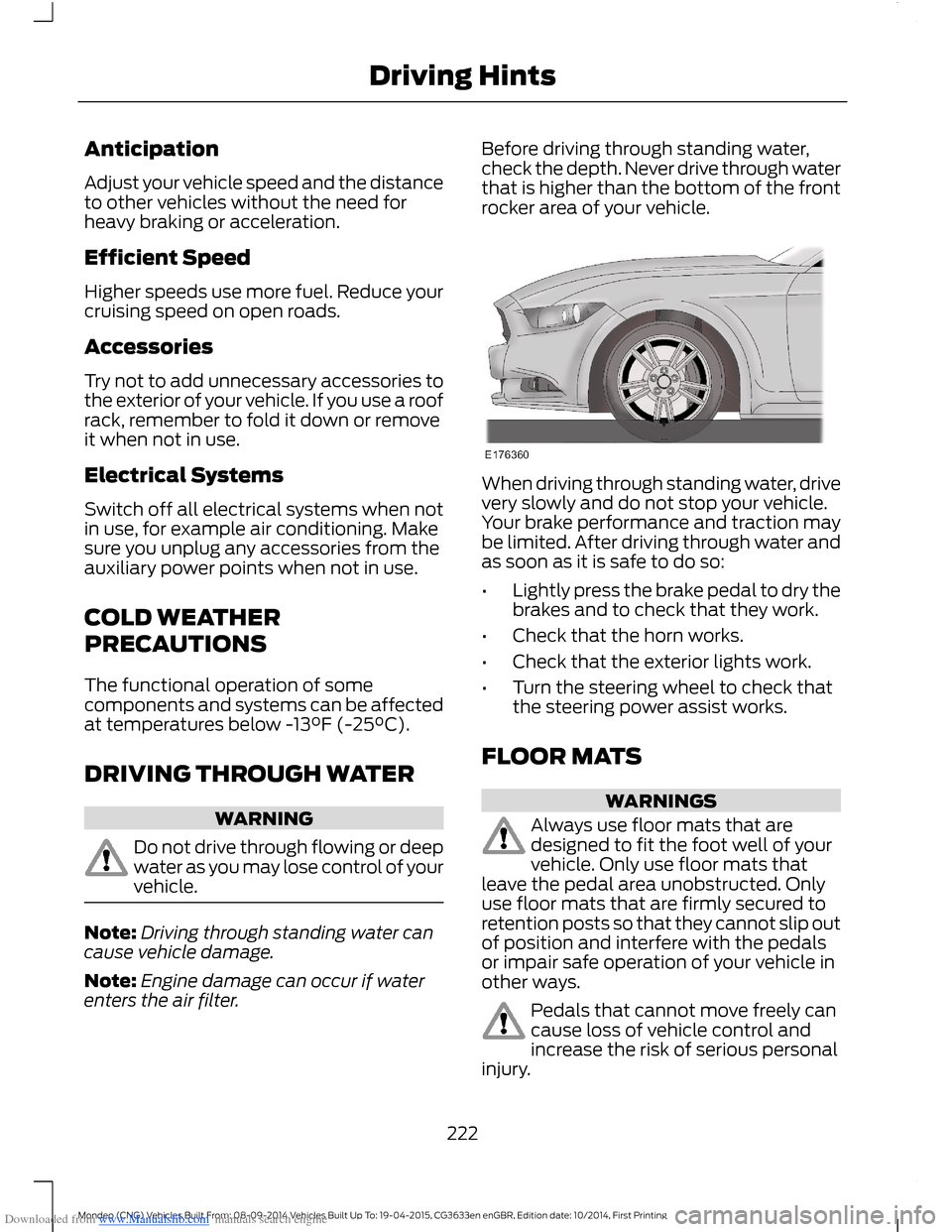
Before driving through standing water,check the depth. Never drive through waterthat is higher than the bottom of the frontrocker area of your vehicle.
When driving through standing water, drivevery slowly and do not stop your vehicle.Your brake performance and traction maybe limited. After driving through water andas soon as it is safe to do so:
•Lightly press the brake pedal to dry thebrakes and to check that they work.
•Check that the horn works.
•Check that the exterior lights work.
•Turn the steering wheel to check thatthe steering power assist works.
FLOOR MATS
WARNINGS
Always use floor mats that aredesigned to fit the foot well of yourvehicle. Only use floor mats thatleave the pedal area unobstructed. Onlyuse floor mats that are firmly secured toretention posts so that they cannot slip outof position and interfere with the pedalsor impair safe operation of your vehicle inother ways.
Pedals that cannot move freely cancause loss of vehicle control andincrease the risk of serious personalinjury.
222Mondeo (CNG) Vehicles Built From: 08-09-2014 Vehicles Built Up To: 19-04-2015, CG3633en enGBR, Edition date: 10/2014, First PrintingDriving Hints