2014 FORD MONDEO air condition
[x] Cancel search: air conditionPage 217 of 446
Downloaded from www.Manualslib.com manuals search engine TOWING A TRAILER
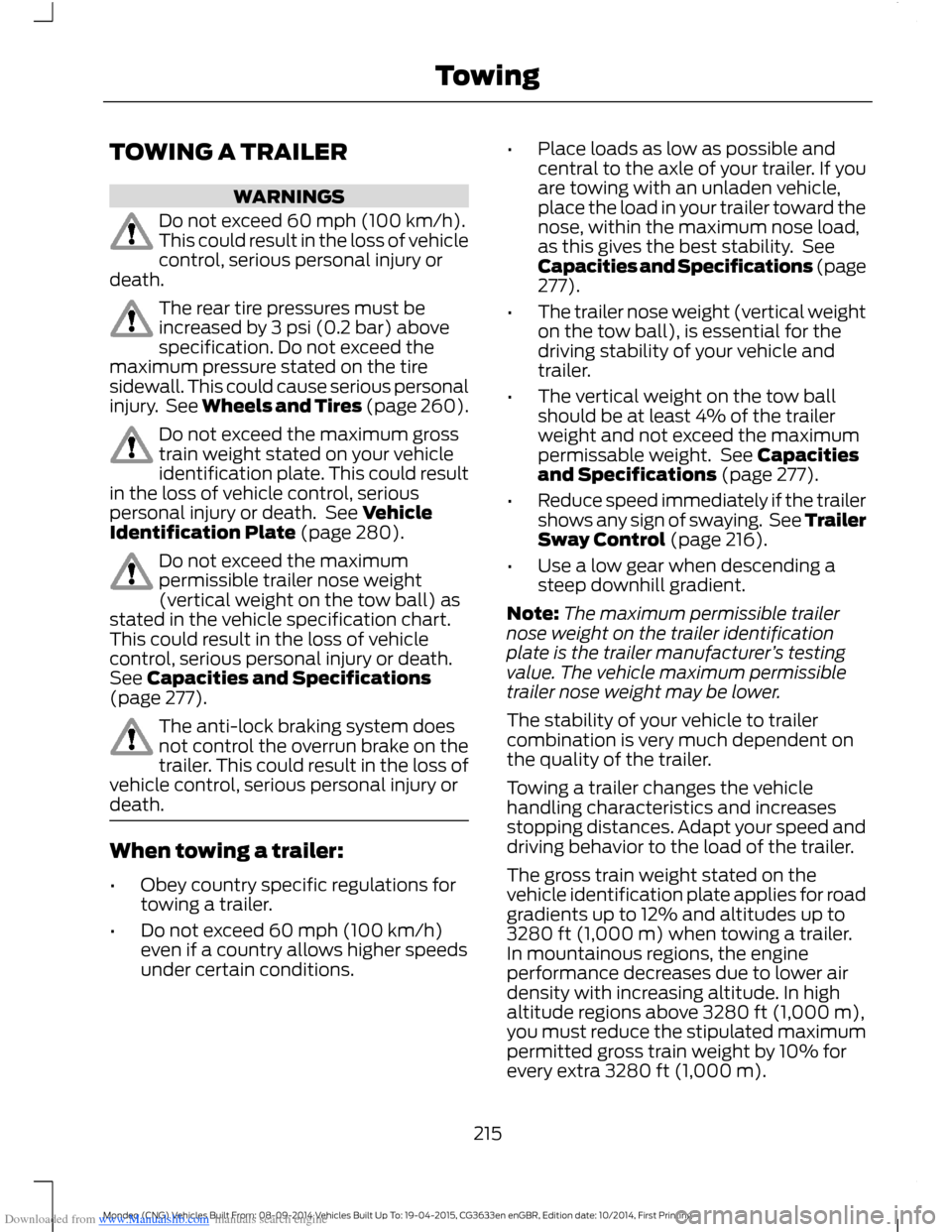
WARNINGS
Do not exceed 60 mph (100 km/h).This could result in the loss of vehiclecontrol, serious personal injury ordeath.
The rear tire pressures must beincreased by 3 psi (0.2 bar) abovespecification. Do not exceed themaximum pressure stated on the tiresidewall. This could cause serious personalinjury. See Wheels and Tires (page 260).
Do not exceed the maximum grosstrain weight stated on your vehicleidentification plate. This could resultin the loss of vehicle control, seriouspersonal injury or death. See VehicleIdentification Plate (page 280).
Do not exceed the maximumpermissible trailer nose weight(vertical weight on the tow ball) asstated in the vehicle specification chart.This could result in the loss of vehiclecontrol, serious personal injury or death.See Capacities and Specifications(page 277).
The anti-lock braking system doesnot control the overrun brake on thetrailer. This could result in the loss ofvehicle control, serious personal injury ordeath.
When towing a trailer:
•Obey country specific regulations fortowing a trailer.
•Do not exceed 60 mph (100 km/h)even if a country allows higher speedsunder certain conditions.
•Place loads as low as possible andcentral to the axle of your trailer. If youare towing with an unladen vehicle,place the load in your trailer toward thenose, within the maximum nose load,as this gives the best stability. SeeCapacities and Specifications (page277).
•The trailer nose weight (vertical weighton the tow ball), is essential for thedriving stability of your vehicle andtrailer.
•The vertical weight on the tow ballshould be at least 4% of the trailerweight and not exceed the maximumpermissable weight. See Capacitiesand Specifications (page 277).
•Reduce speed immediately if the trailershows any sign of swaying. See TrailerSway Control (page 216).
•Use a low gear when descending asteep downhill gradient.
Note:The maximum permissible trailernose weight on the trailer identificationplate is the trailer manufacturer’s testingvalue. The vehicle maximum permissibletrailer nose weight may be lower.
The stability of your vehicle to trailercombination is very much dependent onthe quality of the trailer.
Towing a trailer changes the vehiclehandling characteristics and increasesstopping distances. Adapt your speed anddriving behavior to the load of the trailer.
The gross train weight stated on thevehicle identification plate applies for roadgradients up to 12% and altitudes up to3280 ft (1,000 m) when towing a trailer.In mountainous regions, the engineperformance decreases due to lower airdensity with increasing altitude. In highaltitude regions above 3280 ft (1,000 m),you must reduce the stipulated maximumpermitted gross train weight by 10% forevery extra 3280 ft (1,000 m).
215Mondeo (CNG) Vehicles Built From: 08-09-2014 Vehicles Built Up To: 19-04-2015, CG3633en enGBR, Edition date: 10/2014, First PrintingTowing
Page 219 of 446
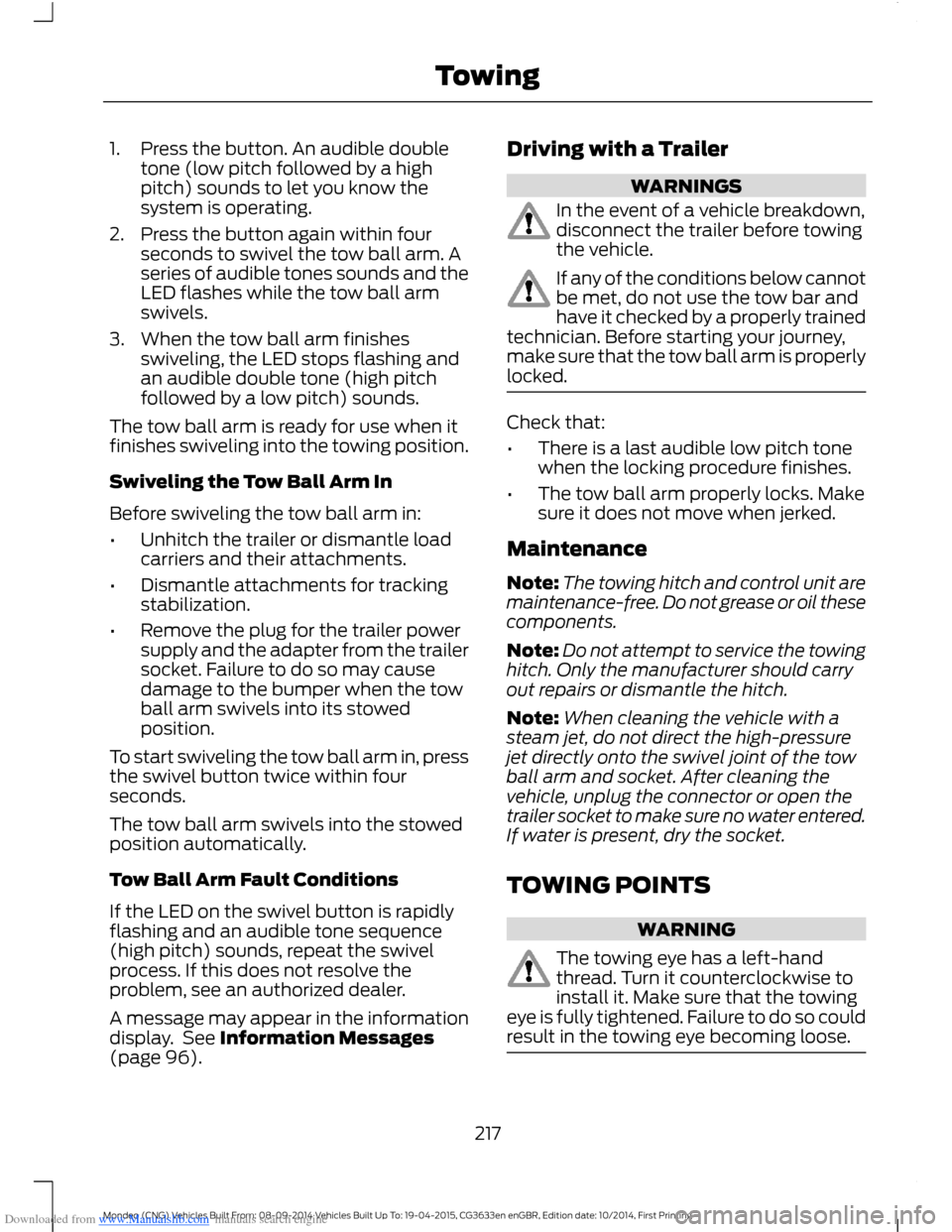
Downloaded from www.Manualslib.com manuals search engine 1.Press the button. An audible doubletone (low pitch followed by a highpitch) sounds to let you know thesystem is operating.
2.Press the button again within fourseconds to swivel the tow ball arm. Aseries of audible tones sounds and theLED flashes while the tow ball armswivels.
3.When the tow ball arm finishesswiveling, the LED stops flashing andan audible double tone (high pitchfollowed by a low pitch) sounds.
The tow ball arm is ready for use when itfinishes swiveling into the towing position.
Swiveling the Tow Ball Arm In
Before swiveling the tow ball arm in:
•Unhitch the trailer or dismantle loadcarriers and their attachments.
•Dismantle attachments for trackingstabilization.
•Remove the plug for the trailer powersupply and the adapter from the trailersocket. Failure to do so may causedamage to the bumper when the towball arm swivels into its stowedposition.
To start swiveling the tow ball arm in, pressthe swivel button twice within fourseconds.
The tow ball arm swivels into the stowedposition automatically.
Tow Ball Arm Fault Conditions
If the LED on the swivel button is rapidlyflashing and an audible tone sequence(high pitch) sounds, repeat the swivelprocess. If this does not resolve theproblem, see an authorized dealer.
A message may appear in the informationdisplay. See Information Messages(page 96).
Driving with a Trailer
WARNINGS
In the event of a vehicle breakdown,disconnect the trailer before towingthe vehicle.
If any of the conditions below cannotbe met, do not use the tow bar andhave it checked by a properly trainedtechnician. Before starting your journey,make sure that the tow ball arm is properlylocked.
Check that:
•There is a last audible low pitch tonewhen the locking procedure finishes.
•The tow ball arm properly locks. Makesure it does not move when jerked.
Maintenance
Note:The towing hitch and control unit aremaintenance-free. Do not grease or oil thesecomponents.
Note:Do not attempt to service the towinghitch. Only the manufacturer should carryout repairs or dismantle the hitch.
Note:When cleaning the vehicle with asteam jet, do not direct the high-pressurejet directly onto the swivel joint of the towball arm and socket. After cleaning thevehicle, unplug the connector or open thetrailer socket to make sure no water entered.If water is present, dry the socket.
TOWING POINTS
WARNING
The towing eye has a left-handthread. Turn it counterclockwise toinstall it. Make sure that the towingeye is fully tightened. Failure to do so couldresult in the towing eye becoming loose.
217Mondeo (CNG) Vehicles Built From: 08-09-2014 Vehicles Built Up To: 19-04-2015, CG3633en enGBR, Edition date: 10/2014, First PrintingTowing
Page 223 of 446

Downloaded from www.Manualslib.com manuals search engine BREAKING-IN
Tires
WARNING
New tires need to be run-in forapproximately 300 miles (500kilometers). During this time, youmay experience different drivingcharacteristics.
Brakes and Clutch
WARNING
Avoid heavy use of the brakes andclutch if possible for the first 100miles (150 kilometers) in town andfor the first 1000 miles (1500 kilometers)on freeways.
Engine
WARNING
Avoid driving too fast during the first1000 miles (1500 kilometers). Varyyour speed frequently and changeup through the gears early. Do not laborthe engine.
Vehicles With a Diesel Engine
During the first 2000 miles (3000kilometers), you may notice a ticking soundwhen your vehicle slows down. This is dueto adjustments of your new diesel engineand is normal.
REDUCED ENGINE
PERFORMANCE
WARNING
Continued operation will increase theengine temperature and cause theengine to shut down completely.
If the engine coolant temperature gaugeneedle moves to the upper limit position,the engine is overheating. See Gauges(page 78).
You must only drive your vehicle for a shortdistance if the engine overheats. Thedistance you can travel depends onambient temperature, vehicle load andterrain. The engine will continue to operatewith limited power for a short time.
If the engine temperature continues to rise,the fuel supply to the engine will reduce.The air conditioning will switch off and theengine cooling fan will operate continually.
1.Reduce your speed gradually and stopyour vehicle as soon as it is safe to doso.
2.Switch the engine off immediately toprevent severe engine damage.
3.Wait for the engine to cool down.
4.Check the coolant level. See EngineCoolant Check (page 247).
5.Have your vehicle checked by anauthorized dealer as soon as possible.
ECONOMICAL DRIVING
The following will help to improve fuelconsumption.
Tire Pressures
Check your tire pressures regularly tooptimize fuel economy. For best resultsuse the economy pressures. See TirePressures (page 273).
Gear Shifting
Use the highest drivable gear appropriatefor the road conditions.
221Mondeo (CNG) Vehicles Built From: 08-09-2014 Vehicles Built Up To: 19-04-2015, CG3633en enGBR, Edition date: 10/2014, First PrintingDriving Hints
Page 224 of 446
Downloaded from www.Manualslib.com manuals search engine Anticipation
Adjust your vehicle speed and the distanceto other vehicles without the need forheavy braking or acceleration.
Efficient Speed
Higher speeds use more fuel. Reduce yourcruising speed on open roads.
Accessories
Try not to add unnecessary accessories tothe exterior of your vehicle. If you use a roofrack, remember to fold it down or removeit when not in use.
Electrical Systems
Switch off all electrical systems when notin use, for example air conditioning. Makesure you unplug any accessories from theauxiliary power points when not in use.
COLD WEATHER
PRECAUTIONS
The functional operation of somecomponents and systems can be affectedat temperatures below -13°F (-25°C).
DRIVING THROUGH WATER
WARNING
Do not drive through flowing or deepwater as you may lose control of yourvehicle.
Note:Driving through standing water cancause vehicle damage.
Note:Engine damage can occur if waterenters the air filter.
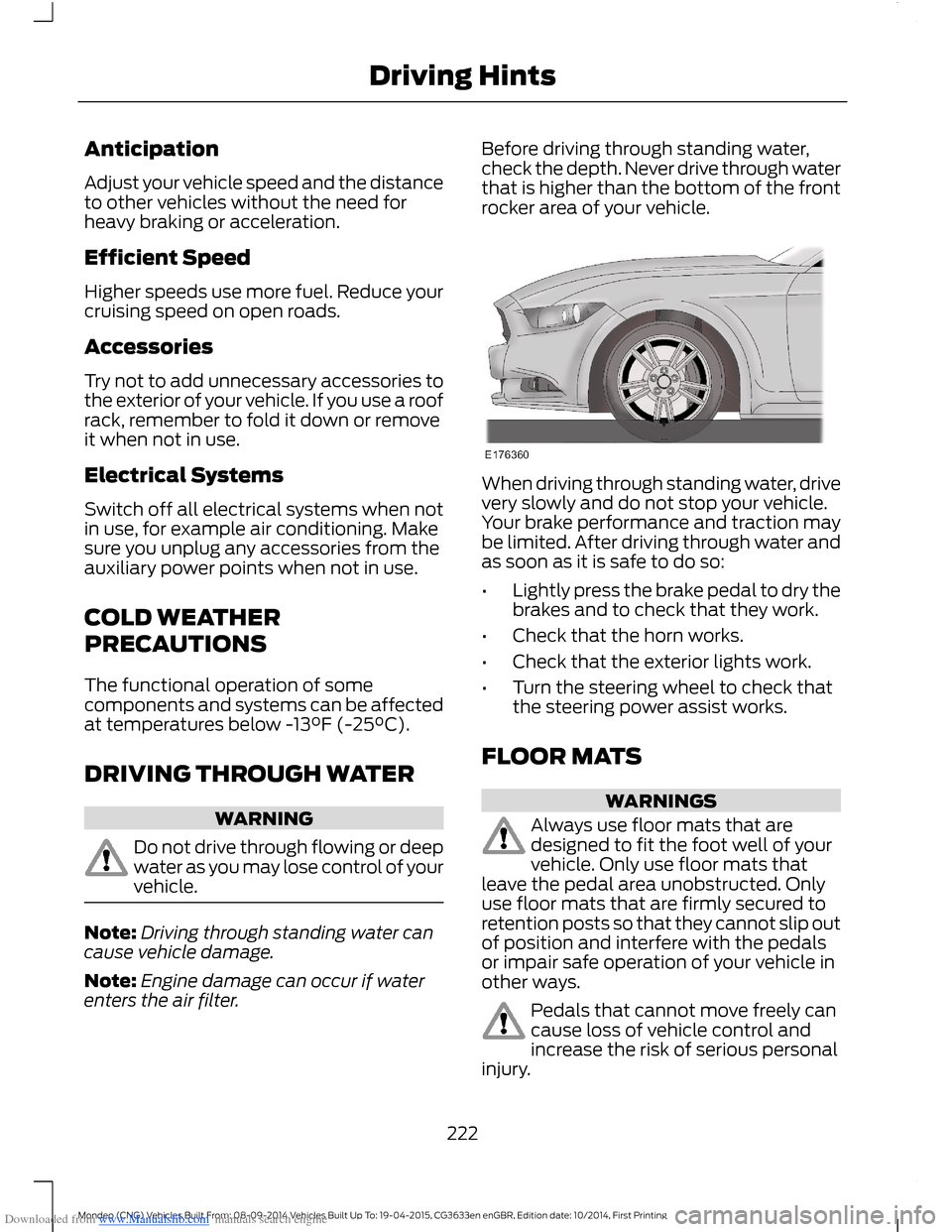
Before driving through standing water,check the depth. Never drive through waterthat is higher than the bottom of the frontrocker area of your vehicle.
When driving through standing water, drivevery slowly and do not stop your vehicle.Your brake performance and traction maybe limited. After driving through water andas soon as it is safe to do so:
•Lightly press the brake pedal to dry thebrakes and to check that they work.
•Check that the horn works.
•Check that the exterior lights work.
•Turn the steering wheel to check thatthe steering power assist works.
FLOOR MATS
WARNINGS
Always use floor mats that aredesigned to fit the foot well of yourvehicle. Only use floor mats thatleave the pedal area unobstructed. Onlyuse floor mats that are firmly secured toretention posts so that they cannot slip outof position and interfere with the pedalsor impair safe operation of your vehicle inother ways.
Pedals that cannot move freely cancause loss of vehicle control andincrease the risk of serious personalinjury.
222Mondeo (CNG) Vehicles Built From: 08-09-2014 Vehicles Built Up To: 19-04-2015, CG3633en enGBR, Edition date: 10/2014, First PrintingDriving Hints
Page 230 of 446

Downloaded from www.Manualslib.com manuals search engine Protected componentsFuse amp ratingFuse or relay number
Powertrain control module relay.—9
Driver front auxiliary power point.20A310
Powertrain control module.15A211
Powertrain control module.15A212
Powertrain control module.10A213
Powertrain control module.10A214
Run-start relay.—15
Console auxiliary power point.20A316
Auxiliary power point.20A317
Powertrain control module.10A118
Power steering.10A119
Run-start lighting.10A120
Transmission control module.15A121Transmission oil pump.
Air conditioning.10A122
Blind spot monitor.15A123Rear view camera.Adaptive Cruise Control.Pre-collision warning indicator.Voltage quality module.Air quality sensor.
Not used (spare).10A124
Anti-lock brake system.10A225
Powertrain control module.10A226
Not used (spare).10A127
Rear washer pump.10A128
228Mondeo (CNG) Vehicles Built From: 08-09-2014 Vehicles Built Up To: 19-04-2015, CG3633en enGBR, Edition date: 10/2014, First PrintingFuses
Page 231 of 446
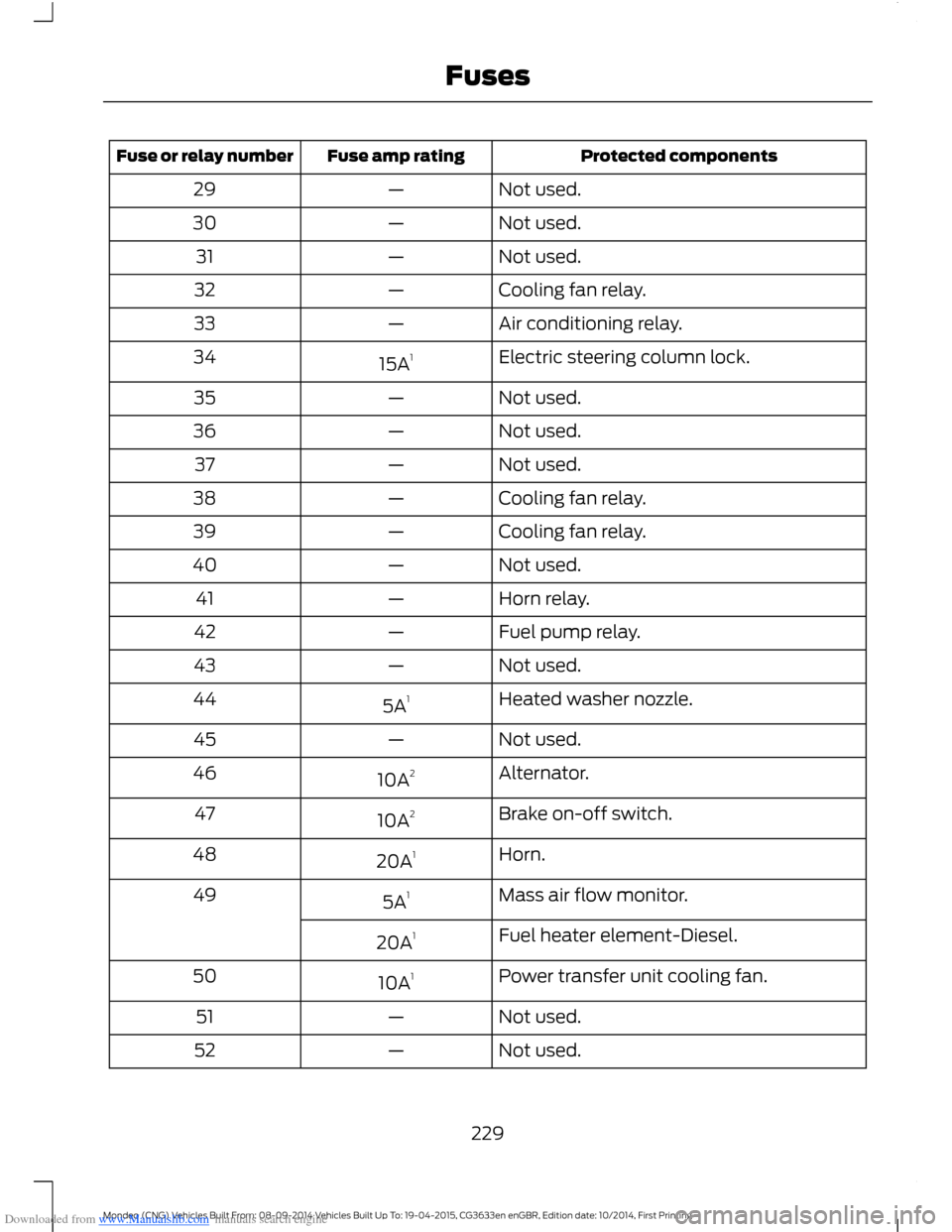
Downloaded from www.Manualslib.com manuals search engine Protected componentsFuse amp ratingFuse or relay number
Not used.—29
Not used.—30
Not used.—31
Cooling fan relay.—32
Air conditioning relay.—33
Electric steering column lock.15A134
Not used.—35
Not used.—36
Not used.—37
Cooling fan relay.—38
Cooling fan relay.—39
Not used.—40
Horn relay.—41
Fuel pump relay.—42
Not used.—43
Heated washer nozzle.5A144
Not used.—45
Alternator.10A246
Brake on-off switch.10A247
Horn.20A148
Mass air flow monitor.5A149
Fuel heater element-Diesel.20A1
Power transfer unit cooling fan.10A150
Not used.—51
Not used.—52
229Mondeo (CNG) Vehicles Built From: 08-09-2014 Vehicles Built Up To: 19-04-2015, CG3633en enGBR, Edition date: 10/2014, First PrintingFuses
Page 239 of 446

Downloaded from www.Manualslib.com manuals search engine GENERAL INFORMATION
Have your vehicle serviced regularly to helpmaintain its roadworthiness and resalevalue. There is a large network of Fordauthorized repairers that are there to helpyou with their professional servicingexpertise. Authorized repairers are bestqualified to service your vehicle properlyand expertly, with a wide range of highlyspecialized tools.
In addition to regular servicing, werecommend that you carry out thefollowing checks.
WARNINGS
Switch the ignition off beforetouching or attempting adjustmentof any kind.
Do not touch the electronic ignitionsystem parts after you have switchedthe ignition on or when the engine isrunning. The system operates at highvoltage.
Keep your hands and clothing clearof the engine cooling fan. Undercertain conditions, the fan maycontinue to run for several minutes afteryou have switched the engine off.
Make sure that you fit filler capssecurely after carrying outmaintenance checks.
Daily Checks
•Exterior lamps.
•Interior lamps.
•Warning lamps and indicators.
Check When Refueling
•Engine oil level. See Engine Oil Check(page 246).
•Brake fluid level. See Brake andClutch Fluid Check (page 248).
•Washer fluid level. See Washer FluidCheck (page 248).
•Tire pressures (when cold). See TirePressures (page 273).
•Tire condition. See Wheels and Tires(page 260).
Monthly Checks
•Engine coolant level (engine cold). SeeEngine Coolant Check (page 247).
•Pipes, hoses and reservoirs for leaks.
•Air conditioning operation.
•Parking brake operation.
•Horn operation.
•Tightness of lug nuts. See TirePressures (page 273).
OPENING AND CLOSING THE
HOOD
Opening the Hood
1.Inside the vehicle, pull the hood releasehandle located under the left-handside of the instrument panel.
2.Slightly lift the hood.
237Mondeo (CNG) Vehicles Built From: 08-09-2014 Vehicles Built Up To: 19-04-2015, CG3633en enGBR, Edition date: 10/2014, First PrintingMaintenance
Page 260 of 446

Downloaded from www.Manualslib.com manuals search engine Note: Do not use razor blades or othersharp objects to clean or remove decalsfrom the inside of the heated rear window.The vehicle warranty does not coverdamage caused to the heated rear windowgrid lines.
CLEANING THE INTERIOR
Note:Do not allow air fresheners and handsanitizers to spill on interior surfaces. If aspill occurs, wipe off immediately. Damagemay not be covered by your warranty.
Safety Belts
Note:Do not use abrasives, or chemicalsolvents to clean them.
Note:Do not allow moisture to penetratethe safety belt retractor mechanism.
Clean them with interior cleaner or waterapplied with a soft sponge. Let them drynaturally, away from artificial heat.
Instrument Cluster Screens, LCDScreens and Radio Screens
Note:Do not use abrasives, alcoholicsolvents or chemical solvents to clean them.
Rear Windows
Note:Do not use any abrasive materials toclean the interior of the rear windows.
Note:Do not install stickers or labels to theinterior of the rear windows.
REPAIRING MINOR PAINT
DAMAGE
You should repair paintwork damagecaused by stones from the road or minorscratches as soon as possible. A choice ofproducts are available from an authorizeddealer.
Remove particles such as bird droppings,tree sap, insect deposits, tar spots, roadsalt and industrial fallout before repairingpaint chips.
Always read and follow the manufacturer’sinstructions before using the products.
CLEANING THE ALLOY
WHEELS
Note:Do not apply a cleaning chemical towarm or hot wheel rims and covers.
Note:Industrial-strength (heavy-duty)cleaners, or cleaning chemicals, incombination with brush agitation to removebrake dust and dirt, could wear away theclear coat finish over a period of time.
Note:Do not use hydrofluoric acid-basedor high caustic-based wheel cleaners, steelwool, fuels or strong household detergent.
Note:If you intend parking your vehicle foran extended period after cleaning thewheels with a wheel cleaner, drive yourvehicle for a few minutes before doing so.This will reduce the risk of increasedcorrosion of the brake discs, brake pads andlinings.
Note:Some automatic car washes maycause damage to the finish on your wheelrims and covers.
Alloy wheels and wheel covers are coatedwith a clear coat paint finish. To maintaintheir condition we recommend that you:
•Clean them weekly with therecommended wheel and tire cleaner.
•Use a sponge to remove heavydeposits of dirt and brake dustaccumulation.
•Rinse them thoroughly with apressurized stream of water when youhave completed the cleaning process.
258Mondeo (CNG) Vehicles Built From: 08-09-2014 Vehicles Built Up To: 19-04-2015, CG3633en enGBR, Edition date: 10/2014, First PrintingVehicle Care