2014 FORD MONDEO trailer
[x] Cancel search: trailerPage 174 of 446
Downloaded from www.Manualslib.com manuals search engine ACTIVE PARK ASSIST
Parallel Parking, PerpendicularParking, Park Out Assist
WARNINGS
You must remain in your vehiclewhen the system turns on. At alltimes, you are responsible forcontrolling your vehicle, supervising thesystem and intervening if required. Failureto take care may result in the loss ofcontrol of your vehicle, serious personalinjury or death.
The sensors may not detect objectsin heavy rain or other conditions thatcause disruptive reflections.
The system scans the area adjacent toboth sides of your vehicle to locate asuitable parking space.
The system informs you when it locates asuitable parking space. When you stopyour vehicle, the system takes control ofthe steering to guide your vehicle into theparking space.
Park Out Assist automatically steers yourvehicle out of a parallel parking space(hands-free) while you control theaccelerator, gearshift and brakes. Thesystem visually and audibly instructs youto enter traffic.
The system may not correctly operate inany of the following conditions:
•a spare tire or a significantly worn tiremore than the other tires is used
•you use a tire size not recommendedby us
•you try to park on a tight curve
•if the edge of the neighboring parkedvehicle is high off the ground (forexample, a bus, tow truck or flatbedtruck)
•the weather conditions are poor (heavyrain, snow, fog, etc).
Note:Keep the sensors, located on thebumper or fascia, free from snow, ice andlarge accumulations of dirt. Covered sensorscan affect the system's accuracy. Do notclean the sensors with sharp objects.
Do not use the system if:
•You have attached a foreign object(bike rack or trailer) to the front or rearof your vehicle or close to the sensors.
•You have attached an overhangingobject (surfboard) to the roof.
•A foreign object damages or obstructsthe front or rear bumper or sidesensors.
•The correct tire size is not in use on yourvehicle (for example, a mini-spare tire).
Using Active Park Assist - ParallelParking
Press the button located on thecenter console near the gearshiftlever once.
When driving at a speed less than 19 mph(30 km/h) the system automatically scansboth sides of your vehicle for an availableparking space. The system displays amessage and a corresponding graphic toindicate it is searching for a parking space.Use the direction indicator to selectsearching either to the left-hand side orright-hand side of your vehicle.
Note:If you do not make a selection thesystem will default to the passenger's side.
172Mondeo (CNG) Vehicles Built From: 08-09-2014 Vehicles Built Up To: 19-04-2015, CG3633en enGBR, Edition date: 10/2014, First PrintingParking Aids
Page 180 of 446
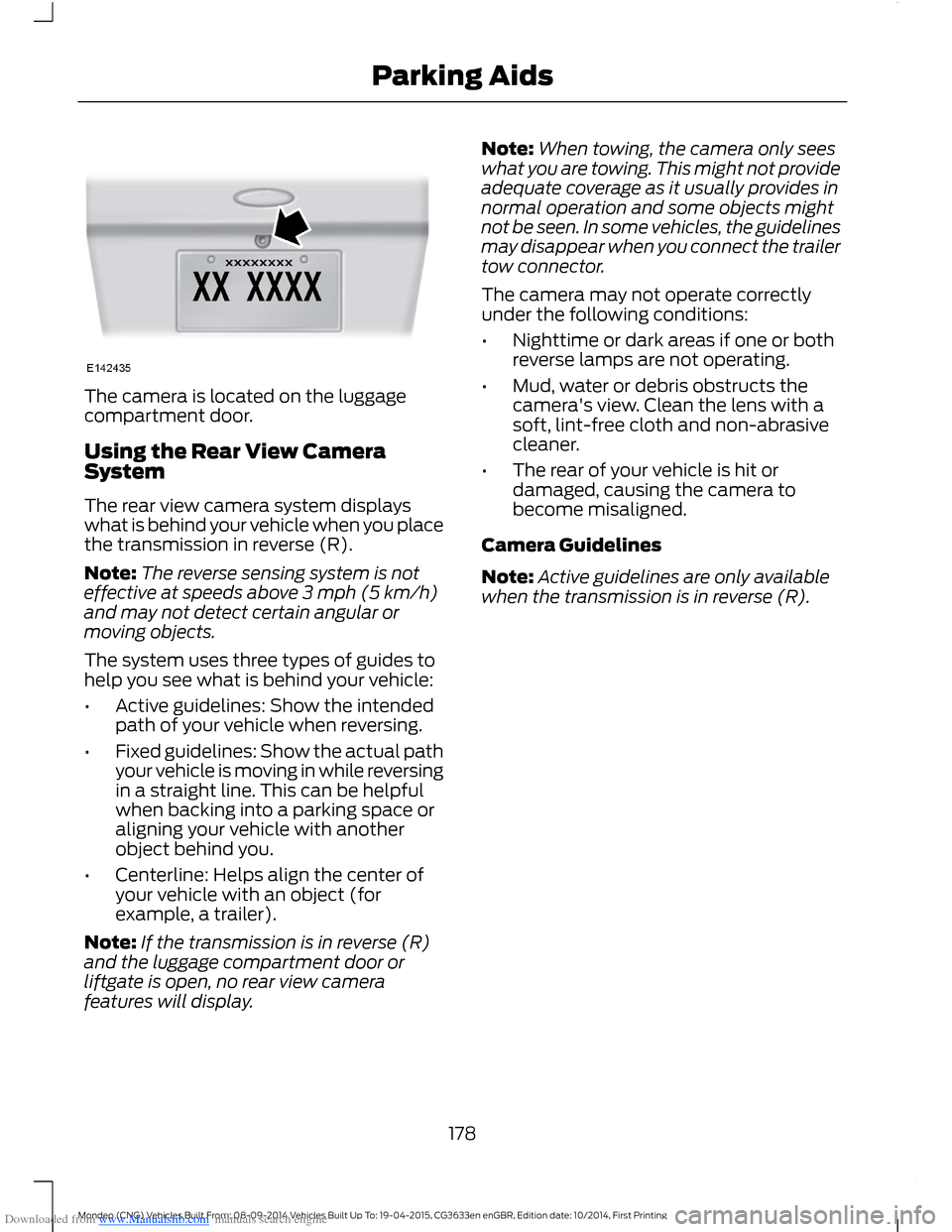
Downloaded from www.Manualslib.com manuals search engine The camera is located on the luggagecompartment door.
Using the Rear View CameraSystem
The rear view camera system displayswhat is behind your vehicle when you placethe transmission in reverse (R).
Note:The reverse sensing system is noteffective at speeds above 3 mph (5 km/h)and may not detect certain angular ormoving objects.
The system uses three types of guides tohelp you see what is behind your vehicle:
•Active guidelines: Show the intendedpath of your vehicle when reversing.
•Fixed guidelines: Show the actual pathyour vehicle is moving in while reversingin a straight line. This can be helpfulwhen backing into a parking space oraligning your vehicle with anotherobject behind you.
•Centerline: Helps align the center ofyour vehicle with an object (forexample, a trailer).
Note:If the transmission is in reverse (R)and the luggage compartment door orliftgate is open, no rear view camerafeatures will display.
Note:When towing, the camera only seeswhat you are towing. This might not provideadequate coverage as it usually provides innormal operation and some objects mightnot be seen. In some vehicles, the guidelinesmay disappear when you connect the trailertow connector.
The camera may not operate correctlyunder the following conditions:
•Nighttime or dark areas if one or bothreverse lamps are not operating.
•Mud, water or debris obstructs thecamera's view. Clean the lens with asoft, lint-free cloth and non-abrasivecleaner.
•The rear of your vehicle is hit ordamaged, causing the camera tobecome misaligned.
Camera Guidelines
Note:Active guidelines are only availablewhen the transmission is in reverse (R).
178Mondeo (CNG) Vehicles Built From: 08-09-2014 Vehicles Built Up To: 19-04-2015, CG3633en enGBR, Edition date: 10/2014, First PrintingParking Aids
Page 184 of 446
Downloaded from www.Manualslib.com manuals search engine USING ADAPTIVE CRUISE
CONTROL (If Equipped)
WARNINGS
Always pay close attention tochanging road conditions, especiallywhen using adaptive cruise control.Adaptive cruise control cannot replaceattentive driving. Failing to follow any ofthe warnings below or failing to payattention to the road may result in a crash,serious injury or death.
The system is not a crash warning oravoidance system. You mustintervene if the system does notdetect a vehicle in front of you.
Adaptive cruise control does notdetect stationary or slow movingvehicles below 6 mph (10 km/h).
The system does not brake for slowor stationary vehicles, pedestrians,objects in the road, oncoming andcrossing vehicles.
Do not use the system when enteringor leaving a freeway.
Do not use adaptive cruise controlon winding roads, in heavy traffic orwhen the road surface is slippery.This could result in loss of vehicle control,serious injury or death.
Do not use the system in poorvisibility, specifically fog, heavy rain,spray or snow.
WARNINGS
Do not use the system when towinga trailer with electronic aftermarkettrailer brake controls. Electronicaftermarket trailer brakes do not functionproperly when you switch on the systembecause the brakes are electronicallycontrolled. Failing to do so may result inloss of vehicle control, which could resultin serious injury. Overrun brakes, surgebrakes and other non-electronictrailer-brake controllers are not affected.
Do not use tire sizes other than thoserecommended because this canaffect the normal operation of thesystem. Failing to do so may result in a lossof vehicle control, which could result inserious injury.
The system is designed to help youmaintain a gap from the vehicle in front ofyou. If there is no vehicle in front of you thesystem will maintain a set speed. Thesystem is intended to provide enhancedoperation of your vehicle when followingother vehicles which are in the same laneand traveling in the same direction. Youcan select from one of five gap settings.
The system is based on the use of a radarsensor which projects a beam directlyforward of your vehicle. This beam willdetect any vehicle ahead within thesystem's range.
If there is no vehicle in front of you, thesystem maintains your set speed.
182Mondeo (CNG) Vehicles Built From: 08-09-2014 Vehicles Built Up To: 19-04-2015, CG3633en enGBR, Edition date: 10/2014, First PrintingCruise Control
Page 200 of 446

Downloaded from www.Manualslib.com manuals search engine The following are other situations that maylimit the Cross Traffic Alert system:
•Adjacently parked vehicles or objectsobstructing the sensors.
•Approaching vehicles passing atspeeds greater than 15 mph (24 km/h).
•Driving in reverse faster than 5 mph(8 km/h).
•Backing out of an angled parking spot.
False Alerts
Note:If your vehicle has a trailer towmodule approved by us, the system willdetect a connected trailer and turn off. Fornon-factory equipped tow bars, you maywant to turn the Blind Spot InformationSystem off manually.
There may be certain instances when thereis a false alert by either the Blind SpotInformation or the Cross Traffic Alertsystems that illuminates the alert indicatorwith no vehicle in the coverage zone. Someamount of false alerts are normal; they aretemporary and self-correct.
Detection Errors
If either system senses a problem with theleft or right sensor, the Blind SpotInformation System warning indicator willilluminate and a message will appear inthe information display.
All other system faults will display onlywith a message in the information display.See Information Messages (page 96).
Switching the Systems Off and On
You can temporarily switch off one or bothsystems in the information display. SeeInformation Messages (page 96). Whenyou switch off the Blind Spot InformationSystem, you will not receive alerts and theinformation display will display a systemoff message.
Note:The Cross Traffic Alert system alwaysswitches on whenever the ignition isswitched on. However, the Blind SpotInformation System will remember the lastselected on or off setting.
One or both systems cannot be switchedoff when MyKey is used. See Principle ofOperation (page 38).
You can also have one or both systemsswitched off permanently at an authorizeddealer. Once switched off, the system canonly be switched back on at an authorizeddealer.
TRAFFIC SIGN RECOGNITION
Principle of Operation
WARNINGS
The system does not relieve you ofyour responsibility to drive with duecare and attention.
At all times you are responsible forcontrolling your vehicle, supervisingthe system and intervening ifrequired.
If the sensor becomes blocked thesystem may not function.
Note:In cold and severe weather conditionsthe system may not function. Rain, snow,spray and large contrasts in lighting can allprevent the sensor from functioningcorrectly.
Note:Do not carry out windshield repairsin the immediate area surrounding thesensor.
Note:If your vehicle has a suspension kitnot approved by us, the system may notfunction correctly.
Note:Always fit Ford original parts whenreplacing headlamp bulbs. Other bulbs mayreduce system performance.
198Mondeo (CNG) Vehicles Built From: 08-09-2014 Vehicles Built Up To: 19-04-2015, CG3633en enGBR, Edition date: 10/2014, First PrintingDriving Aids
Page 217 of 446
Downloaded from www.Manualslib.com manuals search engine TOWING A TRAILER
WARNINGS
Do not exceed 60 mph (100 km/h).This could result in the loss of vehiclecontrol, serious personal injury ordeath.
The rear tire pressures must beincreased by 3 psi (0.2 bar) abovespecification. Do not exceed themaximum pressure stated on the tiresidewall. This could cause serious personalinjury. See Wheels and Tires (page 260).
Do not exceed the maximum grosstrain weight stated on your vehicleidentification plate. This could resultin the loss of vehicle control, seriouspersonal injury or death. See VehicleIdentification Plate (page 280).
Do not exceed the maximumpermissible trailer nose weight(vertical weight on the tow ball) asstated in the vehicle specification chart.This could result in the loss of vehiclecontrol, serious personal injury or death.See Capacities and Specifications(page 277).
The anti-lock braking system doesnot control the overrun brake on thetrailer. This could result in the loss ofvehicle control, serious personal injury ordeath.
When towing a trailer:
•Obey country specific regulations fortowing a trailer.
•Do not exceed 60 mph (100 km/h)even if a country allows higher speedsunder certain conditions.
•Place loads as low as possible andcentral to the axle of your trailer. If youare towing with an unladen vehicle,place the load in your trailer toward thenose, within the maximum nose load,as this gives the best stability. SeeCapacities and Specifications (page277).
•The trailer nose weight (vertical weighton the tow ball), is essential for thedriving stability of your vehicle andtrailer.
•The vertical weight on the tow ballshould be at least 4% of the trailerweight and not exceed the maximumpermissable weight. See Capacitiesand Specifications (page 277).
•Reduce speed immediately if the trailershows any sign of swaying. See TrailerSway Control (page 216).
•Use a low gear when descending asteep downhill gradient.
Note:The maximum permissible trailernose weight on the trailer identificationplate is the trailer manufacturer’s testingvalue. The vehicle maximum permissibletrailer nose weight may be lower.
The stability of your vehicle to trailercombination is very much dependent onthe quality of the trailer.
Towing a trailer changes the vehiclehandling characteristics and increasesstopping distances. Adapt your speed anddriving behavior to the load of the trailer.
The gross train weight stated on thevehicle identification plate applies for roadgradients up to 12% and altitudes up to3280 ft (1,000 m) when towing a trailer.In mountainous regions, the engineperformance decreases due to lower airdensity with increasing altitude. In highaltitude regions above 3280 ft (1,000 m),you must reduce the stipulated maximumpermitted gross train weight by 10% forevery extra 3280 ft (1,000 m).
215Mondeo (CNG) Vehicles Built From: 08-09-2014 Vehicles Built Up To: 19-04-2015, CG3633en enGBR, Edition date: 10/2014, First PrintingTowing
Page 218 of 446

Downloaded from www.Manualslib.com manuals search engine Note:Not all vehicles are suitable orapproved to have tow bars fitted. See anauthorized dealer for further information.
TRAILER SWAY CONTROL
If the trailer begins to sway, the stabilitycontrol warning lamp flashes and amessage appears in the informationdisplay. The system applies the brakes tothe individual wheels and reduces enginetorque to aid vehicle stability.
Stop your vehicle as soon as it is safe todo so. Check the vertical weight on the towball and trailer load distribution. SeeCapacities and Specifications (page277). See Load Carrying (page 207).
Note:This feature does not prevent trailersway, but reduces it once it begins.
Note:This feature cannot stop all trailersfrom swaying.
Note:In some cases, if your vehicle speedis too high, the system may turn on multipletimes, gradually reducing your vehicle speed.
TOW BALL
WARNINGS
An audible warning tone soundswhen the tow ball arm is not in thefully stowed position or in propertowing position. If the audible warning tonedoes not sound when the tow ball armmoves or when the system switches on,do not use the tow bar. See an authorizeddealer.
Do not touch the tow ball arm whenit is moving.
Make sure there are no obstaclespreventing the tow ball arm frommoving.
Note:We recommend keeping the tow ballarm in the stowed position when you arenot using it. In addition, consider localregulations and insurance terms.
Tow ball arm.A
13-pin trailer socket.B
Swiveling the Tow Ball Arm
Note:Do not attach any plug to the 13-pintrailer socket.
Note:Make sure the vehicle battery has afull charge.
Note:The vehicle has to be stationary forthe tow ball arm to operate.
Note:If something is blocking the tow ballarm during its swivel process, the systemtries to reverse. If the tow ball arm stopsbefore it is fully in towing position or stowedposition, restart the swivel process bypressing the button twice.
Swiveling the Tow Ball Arm Out
Note:If the tow ball arm does not operate,but you hear an audible double tone (lowpitch followed by a high pitch), switch onthe ignition for 10 seconds, and then pressthe brake pedal and try operating the towball arm again.
216Mondeo (CNG) Vehicles Built From: 08-09-2014 Vehicles Built Up To: 19-04-2015, CG3633en enGBR, Edition date: 10/2014, First PrintingTowing
Page 219 of 446
Downloaded from www.Manualslib.com manuals search engine 1.Press the button. An audible doubletone (low pitch followed by a highpitch) sounds to let you know thesystem is operating.
2.Press the button again within fourseconds to swivel the tow ball arm. Aseries of audible tones sounds and theLED flashes while the tow ball armswivels.
3.When the tow ball arm finishesswiveling, the LED stops flashing andan audible double tone (high pitchfollowed by a low pitch) sounds.
The tow ball arm is ready for use when itfinishes swiveling into the towing position.
Swiveling the Tow Ball Arm In
Before swiveling the tow ball arm in:
•Unhitch the trailer or dismantle loadcarriers and their attachments.
•Dismantle attachments for trackingstabilization.
•Remove the plug for the trailer powersupply and the adapter from the trailersocket. Failure to do so may causedamage to the bumper when the towball arm swivels into its stowedposition.
To start swiveling the tow ball arm in, pressthe swivel button twice within fourseconds.
The tow ball arm swivels into the stowedposition automatically.
Tow Ball Arm Fault Conditions
If the LED on the swivel button is rapidlyflashing and an audible tone sequence(high pitch) sounds, repeat the swivelprocess. If this does not resolve theproblem, see an authorized dealer.
A message may appear in the informationdisplay. See Information Messages(page 96).
Driving with a Trailer
WARNINGS
In the event of a vehicle breakdown,disconnect the trailer before towingthe vehicle.
If any of the conditions below cannotbe met, do not use the tow bar andhave it checked by a properly trainedtechnician. Before starting your journey,make sure that the tow ball arm is properlylocked.
Check that:
•There is a last audible low pitch tonewhen the locking procedure finishes.
•The tow ball arm properly locks. Makesure it does not move when jerked.
Maintenance
Note:The towing hitch and control unit aremaintenance-free. Do not grease or oil thesecomponents.
Note:Do not attempt to service the towinghitch. Only the manufacturer should carryout repairs or dismantle the hitch.
Note:When cleaning the vehicle with asteam jet, do not direct the high-pressurejet directly onto the swivel joint of the towball arm and socket. After cleaning thevehicle, unplug the connector or open thetrailer socket to make sure no water entered.If water is present, dry the socket.
TOWING POINTS
WARNING
The towing eye has a left-handthread. Turn it counterclockwise toinstall it. Make sure that the towingeye is fully tightened. Failure to do so couldresult in the towing eye becoming loose.
217Mondeo (CNG) Vehicles Built From: 08-09-2014 Vehicles Built Up To: 19-04-2015, CG3633en enGBR, Edition date: 10/2014, First PrintingTowing
Page 222 of 446
Downloaded from www.Manualslib.com manuals search engine Emergency Towing
If your vehicle is disabled without accessto wheel dollies, a car-hauling trailer, or aflatbed transport vehicle it can beflat-towed with all wheels on the ground.You may do this under the followingconditions:
•Your vehicle is facing forward so thatit is towed in a forward direction.
•The transmission selector lever isplaced in position N. If the transmissiongear shift lever cannot be moved toposition N, it may need to beoverridden. See Transmission (page155).
•Maximum speed is 30 mph (50 km/h).
•Maximum distance is 50 mi (80 km).
Note:If you need to exceed a speed of30 mph (50 km/h) and a distance of 50 mi(80 km) while towing, you must lift the drivewheels clear of the ground.
Note:We recommend you do not tow withthe drive wheels on the ground. However, ifit is required to move the vehicle from adangerous location, do not tow your vehiclefaster than 30 mph (50 km/h) or fartherthan 50 mi (80 km).
WARNING
In the event of a mechanical failureof the transmission, do not useindividual axle carriers. All wheelsmust be lifted clear of the ground on a levelplatform.
Drive off slowly and smoothly withoutjerking the vehicle that is being towed.
You must only use the towing eye that wasdelivered with your vehicle. See TowingPoints (page 217).
Tow ropes or rigid towing bars must beplaced on the same side. For example; righthand rear towing point to right hand fronttowing point.
You must use a tow rope or rigid towingbar that is of the correct strength for theweight of the towing vehicle and thevehicle that is being towed.
Note:Using a rigid towing bar is the safestway to tow a vehicle.
The weight of the vehicle that is beingtowed must not exceed the weight of thetowing vehicle.
220Mondeo (CNG) Vehicles Built From: 08-09-2014 Vehicles Built Up To: 19-04-2015, CG3633en enGBR, Edition date: 10/2014, First PrintingTowing