2014 FORD MONDEO engine overheat
[x] Cancel search: engine overheatPage 161 of 446

Downloaded from www.Manualslib.com manuals search engine Automatic Transmission AdaptiveLearning
This feature may increase durability andprovide consistent shift feel over the lifeof your vehicle. A new vehicle ortransmission may have firm shifts, softshifts or both. This operation is considerednormal and does not affect function ordurability of the transmission. Over time,the adaptive learning process fully updatestransmission operation.
If Your Vehicle Gets Stuck In Mudor Snow
Note:Do not rock your vehicle if the engineis not at normal operating temperature ordamage to the transmission may occur.
Note:Do not rock your vehicle for morethan a minute or damage to thetransmission and tires may occur, or theengine may overheat.
If your vehicle gets stuck in mud or snow,it may be rocked out by shifting betweenforward and reverse gears, stoppingbetween shifts in a steady pattern.
Press lightly on the accelerator in eachgear.
159Mondeo (CNG) Vehicles Built From: 08-09-2014 Vehicles Built Up To: 19-04-2015, CG3633en enGBR, Edition date: 10/2014, First PrintingTransmission
Page 188 of 446
Downloaded from www.Manualslib.com manuals search engine Overriding the System
WARNING
Whenever the driver is overriding thesystem by pressing the acceleratorpedal, the system does notautomatically apply the brakes to maintainseparation from any vehicle ahead.
You can override the set speed and gap bypressing the accelerator pedal.
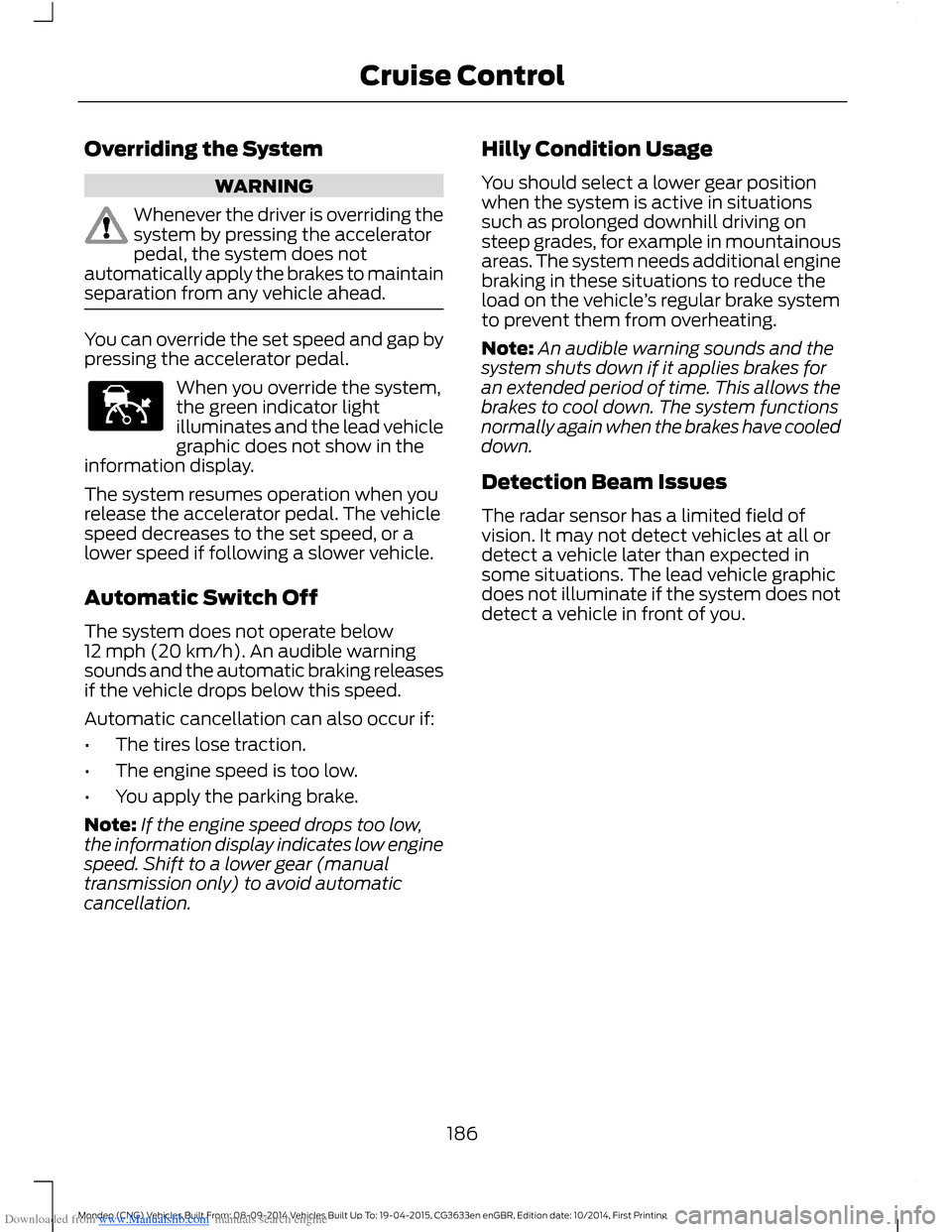
When you override the system,the green indicator lightilluminates and the lead vehiclegraphic does not show in theinformation display.
The system resumes operation when yourelease the accelerator pedal. The vehiclespeed decreases to the set speed, or alower speed if following a slower vehicle.
Automatic Switch Off
The system does not operate below12 mph (20 km/h). An audible warningsounds and the automatic braking releasesif the vehicle drops below this speed.
Automatic cancellation can also occur if:
•The tires lose traction.
•The engine speed is too low.
•You apply the parking brake.
Note:If the engine speed drops too low,the information display indicates low enginespeed. Shift to a lower gear (manualtransmission only) to avoid automaticcancellation.
Hilly Condition Usage
You should select a lower gear positionwhen the system is active in situationssuch as prolonged downhill driving onsteep grades, for example in mountainousareas. The system needs additional enginebraking in these situations to reduce theload on the vehicle’s regular brake systemto prevent them from overheating.
Note:An audible warning sounds and thesystem shuts down if it applies brakes foran extended period of time. This allows thebrakes to cool down. The system functionsnormally again when the brakes have cooleddown.
Detection Beam Issues
The radar sensor has a limited field ofvision. It may not detect vehicles at all ordetect a vehicle later than expected insome situations. The lead vehicle graphicdoes not illuminate if the system does notdetect a vehicle in front of you.
186Mondeo (CNG) Vehicles Built From: 08-09-2014 Vehicles Built Up To: 19-04-2015, CG3633en enGBR, Edition date: 10/2014, First PrintingCruise Control
Page 223 of 446

Downloaded from www.Manualslib.com manuals search engine BREAKING-IN
Tires
WARNING
New tires need to be run-in forapproximately 300 miles (500kilometers). During this time, youmay experience different drivingcharacteristics.
Brakes and Clutch
WARNING
Avoid heavy use of the brakes andclutch if possible for the first 100miles (150 kilometers) in town andfor the first 1000 miles (1500 kilometers)on freeways.
Engine
WARNING
Avoid driving too fast during the first1000 miles (1500 kilometers). Varyyour speed frequently and changeup through the gears early. Do not laborthe engine.
Vehicles With a Diesel Engine
During the first 2000 miles (3000kilometers), you may notice a ticking soundwhen your vehicle slows down. This is dueto adjustments of your new diesel engineand is normal.
REDUCED ENGINE
PERFORMANCE
WARNING
Continued operation will increase theengine temperature and cause theengine to shut down completely.
If the engine coolant temperature gaugeneedle moves to the upper limit position,the engine is overheating. See Gauges(page 78).
You must only drive your vehicle for a shortdistance if the engine overheats. Thedistance you can travel depends onambient temperature, vehicle load andterrain. The engine will continue to operatewith limited power for a short time.
If the engine temperature continues to rise,the fuel supply to the engine will reduce.The air conditioning will switch off and theengine cooling fan will operate continually.
1.Reduce your speed gradually and stopyour vehicle as soon as it is safe to doso.
2.Switch the engine off immediately toprevent severe engine damage.
3.Wait for the engine to cool down.
4.Check the coolant level. See EngineCoolant Check (page 247).
5.Have your vehicle checked by anauthorized dealer as soon as possible.
ECONOMICAL DRIVING
The following will help to improve fuelconsumption.
Tire Pressures
Check your tire pressures regularly tooptimize fuel economy. For best resultsuse the economy pressures. See TirePressures (page 273).
Gear Shifting
Use the highest drivable gear appropriatefor the road conditions.
221Mondeo (CNG) Vehicles Built From: 08-09-2014 Vehicles Built Up To: 19-04-2015, CG3633en enGBR, Edition date: 10/2014, First PrintingDriving Hints
Page 249 of 446
Downloaded from www.Manualslib.com manuals search engine Adding Engine Oil
WARNINGS
Only add oil when the engine is cold.If the engine is hot, wait 10 minutesfor the engine to cool down.
Do not remove the filler cap whenthe engine is running.
1.Remove the engine oil filler cap. SeeMaintenance (page 237).
2.Add engine oil that meets Fordspecifications. See Capacities andSpecifications (page 283).
3.Replace the engine oil filler cap. Turnit until you feel a strong resistance.
Note:Do not add oil further than themaximum mark. Oil levels above themaximum mark may cause engine damage.
Note:Soak up any spillage with anabsorbent cloth immediately.
ENGINE COOLANT CHECK
WARNINGS
Never remove the coolant reservoircap while the engine is running or hot.
Only add coolant when the engine iscold. If the engine is hot, wait 10minutes for the engine to cool down.
Do not allow the fluid to touch yourskin or eyes. If this happens, rinse theaffected areas immediately withplenty of water and contact your physician.
Undiluted coolant is flammable andmay ignite if spilt on a hot exhaust.
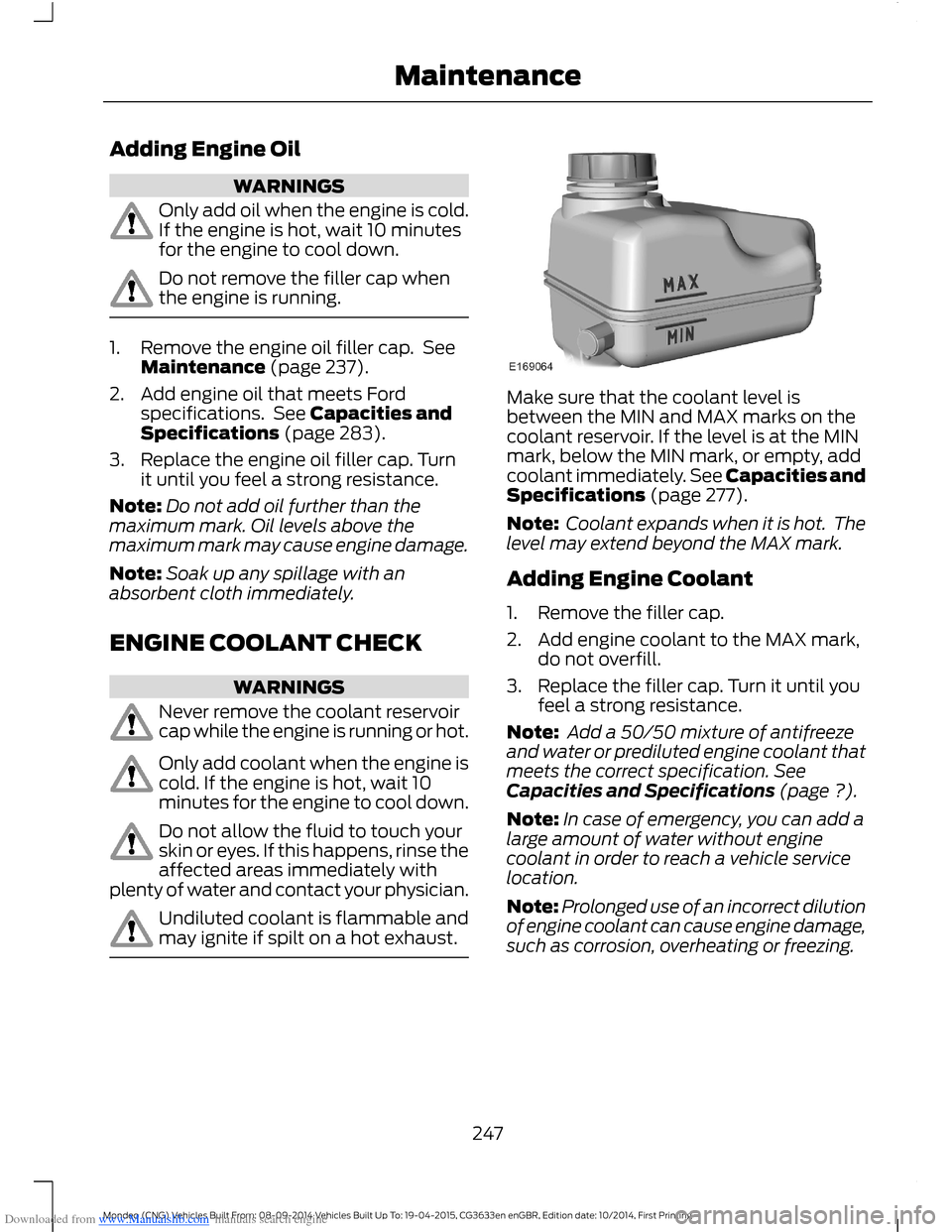
Make sure that the coolant level isbetween the MIN and MAX marks on thecoolant reservoir. If the level is at the MINmark, below the MIN mark, or empty, addcoolant immediately. See Capacities andSpecifications (page 277).
Note: Coolant expands when it is hot. Thelevel may extend beyond the MAX mark.
Adding Engine Coolant
1.Remove the filler cap.
2.Add engine coolant to the MAX mark,do not overfill.
3.Replace the filler cap. Turn it until youfeel a strong resistance.
Note: Add a 50/50 mixture of antifreezeand water or prediluted engine coolant thatmeets the correct specification. SeeCapacities and Specifications (page ?).
Note:In case of emergency, you can add alarge amount of water without enginecoolant in order to reach a vehicle servicelocation.
Note:Prolonged use of an incorrect dilutionof engine coolant can cause engine damage,such as corrosion, overheating or freezing.
247Mondeo (CNG) Vehicles Built From: 08-09-2014 Vehicles Built Up To: 19-04-2015, CG3633en enGBR, Edition date: 10/2014, First PrintingMaintenance
Page 267 of 446
Downloaded from www.Manualslib.com manuals search engine As a driver assistance feature, your vehiclehas a tire pressure monitoring system. Awarning lamp will illuminate when one ormore of the tires are significantlyunder-inflated. If the low tire pressurewarning lamp illuminates, you should stopyour vehicle as soon as it is safe to do so,check the tires and inflate them to thecorrect pressure.
Driving on under-inflated tires can:
•Cause them to overheat.
•Lead to tire failure.
•Reduce fuel efficiency.
•Reduce tire life.
•Affect vehicle handling or stoppingability.
The system is not a substitute for correcttire maintenance.
You must maintain the correct tirepressures, even if low tire pressure has notilluminated the warning lamp.
The tire pressure monitoring system has asystem malfunction indicator to warn youwhen the system is not operating correctly.The malfunction indicator and low tirepressure warning lamp have a combinedfunction. When the system detects amalfunction, the warning lamp will flashfor approximately one minute and thenremain illuminated. This sequence willoccur every time you switch the ignition onwhile the malfunction remains. The systemhas detected a fault that requires service.
When the malfunction indicator isilluminated, the system may not be ableto detect or signal low tire pressures. Amalfunction may occur for a variety ofreasons, including the installation of areplacement tire or wheel that preventsthe system from functioning correctly.Always check the tire pressure monitoringsystem malfunction warning after
replacing one or more tires or wheels onyour vehicle. Make sure the replacementtires or wheels allow the system tocontinue to function correctly. See Whenthe Temporary Spare Tire is Installedin this section.
Changing Tires With a TirePressure Monitoring System
You should always have tires serviced byan authorized dealer.
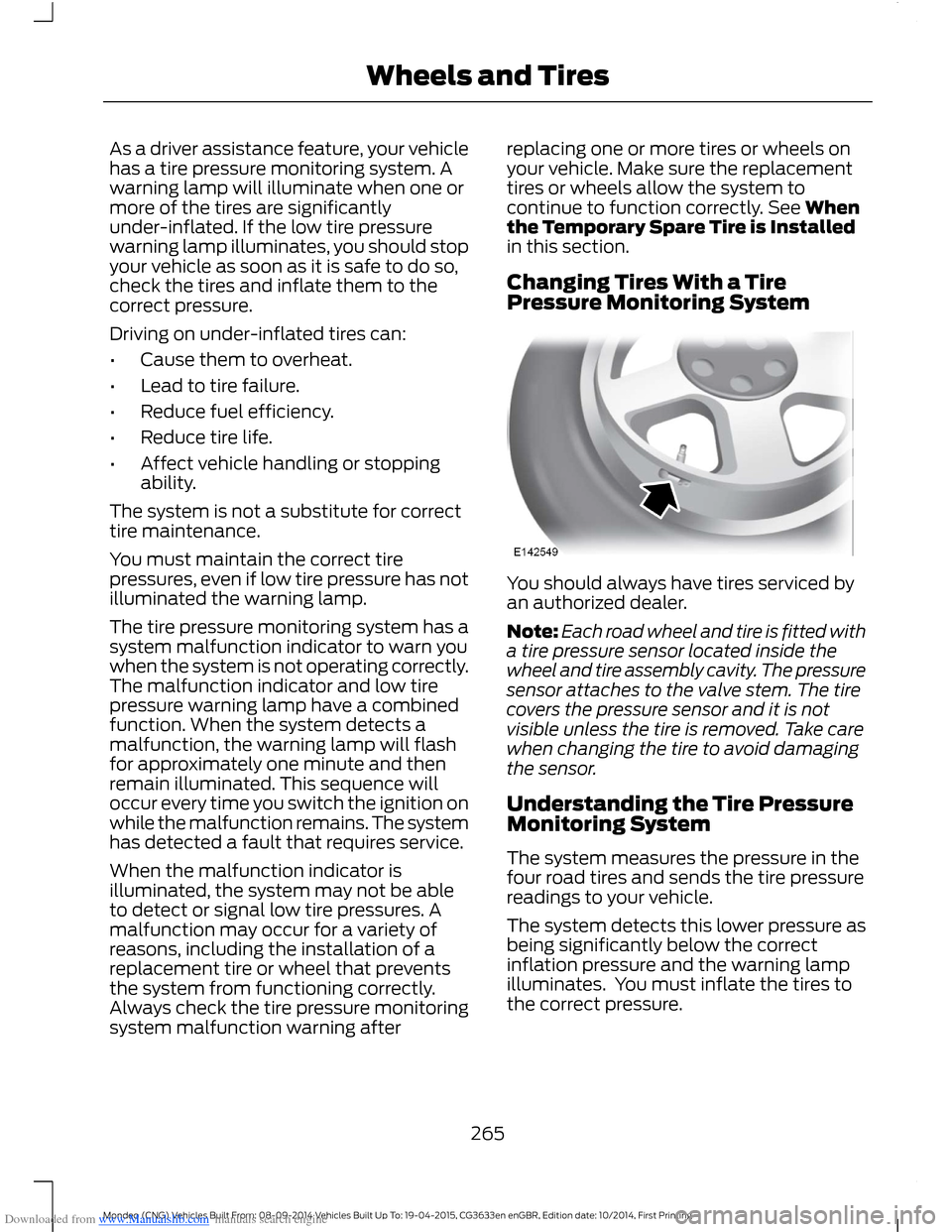
Note:Each road wheel and tire is fitted witha tire pressure sensor located inside thewheel and tire assembly cavity. The pressuresensor attaches to the valve stem. The tirecovers the pressure sensor and it is notvisible unless the tire is removed. Take carewhen changing the tire to avoid damagingthe sensor.
Understanding the Tire PressureMonitoring System
The system measures the pressure in thefour road tires and sends the tire pressurereadings to your vehicle.
The system detects this lower pressure asbeing significantly below the correctinflation pressure and the warning lampilluminates. You must inflate the tires tothe correct pressure.
265Mondeo (CNG) Vehicles Built From: 08-09-2014 Vehicles Built Up To: 19-04-2015, CG3633en enGBR, Edition date: 10/2014, First PrintingWheels and Tires