2014 FORD FIESTA service
[x] Cancel search: servicePage 188 of 396

Recycled Engine Coolant
Ford Motor Company does not recommend
the use of recycled engine coolant since a
Ford-approved recycling process is not yet
available.
Used engine coolant should be disposed
of in an appropriate manner. Follow your
community
’s regulations and standards
for recycling and disposing of automotive
fluids.
Severe Climates
If you drive in extremely cold climates:
• It may be necessary to have a Ford
authorized dealer increase the coolant
concentration above 50%.
• A coolant concentration of 60% will
provide improved freeze point
protection. Engine coolant
concentrations above 60% will
decrease the overheat protection
characteristics of the engine coolant
and may cause engine damage
If you drive in extremely hot climates:
• It may be necessary to have a Ford
authorized dealer decrease the coolant
concentration to 40%.
• A coolant concentration of 40% will
provide improved overheat protection.
Engine coolant concentrations below
40% will decrease the corrosion/freeze
protection characteristics of the engine
coolant and may cause engine
damage.
Vehicles driven year-round in non-extreme
climates should use prediluted engine
coolant for optimum cooling system and
engine protection. AUTOMATIC TRANSMISSION
FLUID CHECK
Note:
Transmission fluid should be checked
by an authorized dealer. If required, fluid
should be added by an authorized dealer.
The automatic transmission does not have
a transmission fluid dipstick.
Have an authorized dealer check and
change the transmission fluid and filter at
the correct service interval. See
Scheduled Maintenance (page 368). Your
transmission does not consume fluid.
However, the fluid level should be checked
if the transmission is not working properly,
(i.e., if the transmission slips or shifts
slowly) or if you notice some sign of fluid
leakage.
Do not use supplemental transmission
fluid additives, treatments or cleaning
agents. The use of these materials may
affect transmission operation and result
in damage to internal transmission
components.
BRAKE FLUID CHECK
Fluid levels between the MIN and MAX
lines are within the normal operating range;
there is no need to add fluid. If the fluid
levels are outside of the normal operating
range, the performance of the system
could be compromised; seek service from
your authorized dealer immediately.
POWER STEERING FLUID
CHECK
Your vehicle is equipped with an electric
power steering (EPS) system. There is no
fluid reservoir to check or fill.
185
Fiesta (CCT) Maintenance
Page 196 of 396
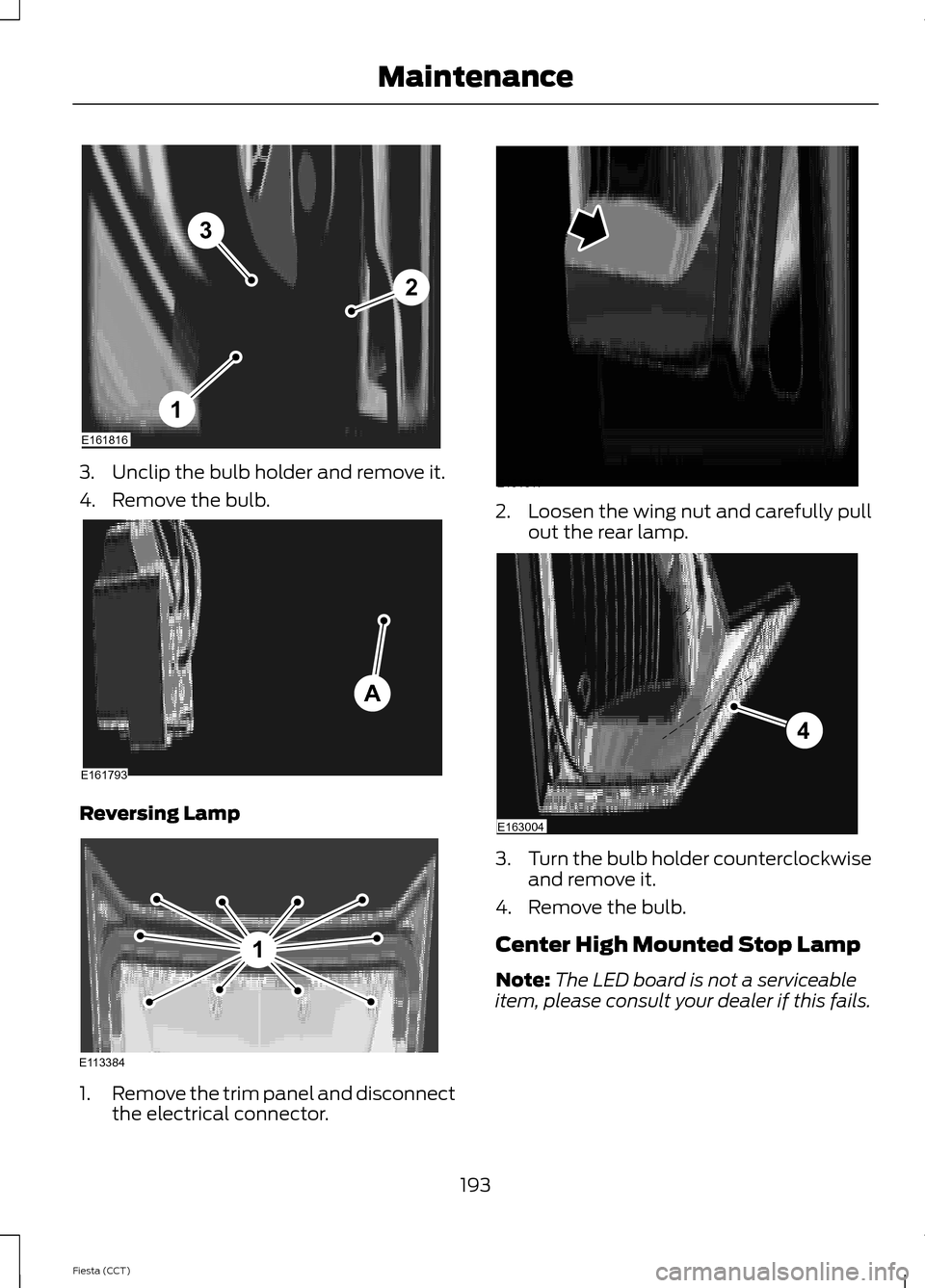
3. Unclip the bulb holder and remove it.
4. Remove the bulb.
Reversing Lamp
1.
Remove the trim panel and disconnect
the electrical connector. 2.
Loosen the wing nut and carefully pull
out the rear lamp. 3.
Turn the bulb holder counterclockwise
and remove it.
4. Remove the bulb.
Center High Mounted Stop Lamp
Note: The LED board is not a serviceable
item, please consult your dealer if this fails.
193
Fiesta (CCT) MaintenanceE161816
1
3
2 E161793
A 1
E113384 E161817 E163004
4
Page 201 of 396
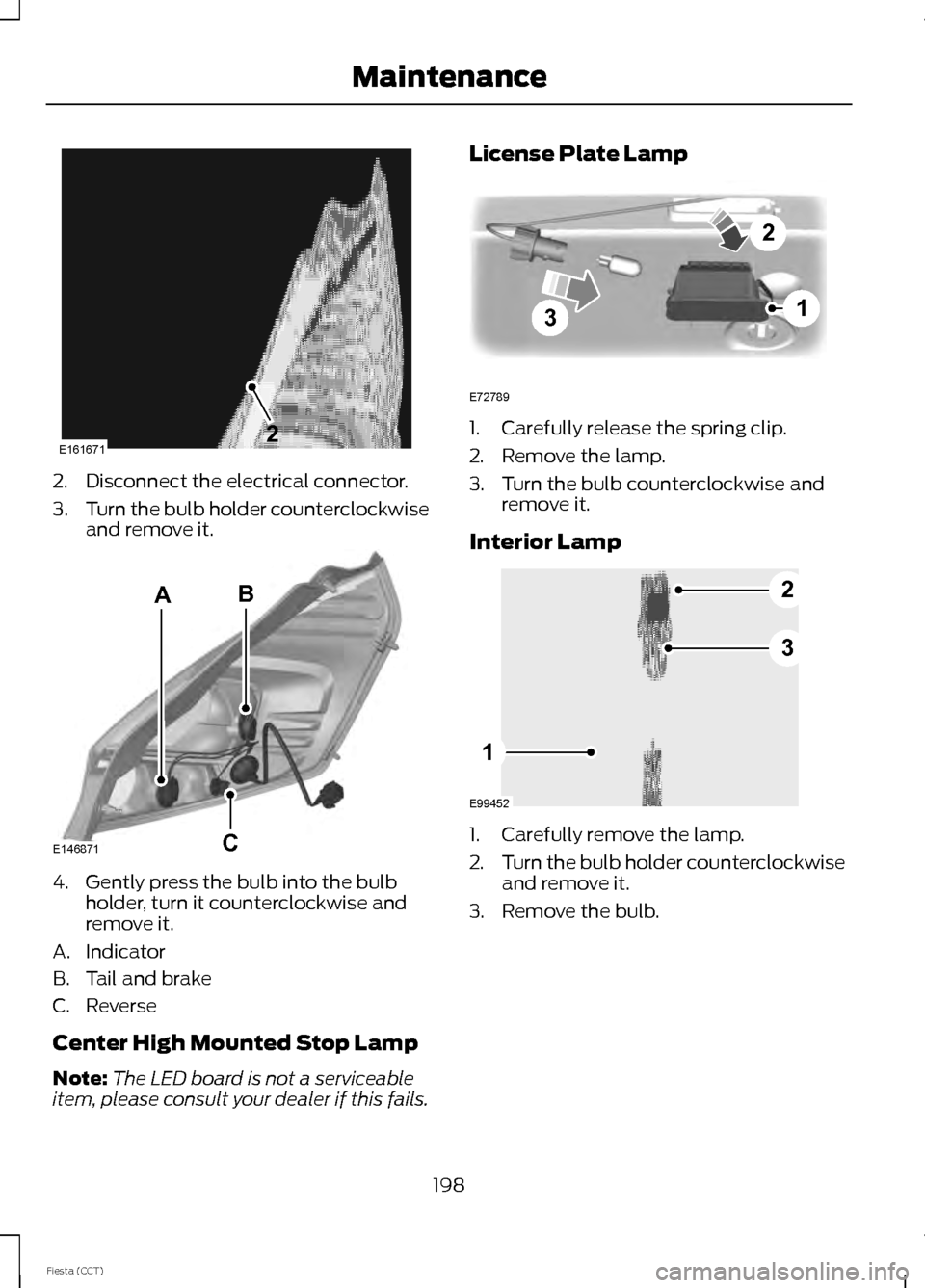
2. Disconnect the electrical connector.
3.
Turn the bulb holder counterclockwise
and remove it. 4. Gently press the bulb into the bulb
holder, turn it counterclockwise and
remove it.
A. Indicator
B. Tail and brake
C. Reverse
Center High Mounted Stop Lamp
Note: The LED board is not a serviceable
item, please consult your dealer if this fails. License Plate Lamp
1. Carefully release the spring clip.
2. Remove the lamp.
3. Turn the bulb counterclockwise and
remove it.
Interior Lamp 1. Carefully remove the lamp.
2.
Turn the bulb holder counterclockwise
and remove it.
3. Remove the bulb.
198
Fiesta (CCT) MaintenanceE1616712 E146871
AB
C 3
2
1
E72789 E99452
2
3
1
Page 203 of 396
Note:
On some vehicles the lamps are LED.
These are not serviceable items, have your
vehicle checked by an authorized dealer as
soon as possible.
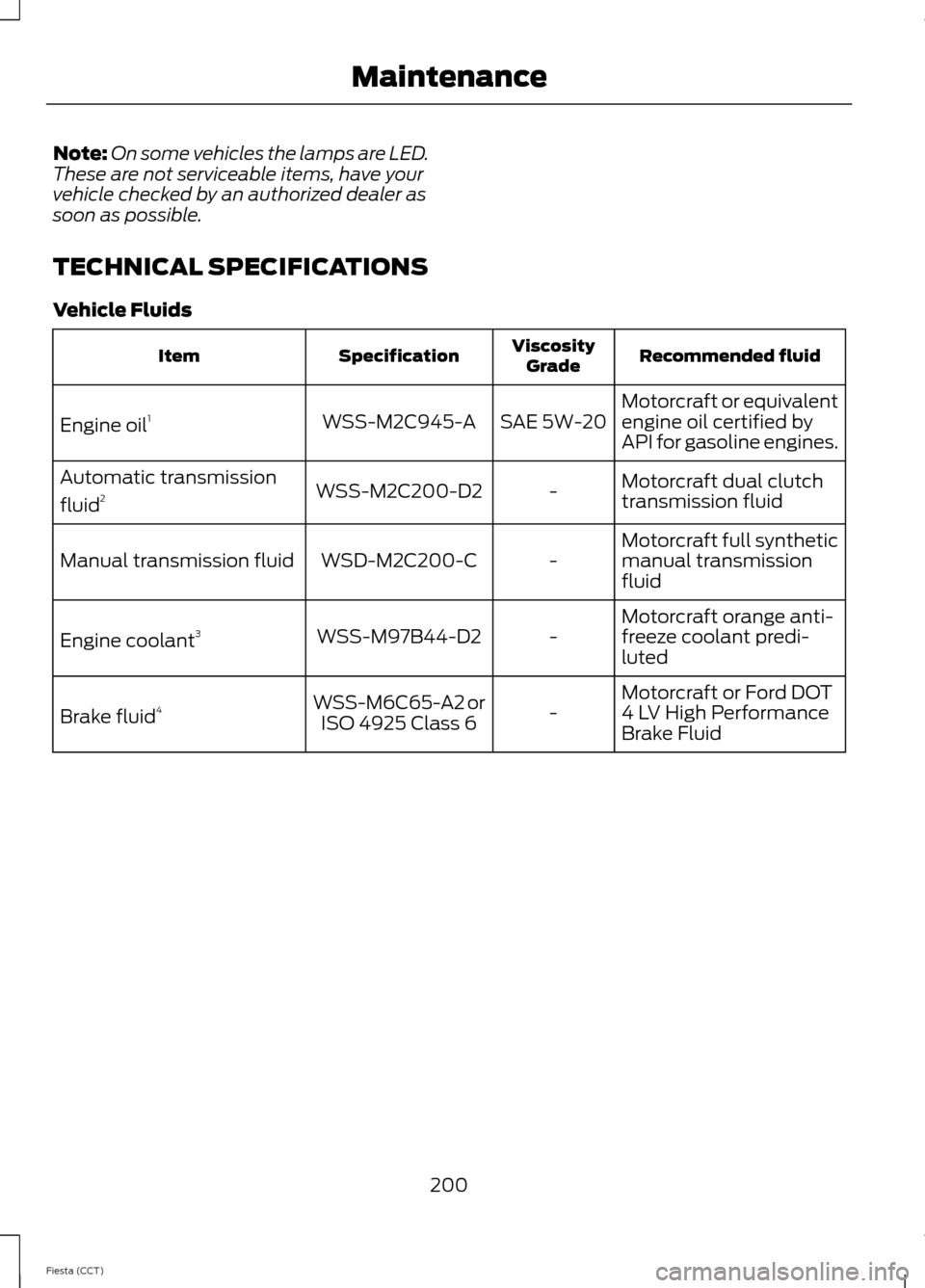
TECHNICAL SPECIFICATIONS
Vehicle Fluids Recommended fluid
Viscosity
Grade
Specification
Item
Motorcraft or equivalent
engine oil certified by
API for gasoline engines.
SAE 5W-20
WSS-M2C945-A
Engine oil 1
Motorcraft dual clutch
transmission fluid
-
WSS-M2C200-D2
Automatic transmission
fluid
2
Motorcraft full synthetic
manual transmission
fluid
-
WSD-M2C200-C
Manual transmission fluid
Motorcraft orange anti-
freeze coolant predi-
luted
-
WSS-M97B44-D2
Engine coolant 3
Motorcraft or Ford DOT
4 LV High Performance
Brake Fluid
-
WSS-M6C65-A2 or
ISO 4925 Class 6
Brake fluid 4
200
Fiesta (CCT) Maintenance
Page 204 of 396

Recommended fluid
Viscosity
Grade
Specification
Item
Multi purpose grease
(Lithium grease)
-
ESB-M1C93-B
Door latch, hood latch,
auxiliary hood latch, trunk
latch, seat tracks
Motorcraft penetrating
and lock lubricant
-
-
Lock cylinder
1 Your engine has been designed to be used with Ford engine oil, which gives a fuel economy
benefit while maintaining the durability of your engine.
Using oils other than the one specified can result in longer engine cranking periods, reduced
engine performance and reduced fuel economy.
2 Automatic transmissions that require Motorcraft MERCON LV transmission fluid should
only use Motorcraft MERCON LV transmission fluid.
Use of any fluid other than the recommended fluid may cause transmission damage.
Change the automatic transmission fluid and filter at the correct service interval. See
Scheduled Maintenance (page 368).
3 Add the coolant type originally used in your vehicle.
4 Use only Motorcraft DOT 4 LV High Performance Brake Fluid, or equivalent, meeting
WSS-M6C65-A2 or ISO 4925 Class 6. Use of any fluid other than the recommended fluid
may cause brake system damage. Capacity
Item
Variant
2.6 qt (2.5 L)
Windshield and rear
window washer system
All
6.1 qt (5.8 L)
Engine cooling
system
All
11.1 gal (42 L)
Fuel tank
1.0L EcoBoost and 1.6L Duratec-16V Ti-
VCT
12.7 gal (48 L)
Fuel tank
1.6L EcoBoost
4.3 qt (4.1 L)
Engine lubrication
system - including the oil filter
All
201
Fiesta (CCT) Maintenance
Page 210 of 396
4.
Remove the soaked cloth and if it is not
soiled badly, use this cloth to clean the
area by using a rubbing motion for 60
seconds.
5. Following this, wipe area dry with a clean, white, cotton cloth.
CLEANING LEATHER SEATS (IF
EQUIPPED)
For routine cleaning, wipe the surface with
a soft, damp cloth. For more thorough
cleaning, wipe the surface with a mild soap
and water solution. Dry the area with a soft
cloth. In Canada, use Motorcraft® Vinyl
Cleaner.
If the leather cannot be completely
cleaned using a mild soap and water
solution, the leather may be cleaned using
a commercially available leather cleaning
product designed for automotive interiors.
Note: To check for compatibility, first test
any cleaner or stain remover on an
inconspicuous part of the leather.
You should:
• remove dust and loose dirt with a
vacuum cleaner.
• clean spills and stains as quickly as
possible.
• To check for compatibility, first test any
cleaner or stain remover on an
inconspicuous part of the leather.
Do not use the following products as these
may damage the leather:
• oil/petroleum-based leather
conditioners.
• household cleaners.
• alcohol solutions.
• solvents or cleaners intended for
rubber, vinyl and plastics. CLEANING THE ALLOY
WHEELS
Note:
Do not apply a cleaning chemical to
warm or hot wheel rims and covers.
Note: Industrial-strength (heavy-duty)
cleaners, or cleaning chemicals, in
combination with brush agitation to remove
brake dust and dirt, could wear away the
clear coat finish over a period of time.
Note: Do not use hydrofluoric acid-based
or high caustic-based wheel cleaners, steel
wool, fuels or strong household detergent.
Note: If you intend parking your vehicle for
an extended period after cleaning the
wheels with a wheel cleaner, drive your
vehicle for a few minutes before doing so.
This will reduce the risk of increased
corrosion of the brake discs, brake pads and
linings.
Note: Some automatic car washes may
cause damage to the finish on your wheel
rims and covers.
Alloy wheels and wheel covers are coated
with a clear coat paint finish. To maintain
their condition we recommend that you:
• Clean them weekly with the
recommended wheel and tire cleaner.
• Use a sponge to remove heavy
deposits of dirt and brake dust
accumulation.
• Rinse them thoroughly with a
pressurized stream of water when you
have completed the cleaning process.
We recommend that you use Ford service
wheel cleaner. Make sure that you read
and follow the manufacturer ’s instructions.
Using other non-recommended cleaning
products can result in severe and
permanent cosmetic damage.
207
Fiesta (CCT) Vehicle Care
Page 214 of 396
U.S. Department of Transportation Tire
quality grades: The U.S. Department of
Transportation requires Ford Motor
Company to give you the following
information about tire grades exactly as
the government has written it.
Treadwear
The treadwear grade is a comparative
rating based on the wear rate of the tire
when tested under controlled conditions
on a specified government test course. For
example, a tire graded 150 would wear one
and one-half (1 ½) times as well on the
government course as a tire graded 100.
The relative performance of tires depends
upon the actual conditions of their use,
however, and may depart significantly from
the norm due to variations in driving habits,
service practices, and differences in road
characteristics and climate.
Traction AA A B C WARNING
The traction grade assigned to this
tire is based on straight-ahead
braking traction tests, and does not
include acceleration, cornering,
hydroplaning or peak traction
characteristics. The traction grades, from highest to lowest
are AA, A, B, and C. The grades represent
the tire
’s ability to stop on wet pavement
as measured under controlled conditions
on specified government test surfaces of
asphalt and concrete. A tire marked C may
have poor traction performance. Temperature A B C WARNING
The temperature grade for this tire
is established for a tire that is
properly inflated and not overloaded.
Excessive speed, under-inflation, or
excessive loading, either separately or in
combination, can cause heat buildup and
possible tire failure. The temperature grades are A (the
highest), B and C, representing the tire
’s
resistance to the generation of heat and
its ability to dissipate heat when tested
under controlled conditions on a specified
indoor laboratory test wheel. Sustained
high temperature can cause the material
of the tire to degenerate and reduce tire
life, and excessive temperature can lead
to sudden tire failure. The grade C
corresponds to a level of performance
which all passenger car tires must meet
under the Federal Motor Vehicle Safety
Standard No. 139. Grades B and A
represent higher levels of performance on
the laboratory test wheel than the
minimum required by law.
Glossary of Tire Terminology
*
Tire label: A label showing the
OE (Original Equipment) tire sizes,
recommended inflation pressure
and the maximum weight the
vehicle can carry.
*
Tire Identification Number
(TIN):
A number on the sidewall
of each tire providing information
about the tire brand and
manufacturing plant, tire size and
date of manufacture. Also referred
to as DOT code.
211
Fiesta (CCT) Wheels and Tires
Page 216 of 396
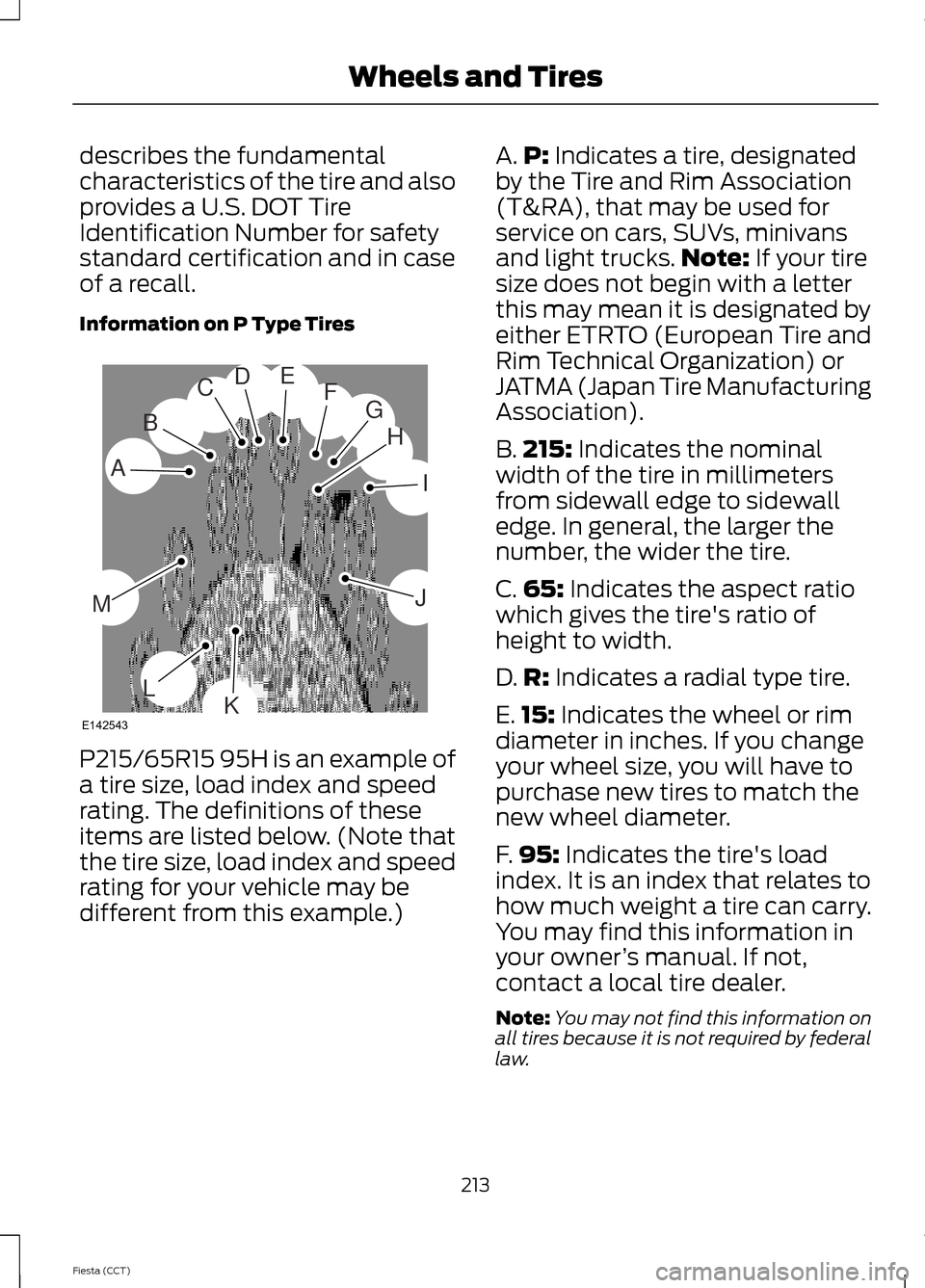
describes the fundamental
characteristics of the tire and also
provides a U.S. DOT Tire
Identification Number for safety
standard certification and in case
of a recall.
Information on P Type Tires
P215/65R15 95H is an example of
a tire size, load index and speed
rating. The definitions of these
items are listed below. (Note that
the tire size, load index and speed
rating for your vehicle may be
different from this example.) A.
P: Indicates a tire, designated
by the Tire and Rim Association
(T&RA), that may be used for
service on cars, SUVs, minivans
and light trucks. Note:
If your tire
size does not begin with a letter
this may mean it is designated by
either ETRTO (European Tire and
Rim Technical Organization) or
JATMA (Japan Tire Manufacturing
Association).
B. 215:
Indicates the nominal
width of the tire in millimeters
from sidewall edge to sidewall
edge. In general, the larger the
number, the wider the tire.
C. 65:
Indicates the aspect ratio
which gives the tire's ratio of
height to width.
D. R:
Indicates a radial type tire.
E. 15:
Indicates the wheel or rim
diameter in inches. If you change
your wheel size, you will have to
purchase new tires to match the
new wheel diameter.
F. 95:
Indicates the tire's load
index. It is an index that relates to
how much weight a tire can carry.
You may find this information in
your owner ’s manual. If not,
contact a local tire dealer.
Note: You may not find this information on
all tires because it is not required by federal
law.
213
Fiesta (CCT) Wheels and TiresH
I
J
KL
M
A
B
CDEFG
E142543