Page 20 of 284

TRIP COMPUTERGeneral information
The Trip computer is used to display information on
car operation when the key is turned to MAR-ON.
Two separate trips, called “Trip A” and “Trip B”,
are provided to monitor the entire mission (journey)
in a reciprocally independent manner.
Both functions can be reset (reset - start of a new
journey).
“Trip A” is used to display the figures relating to:
❒Outside temperature (for versions/markets where
provided)
❒Range
❒Distance covered
❒Average consumption
❒Instantaneous consumption
❒Average speed
❒Trip time (driving time).
“Trip B” is used to display the figures relating to:
❒Distance travelled B
❒Average consumption B
❒Average speed B
❒Trip time B (driving time).
NoteThe “Trip B” function may be disabled (see
“Activating Trip B”). The “Range” and “Instant
consumption" parameters cannot be reset.Values displayed
Range
This indicates the approximate distance which can be
travelled with the amount of fuel present in the
tank.“----”will appear on the display in the
following cases:
❒range value lower than 50 km (or 30 mi)
❒car parked with engine running for an extended
period.
IMPORTANT The range value variation can be
affected by several factors: driving style, type of route
(motorway, urban, mountain roads, etc.), conditions
of use (load, tyre pressures, etc.). Trip planning
must therefore take the above into account.
Distance covered
Shows the distance covered since the start of the
new journey.
Average consumption
Shows the approximate average fuel consumption
since the start of the new journey.
Instantaneous consumption
This indicates the fuel consumption. The value is
constantly updated. The display will show “----”if
the car is parked with the engine running.
16GETTING TO
KNOW YOUR CAR
SAFETY
STARTING AND
DRIVING
WARNING LIGHTS
AND MESSAGES
IN AN EMERGENCY
SERVICING AND
MAINTENANCE
TECHNICAL
SPECIFICATIONS
INDEX
Page 148 of 284

Never use a fast batter y-charger to star t
the engine as this could damage the
electronic systems of your car, par ticularly
the ignition and fuel supply control units.
WARNING
This procedure must be performed by
exper t personnel because incorrect
actions could cause electrical discharge of
considerable intensity. Furthermore, battery
fluid is poisonous and corrosive: avoid contact
with skin and eyes. Keep naked flames and
lighted cigarettes away from the battery and do
not cause sparks.
BUMP STARTING
Never bump start the engine by pushing, towing or
coasting downhill.
IMPORTANT Remember that the brake servo and
electrical power steering system are not active until
the engine is started. A much greater effort will
therefore be required to use the brake pedal or turn
the steering wheel.
CHANGING A WHEELGENERAL INSTRUCTIONS
The car is equipped with the “FIX&GO Automatic
Kit”: see the paragraph “FIX&GO Automatic Kit” for
how to use this device. As an alternative to the
“FIX&GO Automatic Kit” the car may be equipped
with a space-saver wheel: see the instructions on the
following pages for changing the tyre.
WARNING
The space-saver wheel (for versions/
markets where provided) is specific to
your car, do not use it on other models, or use
the space-saver wheel of other models on your
car.The space-saver wheel must only be used
in case of emergency. It must only be used
for the distance necessary to reach a service
point and the car speed must not exceed 80
km/h.The space-saver wheel has an orange
sticker that summarises the main cautions for
use and limitations. Never remove or cover
the label.The following information is provided
in four languages on the label: "Important!
For temporar y use only! 80 km/h max! Replace
with a standard tire as soon as possible. Never
cover this indication." Never apply a wheel
cap on a space-saver wheel.
144
GETTING TO KNOW
YOUR CAR
SAFETY
STARTING AND
DRIVING
WARNING LIGHTS
AND MESSAGES
IN AN
EMERGENCY
SERVICING AND
MAINTENANCE
TECHNICAL
SPECIFICATIONS
INDEX
Page 226 of 284
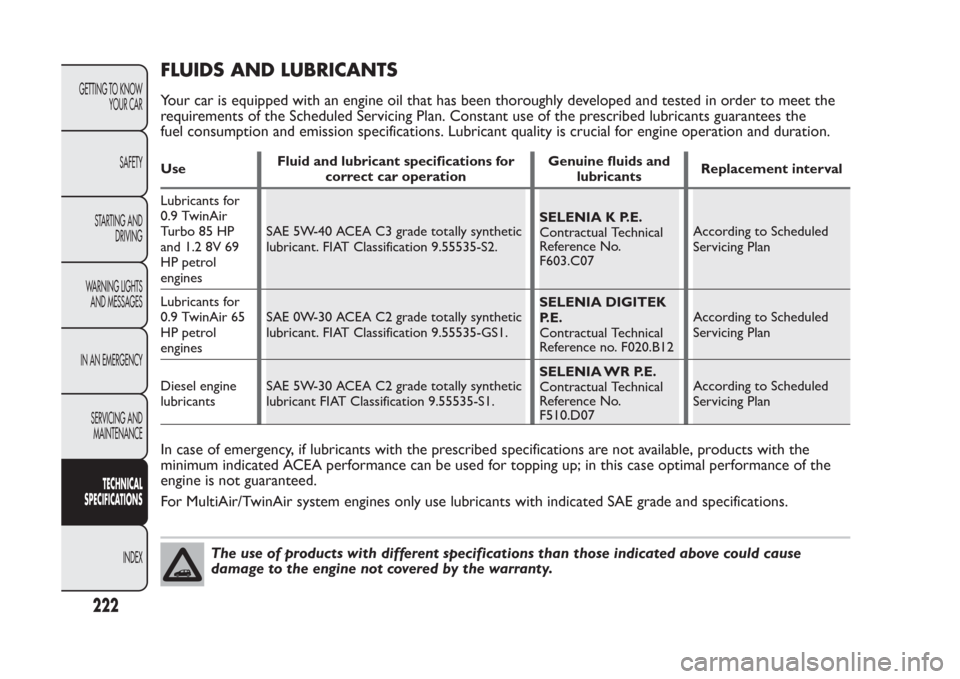
FLUIDS AND LUBRICANTSYour car is equipped with an engine oil that has been thoroughly developed and tested in order to meet the
requirements of the Scheduled Servicing Plan. Constant use of the prescribed lubricants guarantees the
fuel consumption and emission specifications. Lubricant quality is crucial for engine operation and duration.UseFluid and lubricant specifications for
correct car operationGenuine fluids and
lubricantsReplacement interval
Lubricants for
0.9 TwinAir
Turbo 85 HP
and 1.2 8V 69
HP petrol
enginesSAE 5W-40 ACEA C3 grade totally synthetic
lubricant. FIAT Classification 9.55535-S2.SELENIA K P.E.
Contractual Technical
Reference No.
F603.C07According to Scheduled
Servicing Plan
Lubricants for
0.9 TwinAir 65
HP petrol
enginesSAE 0W-30 ACEA C2 grade totally synthetic
lubricant. FIAT Classification 9.55535-GS1.SELENIA DIGITEK
P.E.
Contractual Technical
Reference no. F020.B12According to Scheduled
Servicing Plan
Diesel engine
lubricantsSAE 5W-30 ACEA C2 grade totally synthetic
lubricant FIAT Classification 9.55535-S1.SELENIA WR P.E.
Contractual Technical
Reference No.
F510.D07According to Scheduled
Servicing PlanIn case of emergency, if lubricants with the prescribed specifications are not available, products with the
minimum indicated ACEA performance can be used for topping up; in this case optimal performance of the
engine is not guaranteed.
For MultiAir/TwinAir system engines only use lubricants with indicated SAE grade and specifications.
The use of products with different specifications than those indicated above could cause
damage to the engine not covered by the warranty.
222
GETTING TO KNOW
YOUR CAR
SAFETY
STARTING AND
DRIVING
WARNING LIGHTS
AND MESSAGES
IN AN EMERGENCY
SERVICING AND
MAINTENANCE
TECHNICAL
SPECIFICATIONS
INDEX