2014 FIAT DUCATO button
[x] Cancel search: buttonPage 150 of 367
SEAT BELTSUSING THE SEAT BELTS
The belt should be worn keeping the
torso straight and rested against the
backrest.
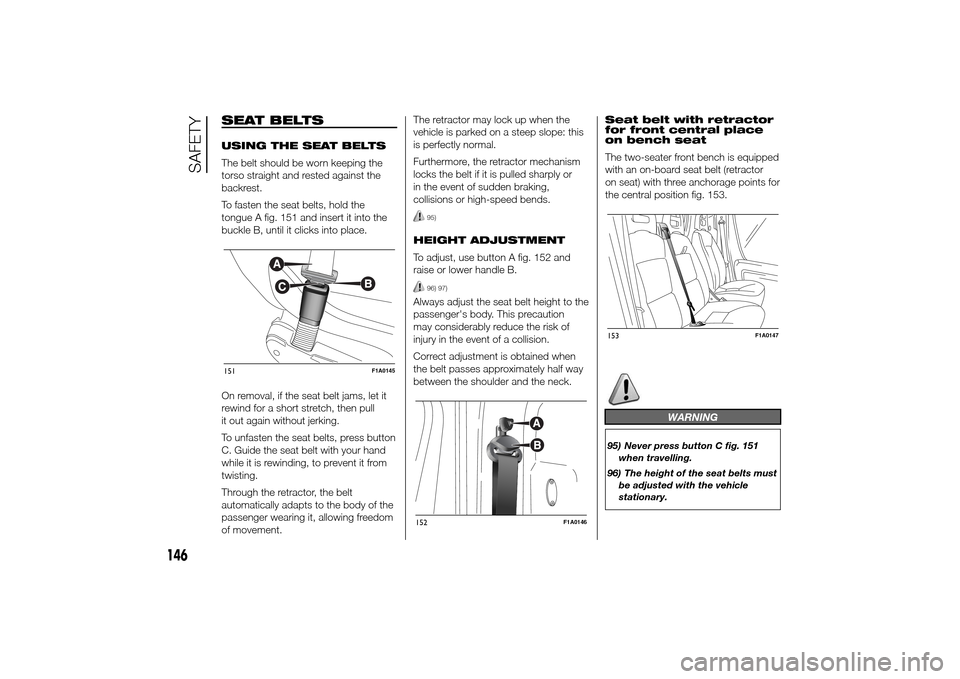
To fasten the seat belts, hold the
tongue A fig. 151 and insert it into the
buckle B, until it clicks into place.
On removal, if the seat belt jams, let it
rewind for a short stretch, then pull
it out again without jerking.
To unfasten the seat belts, press button
C. Guide the seat belt with your hand
while it is rewinding, to prevent it from
twisting.
Through the retractor, the belt
automatically adapts to the body of the
passenger wearing it, allowing freedom
of movement.The retractor may lock up when the
vehicle is parked on a steep slope: this
is perfectly normal.
Furthermore, the retractor mechanism
locks the belt if it is pulled sharply or
in the event of sudden braking,
collisions or high-speed bends.
95)
HEIGHT ADJUSTMENT
To adjust, use button A fig. 152 and
raise or lower handle B.
96) 97)
Always adjust the seat belt height to the
passenger's body. This precaution
may considerably reduce the risk of
injury in the event of a collision.
Correct adjustment is obtained when
the belt passes approximately half way
between the shoulder and the neck.Seat belt with retractor
for front central place
on bench seat
The two-seater front bench is equipped
with an on-board seat belt (retractor
on seat) with three anchorage points for
the central position fig. 153.
WARNING
95) Never press button C fig. 151
when travelling.
96) The height of the seat belts must
be adjusted with the vehicle
stationary.
151
F1A0145
152
F1A0146
153
F1A0147
146
SAFETY
Page 157 of 367
Below is a summary of
the main safety rules to
be followed when
carrying children
❒The recommended position for
installing child restraint systems is on
the rear seat, as it is the most
protected area in the event of an
impact.
❒If the passenger's front airbag is
deactivated always check the
dedicated LED on button
on the
instrument panel to make sure that it
has actually been deactivated.
❒Carefully follow the instructions that
come with the child restraint system,
which the manufacturer must supply.
Keep the instructions in the vehicle
along with the other papers and this
handbook. Do not use second-hand
child restraint systems without
instructions.
❒Always check that the seat belt is
well fastened by pulling on it.
❒Only one child is to be strapped into
each restraint system; never carry
two children using one child restraint
system.
❒Always check that the seat belts do
not restrain the child's throat.
❒While travelling, do not let the child sit
incorrectly or unfasten the belts.❒Never carry children on your lap,
even newborns. No-one can restrain
a child in the event of an accident.
❒In the event of an accident, replace
the child restraint system with a
new one.
153
Page 158 of 367
WARNING
104)Do not place a rearward facing
cradle seat on the front seat if the
passenger side airbag is enabled.
Deployment of the airbag in an
accident could cause fatal injuries
to the child regardless of the
severity of the impact. It is
advisable to always carry children
in a child restraint system on the
rear seat, which is the most
protected position in the event of
a collision. If you need to carry
a child on the front passenger
seat in a rearward facing cradle
seat, the passenger side airbags
(front and side bags for chest/
pelvis protection, for
versions/markets, where
provided) must be deactivated
using the setup menu. It is
important to check the dedicated
LED on button
on the
instrument panel to make sure
that they are actually deactivated.
The passenger seat must also bepositioned back as far as possible
in order to avoid the child
restraint system from coming into
contact with the dashboard.
105) The figures are indicative and
for assembly purposes only. Fit
the child restraint system
according to the instructions,
which must be included.
106) Some child restraint systems
for weight group 0 and 1 have a
rear attachment to the car seat
belts and its own seat belts for
securing the child. Due to their
weight, they may be dangerous if
incorrectly mounted (e.g. if
fastened to the vehicle seat belts
placing a cushion in between).
Follow the assembly instructions
carefully.
SETUP FOR
“UNIVERSAL
ISOFIX” CHILD
RESTRAINT SYSTEMProvision has been made on the vehicle
to fit Universal Isofix child restraint
systems, a new European standardised
system for carrying children safely.
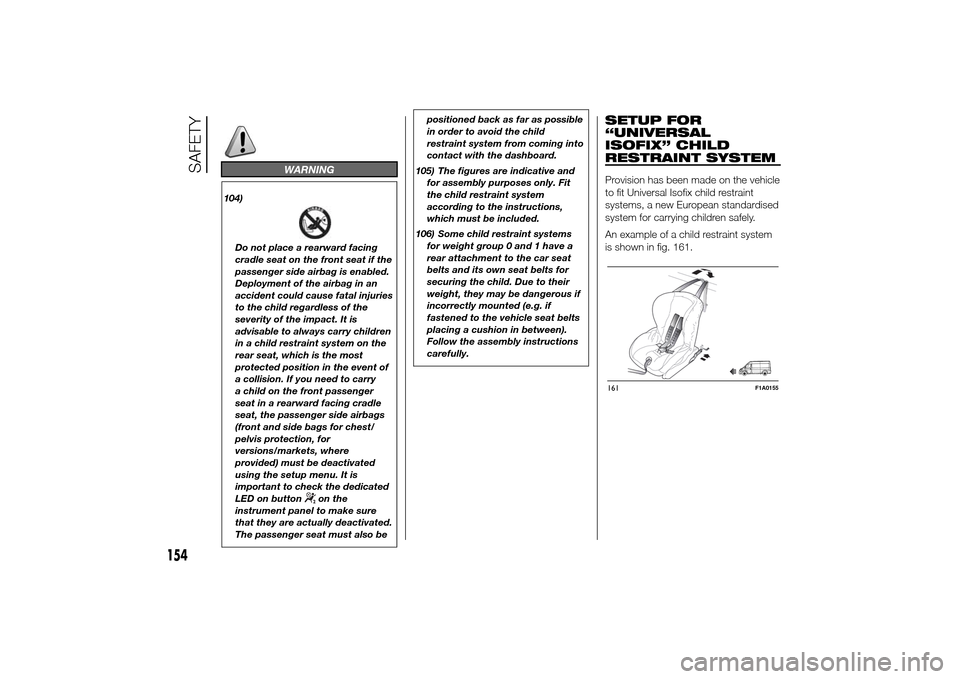
An example of a child restraint system
is shown in fig. 161.161
F1A0155
154
SAFETY
Page 165 of 367
FRONT PASSENGER SIDE
AIRBAG AND CHILD
RESTRAINT SYSTEMS
111)
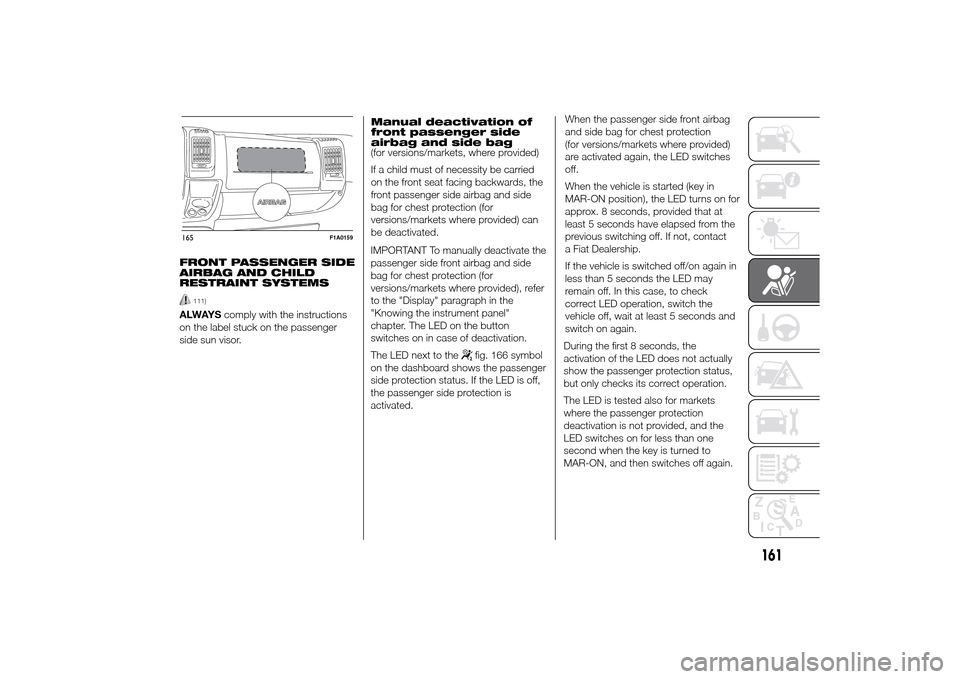
ALWAYScomply with the instructions
on the label stuck on the passenger
side sun visor.Manual deactivation of
front passenger side
airbag and side bag
(for versions/markets, where provided)
If a child must of necessity be carried
on the front seat facing backwards, the
front passenger side airbag and side
bag for chest protection (for
versions/markets where provided) can
be deactivated.
IMPORTANT To manually deactivate the
passenger side front airbag and side
bag for chest protection (for
versions/markets where provided), refer
to the "Display" paragraph in the
"Knowing the instrument panel"
chapter. The LED on the button
switches on in case of deactivation.
The LED next to the
fig. 166 symbol
on the dashboard shows the passenger
side protection status. If the LED is off,
the passenger side protection is
activated.When the passenger side front airbag
and side bag for chest protection
(for versions/markets where provided)
are activated again, the LED switches
off.
When the vehicle is started (key in
MAR-ON position), the LED turns on for
approx. 8 seconds, provided that at
least 5 seconds have elapsed from the
previous switching off. If not, contact
a Fiat Dealership.
If the vehicle is switched off/on again in
less than 5 seconds the LED may
remain off. In this case, to check
correct LED operation, switch the
vehicle off, wait at least 5 seconds and
switch on again.
During the first 8 seconds, the
activation of the LED does not actually
show the passenger protection status,
but only checks its correct operation.
The LED is tested also for markets
where the passenger protection
deactivation is not provided, and the
LED switches on for less than one
second when the key is turned to
MAR-ON, and then switches off again.
165
F1A0159
161
Page 171 of 367

118) If the key is inserted and turned
to MAR-ON, airbags may be
deployed if another vehicle
crashes into the vehicle even if
the engine is not running and the
vehicle is stationary. Therefore,
even if the car is stationary, when
an active front passenger airbag
is fitted, DO NOT install rear
facing child restraint systems on
the front passenger seat.
Deployment of the airbag
following an impact could cause
fatal injuries to the child.
Therefore, always deactivate the
passenger airbag when a rear
facing child restraint system is
installed on the front passenger
seat. The front passenger seat
must also be positioned back as
far as possible in order to prevent
the child restraint system from
coming into contact with the
dashboard. Immediately
reactivate the passenger airbag
as soon as the child restraint
system has been removed. Also
remember that, if the key is
turned to STOP, none of the
safety devices (airbags or
pretensioners) will be deployed in
the event of collision. Non-
deployment in such cases does
not indicate a system malfunction.119) If the vehicle has been subject
to theft, attempted theft,
vandalism, or flooding, have the
airbag system inspected at a Fiat
Dealership.
120) When the ignition key is turned
to MAR-ON, the LED on button
on the dashboard blinks for a
few seconds (the number of
seconds may depend on the
market) to check the correct
operation of the LED on the
button.
121) Do not wash the seats with
water or pressurised steam (by
hand or at automatic car seat
washing stations).
122) The front airbag deploys in the
event of more severe collisions
than those required for deploying
the pretensioners. For impacts
whose intensity falls between the
two levels, normally, only the
pretensioners will be activated.
123) Do not affix rigid objects to the
coat hooks or support handles.124) The airbag does not replace
seat belts but increases their
efficiency. Furthermore, since
front airbags are not deployed in
low-speed frontal impacts, side
impacts, rear shunts or roll-overs,
the passengers are protected
only by the seat belts which must
therefore be fastened at all
times.
167
Page 176 of 367

PARKINGProceed as follows:
❒stop the engine and engage the
handbrake;
❒engage a gear (on a slope, engage
first gear if the car is facing uphill or
reverse if it is facing downhill) and
leave the wheels steered.
If the vehicle is parked on a steep
slope, it is advisable to block the
wheels with a wedge or stone.
Do not leave the key in the ignition as
this drains the battery. Always remove
the key when you leave the car.
126)
HANDBRAKE
The handbrake lever is located to the
left of the driver's seat fig. 170. Pull the
lever upwards to engage the handbrake
and ensure that the vehicle does not
move.
IMPORTANT Make sure that the
handbrake is engaged in such a way as
to ensure the stationing of the vehicle,
especially in the case of steep slopes
and full load.
IMPORTANT If this is not the case,
contact a Fiat Dealership to have the
handbrake adjusted. If the lever travel
gets longer, contact a Fiat Dealership.
When the handbrake lever is engaged
and the ignition key is in MAR-ON
position, the instrument panel warning
light
will switch on.Proceed as follows to release the
handbrake:
❒slightly lift the lever and press release
button A;
❒keep button A pressed and lower the
lever.
The
warning light in the instrument
panel will switch off.
Press the brake pedal when carrying
out this operation to prevent the vehicle
from moving accidentally.
33)
IMPORTANT Apply the handbrake only
when the vehicle is at a standstill or
with the vehicle in motion only in the
event of a failure in the hydraulic
system. If exceptional use is made of
the handbrake with the vehicle in
motion, moderate traction is advisable
in order not to cause locking of the
rear end with consequent swerving of
the vehicle.
170
F1A0162
172
STARTING AND DRIVING
Page 196 of 367

❒arrange the jack near the lift support
closest to the wheel to be replaced
at the points shown in fig. 179.
For short wheelbase versions with
retractable footboard, the jack must
be positioned at the lift point shown
in fig. 180 aligned (45°) so that it
does not interfere with the retractable
footboard;
❒warn all bystanders that the vehicle is
about to be lifted. They must stay
clear and not touch the vehicle until it
is back on the ground.❒for versions equipped with
self-levelling air suspension, before
raising the vehicle with the jack,
press buttons A and B fig. 181
simultaneously for at least 5 seconds.
The operating mode for raising the
vehicle is activated: the LEDs on the
buttons come on constantly. To
exit this mode, press buttons A and
B simultaneously for another 5
seconds; both LEDs on the buttons
will go out and full system operation
will be restored. This mode
deactivates automatically when the
speed of approx. 5 km/h is
exceeded.
143)
❒lift the vehicle.
After lifting the vehicle:❒for all versions, when gaining access
through the vehicle's right rear wheel
arch, adjust the screw A fig. 182
for the spare wheel retaining device,
using the wrench provided with
the dedicated extension/adaptor
Bfig. 182;
❒turn wrench C fig. 183 anticlockwise
1 to allow the spare wheel to be
lowered;
❒continue turning anticlockwise until
the stop point, indicated by the
stiffening of the manoeuvre or a click
from the clutch present in the device;
144) 145)
❒use the wheel dismantling spanner to
remove the wheel from the vehicle
fig. 184;
180
F1A0169
181
F1A0170
182
F1A0171
192
IN AN EMERGENCY
Page 202 of 367

FOR CHECKING AND
RESTORING PRESSURE
ONLY
The compressor can also be used
solely for restoring pressure.
❒Pull the handbrake.
❒Undo the cap for the tyre valve,
extract the pipe C fig. 197 with the
quick coupling and connect it directly
to the valve of the tyre to be inflated.
❒Insert the plug in the nearest 12
V power socket and start the engine.
❒Rotate the selector clockwise to the
pressure renewal position.
❒Activate the kit by pressing the on/off
switch. Inflate the tyre to the pressure
specified in the "Inflation pressure"
paragraph, in the "Technical Data"
chapter.NOTE If the tyre has to be deflated,
press the dedicated button B illustrated
in fig. 198. For a more accurate
reading, it is advisable to check the
pressure reading on the pressure gauge
with the compressor off and without
moving the centre selector from the
pressure renewal position.BOTTLE REPLACEMENT
PROCEDURE
To replace the bottle, proceed as
follows:
❒press button A fig. 199 to release the
part;
❒fit the new bottle and press until it is
automatically engaged.197
F1A0185
198
F1A0186
199
F1A0187
198
IN AN EMERGENCY