Page 111 of 275
❒The performance of the parking assistance system
may also be affected by the position of the
sensors. For example, if the geometry is altered
(as a result of wear of the shock absorbers,
suspension), the tyres are changed, the vehicle is
too heavily laden or specific tuning is carried
out that lowers the vehicle.
❒The detection of obstacles at the top part of the
car may not be guaranteed because the system
detects obstacles that could cause an impact with
the car in the bottom part.
AT THE FILLING STATIONMOTORI DIESEL - Operation at low
temperatures
If the outside temperature is very low, diesel
thickens due to the formation of paraffin clots with
consequent defective operation of the fuel supply
system.
In order to avoid these problems, different types of
diesel are distributed according to the season:
summer type, winter type and arctic type
(cold/mountain areas). If refuelling with diesel fuel
whose specifications are not suitable for the current
temperature, it is advisable to mix TUTELA DIESEL
ART additive in the proportions shown on the
container. Pour the additive into the tank before the
diesel fuel.
When using or parking the car for a long time in the
mountains or cold areas, it is advisable to refuel
using locally available diesel. In this case, it is also
advisable to keep the tank over 50% full.
107GETTING TO
KNOW YOUR CARSAFETY
STARTING AND
DRIVING
WARNING LIGHTS
AND MESSAGES
IN AN EMERGENCY
SERVICING AND
MAINTENANCE
TECHNICAL
SPECIFICATIONS
INDEX
Page 114 of 275
SAFETY
SEAT BELTSUSING THE SEAT BELTS
The seat belt should be worn keeping the torso
straight and rested against the backrest.
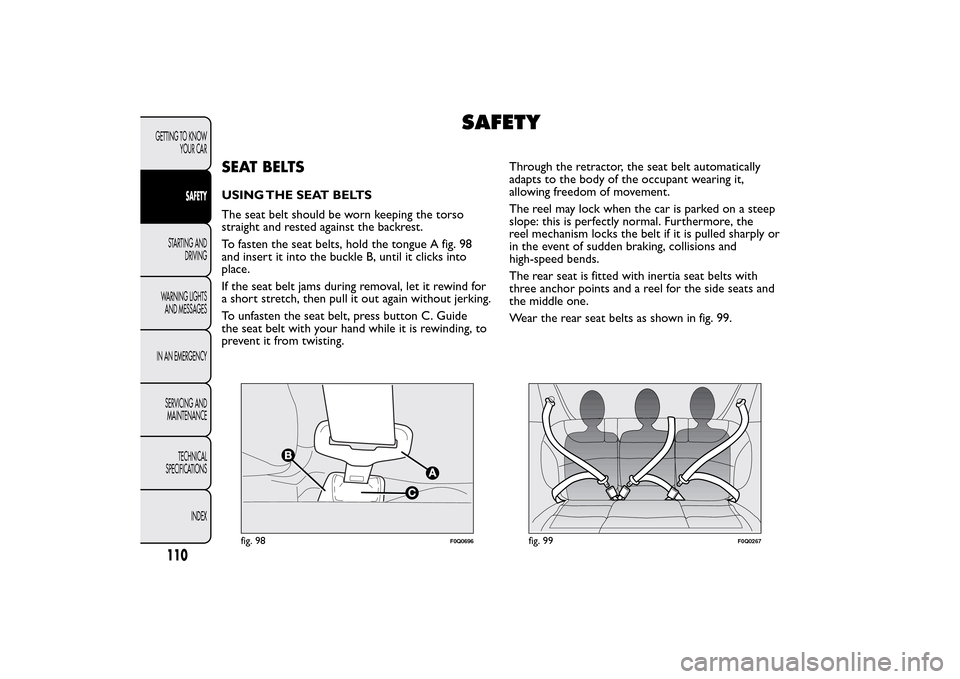
To fasten the seat belts, hold the tongue A fig. 98
and insert it into the buckle B, until it clicks into
place.
If the seat belt jams during removal, let it rewind for
a short stretch, then pull it out again without jerking.
To unfasten the seat belt, press button C. Guide
the seat belt with your hand while it is rewinding, to
prevent it from twisting.Through the retractor, the seat belt automatically
adapts to the body of the occupant wearing it,
allowing freedom of movement.
The reel may lock when the car is parked on a steep
slope: this is perfectly normal. Furthermore, the
reel mechanism locks the belt if it is pulled sharply or
in the event of sudden braking, collisions and
high-speed bends.
The rear seat is fitted with inertia seat belts with
three anchor points and a reel for the side seats and
the middle one.
Wear the rear seat belts as shown in fig. 99.
fig. 98
F0Q0696
fig. 99
F0Q0267
110GETTING TO KNOW
YOUR CAR
SAFETY
STARTING AND
DRIVING
WARNING LIGHTS
AND MESSAGES
IN AN EMERGENCY
SERVICING AND
MAINTENANCE
TECHNICAL
SPECIFICATIONS
INDEX
Page 115 of 275
WARNING
Never press button C fig. 98 when
travelling.
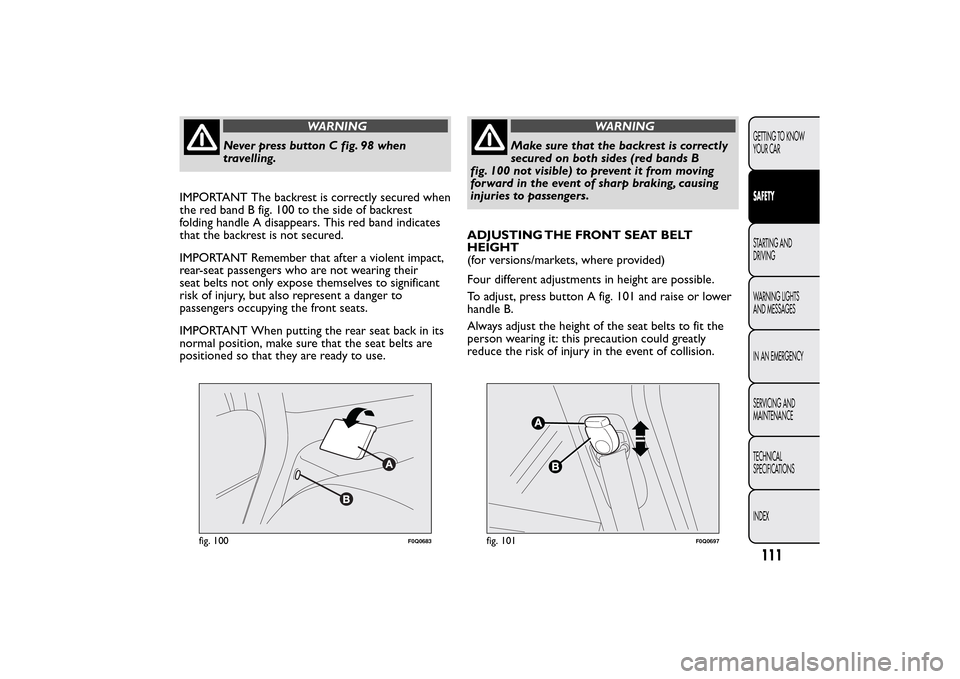
IMPORTANT The backrest is correctly secured when
the red band B fig. 100 to the side of backrest
folding handle A disappears. This red band indicates
that the backrest is not secured.
IMPORTANT Remember that after a violent impact,
rear-seat passengers who are not wearing their
seat belts not only expose themselves to significant
risk of injury, but also represent a danger to
passengers occupying the front seats.
IMPORTANT When putting the rear seat back in its
normal position, make sure that the seat belts are
positioned so that they are ready to use.
WARNING
Make sure that the backrest is correctly
secured on both sides (red bands B
fig. 100 not visible) to prevent it from moving
forward in the event of sharp braking, causing
injuries to passengers.
ADJUSTING THE FRONT SEAT BELT
HEIGHT
(for versions/markets, where provided)
Four different adjustments in height are possible.
To adjust, press button A fig. 101 and raise or lower
handle B.
Always adjust the height of the seat belts to fit the
person wearing it: this precaution could greatly
reduce the risk of injury in the event of collision.
fig. 100
F0Q0683
fig. 101
F0Q0697
111GETTING TO KNOW
YOUR CARSAFETYSTARTING AND
DRIVING
WARNING LIGHTS
AND MESSAGES
IN AN EMERGENCY
SERVICING AND
MAINTENANCE
TECHNICAL
SPECIFICATIONS
INDEX
Page 120 of 275
SEAT BELTS MAINTENANCE
Observe the following precautions for correct seat
belt maintenance:
❒always use the seat belt with the strap well
stretched and not twisted; make sure that it is free
to run without obstructions;
❒check seat belt operation as follows: attach the
seat belt and pull it hard;
❒replace the belt after an accident of a certain
severity even if it does not appear to be damaged.
Always replace the seat belt if the pretensioners
were deployed;
❒to clean the seat belts, wash by hand with water
and neutral soap, rinse and leave to dry in the
shade. Never use strong detergents, bleach, paints
or any other substance which could damage the
belt fibres;
❒prevent the reels from getting wet: their correct
operation is only guaranteed if water does not
get inside;
❒replace the seat belt when it shows wear or cuts.
CARRYING CHILDREN SAFELYFor optimal protection in the event of an impact, all
occupants must be seated and wearing adequate
restraint systems, including newborn and other
children!
This prescription is compulsory in all EC countries
according to EC Directive 2003/20/EC.
Compared with an adult, a child's head is larger and
heavier in proportion to his/her body and the child's
muscular and bone structures are not fully
developed. Therefore, correct restraint systems
other than adult seat belts are necessary to reduce
as much as possible the risk of injuries in the event
of an accident, braking or a sudden manoeuvre.
Children must be seated safely and comfortably. As
far as the characteristics of the child restraint
systems used allow, you are advised to keep children
in rear facing restraint systems for as long as possible
(at least until 3–4 years old), since this is the most
protected position in the event of an impact.
The choice of the most suitable child restraint device
depends on the weight of the child; there are
various types of child restraint systems and you are
advised always to choose the one that is most
suitable for the child.
116GETTING TO KNOW
YOUR CAR
SAFETY
STARTING AND
DRIVING
WARNING LIGHTS
AND MESSAGES
IN AN EMERGENCY
SERVICING AND
MAINTENANCE
TECHNICAL
SPECIFICATIONS
INDEX
Page 121 of 275

When over 1.50 m in height, from the point of view
of restraint systems, children are considered as
adults and wear seat belts normally.
In Europe the characteristics of children restraint
systems are ruled by the regulation ECE-R44, dividing
them into five weight groups:Group Weight groups
Group 0 up to 10 kg of weight
Group 0+ up to 13 kg of weight
Group 1 9-18 kg in weight
Group 2 15-25 kg in weight
Group 3 22-36 kg of weightAll child restraint devices must bear the certification
data, together with the control mark, on a label
solidly fixed to the seat which must never be
removed.
Lineaccessori Fiat offers child restraint systems for
each weight group. These devices are recommended
having been specifically designed for Fiat cars.
WARNING
SEVERE DANGER.When an active
passenger airbag is fitted, DO NOT
install rear facing child restraint systems
on the front seat . Deployment of the
airbag in an accident could cause fatal injuries
to the child regardless of the severity of the
impact . It is advisable to always carr y children
in a child restraint system on the rear seat ,
which is the most protected position in the
event of a collision.
WARNING
On the sun visor there is a label with
suitable symbols reminding the user that
it is compulsory to deactivate the airbag if a
rear facing child restraint system is fitted.
Always comply with the instructions on the
passenger's side sun visor (see the "Front
airbag" paragraph).
WARNING
Do not move the front or rear seat if a
child is seated on it or on the dedicated
child restraint system.
117GETTING TO KNOW
YOUR CARSAFETYSTARTING AND
DRIVING
WARNING LIGHTS
AND MESSAGES
IN AN EMERGENCY
SERVICING AND
MAINTENANCE
TECHNICAL
SPECIFICATIONS
INDEX
Page 125 of 275
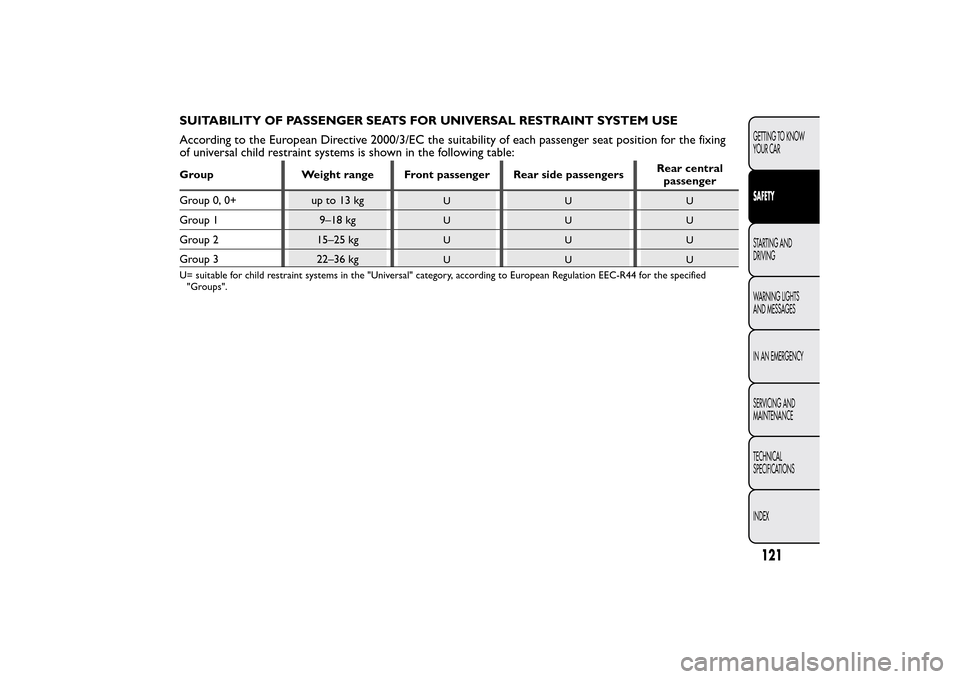
SUITABILITY OF PASSENGER SEATS FOR UNIVERSAL RESTRAINT SYSTEM USE
According to the European Directive 2000/3/EC the suitability of each passenger seat position for the fixing
of universal child restraint systems is shown in the following table:Group Weight range Front passenger Rear side passengersRear central
passenger
Group 0, 0+ up to 13 kg
UUU
Group 1 9–18 kg
UUU
Group 2 15–25 kg
UUU
Group 3 22–36 kg
UUU
U= suitable for child restraint systems in the "Universal" category, according to European Regulation EEC-R44 for the specified
"Groups".
121GETTING TO KNOW
YOUR CARSAFETYSTARTING AND
DRIVING
WARNING LIGHTS
AND MESSAGES
IN AN EMERGENCY
SERVICING AND
MAINTENANCE
TECHNICAL
SPECIFICATIONS
INDEX
Page 126 of 275
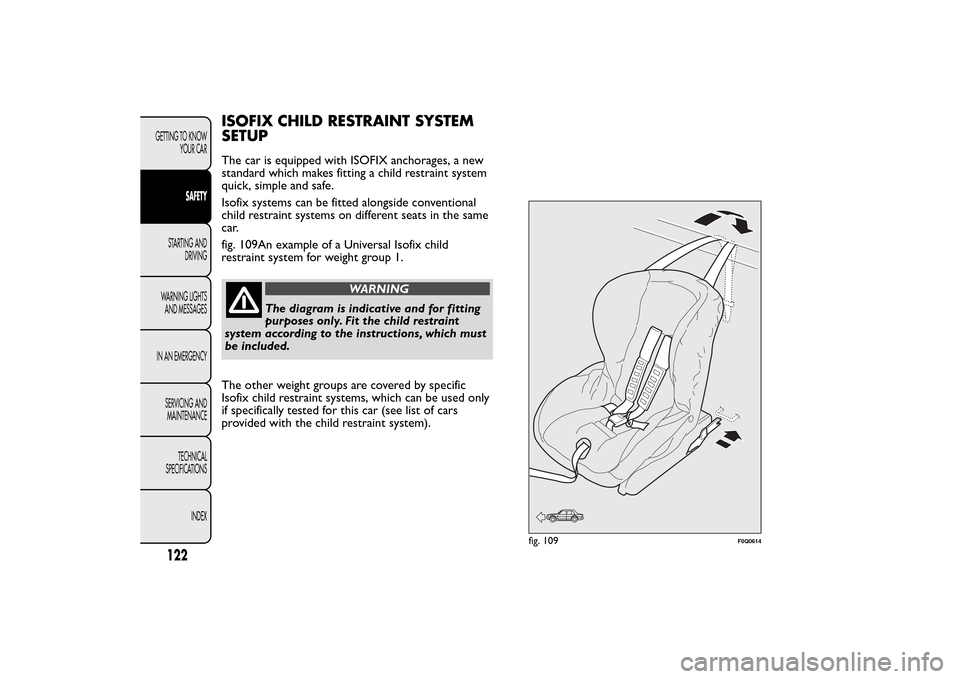
ISOFIX CHILD RESTRAINT SYSTEM
SETUPThe car is equipped with ISOFIX anchorages, a new
standard which makes fitting a child restraint system
quick, simple and safe.
Isofix systems can be fitted alongside conventional
child restraint systems on different seats in the same
car.
fig. 109An example of a Universal Isofix child
restraint system for weight group 1.
WARNING
The diagram is indicative and for fitting
purposes only. Fit the child restraint
system according to the instructions, which must
be included.
The other weight groups are covered by specific
Isofix child restraint systems, which can be used only
if specifically tested for this car (see list of cars
provided with the child restraint system).
fig. 109
F0Q0614
122GETTING TO KNOW
YOUR CAR
SAFETY
STARTING AND
DRIVING
WARNING LIGHTS
AND MESSAGES
IN AN EMERGENCY
SERVICING AND
MAINTENANCE
TECHNICAL
SPECIFICATIONS
INDEX
Page 128 of 275
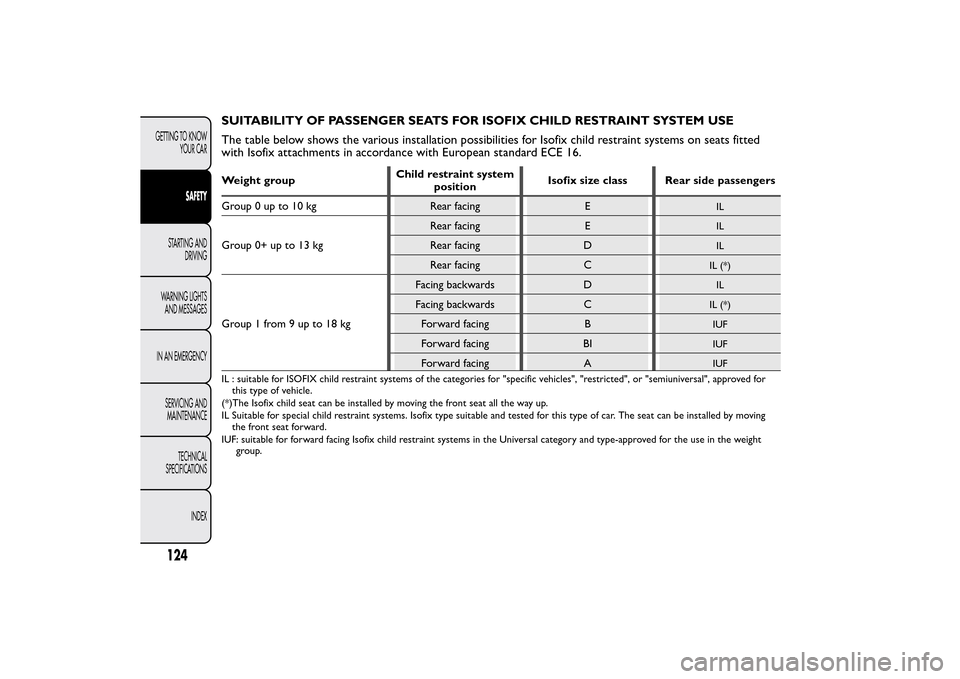
SUITABILITY OF PASSENGER SEATS FOR ISOFIX CHILD RESTRAINT SYSTEM USE
The table below shows the various installation possibilities for Isofix child restraint systems on seats fitted
with Isofix attachments in accordance with European standard ECE 16.Weight groupChild restraint system
positionIsofix size class Rear side passengers
Group 0 up to 10 kg Rear facing E
IL
Group 0+ up to 13 kgRear facing E
IL
Rear facing D
IL
Rear facing C
IL (*)
Group1from9upto18kgFacing backwards D
IL
Facing backwards C
IL (*)
Forward facing B
IUF
Forward facing BI
IUF
Forward facing A
IUF
IL : suitable for ISOFIX child restraint systems of the categories for "specific vehicles", "restricted", or "semiuniversal", approved for
this type of vehicle.
(*)The Isofix child seat can be installed by moving the front seat all the way up.
IL Suitable for special child restraint systems. Isofix type suitable and tested for this type of car. The seat can be installed by moving
the front seat forward.
IUF: suitable for forward facing Isofix child restraint systems in the Universal category and type-approved for the use in the weight
group.
124GETTING TO KNOW
YOUR CAR
SAFETY
STARTING AND
DRIVING
WARNING LIGHTS
AND MESSAGES
IN AN EMERGENCY
SERVICING AND
MAINTENANCE
TECHNICAL
SPECIFICATIONS
INDEX