2014 FIAT BRAVO ECU
[x] Cancel search: ECUPage 146 of 275
WARNING
The ABS with which the car may be
equipped will not control the braking
system of the trailer. Particular caution is
required on slippery roads.
WARNING
Never modify the braking system of the
car to control the trailer brake.The
trailer braking system must be fully
independent of the car ’s hydraulic system.
INSTALLING THE TOW HOOK
The towing device should be fastened to the
bodywork by specialised personnel according to any
additional and/or integrative information supplied
by the Manufacturer of the device. The towing device
must meet current regulations with reference to
Directive 94/20/EEC and subsequent amendments.
For any version the towing device used must be right
for the towable weight of the car on which it is to
be installed.IMPORTANT The use of auxiliary loads other than
external lights (electric brake, winch, etc.) must
be used with engine running.
For the electric connection a unified connector
should be used, which is generally placed on a special
bracket fastened to the towing device, and a special
ECU should be installed on the car to control the
trailer's exterior lights.
7 or 13-pole 12 V DC connections should be used
(CUNA/UNI and ISO/DIN Standards). Follow any
instructions provided by the car manufacturer and/or
the towing device manufacturer.
An electric brake or winch should be powered
directly by the battery through a cable with a
cross-section of no less than 2.5 mm
2.
IMPORTANT Electric brakes or other devices must
be used with engine running.
In addition to the electrical branches, the vehicle's
electrical system can be connected only to the supply
cable for an electric brake and to the cable for an
internal trailer light, though not more than 15 W. For
connections use the preset control unit with battery
cable no less than 2.5 mm
2.
142GETTING TO KNOW
YOUR CAR
SAFETYSTARTING AND
DRIVINGWARNING LIGHTS
AND MESSAGES
IN AN EMERGENCY
SERVICING AND
MAINTENANCE
TECHNICAL
SPECIFICATIONS
INDEX
Page 172 of 275
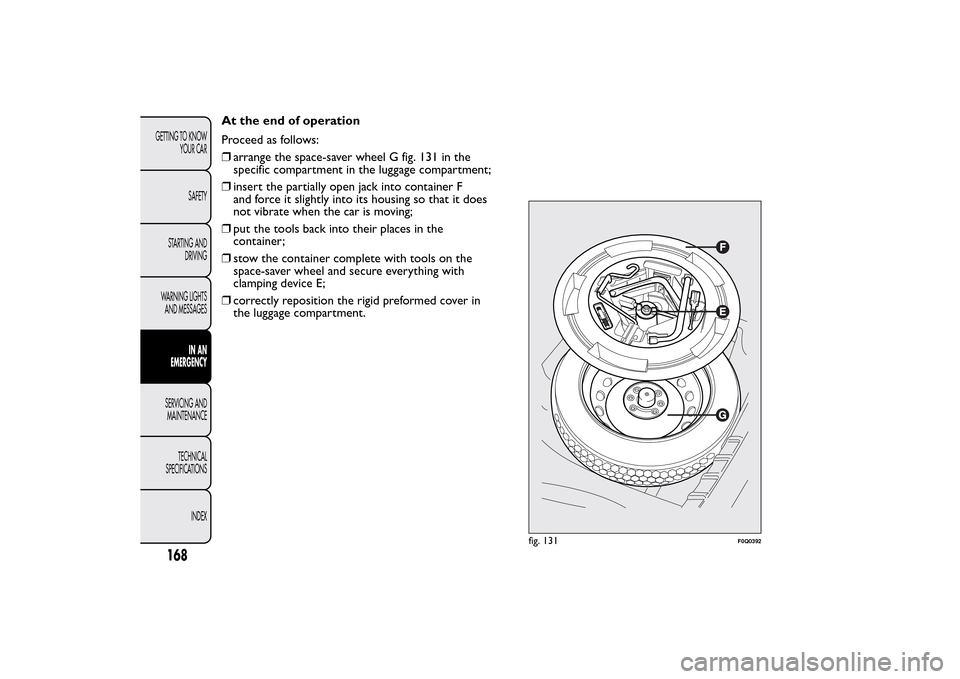
At the end of operation
Proceed as follows:
❒arrange the space-saver wheel G fig. 131 in the
specific compartment in the luggage compartment;
❒insert the partially open jack into container F
and force it slightly into its housing so that it does
not vibrate when the car is moving;
❒put the tools back into their places in the
container;
❒stow the container complete with tools on the
space-saver wheel and secure everything with
clamping device E;
❒correctly reposition the rigid preformed cover in
the luggage compartment.
fig. 131
F0Q0392
168GETTING TO KNOW
YOUR CAR
SAFETY
STARTING AND
DRIVING
WARNING LIGHTS
AND MESSAGES
IN AN
EMERGENCY
SERVICING AND
MAINTENANCE
TECHNICAL
SPECIFICATIONS
INDEX
Page 174 of 275
WARNING
If the wheel rim has been damaged
(bent so as to cause air to leak), the tyre
may not be repaired. Do not remove foreign
bodies (screws or nails) from the tyre.
IMPORTANT INFORMATION:
The sealing fluid of the quick tyre repair kit is
effective with external temperatures of between
−20°C and +50°C.
WARNING
Never operate the compressor for longer
than 20 consecutive minutes. Risk of
overheating.The kit is not suitable for definitive
repairs, so the repaired tyres may only be
used temporarily.Dispose of the cylinder and the sealing
fluid properly. Have the sealing fluid and
the cylinder disposed of in compliance
with national and local regulations.
WARNING
The cylinder contains ethylene glycol
and latex: it may cause an allergic
reaction. It is harmful if swallowed. It is irritant
for the eyes in case of contact . May cause
irritation if inhaled or on contact . Avoid contact
with the eyes, skin and clothes. In the event of
contact , rinse immediately with plenty of water.
If ingested, do not induce vomiting. Rinse out
your mouth, drink large quantities of water and
seek immediate medical attention. Keep away
from children.The product must not be used
by asthmatics. Do not inhale the vapours during
insertion and suction. Call a doctor immediately
if allergic reactions are noted. Store the
cylinder in the specific compartment , away
from sources of heat .The sealing fluid has an
expiry date. Replace the cylinder containing
out-of-date sealing fluid.
170GETTING TO KNOW
YOUR CAR
SAFETY
STARTING AND
DRIVING
WARNING LIGHTS
AND MESSAGES
IN AN
EMERGENCY
SERVICING AND
MAINTENANCE
TECHNICAL
SPECIFICATIONS
INDEX
Page 188 of 275

REPLACING INTERIOR BULBSFor the type of bulb and corresponding power rating,
see the paragraph "Changing a bulb".
FRONT ROOF LIGHT
To change the bulbs, proceed as follows:
❒operate in the points indicated by the arrows and
remove light A fig. 156;
❒open protective flap B fig. 157;
❒replace the bulbs C releasing them from the side
contacts and making sure that the new bulbs are
correctly secured between the contacts;
❒close flap B fig. 157 and fix roof light A fig. 156 in
its housing, making sure that it locks into place.
fig. 155
F0Q0719
fig. 156
F0Q0720
fig. 157
F0Q0721
184GETTING TO KNOW
YOUR CAR
SAFETY
STARTING AND
DRIVING
WARNING LIGHTS
AND MESSAGES
IN AN
EMERGENCY
SERVICING AND
MAINTENANCE
TECHNICAL
SPECIFICATIONS
INDEX
Page 221 of 275
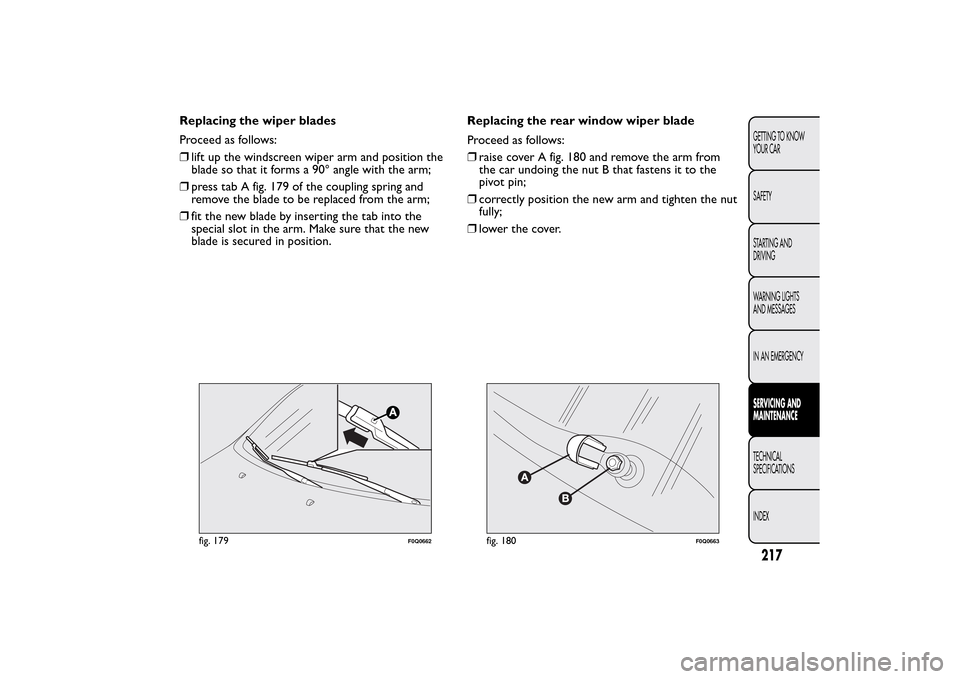
Replacing the wiper blades
Proceed as follows:
❒lift up the windscreen wiper arm and position the
blade so that it forms a 90° angle with the arm;
❒press tab A fig. 179 of the coupling spring and
remove the blade to be replaced from the arm;
❒fit the new blade by inserting the tab into the
special slot in the arm. Make sure that the new
blade is secured in position.Replacing the rear window wiper blade
Proceed as follows:
❒raise cover A fig. 180 and remove the arm from
the car undoing the nut B that fastens it to the
pivot pin;
❒correctly position the new arm and tighten the nut
fully;
❒lower the cover.
fig. 179
F0Q0662
fig. 180
F0Q0663
217GETTING TO KNOW
YOUR CAR
SAFETY
STARTING AND
DRIVING
WARNING LIGHTS
AND MESSAGES
IN AN EMERGENCYSERVICING AND
MAINTENANCETECHNICAL
SPECIFICATIONS
INDEX
Page 226 of 275
INTERIORSPeriodically check for water puddles under the mats
that could cause the panels to rust.
Replace the worn carpet mats, if present, with
genuine products and make sure they remain
securely fastened to the passenger compartment
carpet. It is not advisable to use non genuine mats
that could move whilst driving.
WARNING
Never use flammable products, such as
petrol ether or rectified petrol to clean
the inside of the car.The electrostatic charges
which are generated by rubbing during the
cleaning operation may cause a fire.
WARNING
Do not keep aerosol cans in the car:
they might explode. Aerosol cans must
not be exposed to a temperature exceeding
50°C .When the car is exposed to sunlight ,
internal temperature can greatly exceed this
value.
SEATS AND FABRIC PARTS
Remove dust with a soft brush or a vacuum cleaner.
Rub the seats with a sponge and a solution of water
and mild soap.
222GETTING TO KNOW
YOUR CAR
SAFETY
STARTING AND
DRIVING
WARNING LIGHTS
AND MESSAGES
IN AN EMERGENCYSERVICING AND
MAINTENANCE
TECHNICAL
SPECIFICATIONS
INDEX
Page 271 of 275

Fuel level gauge ........................... 5
Fuel supply ................................... 230
Fuse boxes (location)................ 188
Fuses
– dashboard fuse box.............. 189
– engine compartment fuse
box next to the battery ............
190-191
– fuse list.................................... 193
– luggage compartment
fuse box .................................. 192
– replacing fuses ....................... 187G
Holder........................... 70
Glove compartment light
– bulb replacement.................. 186
H
andbrake .................................. 137
Hazard warning lights ................ 63
Headlight alignment
corrector .................................... 88
Headlights ..................................... 88
– bulb replacement.................. 177
Headlight washers ...................... 58
Head restraints............................ 31
Heated rear window and
door mirrors
demisting/defrosting ...... 40-44-48
Heating and ventilation ............. 39Hill Holder (system) .................. 92
Identification data
– bodywork paint plate .......... 226
– chassis marking ..................... 226
– engine marking ...................... 226
– identification data plate ...... 225
Ignition switch ............................. 16
Initialisation procedure.............. 74
Installing
electrical/electronic devices ... 96
Installing the tow hook............. 142
Interior fittings ............................ 66
Interiors (cleaning) .................... 222
Internal air recirculation
activation................................ 41-44
Internal mirror............................. 34Jack ............................................... 164Key without remote
control ........................................ 8
Key with remote control .......... 9Light clusters
– rear light clusters
(changing a bulb)................... 181
Lights off ....................................... 52
Load limiters ............................... 113Luggage compartment ............... 80
– Extending ................................ 81
– Opening ................................... 80
– Securing your load ................ 84
Luggage compartment roof
light
– bulb replacement.................. 186
M
ain beam headlights ............... 52
– bulb replacement.................. 179
Maintenance and care
– Scheduled servicing.............. 202
– scheduled servicing plan ..... 203
Manual climate control
system ......................................... 42
Menu items................................... 20
MSR system.................................. 93
MSR (system) ............................... 93
N
umber plate lights
– bulb replacement.................. 183
Parking......................................... 137
Parking lights ................................ 52
Parking sensors .......................... 103
Passenger compartment
heating .................................... 40-43
Passenger front airbag .............. 127
Performance (top speed) ......... 240
267GETTING TO KNOW
YOUR CAR
SAFETY
STARTING AND
DRIVING
WARNING LIGHTS
AND MESSAGES
IN AN EMERGENCY
SERVICING AND
MAINTENANCE
TECHNICAL
SPECIFICATIONSINDEX
lass