Page 631 of 698
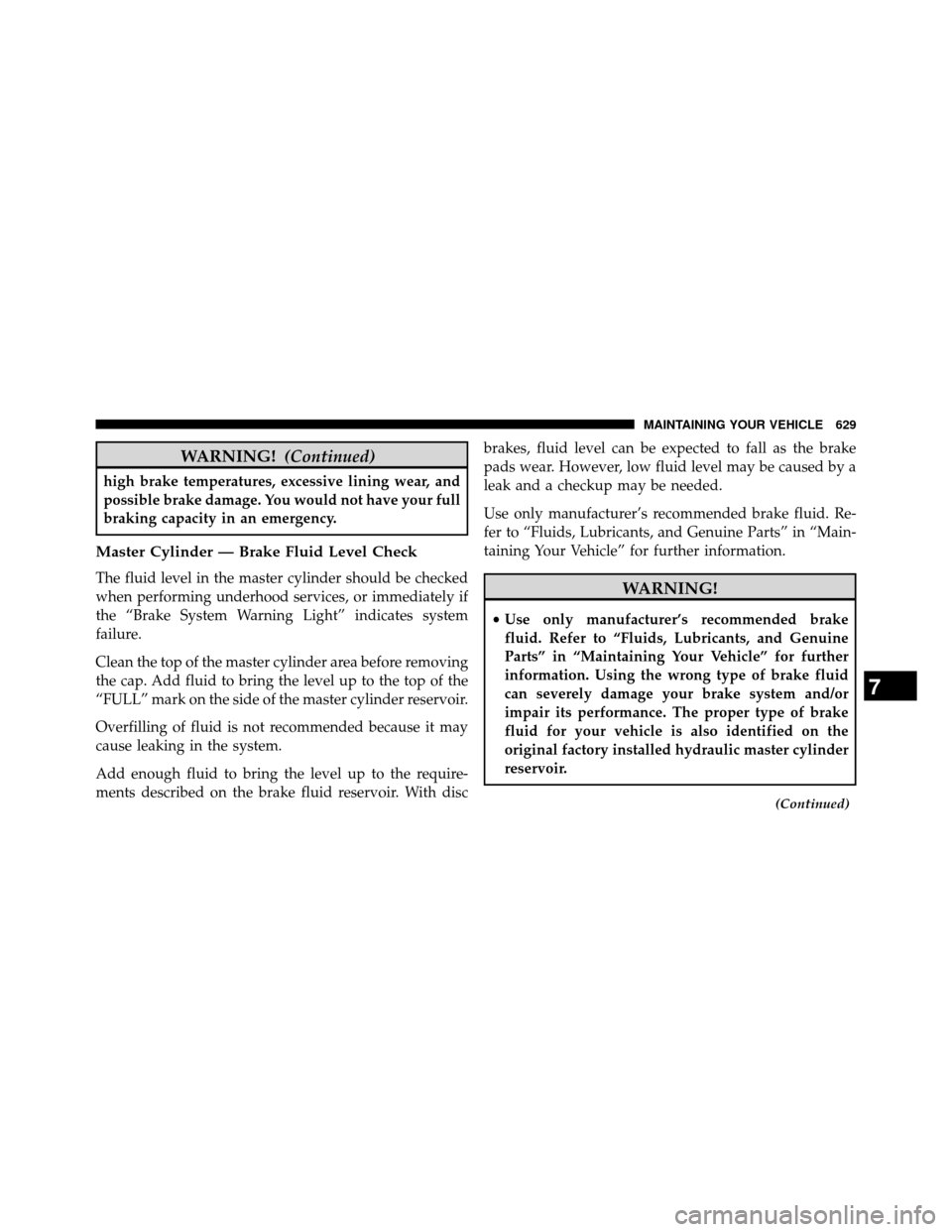
WARNING!(Continued)
high brake temperatures, excessive lining wear, and
possible brake damage. You would not have your full
braking capacity in an emergency.
Master Cylinder — Brake Fluid Level Check
The fluid level in the master cylinder should be checked
when performing underhood services, or immediately if
the “Brake System Warning Light” indicates system
failure.
Clean the top of the master cylinder area before removing
the cap. Add fluid to bring the level up to the top of the
“FULL” mark on the side of the master cylinder reservoir.
Overfilling of fluid is not recommended because it may
cause leaking in the system.
Add enough fluid to bring the level up to the require-
ments described on the brake fluid reservoir. With disc brakes, fluid level can be expected to fall as the brake
pads wear. However, low fluid level may be caused by a
leak and a checkup may be needed.
Use only manufacturer’s recommended brake fluid. Re-
fer to “Fluids, Lubricants, and Genuine Parts” in “Main-
taining Your Vehicle” for further information.WARNING!
•
Use only manufacturer’s recommended brake
fluid. Refer to “Fluids, Lubricants, and Genuine
Parts” in “Maintaining Your Vehicle” for further
information. Using the wrong type of brake fluid
can severely damage your brake system and/or
impair its performance. The proper type of brake
fluid for your vehicle is also identified on the
original factory installed hydraulic master cylinder
reservoir.
(Continued)
7
MAINTAINING YOUR VEHICLE 629
Page 639 of 698
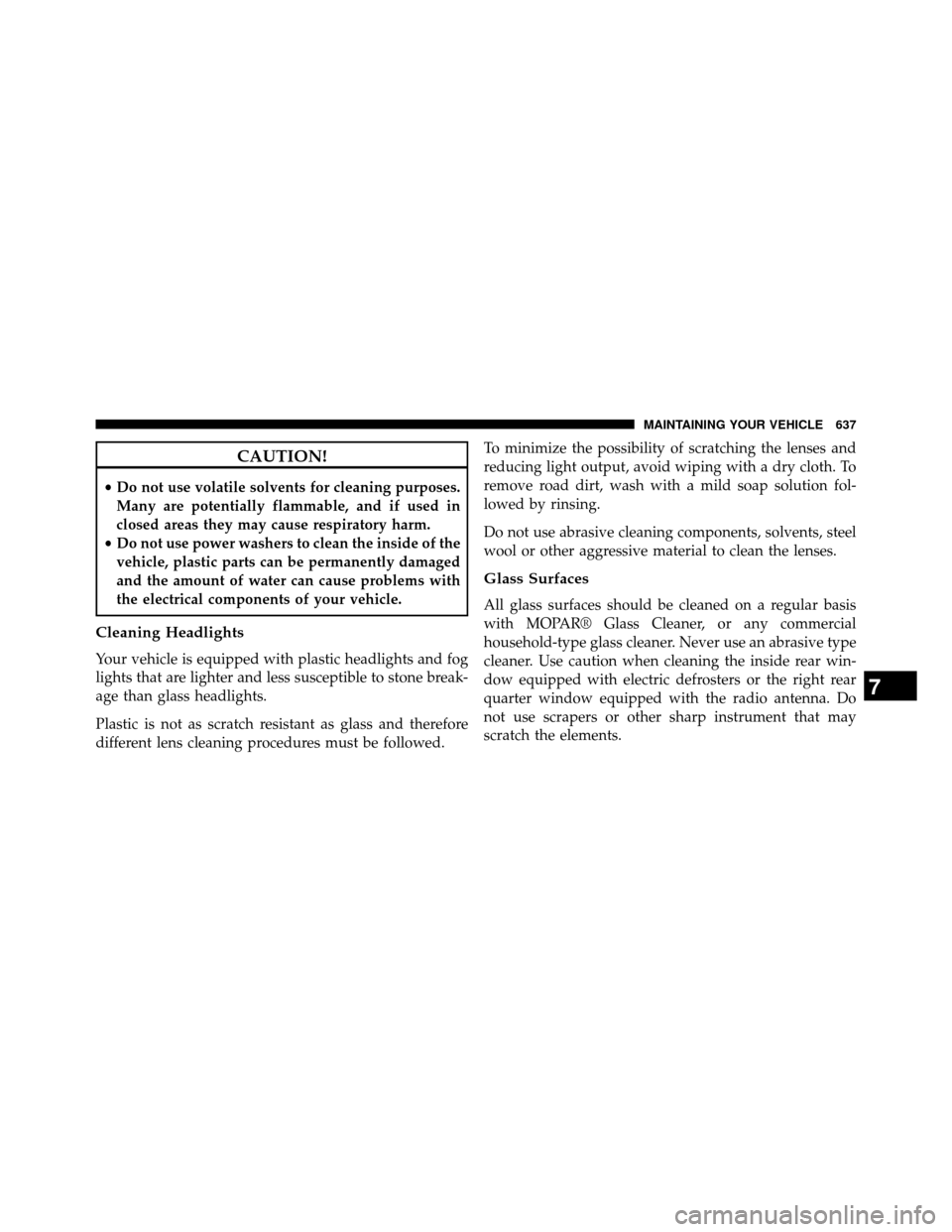
CAUTION!
•Do not use volatile solvents for cleaning purposes.
Many are potentially flammable, and if used in
closed areas they may cause respiratory harm.
• Do not use power washers to clean the inside of the
vehicle, plastic parts can be permanently damaged
and the amount of water can cause problems with
the electrical components of your vehicle.
Cleaning Headlights
Your vehicle is equipped with plastic headlights and fog
lights that are lighter and less susceptible to stone break-
age than glass headlights.
Plastic is not as scratch resistant as glass and therefore
different lens cleaning procedures must be followed. To minimize the possibility of scratching the lenses and
reducing light output, avoid wiping with a dry cloth. To
remove road dirt, wash with a mild soap solution fol-
lowed by rinsing.
Do not use abrasive cleaning components, solvents, steel
wool or other aggressive material to clean the lenses.
Glass Surfaces
All glass surfaces should be cleaned on a regular basis
with MOPAR® Glass Cleaner, or any commercial
household-type glass cleaner. Never use an abrasive type
cleaner. Use caution when cleaning the inside rear win-
dow equipped with electric defrosters or the right rear
quarter window equipped with the radio antenna. Do
not use scrapers or other sharp instrument that may
scratch the elements.
7
MAINTAINING YOUR VEHICLE 637
Page 646 of 698
Cavity Cartridge FuseMini-FuseDescription
M4 —10 Amp Red Trailer Tow
M5 —25 Amp Natural Inverter
M6 —20 Amp Yellow Power Outlet #1 (ACC), Rain Sensor, Cigar
Lighter (Instrument Panel or with ConsoleRear)
M7 —20 Amp Yellow Power Outlet #2 (BATT/ACC SELECT) –
Center Seat or with Console Rear
M8 —20 Amp Yellow Front Heated Seat – If Equipped
M9 —20 Amp Yellow Rear Heated Seat – If Equipped
M10 —15 Amp Blue Ignition Off Draw — Video System, Satellite
Radio, DVD, Hands-Free Module, Universal
Garage Door Opener, Vanity Lamp, Streaming Video Module – If Equipped
M11 —10 Amp Red Climate Control System
M12 —30 Amp Green Amplifier/Radio
644 MAINTAINING YOUR VEHICLE
Page 647 of 698
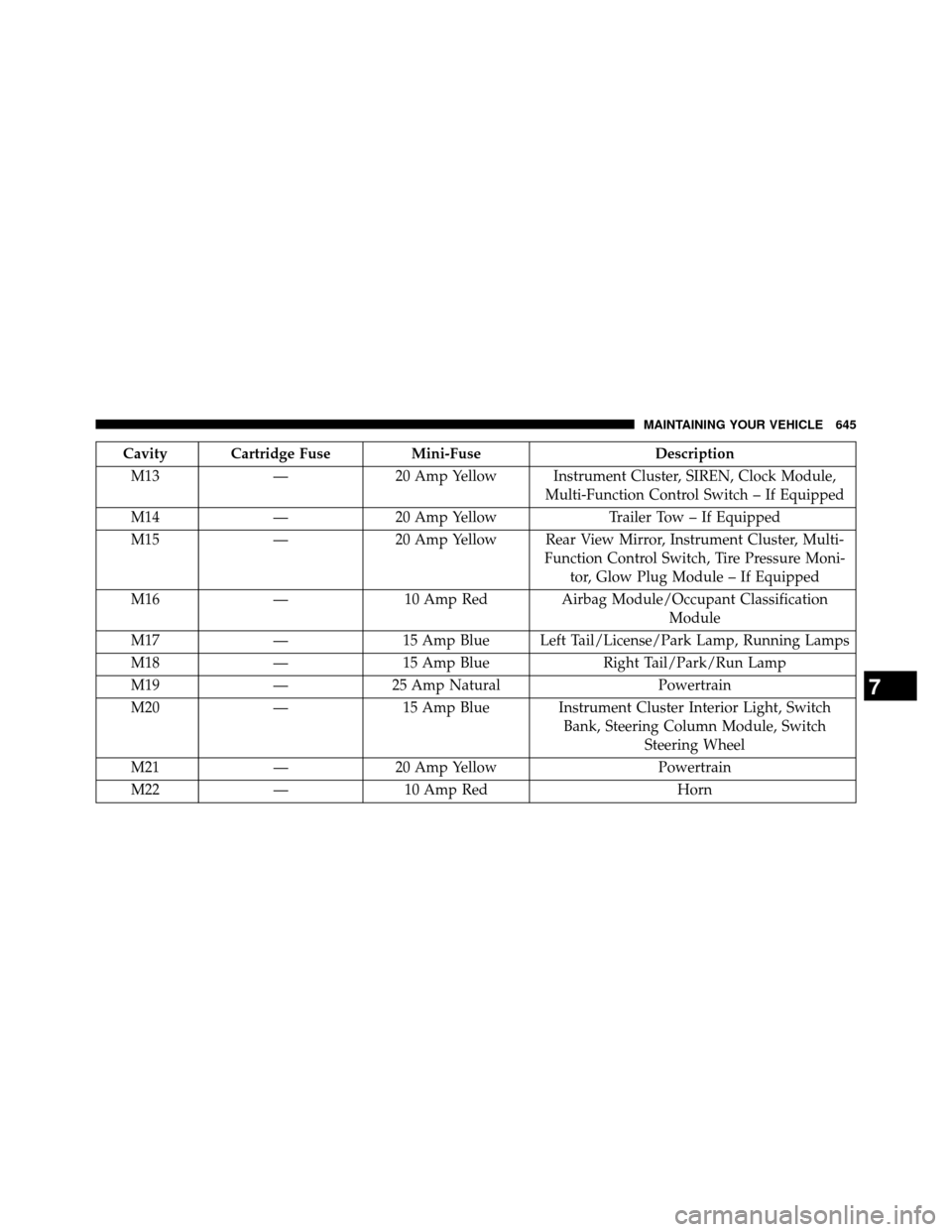
Cavity Cartridge FuseMini-FuseDescription
M13 —20 Amp Yellow Instrument Cluster, SIREN, Clock Module,
Multi-Function Control Switch – If Equipped
M14 —20 Amp Yellow Trailer Tow – If Equipped
M15 —20 Amp Yellow Rear View Mirror, Instrument Cluster, Multi-
Function Control Switch, Tire Pressure Moni-tor, Glow Plug Module – If Equipped
M16 —10 Amp Red Airbag Module/Occupant Classification
Module
M17 —15 Amp Blue Left Tail/License/Park Lamp, Running Lamps
M18 —15 Amp Blue Right Tail/Park/Run Lamp
M19 —25 Amp Natural Powertrain
M20 —15 Amp Blue Instrument Cluster Interior Light, Switch
Bank, Steering Column Module, SwitchSteering Wheel
M21 —20 Amp Yellow Powertrain
M22 —10 Amp Red Horn
7
MAINTAINING YOUR VEHICLE 645
Page 649 of 698
Cavity Cartridge FuseMini-FuseDescription
M34 —10 Amp Red Park Assist, Heater Climate Control Module,
Headlamp Wash, Compass, Rear Camera,
Door Lamps, Flashlight, Relay Diesel Cabin Heater, Rad Fan Diesel – If Equipped
M35 —10 Amp Red Heated Mirrors
M36 —20 Amp Yellow Power Outlet #3 (Instrument Panel or with
Console Center)
M37 —10 Amp Red Antilock Brakes, Stability Control, Stop Lamp,
Fuel Pump
M38 —25 Amp Natural Door Lock/Unlock Motors, Liftgate Lock/
Unlock Motors
The power windows are fused by a 25 Amp circuit
breaker located in the Totally Integrated Power Module.
7
MAINTAINING YOUR VEHICLE 647
Page 651 of 698
Bulb Number
Removable Console
Lamp – If Equipped 194
Visor Vanity Lamps 6501966
NOTE: For lighted switches, see your authorized
dealer for replacement instructions.
Exterior Bulbs
Bulb Number
Headlamp H11
Fog Lamp – If Equipped PSX24W
Front Side Marker, Park/
Turn Signal 3757A or PY27/7W
Rear Tail, Stop, Turn Sig-
nal Lamp LED (Serviced at Autho-
rized Dealer)
Bulb Number
Center High-Mounted
Stop Lamp LED (Serviced at Autho-
rized Dealer)
Backup Lamp 3157
License 168
NOTE: All of the interior bulbs are glass wedge base or
glass cartridge types. Aluminum base bulbs are not
approved and should not be used for replacement.
BULB REPLACEMENT
NOTE: Lens fogging can occur under certain atmo-
spheric conditions. This will usually clear as atmospheric
conditions change to allow the condensation to change
back into a vapor. Turning the lamps on will usually
accelerate the clearing process.
7
MAINTAINING YOUR VEHICLE 649
Page 653 of 698
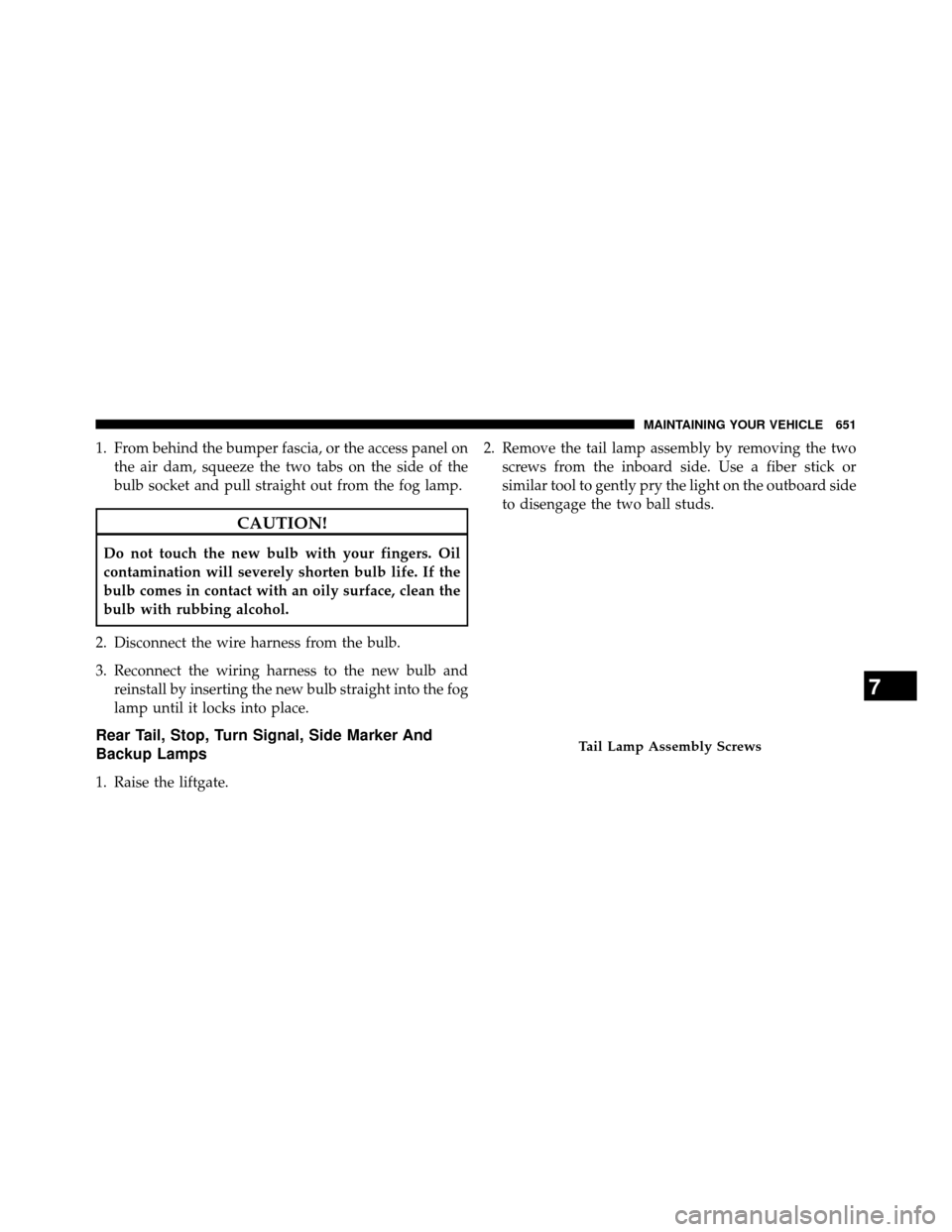
1. From behind the bumper fascia, or the access panel onthe air dam, squeeze the two tabs on the side of the
bulb socket and pull straight out from the fog lamp.
CAUTION!
Do not touch the new bulb with your fingers. Oil
contamination will severely shorten bulb life. If the
bulb comes in contact with an oily surface, clean the
bulb with rubbing alcohol.
2. Disconnect the wire harness from the bulb.
3. Reconnect the wiring harness to the new bulb and reinstall by inserting the new bulb straight into the fog
lamp until it locks into place.
Rear Tail, Stop, Turn Signal, Side Marker And
Backup Lamps
1. Raise the liftgate. 2. Remove the tail lamp assembly by removing the two
screws from the inboard side. Use a fiber stick or
similar tool to gently pry the light on the outboard side
to disengage the two ball studs.
Tail Lamp Assembly Screws
7
MAINTAINING YOUR VEHICLE 651
Page 654 of 698
NOTE:•If a screwdriver is used, make sure a soft material is
placed between the vehicle body and tool so not to
scratch the paint.
• The PRY location is best closest to the studs while
dislodging them separately.
3. Twist the socket and remove from the lamp assembly.
4. Pull the bulb to remove it from the socket.
5. Replace the bulb, reinstall the socket, and reattach the lamp assembly.
Center High-Mounted Stop Lamp (CHMSL)
The CHMSL uses LED lamps that are not serviceable
separately. The CHMSL must be replaced as an assembly.
See your authorized dealer.
License Lamp
The license plate lamp is located under the tailgate light
bar and above the license plate.
1. Using a small screwdriver, press inward the lockingtab on the outboard side of the lamp assembly and
pull down on the lamp assembly for removal.
2. Twist and remove the socket from the lamp assembly and pull the bulb out to remove.
3. Push the bulb into the socket, twist the socket into the lamp assembly and reinstall the lamp assembly into
place ensuring the locking tab is secure.
652 MAINTAINING YOUR VEHICLE