Page 308 of 664

Vehicles Equipped With Keyless Enter-N-Go™
1. Without pressing the brake pedal, press the ENGINESTART/STOP button and cycle the ignition to the
ON/RUN position (do not start the engine.)
2. Fully depress the accelerator pedal, slowly, three times within 10 seconds.
3. Without pressing the brake pedal, press the ENGINE START/STOP button once to return the ignition to the
OFF/LOCK position.
NOTE: If the indicator message illuminates when you
start the vehicle, the oil change indicator system did not
reset. If necessary, repeat this procedure.
Electronic Vehicle Information Center (EVIC)
Messages
• Front Seatbelts Unbuckled
• Driver Seatbelt Unbuckled •
Passenger Seatbelt Unbuckled
• Service Airbag System
• Traction Control Off
• Washer Fluid Low
• Oil Pressure Low
• Oil Change Due
• Fuel Low
• Service Antilock Brake System
• Service Electronic Throttle Control
• Service Power Steering
• Cruise Off
• Cruise Ready
• Cruise Set To XXX MPH
306 UNDERSTANDING YOUR INSTRUMENT PANEL
Page 312 of 664

•Oil Pressure Warning Light
This telltale indicates low engine oil pressure. If
the light turns on while driving, stop the vehicle and shut
off the engine as soon as possible. A chime will sound for
four minutes when this light turns on.
Do not operate the vehicle until the cause is corrected.
This light does not show how much oil is in the engine.
The engine oil level must be checked under the hood.
• Oil Temperature Warning Light
This telltale indicates engine oil temperature is
high. If the light turns on while driving, stop
the vehicle and shut off the engine as soon as
possible.
• Charging System Light
This light shows the status of the electrical charg-
ing system. If the light stays on or comes on while
driving, turn off some of the vehicle’s non-essential electrical devices or increase engine speed (if at idle). If
the charging system light remains on, it means that the
vehicle is experiencing a problem with the charging
system. Obtain SERVICE IMMEDIATELY. See an autho-
rized dealer.
If jump starting is required, refer to “Jump Starting
Procedures” in “What To Do In Emergencies”.
•
Electronic Throttle Control (ETC) Light
This light informs you of a problem with the
Electronic Throttle Control (ETC) system. The
light will come on when the ignition is first
turned ON and remain on briefly as a bulb
check. If the light does not come on during starting, have
the system checked by an authorized dealer.
If a problem is detected, the light will come on while the
engine is running. Cycle the ignition key when the
310 UNDERSTANDING YOUR INSTRUMENT PANEL
Page 316 of 664

Transmission Temperature (Automatic Transmission
Only)
Press and release the RIGHT or LEFT arrow button until
“Transmission Temperature” is displayed in the EVIC. It
shows transmission temperature value with bargraph.
Oil Temperature
Press and release the RIGHT or LEFT arrow button until
“Oil Temperature” is highlighted in the EVIC. Press and
release the RIGHT arrow button and the oil temperature
will be displayed.
Battery Voltage
Press and release the RIGHT or LEFT arrow button until
“Battery Voltage” is highlighted in the EVIC. Press and
release the RIGHT arrow button and the battery voltage
will be displayed.Oil Life
Press and release the RIGHT or LEFT arrow button until
“Oil Life” is highlighted in the EVIC. Press and release
the RIGHT arrow button and the current oil life will be
displayed.
Oil Pressure
Press and release the RIGHT or LEFT arrow button until
“Oil Pressure” is highlighted in the EVIC. Press and
release the RIGHT arrow button and the current oil
pressure will be displayed.
Driver Assist
Press and release the UP or DOWN arrow
button until the Driver Assist display icon is
highlighted in the EVIC. For further informa-
tion, refer to “Adaptive Cruise Control (ACC)
— If Equipped” in “Understanding The Features Of Your
Vehicle”.
314 UNDERSTANDING YOUR INSTRUMENT PANEL
Page 406 of 664
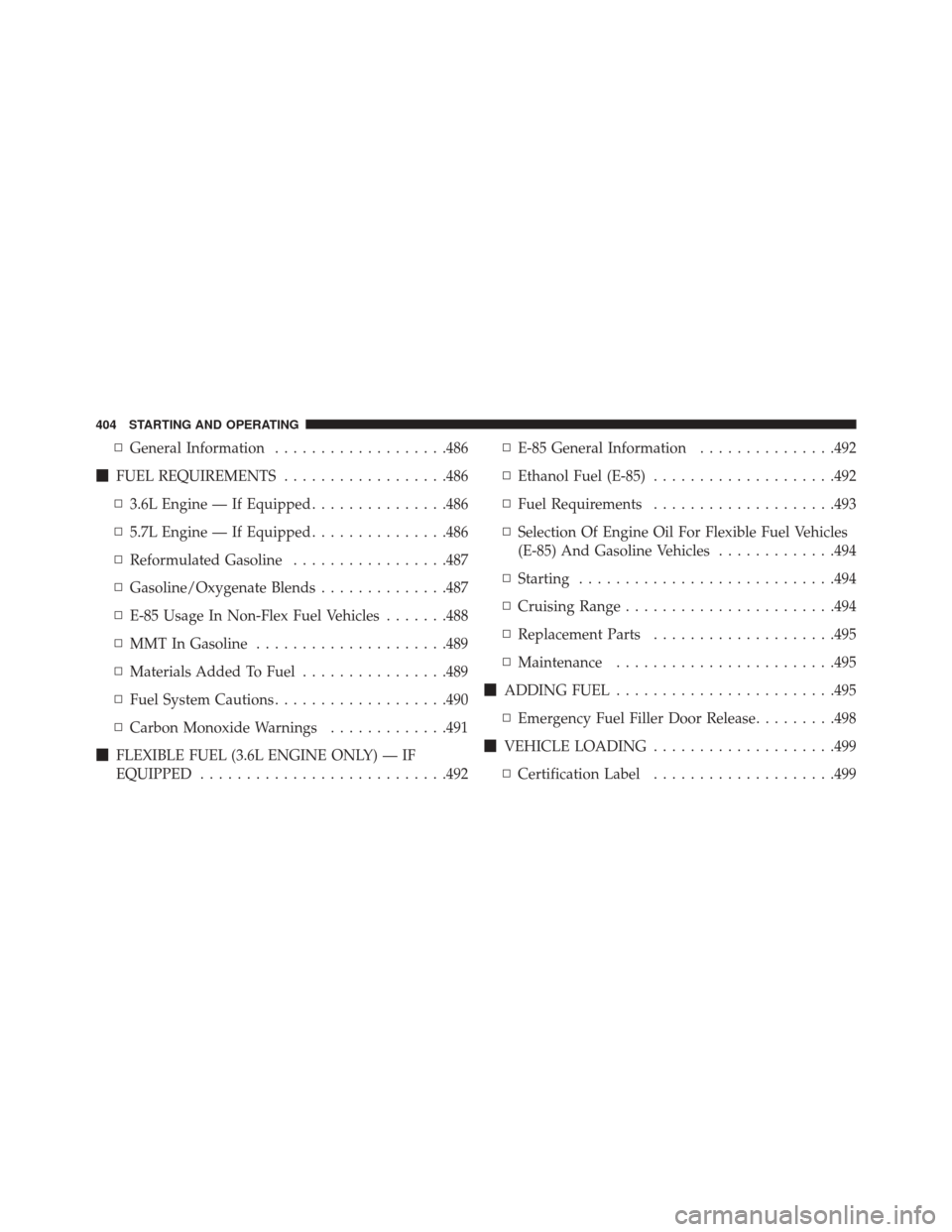
▫General Information ...................486
� FUEL REQUIREMENTS ..................486
▫ 3.6L Engine — If Equipped ...............486
▫ 5.7L Engine — If Equipped ...............486
▫ Reformulated Gasoline .................487
▫ Gasoline/Oxygenate Blends ..............487
▫ E-85 Usage In Non-Flex Fuel Vehicles .......488
▫ MMT In Gasoline .....................489
▫ Materials Added To Fuel ................489
▫ Fuel System Cautions ...................490
▫ Carbon Monoxide Warnings .............491
� FLEXIBLE FUEL (3.6L ENGINE ONLY) — IF
EQUIPPED .......................... .492▫
E-85 General Information ...............492
▫ Ethanol Fuel (E-85) ....................492
▫ Fuel Requirements ....................493
▫ Selection Of Engine Oil For Flexible Fuel Vehicles
(E-85) And Gasoline Vehicles .............494
▫ Starting ........................... .494
▫ Cruising Range ...................... .494
▫ Replacement Parts ....................495
▫ Maintenance ....................... .495
� ADDING FUEL ....................... .495
▫ Emergency Fuel Filler Door Release .........498
� VEHICLE LOADING ....................499
▫ Certification Label ....................499
404 STARTING AND OPERATING
Page 413 of 664

3. Press and release the ENGINE START/STOP buttononce.
The starter motor will engage automatically, run for 10
seconds, and then disengage. Once this occurs, release
the accelerator pedal and the brake pedal, wait 10 to 15
seconds, then repeat the “Normal Starting” procedure.
After Starting
The idle speed is controlled automatically and it will
decrease as the engine warms up.
ENGINE BLOCK HEATER — IF EQUIPPED
The engine block heater warms the engine, and permits
quicker starts in cold weather. Connect the cord to a
standard 110-115 Volt AC electrical outlet with a
grounded, three-wire extension cord.
The engine block heater must be plugged in at least one
hour to have an adequate warming effect on the engine. The engine block heater cord is located:
•
3.6L Engine — Coiled and strapped to the engine oil
dipstick tube.
• 5.7L Engine — Bundled and fastened to the injector
harness.
WARNING!
Remember to disconnect the engine block heater
cord before driving. Damage to the 110-115 Volt
electrical cord could cause electrocution.5
STARTING AND OPERATING 411
Page 435 of 664

Driving through water more than a few inches/
centimeters deep will require extra caution to ensure
safety and prevent damage to your vehicle. If you must
drive through water, try to determine the depth and the
bottom condition (and location of any obstacles) prior to
entering. Proceed with caution and maintain a steady
controlled speed less than 5 mph (8 km/h) in deep water
to minimize wave effects.
Flowing Water
If the water is swift flowing and rising (as in storm
run-off), avoid crossing until the water level recedes
and/or the flow rate is reduced. If you must cross
flowing water avoid depths in excess of 9 in (23 cm). The
flowing water can erode the streambed, causing your
vehicle to sink into deeper water. Determine exit point(s)
that are downstream of your entry point to allow for
drifting.Standing Water
Avoid driving in standing water deeper than 20 in (51
cm), and reduce speed appropriately to minimize wave
effects. Maximum speed in 20 in (51 cm) of water is less
than 5 mph (8 km/h).
Maintenance
After driving through deep water, inspect your vehicle
fluids and lubricants (engine oil, transmission oil, axle,
transfer case) to assure the fluids have not been contami-
nated. Contaminated fluid (milky, foamy in appearance)
should be flushed/changed as soon as possible to pre-
vent component damage.
Driving In Snow, Mud And Sand
In heavy snow, when pulling a load, or for additional
control at slower speeds, shift the transmission to a low
gear and shift the transfer case to LOW if necessary. Refer
5
STARTING AND OPERATING 433
Page 476 of 664

WARNING!
Tires and the spare tire should be replaced after six
years, regardless of the remaining tread. Failure to
follow this warning can result in sudden tire failure.
You could lose control and have a collision resulting
in serious injury or death.
Keep dismounted tires in a cool, dry place with as little
exposure to light as possible. Protect tires from contact
with oil, grease, and gasoline.
Replacement Tires
The tires on your new vehicle provide a balance of many
characteristics. They should be inspected regularly for
wear and correct cold tire inflation pressure. The manu-
facturer strongly recommends that you use tires equiva-
lent to the originals in size, quality and performance
when replacement is needed. Refer to the paragraph on
“Tread Wear Indicator.” Refer to the Tire and Loading Information placard or the Vehicle Certification Label for
the size designation of your tire. The Load Index and
Speed Symbol for your tire will be found on the original
equipment tire sidewall. See the Tire Sizing Chart ex-
ample found in the Tire Safety Information section of this
manual for more information relating to the Load Index
and Speed Symbol of a tire.
It is recommended to replace the two front tires or two
rear tires as a pair. Replacing just one tire can seriously
affect your vehicle’s handling. If you ever replace a
wheel, make sure that the wheel’s specifications match
those of the original wheels.
It is recommended you contact your authorized tire
dealer or original equipment dealer with any questions
you may have on tire specifications or capability. Failure
to use equivalent replacement tires may adversely affect
the safety, handling, and ride of your vehicle.
474 STARTING AND OPERATING
Page 491 of 664

To fix a Non-FFV vehicle inadvertently fueled once with
E-85 perform the following:
•Drain the fuel tank (see your authorized dealer).
• Change the engine oil and oil filter.
• Disconnect and reconnect the battery to reset the
engine controller memory.
More extensive repairs will be required for prolonged
exposure to E-85 fuel.
MMT In Gasoline
Methylcyclopentadienyl Manganese Tricarbonyl (MMT)
is a manganese-containing metallic additive that is
blended into some gasoline to increase octane. Gasoline
blended with MMT provides no performance advantage
beyond gasoline of the same octane number without
MMT. Gasoline blended with MMT reduces spark plug
life and reduces emissions system performance in some
vehicles. The manufacturer recommends that gasoline without MMT be used in your vehicle. The MMT content
of gasoline may not be indicated on the gasoline pump,
therefore, you should ask your gasoline retailer whether
the gasoline contains MMT. MMT is prohibited in Federal
and California reformulated gasoline.
Materials Added To Fuel
All gasoline sold in the United States is required to
contain effective detergent additives. Use of additional
detergents or other additives is not needed under normal
conditions and they would result in additional cost.
Therefore, you should not have to add anything to the
fuel.
5
STARTING AND OPERATING 489