2014 DODGE CHARGER traction control
[x] Cancel search: traction controlPage 465 of 635

WARNING!
•Do not use a tire, wheel size or rating other than
that specified for your vehicle. Some combinations
of unapproved tires and wheels may change sus-
pension dimensions and performance characteris-
tics, resulting in changes to steering, handling, and
braking of your vehicle. This can cause unpredict-
able handling and stress to steering and suspen-
sion components. You could lose control and have
a collision resulting in serious injury or death. Use
only the tire and wheel sizes with load ratings
approved for your vehicle.
• Never use a tire with a smaller load index or
capacity, other than what was originally equipped
on your vehicle. Using a tire with a smaller load
index could result in tire overloading and failure.
You could lose control and have a collision.
(Continued)
WARNING! (Continued)
•Failure to equip your vehicle with tires having
adequate speed capability can result in sudden tire
failure and loss of vehicle control.
CAUTION!
Replacing original tires with tires of a different size
may result in false speedometer and odometer read-
ings.
TIRE CHAINS (TRACTION DEVICES)
Use of traction devices require sufficient tire-to-body
clearance. Follow these recommendations to guard
against damage.
• Traction device must be of proper size for the tire, as
recommended by the traction device manufacturer.
5
STARTING AND OPERATING 463
Page 466 of 635

•Install on Rear Tires Only.
• Due to limited clearance, the Security Chain Company
(SCC) Super Z6 low profile traction device or equiva-
lent is recommended on P215/65R17, P225/60R18 or
P235/55R18 tires..
• For an All Wheel Drive vehicle, P235/55R19 tire with
the use of a traction device that meets the SAE type
“Class S” specification is recommended.
WARNING!
Using tires of different size and type (M+S, Snow)
between front and rear axles can cause unpredictable
handling. You could lose control and have a collision.
CAUTION!
To avoid damage to your vehicle or tires, observe the
following precautions:
• Because of restricted traction device clearance be-
tween tires and other suspension components, it is
important that only traction devices in good condi-
tion are used. Broken devices can cause serious
damage. Stop the vehicle immediately if noise
occurs that could indicate device breakage. Remove
the damaged parts of the device before further use.
• Install device as tightly as possible and then re-
tighten after driving about ½ mile (0.8 km).
• Do not exceed 30 mph (48 km/h).
• Drive cautiously and avoid severe turns and large
bumps, especially with a loaded vehicle.
• Do not drive for a prolonged period on dry pave-
ment.
(Continued)
464 STARTING AND OPERATING
Page 609 of 635

Visit us on the Worldwide Web at:
•www.techauthority.com
DEPARTMENT OF TRANSPORTATION UNIFORM
TIRE QUALITY GRADES
The following tire grading categories were established by
the National Highway Traffic Safety Administration. The
specific grade rating assigned by the tire’s manufacturer
in each category is shown on the sidewall of the tires on
your vehicle.
All passenger car tires must conform to Federal safety
requirements in addition to these grades.
Treadwear
The Treadwear grade is a comparative rating, based on
the wear rate of the tire when tested under controlled
conditions on a specified government test course. For
example, a tire graded 150 would wear one and one-half times as well on the government course as a tire graded
100. The relative performance of tires depends upon the
actual conditions of their use, however, and may depart
significantly from the norm due to variations in driving
habits, service practices, and differences in road charac-
teristics and climate.
Traction Grades
The Traction grades, from highest to lowest, are AA, A, B,
and C. These grades represent the tire’s ability to stop on
wet pavement, as measured under controlled conditions
on specified government test surfaces of asphalt and
concrete. A tire marked C may have poor traction perfor-
mance.
9
IF YOU NEED CONSUMER ASSISTANCE 607
Page 610 of 635

WARNING!
The traction grade assigned to this tire is based on
straight-ahead braking traction tests, and does not
include acceleration, cornering, hydroplaning, or
peak traction characteristics.
Temperature Grades
The temperature grades are A (the highest), B, and C,
representing the tire’s resistance to the generation of heat
and its ability to dissipate heat, when tested under
controlled conditions on a specified indoor laboratory
test wheel. Sustained high temperature can cause the
material of the tire to degenerate and reduce tire life, and
excessive temperature can lead to sudden tire failure. The
grade C corresponds to a level of performance, which all
passenger car tires must meet under the Federal MotorVehicle Safety Standard No. 109. Grades B and A repre-
sent higher levels of performance on the laboratory test
wheel, than the minimum required by law.
WARNING!
The temperature grade for this tire is established for
a tire that is properly inflated and not overloaded.
Excessive speed, under-inflation, or excessive load-
ing, either separately or in combination, can cause
heat buildup and possible tire failure.
608 IF YOU NEED CONSUMER ASSISTANCE
Page 616 of 635

Defroster, Rear Window.....................307
Defroster, Windshield .......................98
Delay (Intermittent) Wipers ..................227
Diagnostic System, Onboard .................535
Dimmer Switch, Headlight ...................223
Dipsticks Oil (Engine) .......................... .538
Disabled Vehicle Towing ....................527
Disposal Antifreeze (Engine Coolant) ................557
Door Locks Child-Protection Door Lock — Rear Doors ......33
Door Locks ............................23
KeyFob...............................30
Key Fob Emergency Key ...................25
Remote ...............................30
Remote Keyless Entry (RKE) ................30
Door Locks, Automatic ......................32 Driving
Through Flowing, Rising, or Shallow Standing
Water ............................... .423
Driving to Achieve Maximum Fuel Economy ......335
E-85 Fuel .............................. .482
Electrical Power Outlets .....................295
Electric Rear Window Defrost .................307
Electric Remote Mirrors .....................111
Electronic Brake Control System ...............431
Anti-Lock Brake System ..................431
Brake Assist System .....................432
Traction Control System ...................431
Electronic Power Distribution Center (Fuses) ......572
Electronic Speed Control (Cruise Control) ........237
Electronic Stability Control (ESC) ..............433
Electronic Vehicle Information Center Instrument Cluster Display .................29
Electronic Vehicle Information Center (EVIC) ......324
614 INDEX
Page 623 of 635
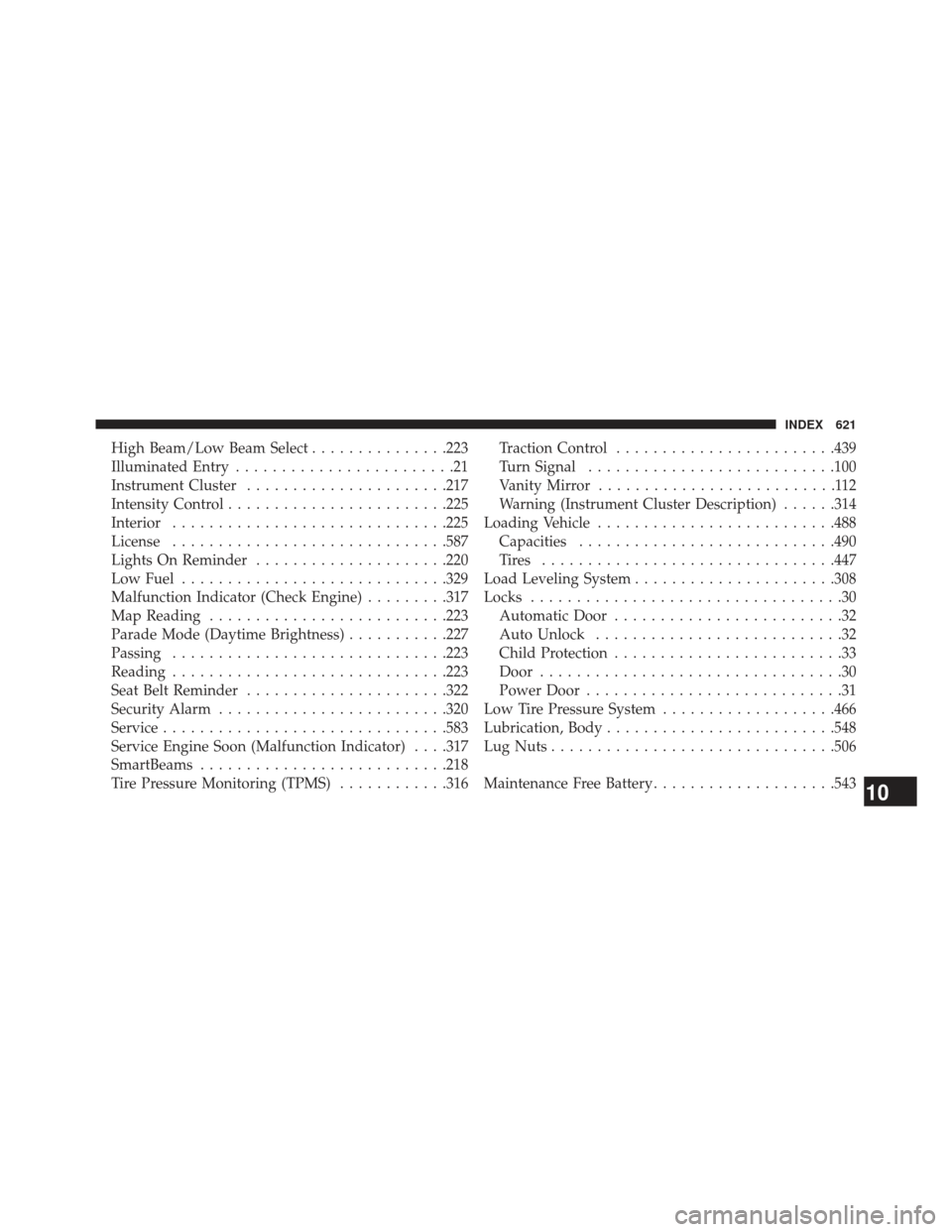
High Beam/Low Beam Select...............223
Illuminated Entry ........................21
Instrument Cluster ..................... .217
Intensity Control ....................... .225
Interior ............................. .225
License ............................. .587
Lights On Reminder .....................220
Low Fuel ............................ .329
Malfunction Indicator (Check Engine) .........317
Map Reading ......................... .223
Parade Mode (Daytime Brightness) ...........227
Passing ............................. .223
Reading ............................. .223
Seat Belt Reminder ..................... .322
Security Alarm ........................ .320
Service .............................. .583
Service Engine Soon (Malfunction Indicator) . . . .317
SmartBeams .......................... .218
Tire Pressure Monitoring (TPMS) ............316Traction Control
....................... .439
Turn Signal .......................... .100
Vanity Mirror ..........................112
Warning (Instrument Cluster Description) ......314
Loading Vehicle ......................... .488
Capacities ........................... .490
Tires ............................... .447
Load Leveling System ..................... .308
Locks ..................................30
Automatic Door .........................32
Auto Unlock ...........................32
Child Protection .........................33
Door .................................30
Power Door ............................31
Low Tire Pressure System ...................466
Lubrication, Body ........................ .548
Lug Nuts .............................. .506
Maintenance Free Battery ....................543
10
INDEX 621
Page 631 of 635

Towing............................... .490
Disabled Vehicle ....................... .527
Guide .............................. .494
Recreational .......................... .502
Weight .............................. .494
Towing Vehicle Behind a Motorhome ...........502
Traction ............................... .422
Traction Control ......................... .431
Trailer Towing .......................... .490
Cooling System Tips .....................501
Hitches ............................. .493
Minimum Requirements ..................495
Tips................................ .500
Trailer and Tongue Weight .................494
Wiring .............................. .499
Trailer Towing Guide ...................... .494
Trailer Weight ........................... .494
Transfer Case ........................... .563
Fluid ............................... .563Maintenance
.......................... .564
Transmission Automatic ........................... .397
Fluid ............................... .561
Maintenance .......................... .561
Shifting ............................. .397
Transmitter Battery Service (Remote Keyless Entry) . .25
Transmitter Programming (Remote Keyless Entry) . . .22
Transmitter, Remote Keyless Entry (RKE) .........22
Tread Wear Indicators ..................... .460
Trip Odometer .......................... .315
Trunk Lid (Deck Lid) .......................42
Trunk Release, Emergency ....................44
Trunk Release Remote Control .................42
Turn Signals ............................ .222
UCI Connector .......................... .369
Uconnect® Advanced Phone Connectivity ..............141
10
INDEX 629