Page 233 of 539

Refer to “Keyless Enter-N-Go™” in “Starting And Oper-
ating” for more information.
NOTE:Under certain conditions, the display may be
superseded by another display of higher priority. But
when the ignition switch position is changed, the display
always re-appears.
Driver-Selectable Surround Sound (DSS) — If
Equipped
Press and release the MENU button until “Surround
Sound” displays in the EVIC. The EVIC provides infor-
mation on the current surround mode.
• Stereo
• Surround Sound
While in the Surround Sound menu, press the SELECT
button to change surround modes. The Video Surround Mode will only be available for video media sources
(DVDs, Video CDs, or other video media supported by
the radio).
Compass Display — If Equipped
MENU Button
The compass readings indicate the direction
the vehicle is facing. Press and release the
MENU button until “Compass” displays in the
EVIC.
NOTE: The system will display the last known outside
temperature when starting the vehicle and may need to
be driven several minutes before the updated tempera-
ture is displayed. Engine temperature can also affect the
displayed temperature; therefore, temperature readings
are not updated when the vehicle is not moving.
4
UNDERSTANDING YOUR INSTRUMENT PANEL 231
Page 284 of 539

Operating Tips
NOTE:Refer to the chart at the end of this section for
suggested control settings for various weather condi-
tions.
Summer Operation
The engine cooling system must be protected with a
high-quality antifreeze coolant to provide proper corro-
sion protection and to protect against engine overheating.
A solution of 50% OAT (Organic Additive Technology)
coolant that meets the requirements of Chrysler Material
Standard MS-12106 and 50% water is recommended.
Refer to “Maintenance Procedures” in “Maintaining Your
Vehicle” for proper coolant selection.
Winter Operation
Use of the air Recirculation Mode during winter months
is not recommended because it may cause window
fogging.
Vacation Storage
Anytime you store your vehicle, or keep it out of service
(i.e., vacation) for two weeks or more, run the air
conditioning system at idle for about five minutes in the
fresh air and high blower settings. This will ensure
adequate system lubrication to minimize the possibility
of compressor damage when the system is started again.
Window Fogging
Interior fogging on the windshield can be quickly re-
moved by turning the mode selector to Defrost. The
Defrost/Floor mode can be used to maintain a clear
windshield and provide sufficient heating. If side win-
dow fogging becomes a problem, increase blower speed.
Vehicle windows tend to fog on the inside in mild but
rainy or humid weather.
NOTE: Recirculate without A/C should not be used for
long periods as fogging may occur.
282 UNDERSTANDING YOUR INSTRUMENT PANEL
Page 287 of 539
STARTING AND OPERATING
CONTENTS
�STARTING PROCEDURES ................290
▫ Manual Transmission — If Equipped ........290
▫ Automatic Transmission — If Equipped .....291
▫ Keyless Enter-N-Go™ — If Equipped .......292
▫ Normal Starting ...................... .293
▫ Extreme Cold Weather
(Below –20°F Or 29°C) ................296
▫ If Engine Fails To Start .................296
▫ After Starting ....................... .299
� ENGINE BLOCK HEATER — IF EQUIPPED . . .299 �
MANUAL TRANSMISSION — IF EQUIPPED . .299
▫ Six-Speed Manual Transmission ...........299
▫ Shifting ............................ .301
▫ Recommended Shift Speeds ..............302
▫ 1–4 Skip Shift ....................... .303
▫ Downshifting ....................... .303
� AUTOMATIC TRANSMISSION —
IF EQUIPPED ........................ .304
▫ Key Ignition Park Interlock ...............306
▫ Brake/Transmission Shift Interlock System . . .306
5
Page 288 of 539

▫Five-Speed Automatic Transmission ........306
▫ Gear Ranges ........................ .307
� AUTOSTICK® ........................ .314
▫ Operation .......................... .314
� SPORT MODE — IF EQUIPPED ............316
� DRIVING ON SLIPPERY SURFACES .........316
▫ Acceleration ........................ .316
▫ Traction ........................... .317
� DRIVING THROUGH WATER .............317
▫ Flowing/Rising Water ..................317
▫ Shallow Standing Water .................318
� POWER STEERING .....................319 �
FUEL SAVER TECHNOLOGY 5.7L ENGINE ONLY
— IF EQUIPPED ...................... .321
� PARKING BRAKE ..................... .321
▫ Manual Transmission — If Equipped ........322
▫ Automatic Transmission — If Equipped ......322
� BRAKE SYSTEM ...................... .324
▫ Anti-Lock Brake System (ABS) ............324
� ELECTRONIC BRAKE CONTROL SYSTEM . . . .327
▫ Anti-Lock Brake System (ABS) ............327
▫ Traction Control System (TCS) ............328
▫ Brake Assist System (BAS) ...............328
▫ Hill Start Assist (HSA) .................329
▫ Electronic Stability Control (ESC) ..........331
286 STARTING AND OPERATING
Page 290 of 539
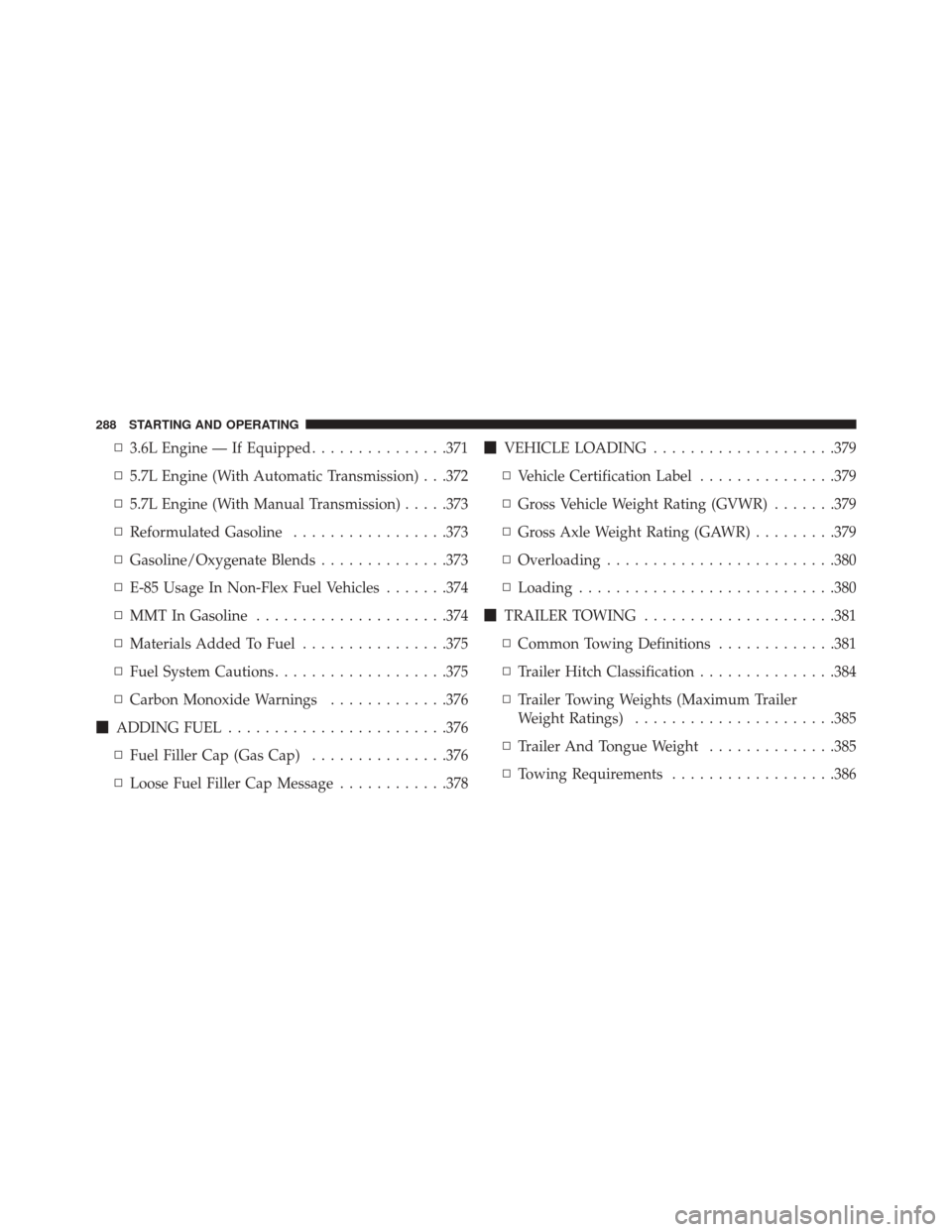
▫3.6L Engine — If Equipped ...............371
▫ 5.7L Engine (With Automatic Transmission) . . .372
▫ 5.7L Engine (With Manual Transmission) .....373
▫ Reformulated Gasoline .................373
▫ Gasoline/Oxygenate Blends ..............373
▫ E-85 Usage In Non-Flex Fuel Vehicles .......374
▫ MMT In Gasoline .....................374
▫ Materials Added To Fuel ................375
▫ Fuel System Cautions ...................375
▫ Carbon Monoxide Warnings .............376
� ADDING FUEL ....................... .376
▫ Fuel Filler Cap (Gas Cap) ...............376
▫ Loose Fuel Filler Cap Message ............378�
VEHICLE LOADING ....................379
▫ Vehicle Certification Label ...............379
▫ Gross Vehicle Weight Rating (GVWR) .......379
▫ Gross Axle Weight Rating (GAWR) .........379
▫ Overloading ........................ .380
▫ Loading ........................... .380
� TRAILER TOWING .....................381
▫ Common Towing Definitions .............381
▫ Trailer Hitch Classification ...............384
▫ Trailer Towing Weights (Maximum Trailer
Weight Ratings) ..................... .385
▫ Trailer And Tongue Weight ..............385
▫ Towing Requirements ..................386
288 STARTING AND OPERATING
Page 292 of 539

STARTING PROCEDURES
Before starting your vehicle, adjust your seat, adjust the
inside and outside mirrors, fasten your seat belt, and if
present, instruct all other occupants to buckle their seat
belts.
WARNING!
•When leaving the vehicle, always remove the Key
Fob from the ignition and lock your vehicle.
• Never leave children alone in a vehicle, or with
access to an unlocked vehicle. Allowing children to
be in a vehicle unattended is dangerous for a
number of reasons. A child or others could be
seriously or fatally injured. Children should be
warned not to touch the parking brake, brake pedal
or the shift lever.
(Continued)
WARNING! (Continued)
•Do not leave the Key Fob in or near the vehicle (or
in a location accessible to children), and do not
leave the ignition of a vehicle equipped with
Keyless Enter-N-Go™ in the ACC or ON/RUN
mode. A child could operate power windows, other
controls, or move the vehicle.
Manual Transmission — If Equipped
Apply the parking brake, place the shift lever in NEU-
TRAL and press the clutch pedal before starting vehicle.
This vehicle is equipped with a clutch interlocking igni-
tion system. It will not start unless the clutch pedal is
pressed to the floor.
Normal Starting With Integrated Key — Manual
Transmission
Normal starting of either a cold or a warm engine does
not require pumping or pressing the accelerator pedal.
290 STARTING AND OPERATING
Page 293 of 539

Press the clutch pedal fully to the floor, and cycle the
ignition switch to the START position and release when
the engine starts. If the engine fails to start within 15
seconds, turn the ignition switch to the OFF position,
wait 10 to 15 seconds, then repeat the “Normal Starting”
procedure.
WARNING!
Do not attempt to push or tow your vehicle to get it
started. Unburned fuel could enter the catalytic con-
verter and once the engine has started, ignite and
damage the converter and vehicle. If the vehicle has
a discharged battery, booster cables may be used to
obtain a start from another vehicle. This type of start
can be dangerous if done improperly, so follow the
procedure carefully. Refer to “Jump Starting” in
“What To Do In Emergencies” for further informa-
tion.
Automatic Transmission — If Equipped
The shift lever must be in the NEUTRAL or PARK
position before you can start the engine. Apply the brakes
before shifting into any driving gear.
CAUTION!
Damage to the transmission may occur if the follow-
ing precautions are not observed:
•Do not shift from REVERSE, PARK, or NEUTRAL
into any forward gear when the engine is above
idle speed.
• Shift into PARK only after the vehicle has come to
a complete stop.
• Shift into or out of REVERSE only after the vehicle
has come to a complete stop and the engine is at
idle speed.
• Before shifting into any gear, make sure your foot
is firmly on the brake pedal.
5
STARTING AND OPERATING 291
Page 294 of 539

Using Fob With Integrated Key (Tip Start)
NOTE:Normal starting of either a cold or a warm
engine is obtained without pumping or pressing the
accelerator pedal.
Do not press the accelerator. Use the Fob with Integrated
Key to briefly turn the ignition switch to the START
position and release it as soon as the starter engages. The
starter motor will continue to run, and it will disengage
automatically when the engine is running. If the engine
fails to start, the starter will disengage automatically in 10
seconds. If this occurs, turn the ignition switch to the
LOCK/OFF position, wait 10 to 15 seconds, then repeat
the “Normal Starting” procedure.
Keyless Enter-N-Go™ — If Equipped
This feature allows the driver to oper-
ate the ignition switch with the push
of a button, as long as the ENGINE
START/STOP button is installed and
the Remote Start/Keyless Enter-N-
Go™ Key Fob is in the passenger
compartment.
Installing And Removing The ENGINE
START/STOP Button
Installing The Button
1. Remove the key fob from the ignition switch.
2. Insert the ENGINE START/STOP button into the ignition switch with the lettering facing up and read-
able.
292 STARTING AND OPERATING
