Page 430 of 517

persists, the message will appear the next time the
vehicle is started. This might indicate a damaged cap. If
the problem is detected twice in a row, the system will
turn on the “Malfunction Indicator Light (MIL).” Resolv-
ing the problem will turn the MIL light off.
EMISSIONS INSPECTION AND MAINTENANCE
PROGRAMS
In some localities, it may be a legal requirement to pass
an inspection of your vehicle’s emissions control system.
Failure to pass could prevent vehicle registration.For states that require an Inspection and Mainte-
nance (I/M), this check verifies the “Malfunction
Indicator Light (MIL)” is functioning and is not
on when the engine is running, and that the OBD II
system is ready for testing. Normally, the OBD II system will be ready. The OBD II
system may
notbe ready if your vehicle was recently
serviced, recently had a dead battery or a battery replace-
ment. If the OBD II system should be determined not
ready for the I/M test, your vehicle may fail the test.
Your vehicle has a simple ignition key-actuated test,
which you can use prior to going to the test station. To
check if your vehicle’s OBD II system is ready, you must
do the following:
1. Cycle the ignition switch to the ON position, but do not crank or start the engine.
NOTE: If you crank or start the engine, you will have to
start this test over.
2. As soon as you cycle the ignition switch to the ON position, you will see the MIL symbol come on as part
of a normal bulb check.
428 MAINTAINING YOUR VEHICLE
Page 431 of 517

3. Approximately 15 seconds later, one of two things willhappen:
• The MIL will flash for about 10 seconds and then
return to being fully illuminated until you turn OFF
the ignition or start the engine. This means that your
vehicle’s OBD II system is not readyand you should
not proceed to the I/M station.
• The MIL will not flash at all and will remain fully
illuminated until you turn OFF the ignition or start the
engine. This means that your vehicle’s OBD II system
is ready and you can proceed to the I/M station.
If your OBD II system is not ready,you should see your
authorized dealer or repair facility. If your vehicle was
recently serviced or had a battery failure or replacement,
you may need to do nothing more than drive your
vehicle as you normally would in order for your OBD II
system to update. A recheck with the above test routine
may then indicate that the system is now ready. Regardless of whether your vehicle’s OBD II system is
ready or not, if the MIL is illuminated during normal
vehicle operation you should have your vehicle serviced
before going to the I/M station. The I/M station can fail
your vehicle because the MIL is on with the engine
running.
REPLACEMENT PARTS
Use of genuine MOPAR® parts for normal/scheduled
maintenance and repairs is highly recommended to en-
sure the designed performance. Damage or failures
caused by the use of non-MOPAR® parts for mainte-
nance and repairs will not be covered by the New Vehicle
Limited Warranty.
DEALER SERVICE
Your authorized dealer has the qualified service person-
nel, special tools, and equipment to perform all service
operations in an expert manner. Service Manuals are
7
MAINTAINING YOUR VEHICLE 429
Page 437 of 517

WARNING!
The air induction system (air cleaner, hoses, etc.) can
provide a measure of protection in the case of engine
backfire. Do not remove the air induction system (air
cleaner, hoses, etc.) unless such removal is necessary
for repair or maintenance. Make sure that no one is
near the engine compartment before starting the
vehicle with the air induction system (air cleaner,
hoses, etc.) removed. Failure to do so can result in
serious personal injury.
Engine Air Cleaner Filter Selection
The quality of replacement engine air cleaner filters
varies considerably. Only high quality filters should be
used to assure most efficient service. MOPAR® engine air
cleaner filters are a high quality filter and are recom-
mended.
Maintenance-Free Battery
Your vehicle is equipped with a maintenance-free battery.
You will never have to add water, nor is periodic main-
tenance required.
NOTE:The battery is stored in a compartment behind
the left front fender and is accessible without removing
the tire and wheel. Remote battery terminals are located
in the engine compartment for jump-starting. Refer to
“Jump-Starting Procedures” in “What To Do In Emergen-
cies” for further information.
To access the battery, turn the steering wheel fully to the
right and remove the inner fender shield.
7
MAINTAINING YOUR VEHICLE 435
Page 438 of 517

WARNING!
•Battery fluid is a corrosive acid solution and can
burn or even blind you. Do not allow battery fluid
to contact your eyes, skin, or clothing. Do not lean
over a battery when attaching clamps. If acid
splashes in eyes or on skin, flush the area imme-
diately with large amounts of water.
• Battery gas is flammable and explosive. Keep
flame or sparks away from the battery. Do not use
a booster battery or any other booster source with
an output greater than 12 Volts. Do not allow cable
clamps to touch each other.
• Battery posts, terminals, and related accessories
contain lead and lead compounds. Wash hands
after handling.
CAUTION!
• It is essential when replacing the cables on the
battery that the positive cable is attached to the
positive post and the negative cable is attached to
the negative post. Battery posts are marked positive
(+) and negative (-) and are identified on the
battery case. Cable clamps should be tight on the
terminal posts and free of corrosion.
• If a “fast charger” is used while the battery is in the
vehicle, disconnect both vehicle battery cables be-
fore connecting the charger to the battery. Do not
use a “fast charger” to provide starting voltage.
436 MAINTAINING YOUR VEHICLE
Page 466 of 517
CavityCar-
tridge Fuse Mini
Fuse Description
2 — 20 Amp YellowBrake Vacuum
Pump
3 — 10 Amp RedCenter High
Mounted Stop
Light (CHMSL)/
Brake Switch
4 — 10 Amp RedIgnition Switch
5 — 20 Amp YellowTrailer Tow – If
Equipped
6 — 10 Amp RedPower Mirror
Switch/Climate
ControlsCavity Car-
tridge Fuse Mini
Fuse Description
7 — 30 Amp GreenIgnition Off Draw
(IOD) Sense 1
8 — 30 Amp GreenIgnition Off Draw
(IOD) Sense 2
9 40 Amp Green Battery Feed –
Power Seats – If
Equipped
10 — 20 Amp YellowInstrument Panel/
Power Locks/
Interior Lights
11 — 15 Amp Lt BlueSelectable Power
Outlet (Inside Cen-
ter Arm Rest)
464 MAINTAINING YOUR VEHICLE
Page 471 of 517
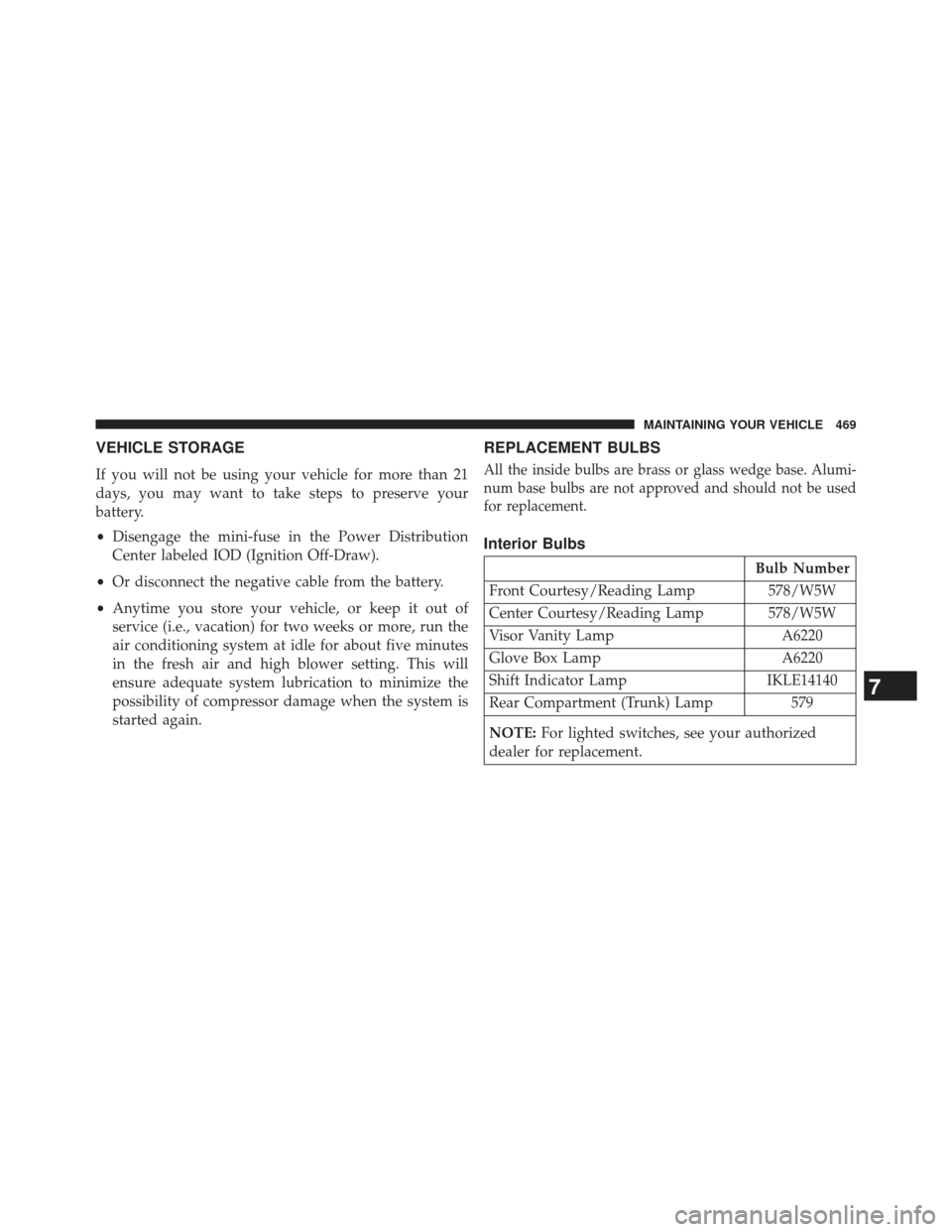
VEHICLE STORAGE
If you will not be using your vehicle for more than 21
days, you may want to take steps to preserve your
battery.
•Disengage the mini-fuse in the Power Distribution
Center labeled IOD (Ignition Off-Draw).
• Or disconnect the negative cable from the battery.
• Anytime you store your vehicle, or keep it out of
service (i.e., vacation) for two weeks or more, run the
air conditioning system at idle for about five minutes
in the fresh air and high blower setting. This will
ensure adequate system lubrication to minimize the
possibility of compressor damage when the system is
started again.
REPLACEMENT BULBS
All the inside bulbs are brass or glass wedge base. Alumi-
num base bulbs are not approved and should not be used
for replacement.
Interior Bulbs
Bulb Number
Front Courtesy/Reading Lamp 578/W5W
Center Courtesy/Reading Lamp 578/W5W
Visor Vanity Lamp A6220
Glove Box Lamp A6220
Shift Indicator Lamp IKLE14140
Rear Compartment (Trunk) Lamp 579
NOTE: For lighted switches, see your authorized
dealer for replacement.
7
MAINTAINING YOUR VEHICLE 469
Page 481 of 517

•Check tire pressure and look for unusual wear or
damage. Rotate tires at the first sign of irregular wear,
even if it occurs before the oil indicator system turns
on.
• Check the fluid levels of the coolant reservoir, brake
master cylinder, power steering and transmission
(four-speed only) and fill as needed.
• Check function of all interior and exterior lights.
Required Maintenance Intervals
Refer to the maintenance schedules on the following
page for the required maintenance intervals.
At Every Oil Change Interval As Indicated By Oil Change Indicator System:
•Change oil and filter.
At Every Oil Change Interval As Indicated By Oil
Change Indicator System:
•Rotate the tires. Rotate at the first sign of irregu-
lar wear, even if it occurs before the oil indicator
system turns on.
• Inspect battery and clean and tighten terminals as
required.
• Inspect automatic transmission fluid if equipped
with dipstick.
• Inspect brake pads, shoes, rotors, drums, hoses
and park brake.
• Inspect engine cooling system protection and
hoses.
• Inspect exhaust system.
• Inspect engine air cleaner if using in dusty or
off-road conditions.
8
M
A I
N T
E
N
A
N
C E
S
C
H E
D
U L
E
SMAINTENANCE SCHEDULES 479
Page 499 of 517

Adding Fluid......................... .453
Fluid and Filter Changes ..................456
Fluid Level Check ...................... .453
Fluid Type ........................... .452
Gear Ranges .......................... .303
Special Additives ...................... .453
Autostick .............................. .318
Auto Unlock, Doors ........................33
Auto Up Power Windows ....................38
Battery ................................ .435
Keyless Transmitter Replacement (RKE) ........26
Location ............................. .435
Belts, Seat ...............................99
Body Mechanism Lubrication .................439
B-Pillar Location ......................... .341
Brake Assist System ...................... .330
Brake, Parking .......................... .324
Brake System ........................... .450Anti-Lock (ABS)
....................... .326
Fluid Check .......................... .450
Master Cylinder ....................... .450
Parking ............................. .324
Warning Light ........................ .214
Brake/Transmission Interlock .................302
Bulb Replacement ........................ .469
Bulbs, Light ............................ .101
Calibration, Compass ..................... .233
Capacities, Antifreeze (Engine Coolant) ...........21
Capacities, Fluid ......................... .474
Caps, Filler Fuel ................................ .376
Oil (Engine) .......................... .425
Power Steering ........................ .323
Radiator (Coolant Pressure) ................447
Carbon Monoxide Warning ...................98
Car Washes ............................ .457
10
INDEX 497
