2014 DACIA SANDERO section 2
[x] Cancel search: section 2Page 5 of 238

Downloaded from www.Manualslib.com manuals search engine JauneNoir Noir texte
0.3
ENG_UD26904_1
Sommaire Général (X52 - Dacia)
ENG_NU_993-5_X52_Dacia_0
Getting to know your vehicle ...............................
Driving ...................................................................
Your comfort .........................................................
Maintenance .........................................................
Practical advice ....................................................
Technical specifications ......................................
Alphabetical index ...............................................
Sections
1
CONTENTS
2
3
4
5
6
7
Page 7 of 238

Downloaded from www.Manualslib.com manuals search engine JauneNoir Noir texte
1.1
ENG_UD34967_6
Sommaire 1 (X52 - Dacia)
ENG_NU_993-5_X52_Dacia_1
Section 1: Getting to know your vehicle
Keys, radio frequency remote control: general information . . . . . . . . . . . . . . . . . . . . . . . . . . . . . . . . 1.2
Locking and unlocking the doors . . . . . . . . . . . . . . . . . . . . . . . . . . . . . . . . . . . . \
. . . . . . . . . . . . . . . . 1.5
Automatic locking of opening elements when driving . . . . . . . . . . . . . . . . . . . . . . . . . . . . . . . . . . . .\
1.7
Opening and closing the doors . . . . . . . . . . . . . . . . . . . . . . . . . . . . . . . . . . . .\
. . . . . . . . . . . . . . . . . 1.8
Headrests . . . . . . . . . . . . . . . . . . . . . . . . . . . . . . . . . . . .\
. . . . . . . . . . . . . . . . . . . . . . . . . . . . . . . . . 1.10
Front seats. . . . . . . . . . . . . . . . . . . . . . . . . . . . . . .\
. . . . . . . . . . . . . . . . . . . . . . . . . . . . . . . . . . . . . . 1.11
Steering wheel, Clock . . . . . . . . . . . . . . . . . . . . . . . . . . . . . . . . . . . .\
. . . . . . . . . . . . . . . . . . . . . . . . 1.13
Seat belts. . . . . . . . . . . . . . . . . . . . . . . . . . . . . . . \
. . . . . . . . . . . . . . . . . . . . . . . . . . . . . . . . . . . . . . . 1.14
Methods of restraint in addition to the front seat belts . . . . . . . . . . . . . . . . . . . . . . . . . . . . . . . . . . . . 1.20
Side protection devices . . . . . . . . . . . . . . . . . . . . . . . . . . . . . . . . . . . . \
. . . . . . . . . . . . . . . . . . . . . . . 1.24
Additional methods of restraint . . . . . . . . . . . . . . . . . . . . . . . . . . . . . . . . . . . .\
. . . . . . . . . . . . . . . . . 1.25
Child safety: general information . . . . . . . . . . . . . . . . . . . . . . . . . . . . . . . . . . . . \
. . . . . . . . . . . . . . . . 1.26 mounting a child seat . . . . . . . . . . . . . . . . . . . . . . . . . . . . . . . . . . . . \
. . . . . . . . . . . . . . . . . . . 1.29
fitting a child seat . . . . . . . . . . . . . . . . . . . . . . . . . . . . . . . . . . . . \
. . . . . . . . . . . . . . . . . . . . . . 1.32
deactivating, activating the front passenger airbag . . . . . . . . . . . . . . . . . . . . . . . . . . . . . . . . 1.39
Driving position . . . . . . . . . . . . . . . . . . . . . . . . . . . . . . . . . . . .\
. . . . . . . . . . . . . . . . . . . . . . . . . . . . . 1.42
Warning lights . . . . . . . . . . . . . . . . . . . . . . . . . . . . . . . . . . . .\
. . . . . . . . . . . . . . . . . . . . . . . . . . . . . . 1.46
Displays and indicators . . . . . . . . . . . . . . . . . . . . . . . . \
. . . . . . . . . . . . . . . . . . . . . . . . . . . . . . . . . . . 1.50
On-board computer . . . . . . . . . . . . . . . . . . . . . . . . . . . . . . . . . . . . \
. . . . . . . . . . . . . . . . . . . . . . . . . . 1.52
Exterior lighting and signals. . . . . . . . . . . . . . . . . . . . . .\
. . . . . . . . . . . . . . . . . . . . . . . . . . . . . . . . . . 1.57
Adjusting the headlight beam height . . . . . . . . . . . . . . . . . . . . . . . . . . . . . . . . . . . . \
. . . . . . . . . . . . . 1.59
Rear-view mirrors . . . . . . . . . . . . . . . . . . . . . . . . . . . . . . . . . . . .\
. . . . . . . . . . . . . . . . . . . . . . . . . . . 1.60
Audible and visual signals . . . . . . . . . . . . . . . . . . . . . . . . . . . . . . . . . . . . \
. . . . . . . . . . . . . . . . . . . . . 1.61
Screen washer, wiper . . . . . . . . . . . . . . . . . . . . . . . . . . . . . . . . . . . .\
. . . . . . . . . . . . . . . . . . . . . . . . 1.62
Fuel tank (filling with fuel) . . . . . . . . . . . . . . . . . . . . . . . . . . . . . . . . . . . .\
. . . . . . . . . . . . . . . . . . . . . 1.64
Page 9 of 238

ENG_NU_993-5_X52")
Downloaded from www.Manualslib.com manuals search engine JauneNoir Noir texte
1.3
ENG_UD29226_2
Clés / télécommande à radiofréquence: généralité\
s (X67 - X92 - X52 - Renault)
ENG_NU_993-5_X52_Dacia_1
The remote control unit
operating range
This varies according to the environ-
ment. It is therefore important when
handling the remote control to ensure
that you do not lock or unlock the ve-
hicle by inadvertently pressing the but-
tons.
Interference
The presence of certain objects (metal
objects, mobile telephones, or an area
with strong electromagnetic radiation,
etc.) close to the key may create inter-
ference and affect the operation of the
system.
KEYS, RADIO FREQUENCY REMOTE CONTROL: general information (2/2)
Replacement and additional keys
or remote controls
If you lose your remote control key
or require another, you can obtain
one from an approved dealer.
If a remote control or key is re-
placed, it will be necessary to take
the vehicle and all of its remote
control keys to an authorised
dealer to reset them.
You may use up to four remote con-
trol keys per vehicle.
Remote control key failure
Make sure that the correct battery
type is being used, and that the
battery is in good condition and in-
serted correctly. These batteries
have a service life of approximately
two years.
Refer to the information on “Radio
frequency remote control: Batteries”
in Section 5.
Page 14 of 238
Downloaded from www.Manualslib.com manuals search engine JauneNoir Noir texte
1.8
ENG_UD32515_4
Ouverture et fermeture des portes (X52 - Dacia)
ENG_NU_993-5_X52_Dacia_1
OPENING AND CLOSING THE DOORS (1/2)
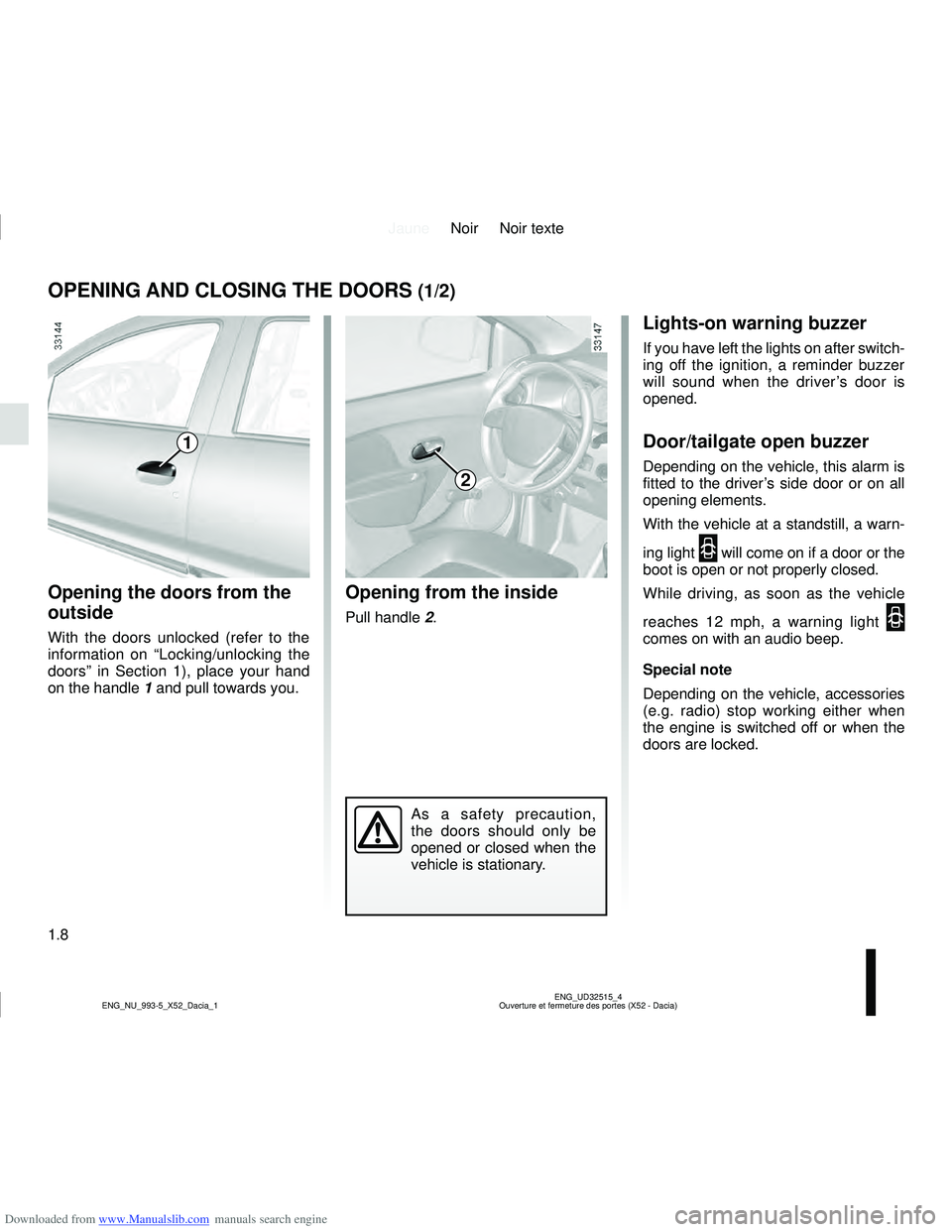
Opening the doors from the
outside
With the doors unlocked (refer to the
information on “Locking/unlocking the
doors” in Section 1), place your hand
on the handle 1 and pull towards you.
Opening from the inside
Pull handle 2.
Lights-on warning buzzer
If you have left the lights on after switch-
ing off the ignition, a reminder buzzer
will sound when the driver’s door is
opened.
Door/tailgate open buzzer
Depending on the vehicle, this alarm is
fitted to the driver’s side door or on all
opening elements.
With the vehicle at a standstill, a warn-
ing light
2 will come on if a door or the
boot is open or not properly closed.
While driving, as soon as the vehicle
reaches 12 mph, a warning light
2
comes on with an audio beep.
Special note
Depending on the vehicle, accessories
(e.g. radio) stop working either when
the engine is switched off or when the
doors are locked.
1
As a safety precaution,
the doors should only be
opened or closed when the
vehicle is stationary.
2
Page 20 of 238

Downloaded from www.Manualslib.com manuals search engine JauneNoir Noir texte
1.14
ENG_UD33182_3
Ceintures de sécurité (X52 - Dacia)
ENG_NU_993-5_X52_Dacia_1
SEAT BELTS (1/6)
Always wear your seat belt when trav-
elling in your vehicle. You must also
comply with the legislation of the par-
ticular country you are in.
Incorrectly adjusted or
twisted seat belts may
cause injuries in the event
of an accident.
Use one seat belt per person,
whether child or adult.
Even pregnant women should wear
a seat belt. In this case, ensure that
the lap belt is not exerting too much
pressure on the abdomen, but do
not allow any slack.
Before starting, first adjust your driv-
ing position, then ask all occupants
to adjust their seat belts to ensure
optimum protection.
Adjusting your driving position
(depending on the vehicle)
– Sit well back in your seat (having
removed your coat or jacket etc.).
This is essential to ensure your back
is positioned correctly;
– adjust the distance between the
seat and the pedals. Your seat
should be as far back as possible
while still allowing you to depress
the clutch pedal fully. The seatback
should be adjusted so that your arms
are slightly bent when you hold the
steering wheel;
– adjust the position of your head- rest. For the maximum safety, your
head must be as close as possible to
the headrest;
– adjust the height of the seat. This
adjustment allows you to select the
seat position which offers you the
best possible view;
– adjust the position of the steering
wheel.
Adjusting the seat belts
Sit with your back firmly against the
seatback.
The shoulder strap 1 should be as close
as possible to the base of the neck but
not on it.
Lap belt 2 must be worn flat over the
thighs and against the pelvis. The seat
belt must be worn as close to the body
as possible. i.e.: avoid wearing heavy
clothing or keeping bulky objects under
the belts, etc.
1
2
Make sure that the rear bench seat
is locked in position correctly so that
the rear seat belts will operate effi-
ciently. Refer to the information on
the “Rear bench seat: functions” in
Section 3.
Page 27 of 238

Downloaded from www.Manualslib.com manuals search engine JauneNoir Noir texte
1.21
ENG_UD26915_1
Dispositifs complémentaires à la ceinture avant (X52 - Dacia)
ENG_NU_993-5_X52_Dacia_1
SYSTEMS IN ADDITION TO THE FRONT SEAT BELTS (2/4)
Each air bag system consists of:
– an airbag and gas generator fitted
on the steering wheel for the driver
and, depending on the vehicle, in the
dashboard for the front passenger;
– an electronic unit for system monitor- ing which controls the gas generator
electrical trigger system;
– a single warning light
å;
– remote sensors.
Load limiter
Above a certain severity of impact, this
mechanism is used to limit the force of
the belt against the body so that it is at
an acceptable level.
The air bag system uses
pyrotechnic principles. This
explains why, when the air
bag inflates, it will gener-
ate heat, produce smoke (this does
not mean that a fire is about to start)
and make a noise upon detonation.
An air bag may inflate immediately,
causing some minor, superficial
grazing to the skin or other discom-
fort.
1
Driver’s and passenger air
bags
They are fitted on the driver’s side and,
depending on the vehicle, on the pas-
senger side.
Depending on the vehicle, the pres-
ence of this equipment is indicated by
the word “airbag” on the steering wheel
and dashboard (airbag zone 1) and
a symbol on the lower section of the
windscreen.
Page 29 of 238

Downloaded from www.Manualslib.com manuals search engine JauneNoir Noir texte
1.23
ENG_UD26915_1
Dispositifs complémentaires à la ceinture avant (X52 - Dacia)
ENG_NU_993-5_X52_Dacia_1
SYSTEMS IN ADDITION TO THE FRONT SEAT BELTS (4/4)
All of the warnings below are given so that the air bag is not obstructed in any way when it\
is inflated and also to prevent
the risk of serious injuries caused by items which may be dislodged when\
the air bag inflates.
Warnings concerning the driver’s air bag
– Do not modify the steering wheel or the steering wheel boss.
– Do not cover the steering wheel boss under any circumstances.
– Do not attach any objects (badge, logo, clock, telephone holder, etc.) to the steering wheel boss.
– You must not remove the steering wheel (such work must only be performed\
by trained personnel from our Network).
– When driving, do not sit too close to the steering wheel. Sit with your \
arms slightly bent (see the information on “Adjusting
your driving position” in Section 1). This will allow sufficient space for the air bag to inflate properly and be fully effective.
Warnings concerning the passenger air bag
– Do not attach or glue any objects (badge, logo, clock, telephone holder, etc.) to the dashboard in the proximity of the air b ag
housing.
– Do not place anything between the dashboard and the passenger (pet, umb\
rella, walking stick, parcels, etc.).
– The passenger must not put his or her feet on the dashboard or seat as t\
here is a risk that serious injuries may occur. In general, all parts of the body should be kept away from the dashboard (\
knees, hands, head etc.).
– The devices in addition to the front passenger seat belt should be reactivated as soon as a child seat is removed, to ensure the protection of the passenger in the event of an impact.
IT IS PROHIBITED TO FIT A REAR-FACING CHILD SEAT TO THE FRONT PASSENGER SEAT UNLESS THE
RESTRAINT SYSTEMS IN ADDITION TO THE FRONT PASSENGER SEAT BELT HAVE BEEN DEACTIVATED.
(Refer to the information on “Child safety: front passenger airbag d\
eactivation/activation” Section 1).
Page 32 of 238

Downloaded from www.Manualslib.com manuals search engine JauneNoir Noir texte
1.26
ENG_UD34943_3
Sécurité enfants : généralités GPL (X52 - Dacia)
ENG_NU_993-5_X52_Dacia_1
CHILD SAFETY: general information (1/3)
Carrying children
Children, and adults, must be correctly
seated and strapped in for all journeys.
The children being carried in your vehi-
cle are your responsibility.
A child is not a miniature adult. Children
are at risk of specific injuries as their
muscles and bones have not yet fin-
ished growing. The seat belt alone
would not provide suitable protection.
Use an approved child seat and ensure
you use it correctly.
To prevent the doors being
opened, use the childproof
locks (refer to the informa-
tion on “Locking/unlocking
the doors” in Section 1).
A collision at 30 mph
(50 km/h) is the same
as falling a distance of
10 metres. Transporting a
child without a restraint is the equi-
valent of allowing him or her to play
on a fourthfloor balcony without rail-
ings.
Never travel with a child held in your
arms. In the event of an accident,
you will not be able to keep hold of
the child, even if you yourself are
wearing a seat belt.
If your vehicle has been involved in
a road accident, replace the child
seat and have the seat belts and
ISOFIX fittings checked.
Never leave a child unat-
tended in the vehicle.
Check that your child is
always strapped in and that
the belt or safety harness used is
correctly set and adjusted. Avoid
wearing bulky clothing which could
cause the belts to slacken.
Never let your child put their head or
arms out of the window.
Check that the child is in the correct
position for the entire journey, espe-
cially if asleep.
Special features of LPG
versions
The vehicle’s LPG installa-
tion may lead to changes to
the vehicle’s features compared to
the petrol version.
This may relate to the number of
seats and the installation of child
seats.
Please contact an authorised dealer.