2014 Citroen DS5 air condition
[x] Cancel search: air conditionPage 100 of 372

5. Air conditioning On / Off
Press this button to switch off
the air conditioning.
Switching the system off could result in
discomfort (humidity, condensation).
Press this button again to return to
automatic operation of the air conditioning.
The indicator lamp in the "A /C "
button
comes on.
To obtain cool air more quickly, you can
use recirculation of the interior air for a
few moments. Then revert to the intake of
exterior air.
6. Air distribution adjustment
Press one or more buttons to
direct the air flow towards:
- the windscreen and side windows,
- the outer and centre air vents,
- the footwells.
You can combine the three orientations to
obtain the desired air distribution.
7. Air fl ow adjustment
Turn this control to the left to
decrease the air flow or to the
right to increase the air flow.
The air flow indicator lamps, between the two
fans, come on progressively in relation to the
value requested.
8. Air intake / Air recirculation
Air recirculation enables the passenger
compartment to be isolated from exterior odours
and smoke when external pollution is detected
(if your vehicle is fitted with a pollution sensor).
It is activated automatically on operation of the
screenwash.
It is inactive when the ambient temperature is
below 5 °C to avoid the risk of misting in the
vehicle.
- The indicator lamp with "A" on
indicates that recirculation is
controlled automatically.
- The indicator lamp without "A"
on indicates that recirculation
is forced manually.
- Both indicator lamps off
indicates that recirculation is
controlled automatically without
taking account of the detection
of pollution.
Without pollution sensor
If your vehicle is not fitted with a
pollution sensor, press this button
to force recirculation manually.
Page 101 of 372
99Comfort
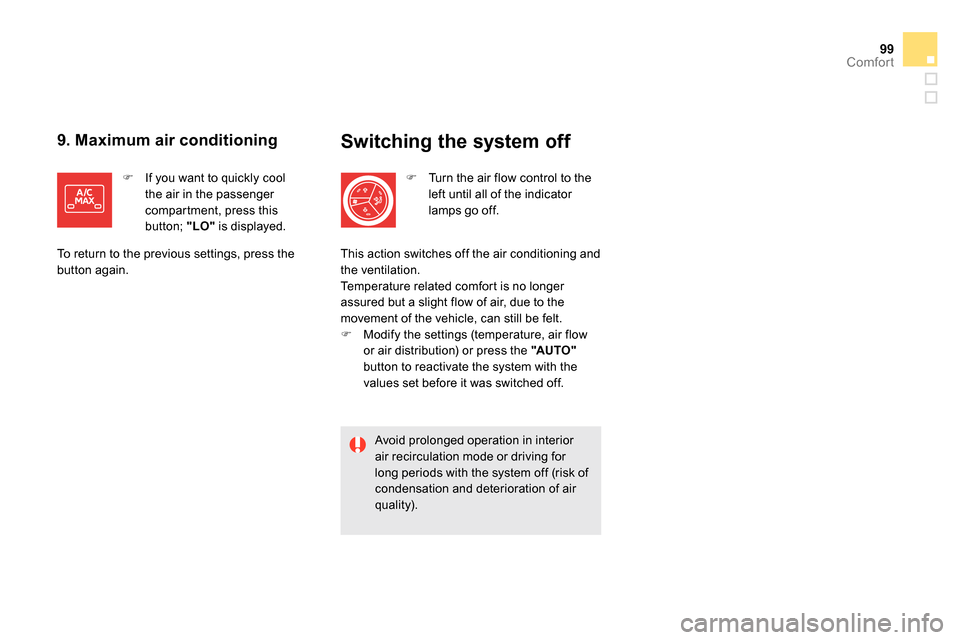
Switching the system off
Turn the air flow control to the
left until all of the indicator
lamps go off.
Avoid prolonged operation in interior
air recirculation mode or driving for
long periods with the system off (risk of
condensation and deterioration of air
quality). This action switches off the air conditioning and
the ventilation.
Temperature related comfort is no longer
assured but a slight flow of air, due to the
movement of the vehicle, can still be felt.
Modify the settings (temperature, air flow
or air distribution) or press the "AUTO "
button to reactivate the system with the
values set before it was switched off.
9. Maximum air conditioning
If you want to quickly cool
the air in the passenger
compartment, press this
button; "LO"
is displayed.
To return to the previous settings, press the
button again.
Page 102 of 372

Switch off the demisting/defrosting
of the rear screen and door mirrors
as soon as appropriate, as lower
current consumption results in
reduced fuel consumption.
Front Demist -
Defrost
Rear screen and door mirrors demist -
defrost
It is possible to stop the
demisting/defrosting operation
before it is switched off
automatically by pressing the
button again. The indicator
lamp associated with the
button goes off.
Automatic visibility programme
Switching on
With Stop & Start, when demisting has
been activated, the STOP mode is not
available.
Switching off
The demisting/defrosting switches off automatically
to prevent an excessive consumption of current.
Select this programme
to demist or defrost the
windscreen and side windows
as quickly as possible.
The system automatically manages the air
conditioning, air flow and air intake, and
provides optimum distribution towards the
windscreen and side windows.
To stop the programme, press either
the "visibility"
button again or "AUTO "
,
the indicator lamp in the button goes off
and the indicator lamp in the "AUTO "
button comes on.
The system starts again with the values in
use before it was overridden by the visibility
programme.
Press this button (located on
the air conditioning system
control panel) to demist /defrost
the rear screen and the door
mirrors. The indicator lamp
associated with the button
comes on.
The rear screen demist - defrost
can only operate when the engine is
running.
Page 187 of 372

185Safety
DSC/ASR
The DSC and ASR systems offer increased
safety in normal driving, but they should not
encourage the driver to take extra risks or
drive at high speed.
It is in conditions of reduced grip (rain,
snow, ice) that the risk of loss of grip
increases. It is therefore important for your
safety to keep the DSC and ASR systems
activated in all conditions, and particularly
in difficult conditions.
After an impact, have these systems
checked by a CITROËN dealer or a
qualified workshop.
The correct operation of these systems
depends on obser vation of the
manufacturer's recommendations regarding
as much the wheels (tyres and rims),
braking and electronic components as the
assembly and repair procedures used by
CITROËN dealers.
To benefit in full from the effectiveness
of the DSC and ASR systems in wintry
conditions, the vehicle must be fitted with
four snow tyres, allowing the the vehicle to
retain neutral behaviour on the road.
Page 191 of 372

189Safety
Airbags
System designed to maximise the safety of the
occupants (with the exception of the rear centre
passenger) in the event of violent collisions.
The airbags supplement the action of the force-
limiting seat belts (with the exception of the
centre rear passenger).
If a collision occurs, the electronic detectors
record and analyse the front and side impacts
sustained in the impact detection zones:
- in the case of a serious impact, the airbags
are deployed instantly and contribute
towards better protection of the occupants
of the vehicle (with the exception of the
rear centre passenger); immediately after
the impact, the airbags deflate rapidly so
that they do not hinder visibility or the exit
of the occupants,
- in the case of a minor or rear impact
or in certain roll-over conditions, the
airbags will not be deployed; the seat belt
alone contributes towards ensuring your
protection in these situations.
The airbags do not operate when the
ignition is switched off.
This equipment will only deploy once.
If a second impact occurs (during the
same or a subsequent accident), the
airbag will not be deployed again. Deployment of the airbag(s) is
accompanied by a slight emission
of smoke and a noise, due to the
activation of the pyrotechnic cartridge
incorporated in the system.
This smoke is not harmful, but sensitive
individuals may experience slight
irritation.
The noise of the detonation may result
in a slight loss of hearing for a short
time.
Impact detection zones
A.
Front impact zone.
B.
Side impact zone.
Front airbags
Deployment
The airbags are deployed, except the passenger's
front airbag if it is deactivated, in the event of a serious
front impact to all or part of the front impact zone A
,
in the longitudinal centreline of the vehicle on a
horizontal plane and directed from the front to the rear
of the vehicle.
The front airbag inflates between the thorax and head
of the front occupant of the vehicle and the steering
wheel, driver's side, and the dashboard, passenger's
side to cushion their for ward movement.
System which protects the driver and front
passenger in the event of a serious front impact
in order to limit the risk of injury to the head and
thorax.
The driver's airbag is fitted in the centre of the
steering wheel; the front passenger's airbag is
fitted in the dashboard above the glove box.
Page 221 of 372

219Practical information
Changing a fuse
Procedure for replacing a failed fuse with a new fuse to rectify a failure of the corresponding function.
The fuse extraction tweezer is fitted to the back
of the dashboard fusebox cover.
For access to it:
remove the cover completely,
remove the tweezer.
Access to tooling
Before changing a fuse, the cause
of the failure must be identified and
rectified.
Identify the failed fuse by checking
the condition of its filament.
Changing a fuse
Good
Failed
Use the special tweezer to extract the fuse
from its housing.
Always replace the failed fuse with a fuse
of the same rating.
Check that the number marked on the
fusebox, the rating marked on the fuse and
the following tables all agree.
CITROËN will not accept responsibility
for the cost incurred in repairing your
vehicle or for rectifying malfunctions
resulting from the installation of
accessories not supplied and not
recommended by CITROËN and
not installed in accordance with its
instructions, in particular when the
combined consumption of all of the
additional equipment connected
exceeds 10 milliamperes.
Installing electrical
accessories
Your vehicle's electrical system is
designed to operate with standard or
optional equipment.
Before installing other electrical
equipment or accessories on your
vehicle, contact a CITROËN dealer
or a qualified workshop.
Page 227 of 372
225Practical information
Load reduction mode
System which manages the use of certain
functions according to the level of charge
remaining in the battery.
When the vehicle is being driven, the load
reduction function temporarily deactivates
certain functions, such as the air conditioning,
the heated rear screen...
The deactivated functions are reactivated
automatically as soon as conditions permit.
System which manages the duration of use of
certain functions to conser ve a sufficient level
of charge in the battery.
After the engine has stopped, you can
still use functions such as the audio and
telematics system, windscreen wipers, dipped
beam headlamps, courtesy lamps, etc. for
a maximum combined duration of about
forty minutes.
Energy economy mode
Switching to economy
mode
A message then appears in the instrument
panel screen indicating that the vehicle has
switched to economy mode and the active
functions are put on standby.
If a telephone call is being made at this time,
it will be maintained for around 10 minutes with
the Bluetooth hands-free system of your audio
system.
Exiting economy mode
These functions are reactivated automatically
next time the vehicle is driven.
In order to restore the use of these functions
immediately, start the engine and let it run:
- for less than ten minutes, to use the
equipment for approximately five minutes,
- for more than ten minutes, to use the
equipment for up to approximately
thirty minutes.
Let the engine run for the duration specified to
ensure that the battery charge is sufficient.
Do not repeatedly and continuously restart the
engine in order to charge the battery.
A flat battery prevents the engine from starting
(refer to the "Battery" section).
Page 248 of 372

Particle emission filter (Diesel)
The start of saturation of the
par ticle filter is indicated by
the temporary illumination of
this warning lamp accompanied by a message
in the multi-function screen.
As soon as the traffic conditions permit,
regenerate the filter by driving at a
speed of at least 40 mph (60 km/h) until
the warning lamp goes off.
If the warning lamp stays on, this
indicates a low additive level.
On a new vehicle, the first particle
filter regeneration operations may be
accompanied by a "burning" smell,
which is per fectly normal.
Following prolonged operation of the
vehicle at very low speed or at idle,
you may, in exceptional circumstances,
notice the emission of water vapour at
the exhaust on acceleration. This does
not affect the behaviour of the vehicle
or the environment.
Refer to the maintenance and
warranty guide for details of the
replacement inter vals for these
components.
Air filter and passenger compartment filter
Replace the oil filter each time the
engine oil is changed.
Refer to the maintenance and
warranty guide for details of the
replacement inter val for this
component.
Oil filter
Depending on the environment (e.g. dusty
atmosphere) and the use of the vehicle
(e.g. city driving), replace them twice as often
if necessary
.
A clogged passenger compartment filter may
have an adverse effect on the per formance
of the air conditioning system and generate
undesirable odours.
Manual gearbox
The gearbox does not require any
maintenance (no oil change).
Refer to the maintenance and
warranty guide for the details of
the level checking inter val for this
component.
Electronic gearbox
The gearbox does not require any
maintenance (no oil change).
Refer to the maintenance and
warranty guide for details of the
checking inter val for this component.
Automatic gearbox
The gearbox does not require any
maintenance (no oil change).
Refer to the maintenance and
warranty guide for details of the level
checking inter val for this component.