Page 160 of 292
158
C3Picasso_en_Chap11_informations-pratiques_ed01-2014
Removing a wheel
List of operations
F Remove the bolt cover from each of the bolts using the tool 3 (with allow wheels
only).
F
F
it the security socket 4 to the
wheelbrace
1
to slacken the security bolt
(if your vehicle has them).
F
S
lacken the other bolts using the
wheelbrace 1 o n l y.
Parking the vehicle
Immobilise the vehicle where it does not
block traffic: the ground must be level,
stable and non-slippery.
Apply the parking brake, switch off the
ignition and engage first gear* to lock
the wheels.
If necessary, place a chock under the
wheel diagonally opposite the wheel to
be changed.
You must ensure that the occupants get
out of the vehicle and wait where they
are safe.
ne
ver go underneath a vehicle raised
using a jack; use an axle stand.
* Position R for an electronic gearbox.
Practical information
Page 161 of 292

159
C3Picasso_en_Chap11_informations-pratiques_ed01-2014
F Position the foot of the jack 2 on the ground, ensuring that it is directly below the
front A or rear B jacking points provided on
the underbody, whichever is closest to the
wheel to be changed.
F
E
xtend the jack 2 until its head comes into
contact with the jacking point A or B used.
The vehicle's contact sur face A or B must
be fully engaged with the central part of the
head of the jack. F
Ra ise the vehicle until there is sufficient
space between the wheel and the ground
to admit the spare (not punctured) wheel
easily.
F
R
emove the bolts and store them in a clean
place.
F
R
emove the wheel.Ensure that the jack is stable. If the
ground is slippery or loose, the jack
could slip or drop - Risk of injury!
Position the jack only at one of the
jacking points A or B under the vehicle,
ensuring that the vehicle's contact
sur face is positioned centrally on the
head of the jack. Other wise, there is a
risk of damage to the vehicle and/or the
jack dropping - Risk of injury!
11
Practical information
Page 162 of 292
160
C3Picasso_en_Chap11_informations-pratiques_ed01-2014
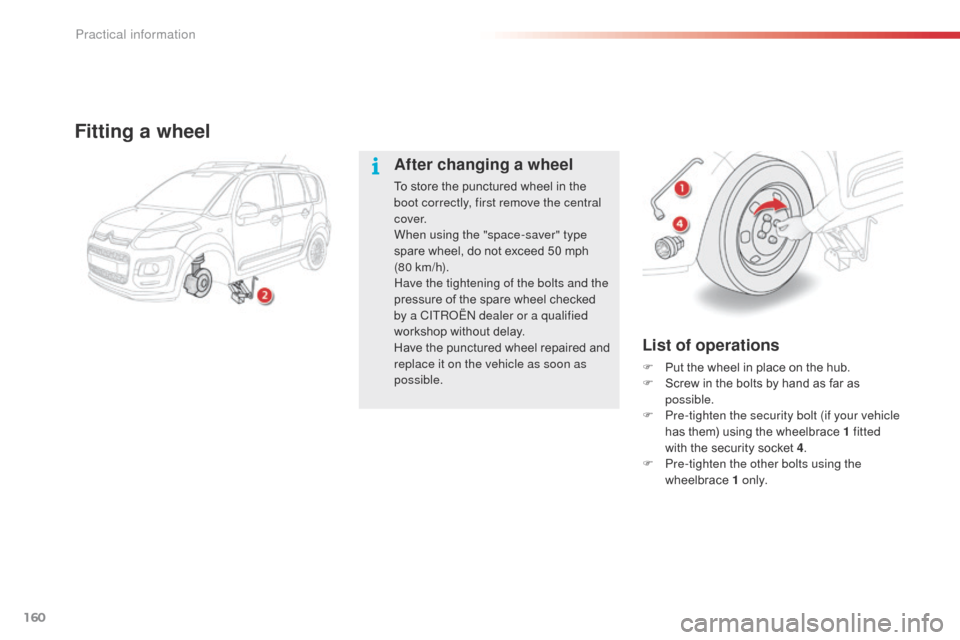
List of operations
F Put the wheel in place on the hub.
F S crew in the bolts by hand as far as
possible.
F
P
re-tighten the security bolt (if your vehicle
has them) using the wheelbrace 1 fitted
with the security socket 4 .
F
P
re-tighten the other bolts using the
wheelbrace 1 o n l y.
Fitting a wheel
After changing a wheel
To store the punctured wheel in the
boot correctly, first remove the central
c ove r.
When using the "space-saver" type
spare wheel, do not exceed 50 mph
(80
km/h).
Have the tightening of the bolts and the
pressure of the spare wheel checked
by a CITR
oËn
dealer or a qualified
workshop without delay.
Have the punctured wheel repaired and
replace it on the vehicle as soon as
possible.
Practical information
Page 163 of 292
161
C3Picasso_en_Chap11_informations-pratiques_ed01-2014
F Tighten the security bolt (if your vehicle has them) using the wheelbrace 1 fitted with
the security socket 4 .
F
T
ighten the other bolts using the
wheelbrace 1 o n l y.
F
R
efit the bolt covers on each of the bolts
(with alloy wheels only).
F
S
tore the tools in the box.
F
L
ower the vehicle fully.
F
F
old the jack 2 and detach it.
11
Practical information
Page 164 of 292

162
C3Picasso_en_Chap11_informations-pratiques_ed01-2014
Snow chains
original tyre sizeMaximum link size.
195 / 60 R15 9 mm
195 / 55 R16 9 mm
205 / 45 R17 7 mm
For more information on snow chains,
contact a CITR
oËn
dealer or a
qualified workshop.
In wintry conditions, snow chains improve traction as well as the behaviour of the vehicle when
braking.
The snow chains must be fitted only
to the front wheels. They must never
be fitted to "space-saver" type spare
wheels.
Take account of the legislation in force
in your country on the use of snow
chains and the maximum running speed
authorised.
Advice on installation
F If you have to fit the chains during a journey, stop the vehicle on a flat sur face
on the side of the road.
F
a
p
ply the parking brake and position any
wheel chocks to prevent movement of your
vehicle.
F
F
it the chains following the instructions
provided by the manufacturer.
F
M
ove off gently and drive for a few
moments, without exceeding 30 mph
(50
km/h).
F
S
top your vehicle and check that the snow
chains are correctly tightened.
Avoid driving with snow chains on roads
that have been cleared of snow, to
avoid damaging your vehicle's tyres and
the road sur face. If your vehicle is fitted
with alloy wheels, check that no part of
the chain or its fixings is in contact with
the wheel rim.
al
l original tyre sizes (15", 16", 17") can be
fitted with chains.
Use only the chains designed to be fitted to the
type of wheel fitted to your vehicle:
It is strongly recommended that before
you leave, you practise fitting the snow
chains on a level and dry sur face.
Practical information
Page 175 of 292
173
C3Picasso_en_Chap11_informations-pratiques_ed01-2014
Dashboard fuses
The fusebox is placed in the lower dashboard
(left-hand side).
Access to fuses
F refer to the paragraph "access to tools".
Fuse tables
Fuse N°Rating Functions
FH36 5 ATrailer relay unit.
FH37 15 ATrailer accessories socket supply.
FH38 20 A
af
termarket navigation.
FH39 20 AHeated seats.
FH40 30 ATrailer relay unit.
Fuse N° Rating Functions
F1 15 ARear wiper.
F2 -
no
t used.
F3 5 A
ai
rbags and pretensioners control unit.
F4 10 ASteering wheel angle sensor, air conditioning, clutch switch,
particle filter pump, diagnostic socket, air flow meter.
F5 30 AElectric window switch panel, passenger's electric window
control, front electric window motor.
F6 30 ARear electric window motor and driver's electric window motor.
F7 5 ACourtesy and front map reading lamps, glove box lighting,
torch, rear reading lamps.
11
Practical information
Page 176 of 292
174
C3Picasso_en_Chap11_informations-pratiques_ed01-2014
Fuse N°Rating Functions
F8 20 AMultifunction screen, audio system, navigation radio.
F9 30 A
au
dio system (aftermarket), 12 V socket.
F10 15 ASteering wheel controls.
F11 15 AIgnition, diagnostic socket.
F12 15 ARain / sunshine sensor, trailer relay unit.
F13 5 AMain stop switch, engine relay unit.
F14 15 AParking assistance control unit, seat belt unfastened warning
lamp, airbag control unit, instrument panel, air conditioning,
USB Box.
F15 30 ALocking.
F16 -
no
t used.
F17 40 ARear screen and door mirrors demist/defrost.
SH -P
aR
C shunt.
Practical information
Page 186 of 292

184
C3Picasso_en_Chap11_informations-pratiques_ed01-2014
Towing the vehicle
Access to the tools
The towing eye is installed under the boot floor.
To gain access to it:
F
o
pen the boot,
F
r
emove the adjustable boot floor,
F
l
ift up the boot carpet,
F
r
emove the towing eye from the tool holder.
Procedure for having your vehicle towed or for towing another vehicle using a removable towing eye.
General recommendations
observe the legislation in force in your country.
Ensure that the weight of the towing vehicle is higher than that of the towed vehicle.
The driver must remain at the wheel of the towed vehicle and must have a valid driving licence.
When towing a vehicle with all four wheels on the ground, always use an approved towing
arm; rope and straps are prohibited.
The towing vehicle must move off gently.
When towing a vehicle with the engine off, there is no longer any power assistance for
braking or steering.
In the following cases, you must always call on a professional recovery service:
-
v
ehicle broken down on a motor way or fast road,
-
f
our-wheel drive vehicle,
-
w
hen it is not possible to put the gearbox into neutral, unlock the steering, or release
the parking brake,
-
t
owing with only two wheels on the ground,
-
w
here there is no approved towing arm available...
Practical information