2014 Citroen C3 lock
[x] Cancel search: lockPage 120 of 284

118
C3_en_Chap09_Conduite_ed01-2014
C3_en_Chap09_Conduite_ed01-2014
Stopping the vehicleOperating fault
When the ignition is on, the lighting
of this warning lamp, accompanied
by an audible signal and a message in the
multifunction screen, indicates a gearbox fault.
In this case, the gearbox switches to back-up
mode and is locked in 3rd gear. You may feel
a substantial knock when changing from P
to R and from N to R . This will not cause any
damage to the gearbox.
do n
ot exceed 60 mph (100 km/h), local speed
restrictions permitting.
Contact a CITR
oËn
dealer or a qualified
workshop as soon as possible. To reduce fuel consumption when at
a prolonged standstill with the engine
running (traffic jam...), put the gear lever
in the N position and apply the parking
brake.There is a risk of damage to the
gearbox:
-
i
f you press the accelerator and
brake pedals at the same time,
-
i
f you force the movement of the gear
lever from the P position to another
position when the battery is flat.
If the lever is not in position P
, when the
driver's door is opened or approximately
45 seconds after the ignition is switched
off, a warning message appears in the
screen.
F
R
eturn the lever to position P ; the
message disappears.
If the ambient temperature is below
-23°C, the engine should be left running
at idle for four minutes, in order to
ensure the correct operation and
durability of the engine and gearbox.
When traversing a flooded road or a
ford, drive at walking pace.
Before switching off the engine, you can engage
position
P or N to place the gearbox in neutral.
In both cases, apply the parking brake to
immobilise the vehicle.
driving
Page 130 of 284

128
C3_en_Chap09_Conduite_ed01-2014
C3_en_Chap09_Conduite_ed01-2014
Rear parking sensors
Activation
This detects any obstacle (person, vehicle,
tree, gate, etc.) behind the vehicle, except
obstacles located just below the bumper.The system is activated as soon as reverse
gear is engaged, accompanied by an audible
signal. The proximity information is given by:
-
a
n audible signal, which becomes more
rapid as the vehicle approaches the
obstacle.
-
a g
raphic (according to version) in the
multifunction screen, with blocks which
become increasingly closer to the vehicle.
On completion of the manoeuvre, when you
exit reverse gear, the system becomes inactive.
An object, such as a stake, a roadworks
cone or any other similar object may be
detected at the beginning of the manoeuvre,
but may no longer be detected when the
vehicle comes close to it.
The parking sensor system cannot in
any circumstances take the place of
vigilance on the part of the driver.
System consisting of four proximity sensors,
located in the rear bumper.
When the distance between the rear of the
vehicle and the obstacle is less than thirty
centimetres, the audible signal becomes
continuous and the "da
nger" symbol appears
in the multifunction screen.
driving
Page 141 of 284

139
according to your version of instrument panel, the start of
saturation of the particle emissions filter is indicated by:
- fixed illumination of the particle emissions filter warning lamp,
accompanied by an audible signal,
or
-
t
emporary illumination of
the service warning lamp,
as s
oon as the traffic conditions permit, regenerate
the filter by driving at a speed of at least 40
mph
(60
km/h) until the warning lamp goes off.
If the warning lamp stays on, refer to the "Additive
level" section.
Checks
12 V battery
The battery does not require any maintenance.
However, check that the terminals are clean
and correctly tightened, particularly in summer
and winter.
The presence of this label, in particular with
the Stop & Start system, indicates the use of
a specific 12
V lead-acid battery with special
technology and specification. The involvement
of a CITROËN dealer or a qualified workshop
is essential when replacing or disconnecting
the battery. When carrying out work on the battery, refer
to the "12 V battery" section for details of the
precautions to be taken before disconnecting
the battery and following its reconnection. Unless other wise indicated, check these components in accordance with the maintenance and warranty guide and according to your engine.
Other wise, have them checked by a CITROËN dealer or a qualified workshop.
On a new vehicle, the first operations of
regeneration of the particle emissions
filter may be accompanied by the smell
of "burning", which is per fectly normal.
Following prolonged operation of the
vehicle at very low speed or at idle,
you may, in exceptional circumstances,
notice the emission of water vapour at
the exhaust on acceleration. This does
not affect the behaviour of the vehicle
or the environment.
Particle emission filter (Diesel)
accompanied by an audible signal and a
message that there is a risk of blockage of
the particle emissions filter.
Air filter and passenger compartment filter
Refer to the maintenance and
warranty guide for details of the
replacement intervals for these
components.
de
pending on the environment (e.g. dusty
atmosphere) and the use of the vehicle
(e.g. city driving), replace them twice as
often if necessar y .
a c
logged passenger compartment filter may
have an adverse effect on the per formance
of the air conditioning system and generate
undesirable odours.
Replace the oil filter each time the
engine oil is changed.
Refer to the maintenance and
warranty guide for details of the
replacement interval for this
component.
Oil filter
10
Checks
Page 151 of 284

149
C3_en_Chap11_Info-pratiques_ed01-2014
Removing a wheel
List of operations
F Remove the bolt cover from each of the bolts using the tool 3 (with alloy wheels
only).
F
F
it the security bolt socket 4 on the
wheelbrace 1 to slacken the security bolt
(if your vehicle has them).
F
S
lacken the other bolts using the
wheelbrace 1 o n l y.
Parking the vehicle
Immobilise the vehicle where it does not
block traffic: the ground must be level,
stable and not slippery.
Apply the parking brake, switch off the
ignition and engage first gear* to lock
the wheels.
If necessary, place a chock under the
wheel diagonally opposite the wheel to
be changed.
It is imperative that you ensure that the
occupants get out of the vehicle and
wait where they are safe.
ne
ver go underneath a vehicle raised
using a jack; use an axle stand.
*
position R for an electronic gearbox;
position
P for an automatic gearbox.
11
Practical information
Page 165 of 284

163
C3_en_Chap11_Info-pratiques_ed01-2014
Fuse N°Rating Functions
F8 20 AMultifunction screen, audio system, navigation and audio
system, instrument panel with clock, alarm control unit, alarm
siren, audio system (after-market), 12 V socket, portable
navigation carrier power supply.
F9 30 AMultifunction screen, audio system, navigation and audio
system, instrument panel with clock, alarm control unit, alarm
siren, audio system (after-market), 12 V socket, portable
navigation carrier power supply, locking.
F10 15 ASteering mounted controls.
F11 15 AIgnition, diagnostic socket, automatic gearbox control unit.
F12 15 ARain
/ sunshine sensor, trailer relay unit, driving school module.
F13 5 AMain stop switch, engine relay unit, gear lever for electronic
gearbox.
F14 15 AParking sensors control unit, airbag control unit, instrument
panel, digital air conditioning, US
b
b
o
x, HiFi amplifier,
reversing camera.
F15 30 ALocking.
F16 -
no
t used.
F17 40 ARear screen and door mirrors demisting/defrosting.
SH -P
aR
C shunt.
11
Practical information
Page 175 of 284

173
C3_en_Chap11_Info-pratiques_ed01-2014
Towing the vehicle
Access to the tools
The towing eye is installed in the boot under
t h e f l o o r.
To gain access to it:
F
o
pen the boot,
F
r
aise the floor,
F
r
emove the polystyrene storage box,
F
r
emove the towing eye from the holder.
Procedure for having your vehicle towed or for towing another vehicle using a removable towing eye.
General recommendations
observe the legislation in force in your country.
Ensure that the weight of the towing vehicle is higher than that of the towed vehicle.
The driver must remain at the wheel of the towed vehicle and must have a valid driving licence.
When towing a vehicle with all four wheels on the ground, always use an approved towing
arm; rope and straps are prohibited.
The towing vehicle must move off gently.
When towing a vehicle with the engine off, there is no longer any power assistance for
braking or steering.
In the following cases, you must always call on a professional recovery service:
-
v
ehicle broken down on a motor way or fast road,
-
f
our-wheel drive vehicle,
-
w
hen it is not possible to put the gearbox into neutral, unlock the steering, or release
the parking brake,
-
t
owing with only two wheels on the ground,
-
w
here there is no approved towing arm available...
11
Practical information
Page 176 of 284

174
C3_en_Chap11_Info-pratiques_ed01-2014
Towing your vehicle
F on the front bumper, unclip the cover by pressing at the bottom.
F
S
crew the towing eye in fully.
F
I
nstall the towing bar.
F
P
lace the gear lever in neutral (position N
for an electronic or automatic gearbox). F
on t he rear bumper, unclip the cover by
pressing at the bottom.
F
S
crew the towing eye in fully.
F
I
nstall the towing bar.
F
S
witch on the hazard warning lamps on
both vehicles.
F
M
ove off gently and drive for a short
distance only.
Towing another vehicle
Failure to observe this special condition
could result in damage to certain
components (braking, transmission...)
and the absence of braking assistance
the next time the engine is started. F
U
nlock the steering by turning the key one
notch in the ignition switch and release the
parking brake.
F
S
witch on the hazard warning lamps on
both vehicles.
F
M
ove off gently and drive for a short
distance only.
Practical information
Page 255 of 284
04
253
C3_en_Chap13c_Rd45_ed01_2014
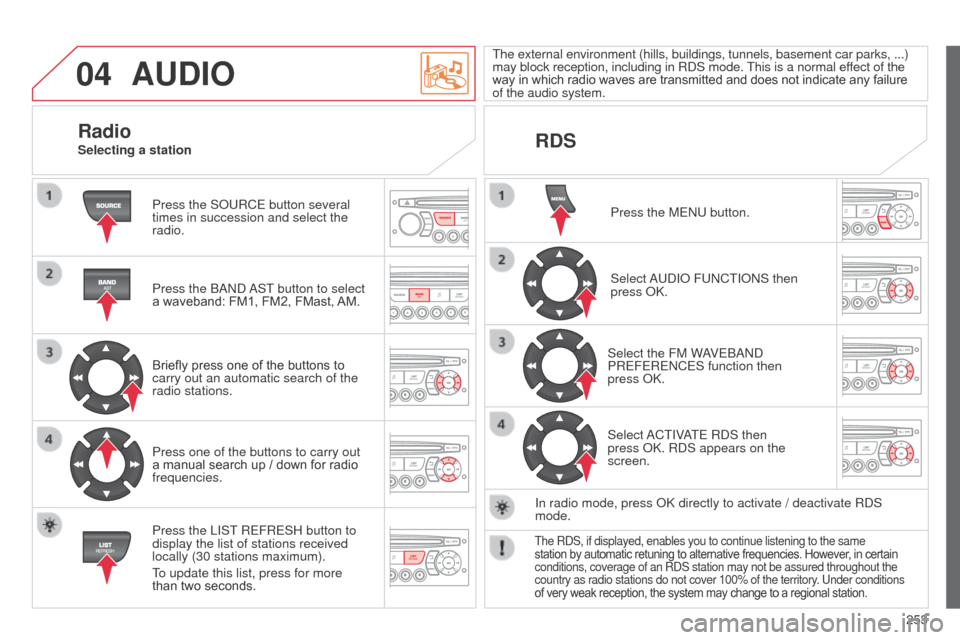
AUDIO
Press the SoURCE button several
times in succession and select the
radio.
Press the
band
a
ST button to select
a waveband: FM1, FM2, FMast, AM.
Briefly press one of the buttons to
carry out an automatic search of the
radio stations.
Press one of the buttons to carry out
a manual search up / down for radio
frequencies.
Press the LIST REFRESH button to
display the list of stations received
locally (30 stations maximum).
To update this list, press for more
than two seconds. The external environment (hills, buildings, tunnels, basement car parks\
, ...)
may block reception, including in R
d S mode. This is a normal effect of the
way in which radio waves are transmitted and does not indicate any failure
of the audio system.
RDS
RadioSelecting a station
Press the ME n U button.
Select
a
U d I o FU n CTI on S then
press
ok .
Select the FM W
aVE
band
PREFERE
n CES function then
press
ok .
Select
a
CTIV
aTE R
d S then
press
ok . R d S appears on the
screen.
In radio mode, press
ok directly to activate / deactivate R d S
mode.
The RdS, if displayed, enables you to continue listening to the same
station by automatic retuning to alternative frequencies. Howev er, in certain
conditions, coverage of an R
d S station may not be assured throughout the
country as radio stations do not cover 100% of the territory. Under conditions
of very weak reception, the system may change to a regional station.