2014 Citroen C3 air con
[x] Cancel search: air conPage 11 of 284

9
C3_en_Chap00c_eco-conduite_ed01-2014
Limit the causes of excess consumption
Spread loads throughout the vehicle; place the heaviest items in the
bottom of the boot, as close as possible to the rear seats.
Limit the loads carried in the vehicle and reduce wind resistance (roof
bars, roof rack, bicycle carrier, trailer...). Use a roof box in preference.
Remove roof bars and roof racks after use.
At the end of winter, remove snow tyres and refit your summer tyres.
Observe the recommendations on maintenance
Check the tyre pressures regularly, when cold, referring to the label in
the door aperture, driver's side.
Carry out this check in particular:
-
b
efore a long journey,
-
a
t each change of season,
-
a
fter a long period out of use.
Don't forget the spare wheel and the tyres on any trailer or caravan.
Have your vehicle serviced regularly (engine oil, oil filter, air filter,
passenger compartment filter...) and observe the schedule of
operations recommended in the maintenance and warranty guide.
With a
b
l
ueH
di
d
i
esel engine, if the SCR system is faulty your vehicle
becomes polluting; go to a CITROËN dealer or a qualified workshop
without delay to have the emissions of nitrous oxides brought back to
the legal level.
When refuelling, do not continue after the third cut-off of the nozzle to
avoid any over flow.
At the wheel of your new vehicle, it is only after the first 1 800 miles
(3 000 kilometres) that you will see the fuel consumption settle down to
a consistent average.
.
Eco-driving
Page 18 of 284

16
C3_en_Chap01_Controle-de-marche_ed01-2014
C3_en_Chap01_Controle-de-marche_ed01-2014
Deactivation indicator lamps
If one of the following indicator lamps comes on, this confirms that the corresponding system has been switched off intentionally.
This is may be accompanied by an audible signal and a message on the multifunction screen.Passenger's
airbag system fixed.
The control, located in the glove box,
is set to the OFF position.
The passenger's front airbag is
deactivated.
You can install a "rear ward facing"
child seat, unless there is a fault with
the operation of the airbags (
ai
rbag
warning lamp on). Set the control to the ON
position to activate the
passenger's front airbag.
In this case, do not fit a child seat in the rear ward
facing position.
Dynamic
stability control
(DSC/ASR )fixed.
The button, located at the bottom
left of the dashboard, is pressed. Its
indicator lamp is on.
The
d
S
C/
aS
R is deactivated.
dSC
: dynamic stability control.
aS
R: anti-slip regulation.Press the button to activate the
d
S
C/
aS
R. Its
indicator lamp goes off.
The DSC/ASR system is activated automatically when
the vehicle is started.
If deactivated, the system is reactivated automatically
from around 30 mph (50 km/h).
Warning
/indicator lampis on Cause Action / Observations
Monitoring
Page 22 of 284

20
C3_en_Chap01_Controle-de-marche_ed01-2014
C3_en_Chap01_Controle-de-marche_ed01-2014
Airbagstemporarily. This lamp comes on for a few
seconds when you turn on the
ignition, then goes off. This lamp should go off when the engine is started.
If it does not go off, contact a CITRoËn
dealer or a
qualified workshop.
fixed.
on
e of the airbag or seat belt
pretensioner systems has a fault. Have it checked by a CITR
oËn
dealer or a qualified
workshop.
Seat belt not
fastened /
unfastened fixed then flashing
accompanied by an
increasing audible
signal. The driver and/or the front passenger
has not fastened or has unfastened
their seat belt.
Pull the strap then insert the tongue in the buckle.
Warning
/indicator lampis on Cause Action / Observations
Door(s) open fixed if the speed is
below 6 mph (10 km/h).
a
door or the boot is still open. Close the door or boot.
fixed and accompanied
by an audible signal
if the speed is above
6 mph (10 km/h).
Power steering fixed. The power steering has a fault.
dr
ive carefully at reduced speed.
Have it checked by a CITR
oËn
dealer or a qualified
workshop.
Monitoring
Page 38 of 284

36
C3_en_Chap02_Ecrans-multifonction_ed01-2014
"Telephone" Menu
With audio system on, once this menu is
selected you can configure your bl uetooth
hands-free system (pairing), view the various
telephone directories (list of calls, services...)
and manage your calls (call, hang up, second
call, secret mode...).
For more information on the "Telephone"
function, refer to the "
au
dio system" section.Choice of language
once this menu has been selected, you can
change the language used by the display, by
choosing a new language from the list offered.
For safety reasons, configuration by the
driver of the multifunction screen must
only be done when stationary.
Display configuration
once this menu has been selected, you can
gain access to the following settings:
-
b
rightness-video setting,
-
d
ate and time setting,
-
s
election of units.
on
ce the fuel consumption units have
been changed to mpg, the information
in the screen relating to speed and
distance also changes to mph and miles
respectively.
Setting the date and time
F
Sel
ect the " Set date and time" function
using the " 5" or " 6" button.
F
Press "OK" to confirm the selection.
F
a
d
just the settings one by one using the
" 7 " or " 8" button then confirm with "OK" .
F
T
hen select the "OK" box in the screen
and confirm.
Multifunction screens
Page 41 of 284

39
C3_en_Chap03_Confort_ed01-2014
Ventilation
Air intake
The air circulating in the passenger compartment
is filtered and originates either from the
outside via the grille located at the base of the
windscreen or from the inside in air recirculation
mode.
Air treatment
The incoming air follows various routes
depending on the controls selected by the
driver:
-
d
irect arrival in the passenger
compartment (air intake),
-
p
assage through a heating circuit (heating),
-
p
assage through a cooling circuit (air
conditioning).
The temperature control enables you to obtain
the level of comfort required by mixing the air of
the various circuits.
The air distribution control enables you to
diffuse the air in the passenger compartment
combining several air vents.
The air flow control enables you to increase or
reduce the speed of the ventilation blower.
Control panel
The controls of this system are grouped
together on control panel A on the centre
console.
d
e
pending on the model, the
functions offered are:
-
t
he level of comfort required,
-
a
ir flow,
-
a
ir distribution,
-
demisting-defrosting,
-
m
anual or digital air conditioning controls.
Air distribution
1. Windscreen demisting-defrosting vents.
2. Front side window demisting-defrosting
vents.
3.
S
ide adjustable air vents.
4.
C
entral adjustable air vents.
5.
A
ir outlets to the front footwells.
6.
A
ir outlets to the rear footwells.
3
Comfort
Page 42 of 284

40
C3_en_Chap03_Confort_ed01-2014
If after an extended stop in sunshine,
the interior temperature is very
high, first ventilate the passenger
compartment for a few moments.
Put the air flow control at a setting high
enough to quickly change the air in the
passenger compartment.
The air conditioning system does not
contain chlorine and does not present
any danger to the ozone layer.The condensation created by the air
conditioning results in a discharge
of water under the vehicle which is
perfectly normal.Recommendations for ventilation and
air conditioning
In order for these systems to be fully effective, follow the operation and maintenance
guidelines below:
F
T
o obtain an even air distribution, take care not to obstruct the exterior air intake grilles
located at the base of the windscreen, the nozzles, the vents and the air outlets, as well
as the air extractor located in the boot.
F
D
o not cover the sunshine sensor, located on the dashboard; this is used for regulation
of the air conditioning system.
F
O
perate the air conditioning system for at least 5 to 10 minutes, once or twice a month
to keep it in per fect working order.
F
E
nsure that the passenger compartment filter is in good condition and have the filter
elements replaced regularly.
W
e recommend the use of a combined passenger compartment filter. Thanks to its
special active additive, it contributes to the purification of the air breathed by the
occupants and the cleanliness of the passenger compartment (reduction of allergic
symptoms, bad odours and greasy deposits).
F
T
o ensure correct operation of the air conditioning system, you are also advised to have
it checked regularly as recommended in the maintenance and warranty guide.
F
I
f the system does not produce cold air, switch it off and contact a CITROËN dealer or a
qualified workshop.
When towing the maximum load on a steep gradient in high temperatures, switching off the
air conditioning increases the available engine power and so improves the towing ability.
Comfort
Page 43 of 284

41
C3_en_Chap03_Confort_ed01-2014
Heating / VentilationManual air
conditioning
The heating / ventilation or air conditioning
systems operates with the engine running,
as well as in STOP mode with Stop & Start.
1. Temperature adjustment
2. Air flow adjustment
F Turn the dial from blue
(cold) to red (hot) to adjust
the temperature to your
requirements.
F
T
urn the dial from position 1
to position 5 to obtain a
comfortable air flow.
Manual control panel
Electric control panel Manual control panel
Electric control panel
F If you place the air flow control
in position 0 (deactivation of the
system), the temperature is no
longer maintained at a comfortable
level. However, a slight flow of air,
due to the movement of the vehicle,
can still be felt.
3
Comfort
Page 44 of 284
42
C3_en_Chap03_Confort_ed01-2014
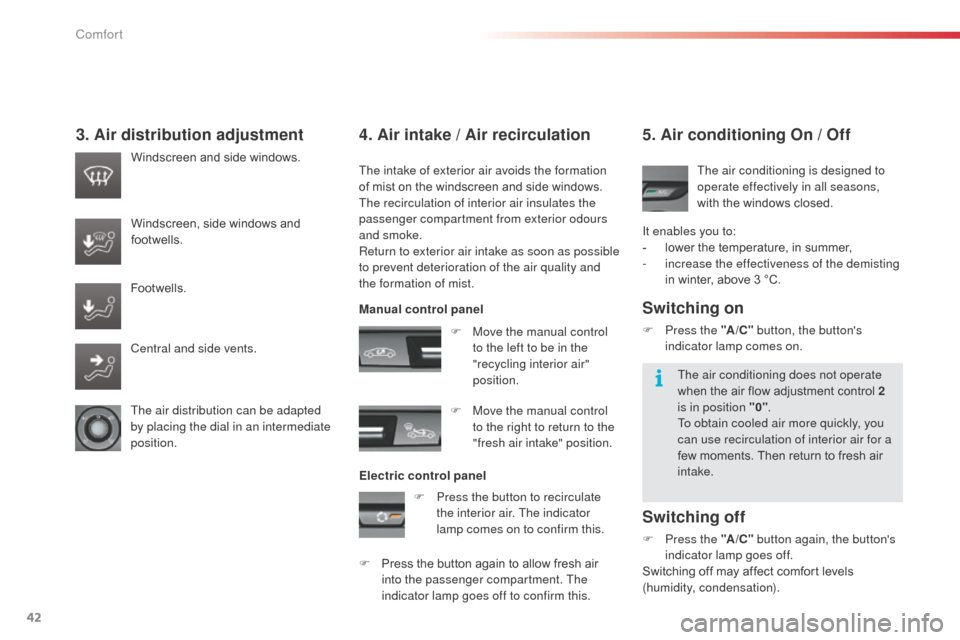
3. Air distribution adjustment
The intake of exterior air avoids the formation
of mist on the windscreen and side windows.
The recirculation of interior air insulates the
passenger compartment from exterior odours
and smoke.
Return to exterior air intake as soon as possible
to prevent deterioration of the air quality and
the formation of mist.
Windscreen and side windows.
Windscreen, side windows and
footwells.
Footwells.
Central and side vents.
The air distribution can be adapted
by placing the dial in an intermediate
position. F
M
ove the manual control
to the left to be in the
"recycling interior air"
position.
F
M
ove the manual control
to the right to return to the
"fresh air intake" position.
Manual control panel
Electric control panel
F
P
ress the button to recirculate
the interior air. The indicator
lamp comes on to confirm this.
F
P
ress the button again to allow fresh air
into the passenger compartment. The
indicator lamp goes off to confirm this.
5. Air conditioning On / Off
Switching off
F Press the "A /C " button again, the button's
indicator lamp goes off.
Switching off may affect comfort levels
(humidity, condensation). The air conditioning is designed to
operate effectively in all seasons,
with the windows closed.
It enables you to:
-
l
ower the temperature, in summer,
-
i
ncrease the effectiveness of the demisting
in winter, above 3 °C.
Switching on
F Press the "A /C " button, the button's
indicator lamp comes on.
The air conditioning does not operate
when the air flow adjustment control 2
is in position "0" .
To obtain cooled air more quickly, you
can use recirculation of interior air for a
few moments. Then return to fresh air
intake.
4. Air intake / Air recirculation
Comfort