Page 457 of 590
Loading
To load your vehicle properly, first figure out its empty
weight, axle-by-axle and side-by-side. Store heavier items
down low and be sure you distribute their weight as
evenly as possible. Stow all loose items securely before
driving. If weighing the loaded vehicle shows that you
have exceeded either GAWR, but the total load is within
the specified GVWR, you must redistribute the weight.
Improper weight distribution can have an adverse effect
on the way your vehicle steers and handles and the way
the brakes operate.
NOTE:
•Refer to the “Vehicle Certification Label” affixed to the
rear of the driver’s door for your vehicle’s GVWR and
GAWRs.
• Refer to the “Tire Placard” for your vehicle’s proper
tire pressure.
TRAILER TOWING
Trailer towing with this vehicle is not recommended.
RECREATIONAL TOWING (BEHIND
MOTORHOME, ETC.)
Recreational towing (with all four wheels on the ground,
or using a towing dolly) is NOT ALLOWED. The only
acceptable method for towing this vehicle (behind an-
other vehicle) is on a vehicle trailer with all four wheels
OFF the ground.
CAUTION!
Towing this vehicle in violation of the above require-
ments can cause severe transmission damage. Dam-
age from improper towing is not covered under the
New Vehicle Limited Warranty.
5
STARTING AND OPERATING 455
Page 459 of 590
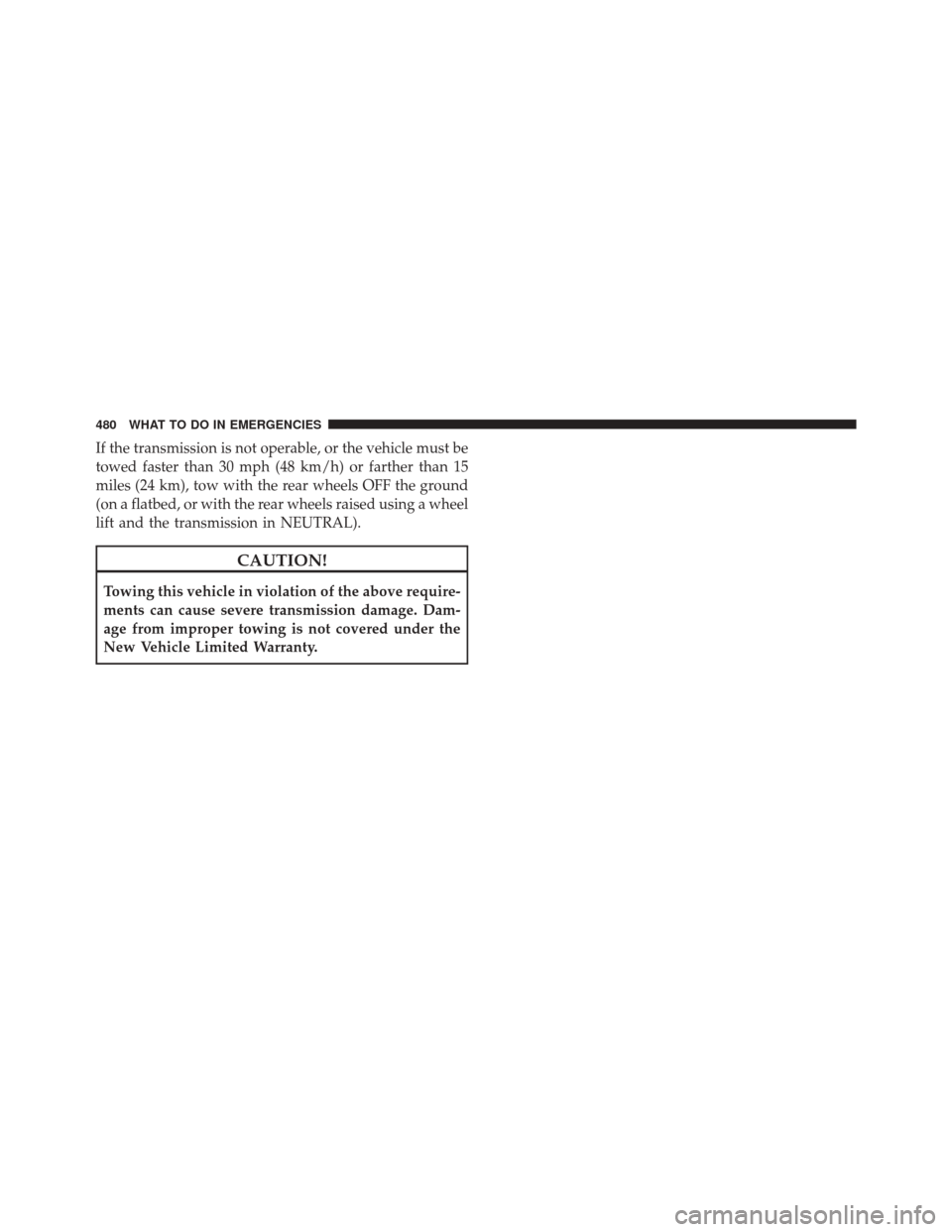
WHAT TO DO IN EMERGENCIES
CONTENTS
�HAZARD WARNING FLASHERS ...........458
� IF YOUR ENGINE OVERHEATS ............458
� WHEEL AND TIRE TORQUE
SPECIFICATIONS ..................... .459
▫ Torque Specifications ...................460
� TIREFIT KIT — IF EQUIPPED .............461
▫ TIREFIT Storage ..................... .461
▫ TIREFIT Kit Components And Operation .....462▫
TIREFIT Usage Precautions ...............463
▫ Sealing A Tire With TIREFIT ..............466
� JUMP-STARTING PROCEDURES ...........471
▫ Preparations For Jump-Start ..............472
▫ Jump-Starting Procedure ................473
� FREEING A STUCK VEHICLE .............475
� SHIFT LEVER OVERRIDE ................477
� TOWING A DISABLED VEHICLE ...........478
6
Page 480 of 590
TOWING A DISABLED VEHICLE
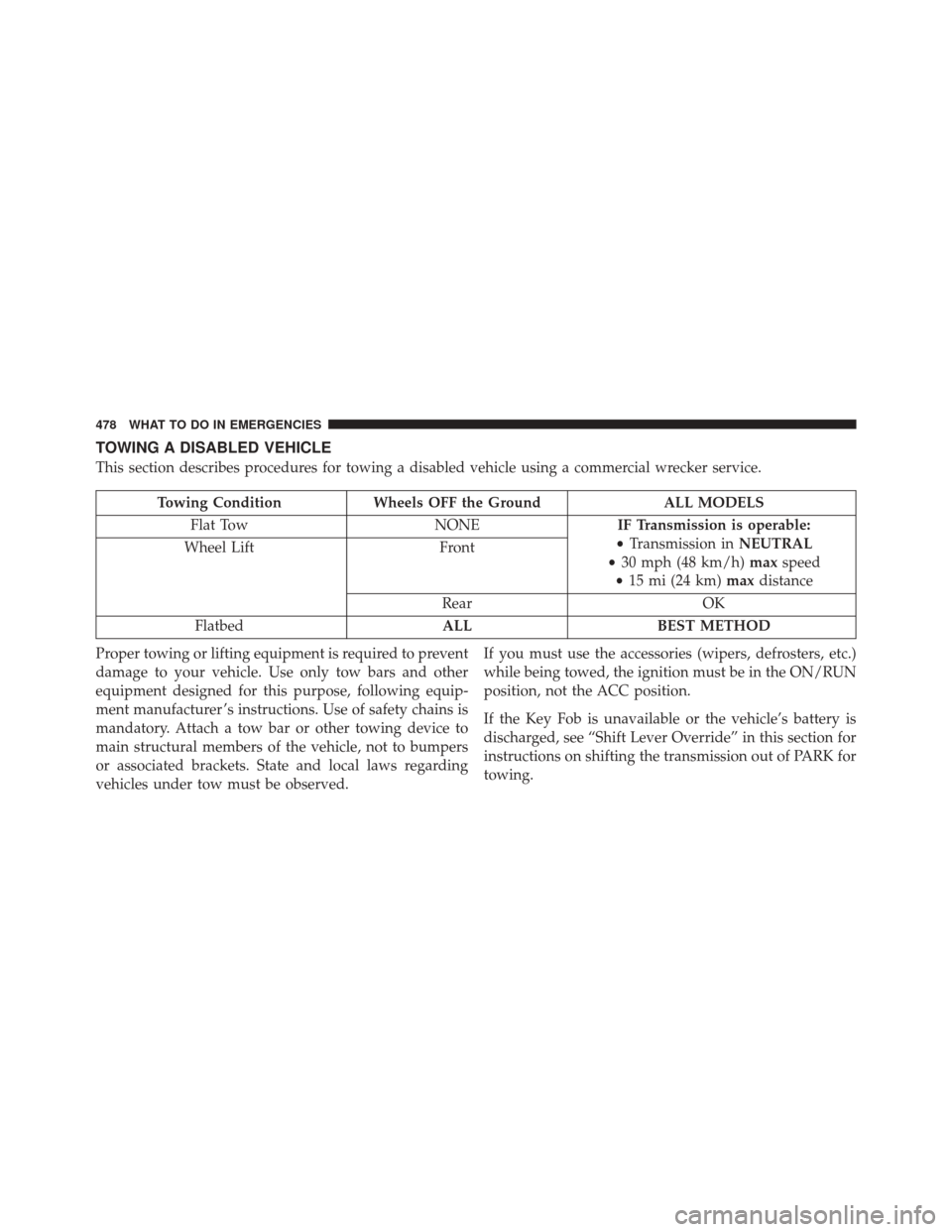
This section describes procedures for towing a disabled vehicle using a commercial wrecker service.
Towing ConditionWheels OFF the Ground ALL MODELS
Flat Tow NONEIF Transmission is operable:
• Transmission in NEUTRAL
• 30 mph (48 km/h) maxspeed
• 15 mi (24 km) maxdistance
Wheel Lift
Front
Rear OK
Flatbed ALLBEST METHOD
Proper towing or lifting equipment is required to prevent
damage to your vehicle. Use only tow bars and other
equipment designed for this purpose, following equip-
ment manufacturer ’s instructions. Use of safety chains is
mandatory. Attach a tow bar or other towing device to
main structural members of the vehicle, not to bumpers
or associated brackets. State and local laws regarding
vehicles under tow must be observed. If you must use the accessories (wipers, defrosters, etc.)
while being towed, the ignition must be in the ON/RUN
position, not the ACC position.
If the Key Fob is unavailable or the vehicle’s battery is
discharged, see “Shift Lever Override” in this section for
instructions on shifting the transmission out of PARK for
towing.
478 WHAT TO DO IN EMERGENCIES
Page 481 of 590
CAUTION!
•Do not use sling type equipment when towing.
Damage to the fascia will occur.
• When securing the vehicle to a flatbed truck, do not
attach to the front or rear suspension components.
Damage to your vehicle may result from improper
towing.
• Do not push or tow this vehicle with another
vehicle as damage to the bumper fascia and trans-
mission may result.
• The ignition switch must be in the ON/RUN posi-
tion, not in the OFF or ACC position.
• If the vehicle being towed requires steering, the
ignition switch must be in the ON/RUN position,
not in the OFF or ACC position.
•
The manufacturer does not recommend towing this
vehicle using a tow dolly. Vehicle damage may occur.
The manufacturer recommends towing your vehicle with
all four wheels OFF the ground using a flatbed.
If flatbed equipment is not available, and the transmis-
sion is operable, this vehicle may be towed (with rear
wheels on the ground) under the following conditions:
• The transmission must be in NEUTRAL.
• The towing speed must not exceed 30 mph (48 km/h).
• The towing distance must not exceed 15 miles (24 km).
6
WHAT TO DO IN EMERGENCIES 479
Page 482 of 590
If the transmission is not operable, or the vehicle must be
towed faster than 30 mph (48 km/h) or farther than 15
miles (24 km), tow with the rear wheels OFF the ground
(on a flatbed, or with the rear wheels raised using a wheel
lift and the transmission in NEUTRAL).
CAUTION!
Towing this vehicle in violation of the above require-
ments can cause severe transmission damage. Dam-
age from improper towing is not covered under the
New Vehicle Limited Warranty.
480 WHAT TO DO IN EMERGENCIES
Page 486 of 590
ONBOARD DIAGNOSTIC SYSTEM — OBD II
Your vehicle is equipped with a sophisticated onboard
diagnostic system called OBD II. This system monitors
the performance of the emissions, engine, and automatic
transmission control systems. When these systems are
operating properly, your vehicle will provide excellent
performance and fuel economy, as well as engine emis-
sions well within current government regulations.
If any of these systems require service, the OBD II system
will turn on the “Malfunction Indicator Light (MIL).” It
will also store diagnostic codes and other information to
assist your service technician in making repairs. Al-
though your vehicle will usually be drivable and not
need towing, see your authorized dealer for service as
soon as possible.
CAUTION!
•Prolonged driving with the MIL on could cause
further damage to the emissions control system. It
could also affect fuel economy and driveability.
The vehicle must be serviced before any emissions
tests can be performed.
• If the MIL is flashing while the engine is running,
severe catalytic converter damage and power loss
will soon occur. Immediate service is required.
EMISSIONS INSPECTION AND MAINTENANCE
PROGRAMS
In some localities, it may be a legal requirement to pass
an inspection of your vehicle’s emissions control system.
Failure to pass could prevent vehicle registration.
For states that require an Inspection and Mainte-
nance (I/M), this check verifies the “Malfunction
484 MAINTAINING YOUR VEHICLE
Page 501 of 590
To minimize the possibility of catalytic converter dam-
age:
•Do not shut off the engine or interrupt the ignition,
when the transmission is in gear and the vehicle is in
motion.
• Do not try to start the engine by pushing or towing the
vehicle.
• Do not idle the engine with any spark plug wires
disconnected or removed, such as when diagnostic
testing, or for prolonged periods during very rough
idle or malfunctioning operating conditions.Cooling System
WARNING!
• When working near the radiator cooling fan, dis-
connect the fan motor lead or cycle the ignition
switch to the LOCK position. The fan is tempera-
ture controlled and can start at any time the igni-
tion switch is in the ON position.
• You or others can be badly burned by hot engine
coolant (antifreeze) or steam from your radiator. If
you see or hear steam coming from under the hood,
do not open the hood until the radiator has had
time to cool. Never try to open a cooling system
pressure cap when the radiator is hot.
7
MAINTAINING YOUR VEHICLE 499
Page 545 of 590
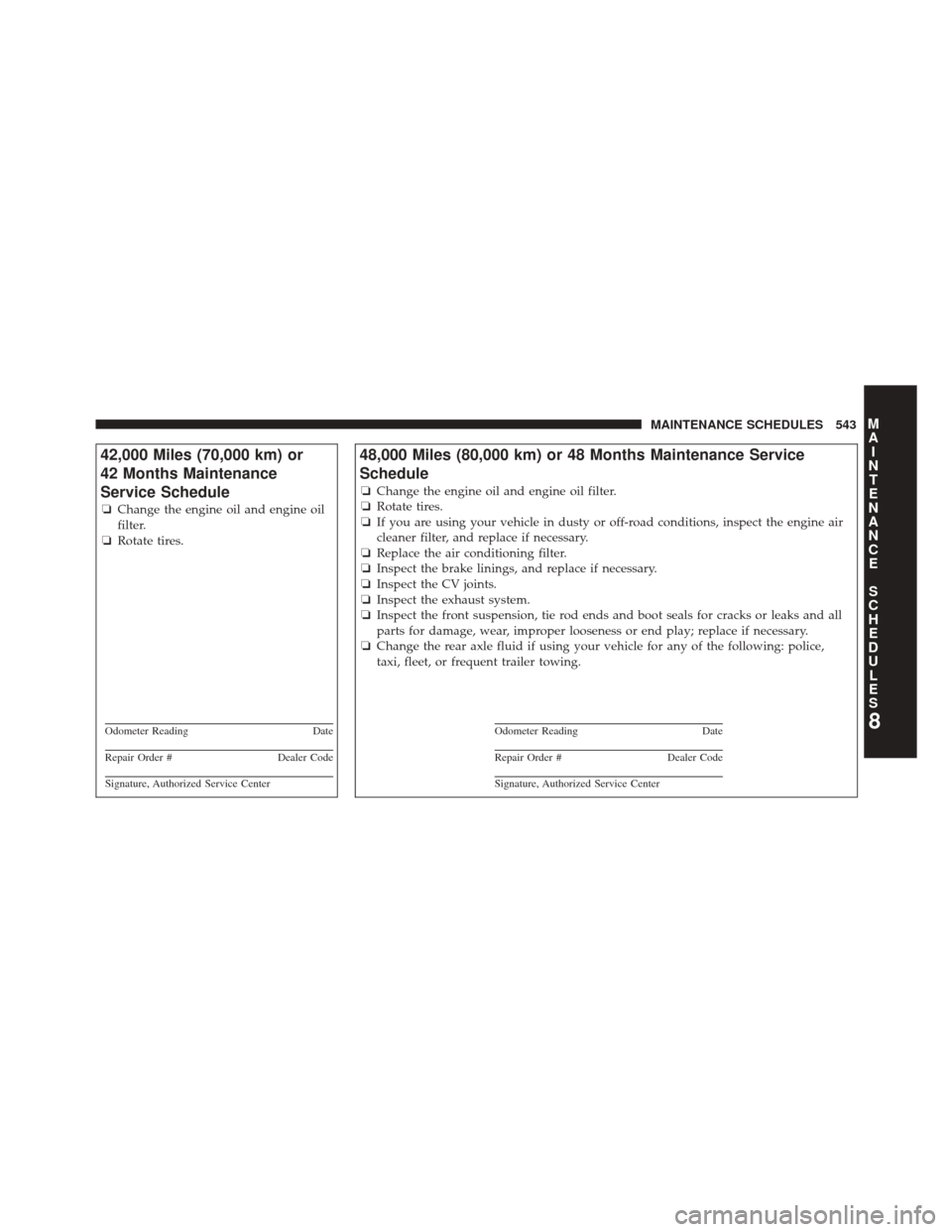
42,000 Miles (70,000 km) or
42 Months Maintenance
Service Schedule
❏Change the engine oil and engine oil
filter.
❏ Rotate tires.
Odometer Reading Date
Repair Order #Dealer Code
Signature, Authorized Service Center
48,000 Miles (80,000 km) or 48 Months Maintenance Service
Schedule
❏Change the engine oil and engine oil filter.
❏ Rotate tires.
❏ If you are using your vehicle in dusty or off-road conditions, inspect the engine air
cleaner filter, and replace if necessary.
❏ Replace the air conditioning filter.
❏ Inspect the brake linings, and replace if necessary.
❏ Inspect the CV joints.
❏ Inspect the exhaust system.
❏ Inspect the front suspension, tie rod ends and boot seals for cracks or leaks and all
parts for damage, wear, improper looseness or end play; replace if necessary.
❏ Change the rear axle fluid if using your vehicle for any of the following: police,
taxi, fleet, or frequent trailer towing.
Odometer Reading Date
Repair Order #Dealer Code
Signature, Authorized Service Center
8
M
A I
N T
E
N
A
N
C E
S
C
H E
D
U L
E
SMAINTENANCE SCHEDULES 543