Page 21 of 516

VEHICLE SECURITY ALARM — IF EQUIPPED
The Vehicle Security Alarm monitors the doors and trunk
for unauthorized entry and ignition switch for unauthor-
ized operation. While the Vehicle Security Alarm is
armed, interior switches for door locks and decklid
release are disabled.
If something triggers the alarm, the Vehicle Security
Alarm will signal for about 18 minutes. For the first three
minutes, the horn will sound intermittently, the head-
lights will turn on, the park lamps and/or turn signals
will flash and the Vehicle Security Light in the cluster will
flash. Then the exterior lights will flash for another 15
minutes.
Rearming The System
If something triggers the alarm, and no action is taken to
disarm it, the Vehicle Security Alarm will turn off thehorn after three minutes, turn off all of the visual signals
after 15 minutes, and then the Vehicle Security Alarm will
rearm itself.
To Arm The System
1. Remove the keys from the ignition switch and get out
of the vehicle.
2. Lock the door using either the power door lock switch (one door must be open) or the LOCK button on the
Remote Keyless Entry (RKE) transmitter (doors can be
open or closed), and close all doors.
NOTE: The Vehicle Security Alarm will not arm if you
lock the doors with the manual door lock plungers.
3. The Vehicle Security Light in the instrument cluster will flash for 16 seconds. This shows that the Vehicle
Security Alarm is arming. During this period, if a door
is opened, the ignition switch is turned to ON/RUN,
2
THINGS TO KNOW BEFORE STARTING YOUR VEHICLE 19
Page 69 of 516

It also includes diagnostics that will illuminate the instru-
ment cluster Air Bag Warning Light if a malfunction is
noted that could affect the air bag system. The diagnos-
tics also record the nature of the malfunction.
WARNING!
Ignoring the Air Bag Warning Light in your instru-
ment panel could mean you won’t have the air bags
to protect you in a collision. If the light does not come
on as a bulb check when the ignition is first turned
on, stays on after you start the vehicle, or if it comes
on as you drive, have an authorized dealer service the
air bag system immediately.
Driver And Passenger Advanced Front Air Bag
Inflator Units
The Driver and Passenger Advanced Front Air Bag
Inflator Units are located in the center of the steering
wheel and on the right side of the instrument panel.When the ORC detects a collision requiring the Ad-
vanced Front Air Bags, it signals the inflator units. A large
quantity of non-toxic gas is generated to inflate the
Advanced Front Air Bags. Different air bag inflation rates
are possible, based on several factors, including the
collision type and severity. The steering wheel hub trim
cover and the upper right side of the instrument panel
separate and fold out of the way as the air bags inflate to
their full size. The air bags fully inflate in about 50 to 70
milliseconds. This is about half of the time it takes to
blink your eyes. The air bags then quickly deflate while
helping to restrain the driver and front passenger.
The Advanced Front Air Bag gas is vented through the
vent holes in the sides of the air bag. In this way, the air
bags do not interfere with your control of the vehicle.
2
THINGS TO KNOW BEFORE STARTING YOUR VEHICLE 67
Page 128 of 516

•Some paging and voice mail systems have system time
out settings that are too short and may not allow the
use of this feature.
Barge In — Overriding Prompts
The “Voice Command” button can be used when you
wish to skip part of a prompt and issue your voice
command immediately. For example, if a prompt is
asking “Would you like to pair a phone, clear a...,” you
could press the
button and say, “Pair a Phone” to
select that option without having to listen to the rest of
the voice prompt.
Turning Confirmation Prompts ON/OFF
Turning confirmation prompts off will stop the system
from confirming your choices (e.g., the Uconnect® Phone
will not repeat a phone number before you dial it).
• Press the
button to begin. •
After the “Ready” prompt and the following beep, say
one of the following:
– “Setup Confirmation Prompts On”
– “Setup Confirmation Prompts Off”
Phone And Network Status Indicators
If available on the radio and/or on a premium display
such as the instrument panel cluster, and supported by
your mobile phone, the Uconnect® Phone will provide
notification to inform you of your phone and network
status when you are attempting to make a phone call
using Uconnect® Phone. The status is given for network
signal strength, phone battery strength, etc.
Dialing Using The Mobile Phone Keypad
You can dial a phone number with your mobile phone
keypad and still use the Uconnect® Phone (while dialing
via the mobile phone keypad, the user must exercise
caution and take precautionary safety measures). By
126 UNDERSTANDING THE FEATURES OF YOUR VEHICLE
Page 167 of 516
Turn Signals
Move the multifunction lever up or down and the arrows
on each side of the instrument cluster flash to show
proper operation of the front and rear turn signal lights.NOTE:
If either light remains on and does not flash, or
there is a very fast flash rate, check for a defective outside
light bulb. If an indicator fails to light when the lever is
moved, it would suggest that the indicator bulb is
defective.
Lane Change Assist
Tap the lever up or down once, without moving beyond
the detent, and the turn signal (right or left) will flash
three times then automatically turn off.
High/Low Beam Switch
Push the multifunction lever away from you to switch
the headlights to high beam. Pull the lever toward you, to
switch the headlights back to low beam.
Turn Signal Control
3
UNDERSTANDING THE FEATURES OF YOUR VEHICLE 165
Page 177 of 516
NOTE:In order to ensure proper operation, the Elec-
tronic Speed Control System has been designed to shut
down if multiple Speed Control functions are operated at
the same time. If this occurs, the Electronic Speed Control
System can be reactivated by pushing the Electronic
Speed Control ON/OFF button and resetting the desired
vehicle set speed.
To Activate
Push the ON/OFF button. The Cruise Indicator Light in
the instrument cluster will illuminate. To turn the system
off, push the ON/OFF button a second time. The Cruise
Indicator Light will turn off. The system should be
turned off when not in use.
WARNING!
Leaving the Electronic Speed Control system on
when not in use is dangerous. You could accidentally
set the system or cause it to go faster than you want.
You could lose control and have an accident. Always
leave the system OFF when you are not using it.
To Set A Desired Speed
Turn the Electronic Speed Control ON. When the vehicle
has reached the desired speed, press the SET (-) button
and release. Release the accelerator and the vehicle will
operate at the selected speed.
NOTE: The vehicle should be traveling at a steady speed
and on level ground before pressing the SET (-) button.
3
UNDERSTANDING THE FEATURES OF YOUR VEHICLE 175
Page 205 of 516
UNDERSTANDING YOUR INSTRUMENT PANEL
CONTENTS
�INSTRUMENT PANEL FEATURES ..........206
� INSTRUMENT CLUSTER .................207
� INSTRUMENT CLUSTER DESCRIPTIONS .....208
� MINI-TRIP COMPUTER — IF EQUIPPED .....222
▫ Control Buttons ...................... .223
� ELECTRONIC VEHICLE INFORMATION
CENTER (EVIC) — IF EQUIPPED ...........224
▫ Electronic Vehicle Information Center (EVIC)
Displays ........................... .226
▫ Oil Change Required — If Equipped .......227▫
EVIC Main Menu .....................228
▫ Compass Display .....................229
▫ Average Fuel Economy ..................231
▫ Distance To Empty (DTE) ................232
▫ TirePSI............................ .232
▫ Elapsed Time ....................... .233
▫ EVIC Units Selection (UNITS IN Display) . . . .233
▫ System Status ....................... .233
▫ Personal Settings (Customer-Programmable
Features) .......................... .233
4
Page 208 of 516
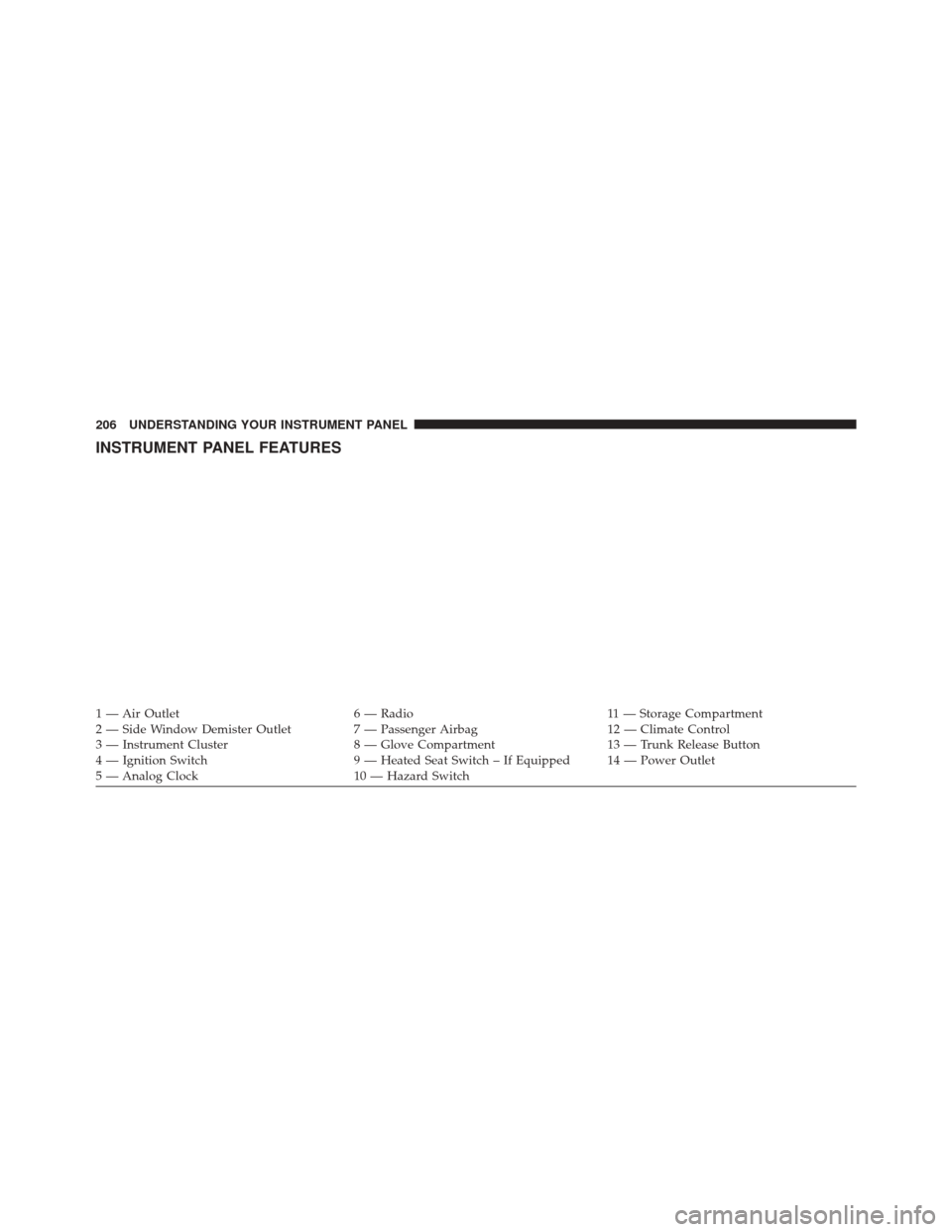
INSTRUMENT PANEL FEATURES
1 — Air Outlet6 — Radio11 — Storage Compartment
2 — Side Window Demister Outlet 7 — Passenger Airbag12 — Climate Control
3 — Instrument Cluster 8 — Glove Compartment13 — Trunk Release Button
4 — Ignition Switch 9 — Heated Seat Switch – If Equipped 14 — Power Outlet
5 — Analog Clock 10 — Hazard Switch
206 UNDERSTANDING YOUR INSTRUMENT PANEL
Page 209 of 516
INSTRUMENT CLUSTER
4
UNDERSTANDING YOUR INSTRUMENT PANEL 207