Page 121 of 522
EVIC
Message�EVIC
Message
Display
Time�Odometer
Message
(<5mph
[8 km/h])��Odometer
Message
Display
Time��Odometer
Message
(>5mph
[8 km/h])��Odometer
Message
Display
Time��ChimeConditionOperator
Action
Required
TRUNK
AJAR Continu-
ousDECK Continu-
ousDECK Continu-
ousSingle
Chime
The
Trunk Lid
is Un-
latched or
OpenThe Top
Will Not
Operate
Unless
the Trunk
Lid is
Closed3
UNDERSTANDING THE FEATURES OF YOUR VEHICLE 119
Page 218 of 522
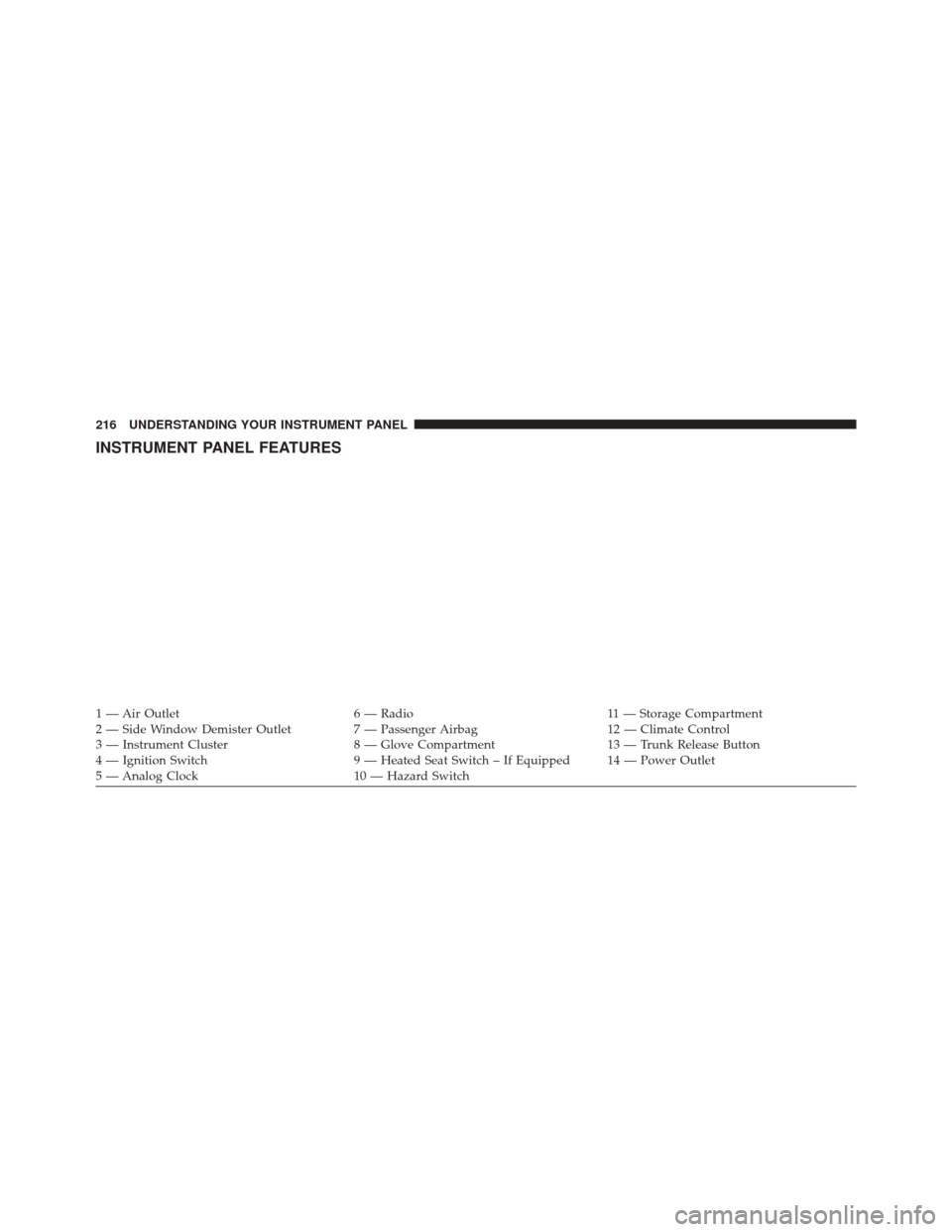
INSTRUMENT PANEL FEATURES
1 — Air Outlet6 — Radio11 — Storage Compartment
2 — Side Window Demister Outlet 7 — Passenger Airbag12 — Climate Control
3 — Instrument Cluster 8 — Glove Compartment13 — Trunk Release Button
4 — Ignition Switch 9 — Heated Seat Switch – If Equipped 14 — Power Outlet
5 — Analog Clock 10 — Hazard Switch
216 UNDERSTANDING YOUR INSTRUMENT PANEL
Page 225 of 522

The two trip odometers show individual trip mileage. To
switch from odometer to trip odometers, press and
release the Trip Odometer button. To reset a trip odom-
eter, display the desired trip odometer to be reset then
push and hold the button until the display resets (ap-
proximately two seconds). Refer to “Trip Odometer But-
ton” for additional information.
Vehicle Odometer Messages
When the appropriate conditions exist, the odometer will
display the following messages:
door............................. Door Ajar
dECK ...........................Trunk Ajar
TOP ................. Convertible Top Up/Down
TOP FAIL ..
Convertible Top Up/Down Operation Failed
SET CARgO SHIELd ....TheConvertible Top Cargo
Shield Must Be Put In The Stowed Position
SPEEd TOO HIgH ....Vehicle Speed Is Too High For
Convertible Top Up/Down Operation
TOP donE . . . Convertible Top Up/Down Operation Is
Complete
TOP nOT SECUrE . . . Convertible Top Is Not Secured
LoW tirE ....................LowTirePr essure
HOTOIL ................ Engine Oil Temperature
Exceeds Safe Threshold
gASCAP ...................... Fuel Cap Fault
CHANgE OIL ..............Oil Change Required
4
UNDERSTANDING YOUR INSTRUMENT PANEL 223
Page 226 of 522

NOTE:If the instrument cluster is equipped with the
optional Electronic Vehicle Information Center (EVIC),
then all warnings including ”Low Tire,” “Door Ajar” and
“Trunk Ajar” will only display in the EVIC. (Refer to
“Electronic Vehicle Information Center (EVIC)” for spe-
cific messages).
Refer to “Convertible Top Operation” in “Understanding
The Features Of Your Vehicle” for a table that explains
how long each message is displayed and the conditions
under which each message is displayed.
LoW tirE
When the appropriate condition exists, the odometer
display will toggle between LoW and TirE for three
cycles. HOTOIL
When this message is displayed there is a engine oil
over-temperature condition. When this condition occurs,
the “HOTOIL” message will be displayed in the odom-
eter along with a chime.
Refer to “If Your Engine Overheats” in “What To Do In
Emergencies”.
gASCAP
If the vehicle diagnostic system detects a leak or change
in the evaporative system, or the fuel filler cap is loose,
improperly installed, or damaged, the words “gASCAP”
will display in the odometer display area. If this occurs,
tighten the fuel filler cap properly and press the odom-
eter reset button to turn off the “gASCAP” message.
(Refer to “Onboard Diagnostic System — OBDII” in
“Maintaining Your Vehicle” for further information). If
224 UNDERSTANDING YOUR INSTRUMENT PANEL
Page 239 of 522
•SELECT Button
Press and release the SELECT Button to accept
a selection. The SELECT Button also resets
various Trip Functions.
Electronic Vehicle Information Center (EVIC)
Displays
When the appropriate conditions exist, the EVIC displays
the following messages:
•Turn Signal On (with a continuous warning chime
after one mile traveled)
• Left Front Turn Signal Lamp Out (with a single chime)
• Left Rear Turn Signal Lamp Out (with a single chime)
• Right Front Turn Signal Lamp Out (with a single
chime)
• Right Rear Turn Signal Lamp Out (with a single chime) •
RKE (Remote Keyless Entry) Battery Low (with a
single chime)
• Personal Settings Not Avail – Vehicle Not in Park
• Personal Settings Not Avail – Vehicle in Motion
• Door Ajar (with vehicle graphic showing which door is
open. A single chime sounds if the vehicle is in
motion).
• Doors Ajar (with vehicle graphic showing which doors
are open. A single chime sounds if the vehicle is in
motion).
• Trunk Open (with vehicle graphic showing and open
trunk and A single chime )
• Lights On
• Key In Ignition
• Remote start aborted — Door ajar4
UNDERSTANDING YOUR INSTRUMENT PANEL 237
Page 240 of 522

•Remote start aborted — Hood ajar
• Remote start aborted — Trunk ajar
• Remote start aborted — Fuel low
• Remote start disabled — System fault
• Convertible Top Not Secured (with a single chime)
• Convertible Top Complete (with a single chime)
• Secure Cargo Shield (with a single chime)
• Speed Too High (with a single chime)
• Convertible Top Malfunction (with a single chime)
• Oil Change Required (with a single chime)
• Low Tire (with a graphic of the car showing which
tire(s) is/are low - with a single chime and �Inflate to
XX”). Refer to �Tire Pressure Monitoring System� in
�Starting and Operating�. •
Check TPM System (with a single chime) Refer to �Ti re
Pressure Monitoring System� in�Starting and Operat-
ing�.
Oil Change Required — If Equipped
Your vehicle is equipped with an engine oil change
indicator system. The “Oil Change Required” message
will flash in the EVIC display for approximately five
seconds after a single chime has sounded to indicate the
next scheduled oil change interval. The engine oil change
indicator system is duty cycle based, which means the
engine oil change interval may fluctuate dependent upon
your personal driving style.
Unless reset, this message will continue to display each
time you turn the ignition switch to the ON/RUN
position. To turn off the message temporarily, press and
release the Menu button. To reset the oil change indicator
system (after performing the scheduled maintenance),
perform the following procedure:
238 UNDERSTANDING YOUR INSTRUMENT PANEL
Page 402 of 522
JACKING AND TIRE CHANGING
WARNING!
•Do not attempt to change a tire on the side of the
vehicle close to moving traffic. Pull far enough off
the road to avoid the danger of being hit when
operating the jack or changing the wheel.
• Being under a jacked-up vehicle is dangerous. The
vehicle could slip off the jack and fall on you. You
could be crushed. Never put any part of your body
under a vehicle that is on a jack. If you need to get
under a raised vehicle, take it to a service center
where it can be raised on a lift.
• Never start or run the engine while the vehicle is
on a jack.
(Continued)
WARNING! (Continued)
•The jack is designed to be used as a tool for
changing tires only. The jack should not be used to
lift the vehicle for service purposes. The vehicle
should be jacked on a firm level surface only.
Avoid ice or slippery areas.
Jack Location
The jack and jack-handle are stowed under the load floor
in the trunk.
Spare Tire Stowage
The compact spare tire is stowed under the rear load floor
in the trunk.
400 WHAT TO DO IN EMERGENCIES
Page 457 of 522
•If insects, tar, or other similar deposits have accumu-
lated on your vehicle, use MOPAR® Super Kleen Bug
and Tar Remover to remove.
• Use a high quality cleaner wax, such as MOPAR®
Cleaner Wax to remove road film, stains and to protect
your paint finish. Take care never to scratch the paint.
• Avoid using abrasive compounds and power buffing
that may diminish the gloss or thin out the paint finish.
CAUTION!
• Do not use abrasive or strong cleaning materials
such as steel wool or scouring powder that will
scratch metal and painted surfaces.
• Use of power washers exceeding 1,200 psi
(8 274 kPa) can result in damage or removal of paint
and decals.
Special Care
• If you drive on salted or dusty roads or if you drive
near the ocean, hose off the undercarriage at least once
a month.
• It is important that the drain holes in the lower edges
of the doors, rocker panels, and trunk be kept clear and
open.
• If you detect any stone chips or scratches in the paint,
touch them up immediately. The cost of such repairs is
considered the responsibility of the owner.
• If your vehicle is damaged due to a collision or similar
cause that destroys the paint and protective coating,
have your vehicle repaired as soon as possible. The
cost of such repairs is considered the responsibility of
the owner.
7
MAINTAINING YOUR VEHICLE 455