2014 CHRYSLER 200 CONVERTIBLE radiator
[x] Cancel search: radiatorPage 446 of 522
CAUTION!(Continued)
•Do not use water alone or alcohol-based engine
coolant (antifreeze) products. Do not use additional
rust inhibitors or antirust products, as they may not
be compatible with the radiator engine coolant and
may plug the radiator.
• This vehicle has not been designed for use with
propylene glycol-based engine coolant (antifreeze).
Use of propylene glycol-based engine coolant (an-
tifreeze) is not recommended.
Adding Coolant
Your vehicle has been built with an improved engine
coolant (OAT coolant conforming to MS-12106) that
allows extended maintenance intervals. This engine cool-
ant (antifreeze) can be used up to ten years or 150,000
miles (240,000 km) before replacement. To prevent reduc-
ing this extended maintenance period, it is important that you use the same engine coolant (OAT coolant conform-
ing to MS-12106) throughout the life of your vehicle.
Please review these recommendations for using Organic
Additive Technology (OAT) engine coolant (antifreeze)
that meets the requirements of Chrysler Material Stan-
dard MS-12106. When adding engine coolant (antifreeze):
•
We recommend using MOPAR® Antifreeze/Coolant
10 Year/150,000 Mile Formula OAT (Organic Additive
Technology) that meets the requirements of Chrysler
Material Standard MS-12106.
• Mix a minimum solution of 50% OAT engine coolant
that meets the requirements of Chrysler Material Stan-
dard MS-12106 and distilled water. Use higher concen-
trations (not to exceed 70%) if temperatures below
34° F (37° C) are anticipated.
• Use only high purity water such as distilled or deion-
ized water when mixing the water/engine coolant
444 MAINTAINING YOUR VEHICLE
Page 447 of 522

(antifreeze) solution. The use of lower quality water
will reduce the amount of corrosion protection in the
engine cooling system.
Please note that it is the owner’s responsibility to main-
tain the proper level of protection against freezing ac-
cording to the temperatures occurring in the area where
the vehicle is operated.
NOTE: Mixing engine coolant (antifreeze) types is not
recommended and can result in cooling system damage.
If HOAT and OAT coolant are mixed in an emergency,
have a authorized dealer drain, flush, and refill with OAT
coolant (conforming to MS-12106) as soon as possible.
Cooling System Pressure Cap
The cap must be fully tightened to prevent loss of engine
coolant (antifreeze), and to ensure that engine coolant
(antifreeze) will return to the radiator from the coolant
recovery tank. The cap should be inspected and cleaned if there is any
accumulation of foreign material on the sealing surfaces.
WARNING!
•
The warning words “DO NOT OPEN HOT” on the
cooling system pressure cap are a safety precaution.
Never add engine coolant (antifreeze) when the
engine is overheated. Do not loosen or remove the
cap to cool an overheated engine. Heat causes
pressure to build up in the cooling system. To
prevent scalding or injury, do not remove the
pressure cap while the system is hot or under
pressure.
• Do not use a pressure cap other than the one
specified for your vehicle. Personal injury or en-
gine damage may result.
7
MAINTAINING YOUR VEHICLE 445
Page 448 of 522

Disposal Of Used Engine Coolant
Used ethylene glycol-based engine coolant (antifreeze) is
a regulated substance requiring proper disposal. Check
with your local authorities to determine the disposal
rules for your community. To prevent ingestion by ani-
mals or children, do not store ethylene glycol-based
engine coolant in open containers or allow it to remain in
puddles on the ground. If ingested by a child or pet, seek
emergency assistance immediately. Clean up any ground
spills immediately.
Coolant Level
Four-Cylinder Engines –the coolant bottle provides a
quick visual method for determining that the engine
coolant (antifreeze) level is adequate. With the engine
idling and warm to normal operating temperature, the
level of the engine coolant (antifreeze) in the bottle
should be between the “ADD” and “FULL” lines, shown
on the bottle. Six-Cylinder Engines –
the level of the engine coolant
(antifreeze) in the pressurized coolant bottle should be
between the “COLD” and “FULL” range on the bottle
when the engine is cold.
The radiator normally remains completely full, so there is
no need to remove the radiator cap unless checking for
engine coolant (antifreeze) freeze point or replacing cool-
ant. Advise your service attendant of this. As long as the
engine operating temperature is satisfactory, the coolant
bottle need only be checked once a month. When addi-
tional engine coolant (antifreeze) is needed to maintain
the proper level, it should be added to the coolant bottle.
Do not overfill.
446 MAINTAINING YOUR VEHICLE
Page 449 of 522

Points To Remember
NOTE:When the vehicle is stopped after a few miles/
kilometers of operation, you may observe vapor coming
from the front of the engine compartment. This is nor-
mally a result of moisture from rain, snow, or high
humidity accumulating on the radiator and being vapor-
ized when the thermostat opens, allowing hot engine
coolant (antifreeze) to enter the radiator.
If an examination of your engine compartment shows no
evidence of radiator or hose leaks, the vehicle may be
safely driven. The vapor will soon dissipate.
• Do not overfill the coolant expansion bottle.
• Check the coolant freeze point in the radiator and in
the coolant expansion bottle. If engine coolant (anti-
freeze) needs to be added, the contents of the coolant
expansion bottle must also be protected against freez-
ing. •
If frequent engine coolant (antifreeze) additions are
required, the cooling system should be pressure tested
for leaks.
• Maintain engine coolant (antifreeze) concentration at a
minimum of 50% OAT coolant (conforming to MS-
12106) and distilled water for proper corrosion protec-
tion of your engine which contains aluminum compo-
nents.
• Make sure that the coolant expansion bottle overflow
hoses are not kinked or obstructed.
• Keep the front of the radiator clean. If your vehicle is
equipped with air conditioning, keep the front of the
condenser clean.
• Do not change the thermostat for Summer or Winter
operation. If replacement is ever necessary, install
ONLY the correct type thermostat. Other designs may
7
MAINTAINING YOUR VEHICLE 447
Page 468 of 522
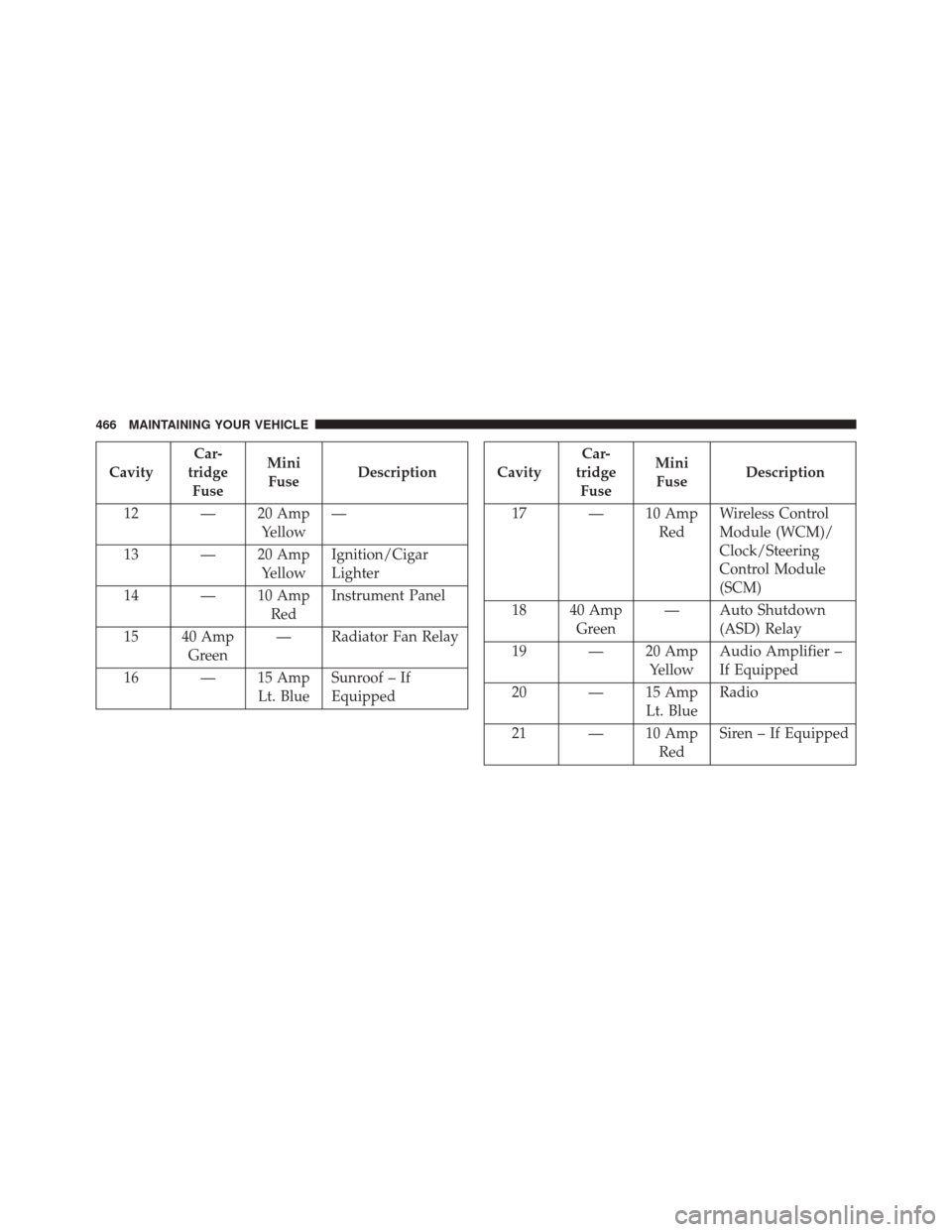
CavityCar-
tridge Fuse Mini
Fuse Description
12 — 20 Amp Yellow—
13 — 20 Amp YellowIgnition/Cigar
Lighter
14 — 10 Amp RedInstrument Panel
15 40 Amp Green — Radiator Fan Relay
16 — 15 Amp Lt. BlueSunroof – If
EquippedCavity Car-
tridge Fuse Mini
Fuse Description
17 — 10 Amp RedWireless Control
Module (WCM)/
Clock/Steering
Control Module
(SCM)
18 40 Amp Green — Auto Shutdown
(ASD) Relay
19 — 20 Amp YellowAudio Amplifier –
If Equipped
20 — 15 Amp Lt. BlueRadio
21 — 10 Amp RedSiren – If Equipped
466 MAINTAINING YOUR VEHICLE
Page 503 of 522

Automatic Transmission....................303
Adding Fluid ......................... .451
Fluid and Filter Changes ..................453
Fluid Level Check ...................... .451
Fluid Type ........................... .450
Gear Ranges .......................... .306
Special Additives ...................... .450
Autostick .............................. .320
Auto Unlock, Doors ........................34
Battery ................................ .433
Keyless Transmitter Replacement (RKE) ........27
Location ............................. .433
Belts, Seat ...............................44
Body Mechanism Lubrication .................437
B-Pillar Location ......................... .344
Brake Assist System ...................... .333
Brake, Parking .......................... .327
Brake System ........................... .448Anti-Lock (ABS)
....................... .329
Fluid Check .......................... .448
Master Cylinder ....................... .448
Parking ............................. .327
Warning Light ........................ .221
Brake/Transmission Interlock .................305
Bulb Replacement ........................ .470
Bulbs, Light ..............................96
Calibration, Compass ..................... .240
Capacities, Fluid ......................... .477
Caps, Filler Fuel ................................ .379
Oil (Engine) .......................... .423
Power Steering ........................ .326
Radiator (Coolant Pressure) ................445
Carbon Monoxide Warning ...................92
Car Washes ............................ .454
Cellular Phone .......................... .128
10
INDEX 501
Page 504 of 522

Certification Label........................ .382
Chains, Tire ............................ .360
Changing A Flat Tire ...................... .400
Chart, Tire Sizing ........................ .339
Check Engine Light (Malfunction Indicator Light) . .426
Checking Your Vehicle For Safety ...............92
Checks, Safety ............................92
Child Restraint ............................70
Cigar Lighter ........................... .204
Clean Air Gasoline ....................... .371
Cleaning Wheels .............................. .456
Climate Control ......................... .283
Clock ................................. .247
Cold Weather Operation ....................302
Compact Disc (CD) Maintenance ..............282
Compact Spare Tire ....................... .355
Compass .............................. .233
Compass Calibration ...................... .240Compass Variance
........................ .241
Computer, Trip/Travel ..................... .239
Connector UCI................................ .273
Universal Consumer Interface (UCI) ..........273
Console ............................... .206
Console, Floor .......................... .206
Contract, Service ......................... .493
Convertible ............................ .101
Convertible Top ......................... .101
Coolant Pressure Cap (Radiator Cap) ...........445
Cooling System .......................... .442
Adding Coolant (Antifreeze) ...............444
Coolant Capacity ...................... .477
Coolant Level ......................... .442
Disposal of Used Coolant .................446
Drain, Flush, and Refill ...................443
Inspection ........................... .446
Points to Remember .....................447
502 INDEX
Page 505 of 522

Pressure Cap......................... .445
Radiator Cap ......................... .445
Selection of Coolant (Antifreeze) .............443
Corrosion Protection ...................... .454
Cruise Light ............................ .226
Cupholders ............................ .204
Customer Assistance ...................... .491
Customer Programmable Features .............244
Data Recorder, Event .......................69
Daytime Running Lights ....................182
Dealer Service ........................... .427
Deck Lid, Power Release .....................38
Defroster, Rear Window .....................210
Defroster, Windshield .......................94
Delay (Intermittent) Wipers ..................185
Diagnostic System, Onboard .................425
Dimmer Switch, Headlight ...................180 Dipsticks
Automatic Transmission ..................451
Oil (Engine) .......................... .429
Power Steering ........................ .326
Disabled Vehicle Towing ....................418
Disposal Antifreeze (Engine Coolant) ................446
Door Locks ..............................32
Door Locks, Automatic ......................33
Door Opener, Garage ...................... .192
Driver’s Seat Back Tilt ..................... .171
Driving Through Flowing, Rising, or Shallow Standing
Water ............................... .322
E-85 Fuel .............................. .375
Electrical Power Outlets .....................201
Electric Rear Window Defrost .................210
Electric Remote Mirrors .....................126
10
INDEX 503