2014 BMW M5 instrument cluster
[x] Cancel search: instrument clusterPage 135 of 237

Using the button
Press button repeatedly until the desired
program is displayed in the instrument
cluster.
Display in the instrument cluster Servotronic with selected program with
activated display of the System states
of the driving dynamics, refer to
page 90.
Seite 131Driving stability control systemsControls131
Online Edition for Part no. 0140 2 956 245 - X/14
Page 137 of 237

The displays go out. The stored desired speed
is deleted.
Interrupting When active, press the button.
The system is automatically interrupted if:▷The brakes are applied.▷The clutch pedal is depressed for a few
seconds or released while a gear is not en‐
gaged.▷Selector lever position D is disengaged.▷MDM is activated or DSC is deactivated.▷DSC is actively controlling stability.
Maintaining, storing, and changing the
speed
Hints Adjusting the desired speed
Modify desired speed to road conditions
and be ready to brake at all times; otherwise,
there is the risk of an accident.◀
Maintaining/storing the speed Press button.
Or:
Press the rocker reel while the system is inter‐
rupted.
When the system is switched on, the current
speed is maintained and stored as the desired
speed.
This is displayed, refer to page 133, in the
speedometer and briefly in the instrument
cluster.
When cruise control is maintained or stored,
DSC Dynamic Stability Control will be turned
on if needed.
Changing the speed
Press the rocker reel up or down repeatedly
until the desired speed is set.
If active, the displayed speed is stored and the
vehicle reaches the stored speed when the
road is clear.▷Each time the rocker reel is pressed to the
point of resistance, the desired speed in‐
creases or decreases by approx.
1 mph/1 km/h.▷Each time the rocker reel is pressed past
the point of resistance, the desired speed
increases or decreases by a maximum of
5 mph/10 km/h.
The maximum speed that can be set de‐
pends on the vehicle.▷Pressing the rocker reel to the resistance
point and holding it accelerates or deceler‐
ates the vehicle without requiring pressure
on the accelerator pedal.
After the rocker reel is released, the vehicle
maintains its final speed. Pressing the reel
beyond the resistance point causes the ve‐
hicle to accelerate more rapidly.
Resuming the desired speed
Press button.
The stored speed is reached and maintained. Displays in the instrument cluster
Indicator lamp Depending on how the vehicle is equip‐
ped, the indicator lamp in the instru‐
Seite 133Driving comfortControls133
Online Edition for Part no. 0140 2 956 245 - X/14
Page 200 of 237

Too much engine oil
Have the vehicle checked immediately;
otherwise, surplus engine oil can lead to en‐
gine damage.◀
Detailed measurement
The concept In the detailed measurement the engine oil
level is checked and displayed via a scale.
During the measurement, the idle speed is in‐
creased somewhat.
Requirements▷Vehicle is on level road.▷Manual transmission: shift lever in neutral
position, clutch and accelerator pedals not
depressed.▷M Double clutch transmission: selector
lever in selector lever position N and accel‐
erator pedal not depressed.▷Engine is running and is at operating tem‐
perature.
Performing a detailed measurement
In order to perform a detailed measurement of
the engine oil level:
1."Vehicle info"2."Vehicle status"3. "Measure engine oil level"4."Start measurement"
The engine oil level is checked and displayed
via a scale.
Time: approx. 1 minute.
Adding engine oil General information
Switch off the ignition and safely park the vehi‐
cle before engine oil is added.
Oil filler neck
Only add engine oil when the message is dis‐
played in the instrument cluster.
Add 1 US quart/liter.
Adding engine oil
Add oil within the next 125 miles/200 km;
otherwise, this may cause engine damage.◀
Do not add too much engine oil
When too much engine oil is added, im‐
mediately have the vehicle checked, otherwise,
this may cause engine damage.◀
Protect children
Keep oil, grease, etc., out of reach of chil‐
dren and observe the warnings on the contain‐
ers to prevent health risks.◀
Engine oil types to add Hints No oil additives
Oil additives may lead to engine dam‐
age.◀
Viscosity grades for engine oils
When selecting an engine oil, ensure that
the engine oil belongs to the viscosity grade
SAE 0W-30, or malfunctions or engine dam‐
age may occur.
As an alternative, you can also use motor oils
with a viscosity grade of SAE 5W-30.◀
Seite 196MobilityEngine oil196
Online Edition for Part no. 0140 2 956 245 - X/14
Page 220 of 237

Leather care
Remove dust from the leather often, using a
cloth or vacuum cleaner.
Otherwise, particles of dust and road grime
chafe in pores and folds, and lead to increased
wear and premature degradation of the leather
surface.
To guard against discoloration, such as from
clothing, provide leather care roughly every
two months.
Clean light-colored leather more frequently be‐
cause soiling on such surfaces is substantially
more visible.
Use leather care products; otherwise, dirt and
grease will gradually break down the protective
layer of the leather surface.
Suitable care products are available from the
service center.
Upholstery material care Vacuum regularly with a vacuum cleaner.
If upholstery is very dirty, e.g., with beverage
stains, use a soft sponge or microfiber cloth
with a suitable interior cleaner.
Clean the upholstery down to the seams using
large sweeping motions. Avoid rubbing the
material vigorously.
Damage from Velcro® fasteners
Open Velcro® fasteners on pants or
other articles of clothing can damage the seat
covers. Ensure that any Velcro® fasteners are
closed.◀
Caring for special components
Light-alloy wheels When cleaning the vehicle, use only neutral
wheel cleaners having a pH value from 5 to 9.
Do not use abrasive cleaning agents or steam
jets above 140 ℉/60 ℃. Follow the manufac‐
turer's instructions.Aggressive, acidic or alkaline cleaning agents
can destroy the protective layer of adjacent
components, such as the brake disk.
Chrome surfaces
Carefully clean components such as the radia‐
tor grille or door handles with an ample supply
of water, possibly with shampoo added, partic‐
ularly when they have been exposed to road
salt.
Rubber components Aside from water, treat only with rubber
cleansers.
When cleaning rubber seals, do not use any
silicon-containing car care products in order to
avoid damage or noises.
Fine wood partsClean fine wood facing and fine wood compo‐
nents only with a moist rag. Then dry with a
soft cloth.
Plastic components
These include:▷Imitation leather surfaces.▷Roofliner.▷Lamp lenses.▷Instrument cluster cover.▷Matt black spray-coated components.▷Painted parts in the interior.
Clean with a microfiber cloth.
Dampen cloth lightly with water.
Do not soak the roofliner.
No cleansers that contain alcohol or sol‐
vents
Do not use cleansers that contain alcohol or
solvents, such as lacquer thinners, heavy-duty
grease removers, fuel, or such; this could lead
to surface damage.◀
Seite 216MobilityCare216
Online Edition for Part no. 0140 2 956 245 - X/14
Page 230 of 237
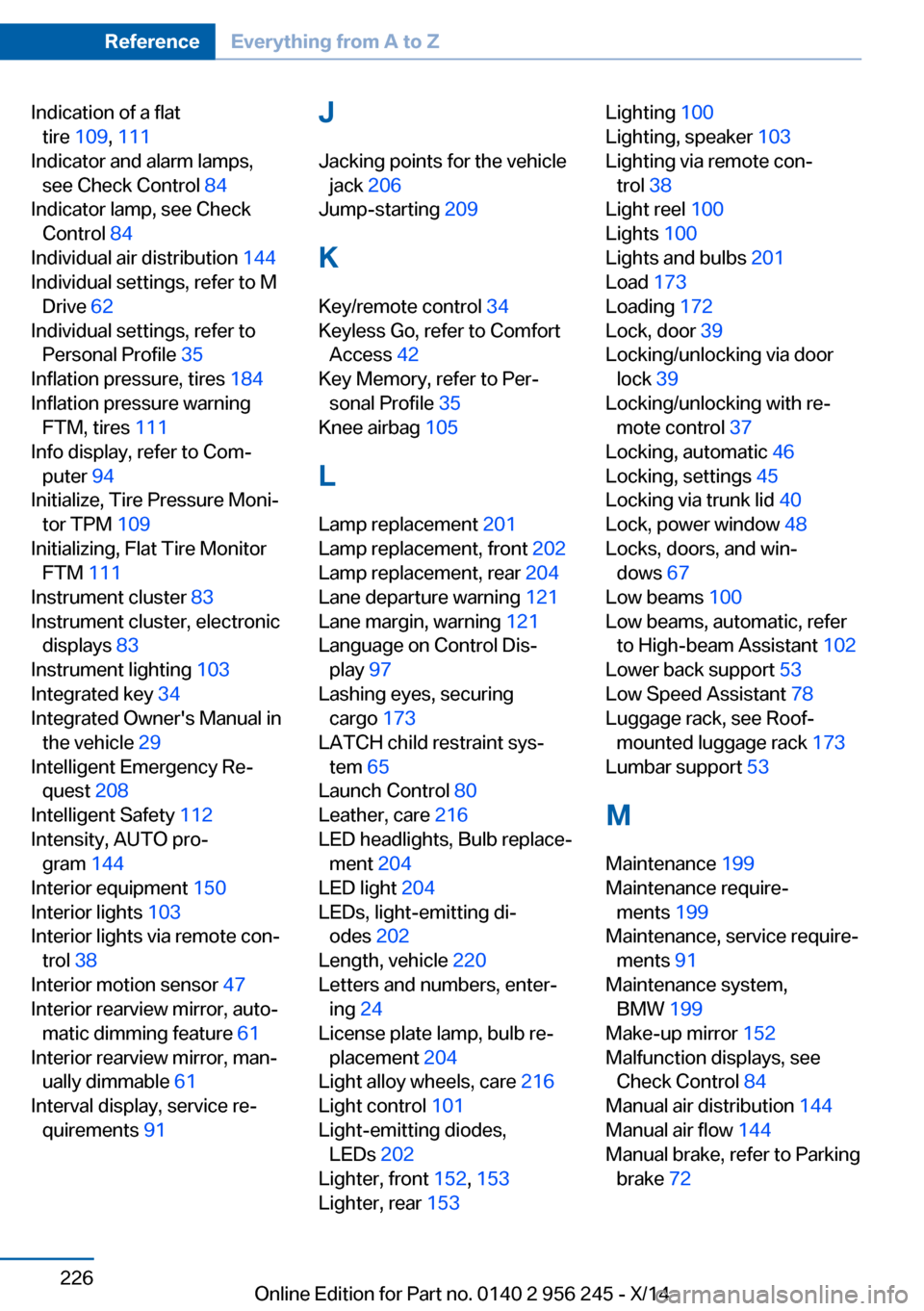
Indication of a flattire 109 , 111
Indicator and alarm lamps, see Check Control 84
Indicator lamp, see Check Control 84
Individual air distribution 144
Individual settings, refer to M Drive 62
Individual settings, refer to Personal Profile 35
Inflation pressure, tires 184
Inflation pressure warning FTM, tires 111
Info display, refer to Com‐ puter 94
Initialize, Tire Pressure Moni‐ tor TPM 109
Initializing, Flat Tire Monitor FTM 111
Instrument cluster 83
Instrument cluster, electronic displays 83
Instrument lighting 103
Integrated key 34
Integrated Owner's Manual in the vehicle 29
Intelligent Emergency Re‐ quest 208
Intelligent Safety 112
Intensity, AUTO pro‐ gram 144
Interior equipment 150
Interior lights 103
Interior lights via remote con‐ trol 38
Interior motion sensor 47
Interior rearview mirror, auto‐ matic dimming feature 61
Interior rearview mirror, man‐ ually dimmable 61
Interval display, service re‐ quirements 91 J
Jacking points for the vehicle jack 206
Jump-starting 209
K
Key/remote control 34
Keyless Go, refer to Comfort Access 42
Key Memory, refer to Per‐ sonal Profile 35
Knee airbag 105
L Lamp replacement 201
Lamp replacement, front 202
Lamp replacement, rear 204
Lane departure warning 121
Lane margin, warning 121
Language on Control Dis‐ play 97
Lashing eyes, securing cargo 173
LATCH child restraint sys‐ tem 65
Launch Control 80
Leather, care 216
LED headlights, Bulb replace‐ ment 204
LED light 204
LEDs, light-emitting di‐ odes 202
Length, vehicle 220
Letters and numbers, enter‐ ing 24
License plate lamp, bulb re‐ placement 204
Light alloy wheels, care 216
Light control 101
Light-emitting diodes, LEDs 202
Lighter, front 152, 153
Lighter, rear 153 Lighting 100
Lighting, speaker 103
Lighting via remote con‐ trol 38
Light reel 100
Lights 100
Lights and bulbs 201
Load 173
Loading 172
Lock, door 39
Locking/unlocking via door lock 39
Locking/unlocking with re‐ mote control 37
Locking, automatic 46
Locking, settings 45
Locking via trunk lid 40
Lock, power window 48
Locks, doors, and win‐ dows 67
Low beams 100
Low beams, automatic, refer to High-beam Assistant 102
Lower back support 53
Low Speed Assistant 78
Luggage rack, see Roof- mounted luggage rack 173
Lumbar support 53
M
Maintenance 199
Maintenance require‐ ments 199
Maintenance, service require‐ ments 91
Maintenance system, BMW 199
Make-up mirror 152
Malfunction displays, see Check Control 84
Manual air distribution 144
Manual air flow 144
Manual brake, refer to Parking brake 72 Seite 226ReferenceEverything from A to Z226
Online Edition for Part no. 0140 2 956 245 - X/14
Page 232 of 237

Parked vehicle, condensa‐tion 171
Parking aid, refer to PDC 134
Parking brake 72
Parking lights 100
Passenger side mirror, tilting downward 60
Pathway lines, rearview cam‐ era 138
PDC Park Distance Con‐ trol 134
Pedestrian detection, see Night Vision 118
Pedestrian warning with city braking function 115
Personal Profile 35
Personal Profile, exporting profiles 36
Pinch protection system, glass sunroof 50
Pinch protection system, win‐ dows 48
Plastic, care 216
Power failure 206
Power sunroof, glass 49
Power windows 47
Pressure, tire air pres‐ sure 184
Pressure warning FTM, tires 111
Preventing Auto Start Stop 71
Profile, refer to Personal Pro‐ file 35
Programmable memory but‐ tons, iDrive 23
Protective function, glass sunroof 50
Protective function, win‐ dows 48
Push-and-turn reel, refer to Controller 18
R Radiator fluid 198 Radio-operated key, refer to
Remote control 34
Radio ready state 69
Radio, see user's manual for Navigation, Entertainment
and Communication
Rain sensor 75
Rear automatic climate con‐ trol 147
Rear lights 204
Rear socket 155
Rearview camera 136
Rearview mirror 59
Rear window defroster 145
Recirculated-air mode 145
Recommended fuel grade 182
Recommended tire brands 188
Refueling 180
Remaining range 89
Remote control/key 34
Remote control, malfunc‐ tion 38
Remote control, univer‐ sal 150
Replacement fuse 207
Replacing parts 201
Replacing wheels/tires 188
Reporting safety defects 9
RES button, see Cruise con‐ trol 132
Reserve warning, refer to Range 89
Reset, Tire Pressure Monitor TPM 109
Residual heat, automatic cli‐ mate control 146
Retaining straps, securing cargo 173
Retreaded tires 188
Reversing lamp, bulb replace‐ ment 204
Roadside parking lights 101
Roller sunblinds 49 RON recommended fuel
grade 182
Roofliner 17
Roof load capacity 220
Roof-mounted luggage rack 173
Rope for tow-starting/ towing 212
Rubber components, care 216
S
Safe braking 170
Safety 7
Safety belt reminder for driv‐ er's seat and front passen‐
ger seat 56
Safety belts 55
Safety belts, care 217
Safety Package, refer to Ac‐ tive Protection 124
Safety reel, windows 48
Safety systems, airbags 105
Saving fuel 175
Screen, refer to Control Dis‐ play 18
Screwdriver, see Onboard ve‐ hicle tool kit 201
Screw thread, see screw thread for tow fitting, screw
thread for tow fitting 213
Sealant 189
Seat belts, refer to Safety belts 55
Seat heating, front 54
Seat heating, rear 54
Seating position for chil‐ dren 64
Seat, mirror, and steering wheel memory 58
Seats 52
Seat ventilation, front 55
Selection list in instrument cluster 93
Selector lever 77 Seite 228ReferenceEverything from A to Z228
Online Edition for Part no. 0140 2 956 245 - X/14