Page 178 of 230

2.Turn the tank lid counterclockwise.3.Place the tank lid in the bracket attached to
the fuel filler flap.
Closing
1.Fit the lid and turn it clockwise until you
clearly hear a click.2.Close the fuel filler flap.
Do not pinch the retaining strap
Do not pinch the retaining strap attached
to the lid; otherwise, the lid cannot be closed
properly and fuel vapors can escape.◀
Manually unlocking fuel filler flap In the event of an electrical malfunction, e.g.
The release is located in the cargo area.1.Open hood, refer to page 180.2.Pull the green knob with the fuel pump
symbol. This releases the fuel filler flap.3.Open the fuel filler flap.4.Carefully open the fuel filler flap. Excess
pressure can build up in the fuel tank from
gasoline vapor.5.Fuel the vehicle as usual. This may be diffi‐
cult due to the residue pressure in the
tank, caused by frequent stopping of the
fuel pump nozzle, e.g.
Observe the following when
refueling
The fuel tank is full when the filler nozzle clicks
off the first time.
Do not overfill the fuel tank
Do not overfill the fuel tank; otherwise
fuel may eslide, causing harm to the environ‐
ment and damaging the vehicle.◀
Seite 164MobilityRefueling166
Page 191 of 230
Under the hoodWhat is important under the hood1Washer fluid reservoir2With Range Extender: filler flap emergency
unlocking3Coolant reservoir for climate control4Coolant reservoir for driveThe occasional use cable compartment in the
center is used for storage of the Level 1 charg‐
ing cable and the Level 2 charging cable.
Moisture can penetrate into the occasional use
cable compartment, e.g. in a car wash.
Hood Hints Working under the hood
Never attempt to perform any service or
repair operations on your vehicle without the
necessary professional technical training.If you are unfamiliar with the statutory guide‐
lines, have any work on the vehicle performed
only by a service center.
If work is not carried out properly, there is a
danger of subsequent damage and related
safety hazards.◀
Fold down wiper arm
Before opening the hood, ensure that the
wiper arms are against the windshield, or this
may result in damage.◀Seite 177Under the hoodMobility179
Page 192 of 230
Opening hood
Unlocking hood1. Press button on the remote con‐
trol or in the driver's footwell, refer to
page 42.
Opening hood
1.Press the release handle and open the
hood.
Indicator/warning lights
When the hood is opened, a Check Control
message is displayed.
Closing the hood
From approx. 16 in/40 cm height allow to fall
and press again to lock the hook completely.
Make sure you hear the hood engage.
Hood open when driving
If you see any signs that the hood is not
completely closed while driving, pull over im‐
mediately and close it securely.◀
Danger of jamming
Make sure that the closing path of the
hood is clear; otherwise, injuries may result.◀Seite 178MobilityUnder the hood180
Page 193 of 230

Engine oilVehicle features and options
This chapter describes all standard, country-
specific and optional features offered with the
series. It also describes features that are not
necessarily available in your car, e. g., due to
the selected options or country versions. This
also applies to safety-related functions and
systems.
General information
Engine oil consumption depends on the fre‐
quency of Range Extender use. Therefore,
regularly check the engine oil level after refuel‐
ing.
Checking the oil level
Note Check the engine oil level with Range Extender
warmed up to operating temperature.
After switching off the Range Extender, wait
several minutes before checking the oil level
so that the engine oil can collect in the oil pan.
Checking1.Park the vehicle in horizontal position in a
safe place.2.Switch the engine off.3.Remove the cargo floor panel.4.Turn the lid counterclockwise and remove.5.After approx. 5, minutes, remove the dip
stick and wipe with a lint-free cloth, paper
towel or similar.6.Carefully insert the dipstick up to the stop
in the measuring tube, and pull it back out.
The engine oil level must be between the
two marks of the dipstick.Seite 179Engine oilMobility181
Page 195 of 230

CoolantVehicle features and optionsThis chapter describes all standard, country-
specific and optional features offered with the
series. It also describes features that are not
necessarily available in your car, e. g., due to
the selected options or country versions. This
also applies to safety-related functions and
systems.
Hints Danger of burns from hot engine
Do not open the cooling system while
the engine is hot; otherwise, esliding coolant
may cause burns.◀
Suitable additives
Only use suitable additives; otherwise,
engine damage may occur. The additives are
harmful to your health.◀
Coolant consists of water and additives.
The vehicle's cooling circuits are filled with dif‐
ferent types of coolant. Do not mix the differ‐
ent types of coolant.
Not all commercially available additives are
suitable for the vehicle. Information about the
suitable additives are available from the service
center.
Coolant reservoir The vehicle has two coolant reservoirs that are
located under the hood.
To ensure the operational reliability of the vehi‐
cle, always check the coolant level of both
coolant reservoirs.
Open hood, refer to page 180.1Coolant reservoir for climate control2Coolant reservoir for drive
Coolant level
Coolant reservoir for climate control
Checking
1.Allow the drive to cool down.2.Turn the lid of the coolant reservoir slightly
counterclockwise to allow any excess
pressure to dissipate, then open it.3.Check the coolant level.
The coolant level is correct if it lies be‐
tween the minimum and maximum marks
in the reservoir.
Adding
1.Slowly add coolant up to the specified
level; do not overfill.Seite 181CoolantMobility183
Page 196 of 230
2.Close cap.3.Have the cause of the coolant loss elimi‐
nated by the service center as soon as
possible.
Coolant reservoir for drive
Checking
1.Allow the drive to cool down.2.Check the coolant level.
The marks are on the side of the coolant
reservoir. The coolant level is correct if it
lies between the minimum and maximum
marks.
Adding
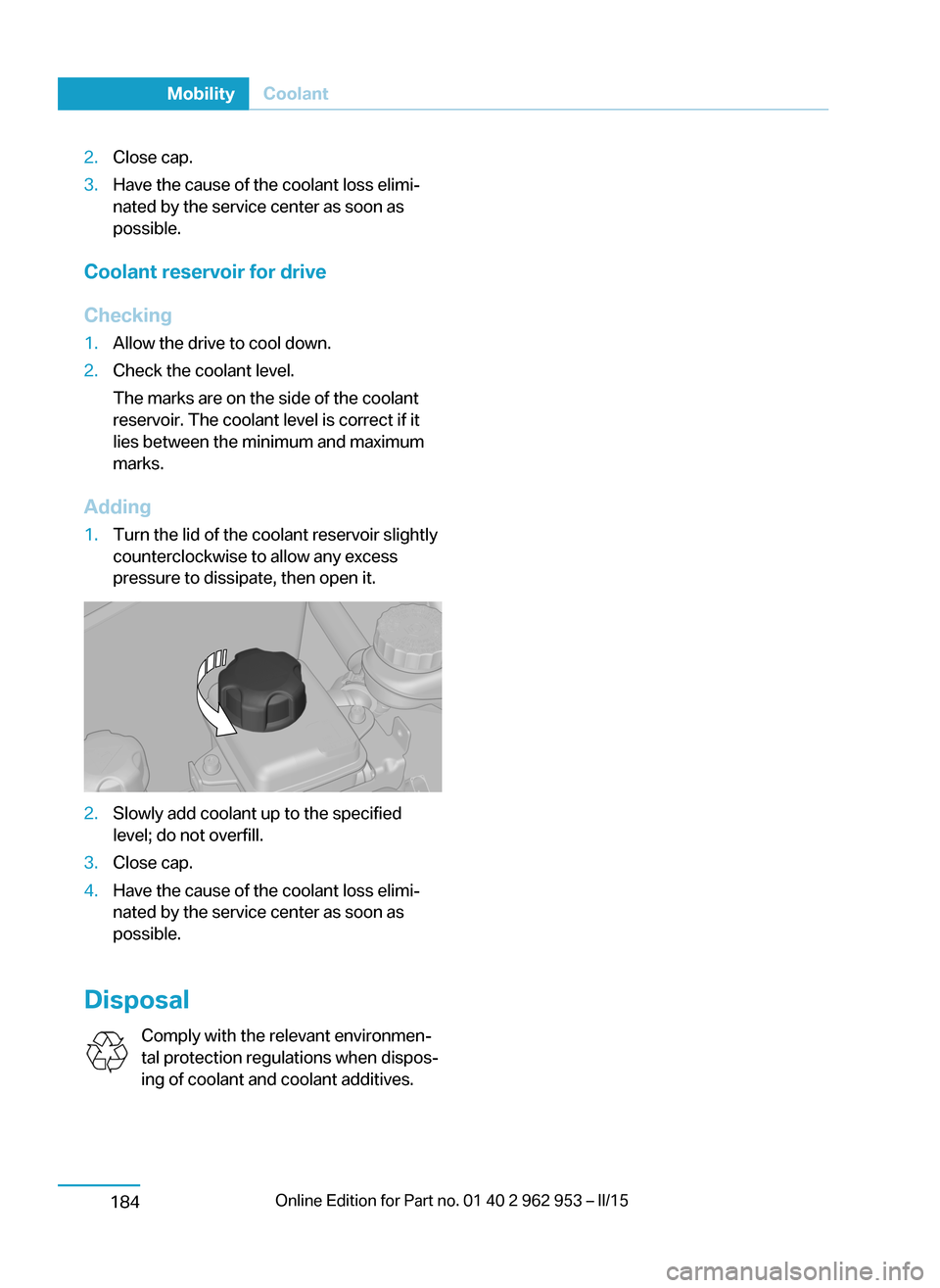
1.Turn the lid of the coolant reservoir slightly
counterclockwise to allow any excess
pressure to dissipate, then open it.2.Slowly add coolant up to the specified
level; do not overfill.3.Close cap.4.Have the cause of the coolant loss elimi‐
nated by the service center as soon as
possible.
Disposal
Comply with the relevant environmen‐
tal protection regulations when dispos‐
ing of coolant and coolant additives.
Seite 182MobilityCoolant184
Page 199 of 230

Replacing componentsVehicle features and optionsThis chapter describes all standard, country-
specific and optional features offered with the
series. It also describes features that are not
necessarily available in your car, e. g., due to
the selected options or country versions. This
also applies to safety-related functions and
systems.
Wiper blade replacement
General information Do not fold down the wipers without
wiper blades
Do not fold down the wipers if wiper blades
have not been installed; this may damage the
windshield.◀
Front: Replacing the wiper blades1.To change the wiper blades, fold up, refer
to page 72, the wiper arms.2.Fold up the wipers.3.Position the wiper blade in a horizontal po‐
sition.4.Remove the wiper blade toward one side.5.Insert the new wiper blade in reverse order
of removal until it locks in place.6.Fold down the wipers.
Rear: replacing the wiper blades
1.Lift off the wiper fully and pull off the wiper
blade, arrow.2.Attach a new wiper blade. It must engage
audibly.3.Fold down the wipers.
Lamp and bulb replacement
Hints
Lights and bulbs
Lights and bulbs make an essential contribu‐
tion to vehicle safety.
The manufacturer of the vehicle recommends
that you entrust corresponding procedures to
Seite 185Replacing componentsMobility187
Page 201 of 230

Low beamsFollow general instructions, refer to page 187.
55-watt bulb, H7.1.Fold up cover in front of the headlights.2.Turn the lid counterclockwise and remove.3.Pull off the connector.4.Press bulb holder slightly inward, loosen it
to the right from the anchor and fold it
down.5.Turn the bulb counterclockwise and re‐
move.6.To insert the bulb and bulb holder, proceed
in reverse order of removal. Make sure that
the bulb holder snaps into place.7.Close the headlight housing with the lid.
Make sure that the lid engages.
LED headlights
Hints
With LED headlamps, all front lights and park‐
ing lights/daytime running lights are designed
with LED technology.
Contact your service center in the event of a
malfunction.
At a glance
1Parking lights / daytime running lights2Low beams
Parking lights/daytime running lights
Parking lights/daytime running lights are de‐
signed with LED technology.
Contact your service center in the event of a
malfunction.
Turn signal and high beams Follow general instructions, refer to page 187.
Seite 187Replacing componentsMobility189