2014 BMW ACTIVE HYBRID 3 transmission
[x] Cancel search: transmissionPage 176 of 247

Coasting to a standstill and braking phases are
used more often to recover energy.
eDRIVE electric driving and the Auto Start
Stop function will also be deactivated.
Fast charging
In exceptional cases it can be charged in place,
such as before extended idle phases in order
to prevent damage to the high-voltage battery.1.Start the engine.2.Engage transmission position P and set
parking brake.3.Press and hold down brake pedal.4.Use the accelerator pedal to maintain an
engine speed of approx. 2,000 rpm.
After a few minutes, the high-voltage battery is
fully charged again.
The battery charge indicator in the instrument
cluster, refer to page 81, is used to check the
status.
General driving notes
Closing the trunk lid Drive with the trunk lid closed
Only drive with the tailgate closed; other‐
wise, in the event of an accident or braking and
evasive maneuvers, passengers and other traf‐
fic may be injured, and the vehicle may be
damaged. In addition, exhaust fumes may en‐
ter the vehicle interior.◀
If driving with the tailgate open cannot be
avoided:
▷Close all windows and the glass sunroof.▷Greatly increase the air flow from the vents.▷Drive moderately.Hot exhaust system
Hot exhaust system
High temperatures are generated in the
exhaust system.
Do not remove the heat shields installed and
never apply undercoating to them. Make sure
that flammable materials, e. g. hay, leaves,
grass, etc. do not come in contact with the hot
exhaust system while driving, while in idle po‐
sition mode, or when parked. Such contact
could lead to a fire, resulting in an increased
risk of serious personal injury as well as prop‐
erty damage.
Do not touch hot exhaust pipes; otherwise,
there is a danger of getting burned.◀
Mobile communication devices in the
vehicle
Mobile communication devices in the ve‐
hicle
It is not recommended to use mobile phones,
such as mobile phones, in the vehicle interior
without a direct connection to an external aer‐
ial. Otherwise, the vehicle's electronics and
mobile communication devices can interfere
with each other. In addition, there is no assur‐
ance that the radiation generated during trans‐
mission will be conducted away from the vehi‐
cle interior.◀
Hydroplaning Hydroplaning
When driving on wet or slushy roads, re‐
duce your speed to prevent hydroplaning.◀
On wet or slushy roads, a wedge of water can
form between the tires and road surface.
This phenomenon is referred to as hydroplan‐
ing. It is characterized by a partial or complete
loss of contact between the tires and the road
surface, ultimately undermining your ability to
steer and brake the vehicle.Seite 172Driving tipsThings to remember when driving172
Online Edition for Part no. 01 40 2 956 725 - X/14
Page 185 of 247

Mark in the area of arrow 1: display of the en‐
ergy recovered by coasting or when braking.
Mark in the area of arrow 2: display when ac‐
celerating.
Your driving style's efficiency is shown by the
bar's color:▷Blue display: efficient driving style as long
as the mark moves within the blue range.▷Gray display: adjust driving style, e. g. by
backing off the accelerator pedal.
The display switches to blue as soon as all
conditions for fuel-efficiency-optimized driving
are met.
ECO PRO tip, driving tip The arrow indicates that the driving
style can be adjusted to be more fuel
efficient by backing off the accelerator
for instance.
Note The driving style display and ECO PRO tips in
the instrument cluster appear when the ECO
PRO display is activated.
Activating driving style and ECO PRO tips:
1."Settings"2."Instrument cluster"3."ECO PRO Info"
ECO PRO tip, symbols
An additional symbol and text instructions are
displayed.
SymbolMeasureFor efficient driving back off the ac‐
celerator or delay accelerating to al‐
low time to assess road conditions.Reduce speed to the selected ECO
PRO speed.Steptronic transmission: shift from
M/S to D.
Indications on the Control Display
Displaying ECO PRO Tips The ECO PRO Tips can also be displayed in
split screen configuration.
1."Vehicle info"2."Hybrid"3. "ECO PRO Tips"
Settings are stored for the profile currently in
use.
ECO PRO driving style analysis
The concept
In this situation the system helps develop an
especially efficient driving style and to con‐
serve fuel.
For this purpose, the driving style is analyzed.
The assessment is done in various categories
and is displayed on the Control Display.
Using this indication, the individual driving
style can be oriented toward conserving fuel.
The last fifteen minutes of a trip are evaluated.
The range of the vehicle can be extended by
an efficient driving style.
This gain in range is displayed as a bonus
range in the instrument cluster and on the
Control Display.
Seite 181Saving fuelDriving tips181
Online Edition for Part no. 01 40 2 956 725 - X/14
Page 190 of 247

RefuelingVehicle features and options
This chapter describes all standard, country-
specific and optional features offered with the
series. It also describes features that are not
necessarily available in your car, e. g., due to
the selected options or country versions. This
also applies to safety-related functions and
systems.
Hints Refuel promptly
Refuel no later than at a range of
30 miles/50 km or engine operation might fail
and damage might occur.◀
Do not refuel unless the engine is at a
standstill and the transmission is in posi‐
tion P/N
Do not refuel unless the engine is at a standstill
and the transmission is in position P/N, other‐
wise the buildup of pressure may cause the
fuel nozzle to shut off prematurely.◀
Fuel lid
Opening1.Briefly press the rear edge of the fuel filler
flap.2.Turn the tank lid counterclockwise.3.Place the tank lid in the bracket attached to
the fuel filler flap.
Closing
1.Fit the lid and turn it clockwise until you
clearly hear a click.2.Close the fuel filler flap.
Do not pinch the retaining strap
Do not pinch the retaining strap attached
to the lid; otherwise, the lid cannot be closed
properly and fuel vapors can escape.◀
Manually unlocking fuel filler flap In the event of an electrical malfunction, e.g.
The release is located in the cargo area.
Seite 186MobilityRefueling186
Online Edition for Part no. 01 40 2 956 725 - X/14
Page 205 of 247
Detailed measurement
The concept In the detailed measurement the engine oil
level is checked and displayed via a scale.
During the measurement, the idle speed is in‐
creased somewhat.
General information
A detailed measurement is only possible with
certain engines.
Requirements▷Vehicle is on level road.▷Steptronic transmission: selector lever in
selector lever position N or P and accelera‐
tor pedal not depressed.▷Engine is running and is at operating tem‐
perature.
Performing a detailed measurement
In order to perform a detailed measurement of
the engine oil level:
1."Vehicle info"2."Vehicle status"3. "Measure engine oil level"4."Start measurement"
The engine oil level is checked and displayed
via a scale.
Time: approx. 1 minute.
Adding engine oil General information
Switch off the ignition and safely park the vehi‐
cle before engine oil is added.
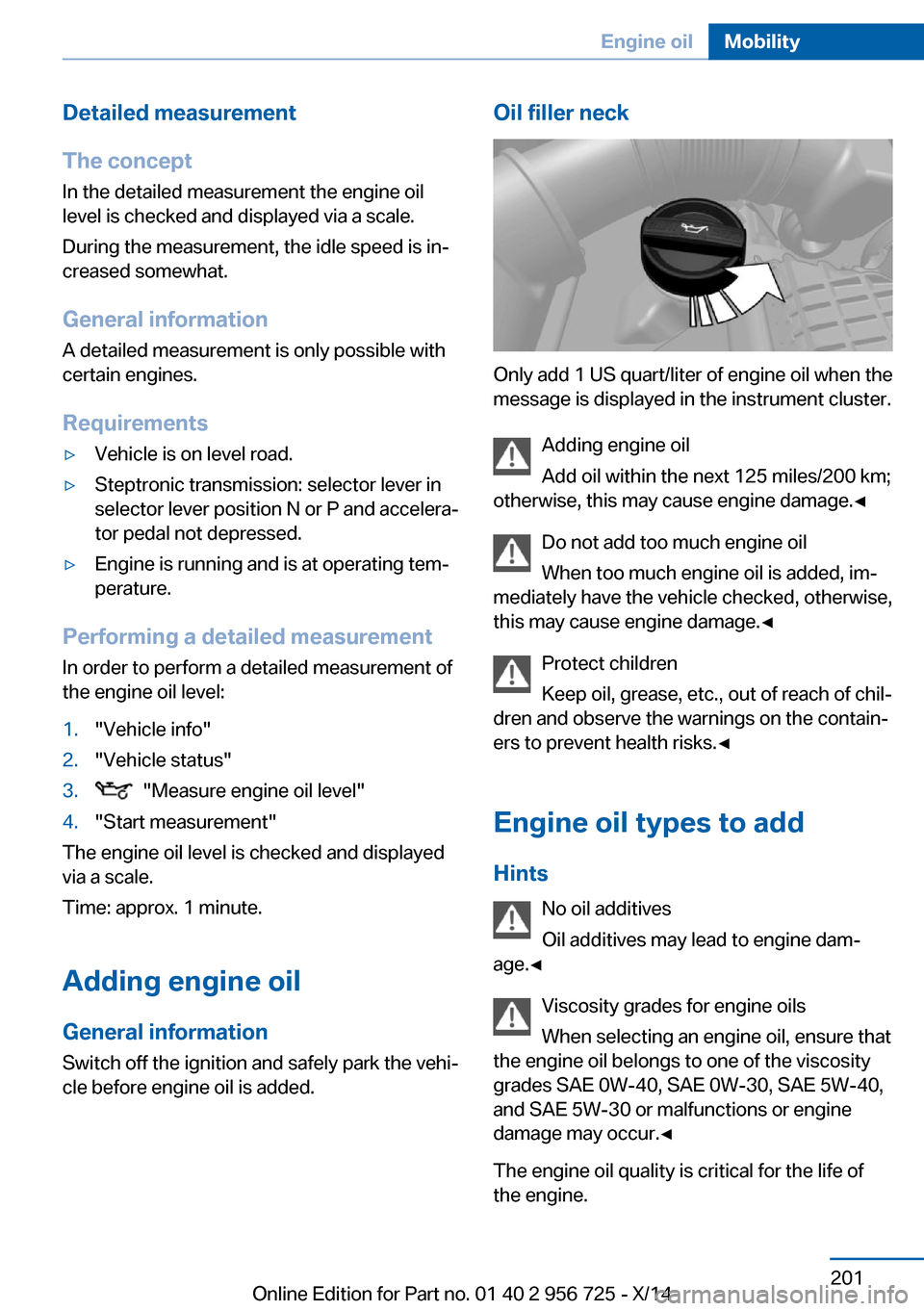
Oil filler neck
Only add 1 US quart/liter of engine oil when the
message is displayed in the instrument cluster.
Adding engine oil
Add oil within the next 125 miles/200 km;
otherwise, this may cause engine damage.◀
Do not add too much engine oil
When too much engine oil is added, im‐
mediately have the vehicle checked, otherwise,
this may cause engine damage.◀
Protect children
Keep oil, grease, etc., out of reach of chil‐
dren and observe the warnings on the contain‐
ers to prevent health risks.◀
Engine oil types to add Hints No oil additives
Oil additives may lead to engine dam‐
age.◀
Viscosity grades for engine oils
When selecting an engine oil, ensure that
the engine oil belongs to one of the viscosity
grades SAE 0W-40, SAE 0W-30, SAE 5W-40,
and SAE 5W-30 or malfunctions or engine
damage may occur.◀
The engine oil quality is critical for the life of
the engine.
Seite 201Engine oilMobility201
Online Edition for Part no. 01 40 2 956 725 - X/14
Page 224 of 247

corresponding engine or body ground of
the vehicle to be started.
Starting the engine
Never use spray fluids to start the engine.
1.Start the engine of the assisting vehicle
and let it run for several minutes at an in‐
creased idle speed.2.Start the engine of the vehicle that is to be
started in the usual way.
If the first starting attempt is not success‐
ful, wait a few minutes before making an‐
other attempt in order to allow the dis‐
charged battery to recharge.3.Let both engines run for several minutes.4.Disconnect the jumper cables in the re‐
verse order.
Check the battery and recharge if needed.
Tow-starting and towing Note Tow-starting and towing
For towing the vehicle turn, switch off the
Intelligent Safety systems; otherwise malfunc‐
tions of the individual braking systems might
lead to accidents.◀
Steptronic transmission: transporting
your vehicle
Note Your vehicle is not permitted to be towed.
Therefore, contact a service center in the
event of a breakdown.
Do not have the vehicle towedHave your vehicle transported on a load‐
ing platform only; otherwise, damage may oc‐
cur.◀
Tow truck
The vehicle should only be transported on a
loading platform.
Do not lift the vehicle
Do not lift the vehicle by the tow fitting or
body and chassis parts; otherwise, damage
may result.◀
Use tow fitting located in the front only for po‐
sitioning the vehicle.
Towing other vehicles
Hints Light towing vehicle
The towing vehicle must not be lighter
than the vehicle being towed; otherwise, it will
not be possible to control the vehicle's re‐
sponse.◀
Attaching the tow bar/tow rope correctly
Attach the tow bar or tow rope to the tow
fitting; connecting it to other vehicle parts may
cause damage.◀
▷Switch on the hazard warning system, de‐
pending on local regulations.▷If the electrical system has failed, clearly
identify the vehicle being towed by placing
a sign or a warning triangle in the rear win‐
dow.
Tow bar
The tow fittings used should be on the same
side on both vehicles.
Seite 220MobilityBreakdown assistance220
Online Edition for Part no. 01 40 2 956 725 - X/14
Page 225 of 247

Should it prove impossible to avoid mounting
the tow bar at an offset angle, please observe
the following:▷Maneuvering capability is limited going
around corners.▷The tow bar will generate lateral forces if it
is secured with an offset.
Tow rope
When starting to tow the vehicle, make sure
that the tow rope is taut.
To avoid jerking and the associated stresses
on the vehicle components when towing, al‐
ways use nylon ropes or nylon straps.
Tow fitting
The screw-in tow fitting should always be car‐
ried in the vehicle.
The tow fitting can be screwed in at the front
or rear of the BMW.
The tow fitting is located in a compartment un‐
der the cargo floor panel.
Tow fitting, information on use
▷Use only the tow fitting provided with
the vehicle and screw it all the way in.▷Use the tow fitting for towing on paved
roads only.▷Avoid lateral loading of the tow fitting, e.g.,
do not lift the vehicle by the tow fitting.
Otherwise, damage to the tow fitting and the
vehicle can occur.◀
Screw thread for tow fitting
Press on the mark on the edge of the cover to
push it out.
Tow-starting
Steptronic transmission
Do not tow-start the vehicle.
Tow-starting the engine is not possible due to
the Steptronic transmission.
Have the cause of the starting problems fixed.
Safety of the hybrid system
Hybrid system work Your vehicle's hybrid system is a self-con‐
tained system. Safety is ensured as long as no
work is performed on the technical compo‐
nents.
Thus, have work on the vehicle, for instance retrofitting accessories, performed by the
service center or a workshop that works ac‐
cording to BMW specifications with appropri‐
ately trained personnel.
Maintenance and repairs
Have maintenance and repair work per‐
formed only by a service center or a workshop
that works according to BMW specifications
with appropriately trained personnel. Other‐
wise, there is the risk of fatal injury from elec‐
trocution due to the high-voltage system's
high voltage.◀
Seite 221Breakdown assistanceMobility221
Online Edition for Part no. 01 40 2 956 725 - X/14
Page 236 of 247

Everything from A to Z
IndexA ABS, Antilock Brake Sys‐ tem 124
ACC, Active Cruise Control with Stop & Go 129
Acceleration Assistant, refer to Launch Control 78
Activated-charcoal filter 153
Activate drive readiness 68
Active Blind Spot Detec‐ tion 120
Active Cruise Control with Stop & Go, ACC 129
ActiveHybrid, system 31
Adapting to the course of the road, hybrid system 83
Adaptive brake lights, refer to Brake force display 122
Adaptive Light Control 98
Additives, oil 201
Adjustments, seats/head re‐ straints 52
After washing vehicle 224
Airbags 102
Airbags, indicator/warning light 103
Air circulation, refer to Recir‐ culated-air mode 152
Air, dehumidifying, refer to Cooling function 151
Air distribution, manual 152
Air flow, automatic climate control 152
Air pressure, tires 190
Air vents, refer to Ventila‐ tion 153
Alarm system 46
Alarm, unintentional 47
All around the center con‐ sole 16 All around the roofliner 17
All around the steering wheel 14
All-season tires, refer to Win‐ ter tires 196
Alternating-code hand-held transmitter 157
Alternative oil types 202
Antifreeze, washer fluid 75
Antilock Brake System, ABS 124
Anti-slip control, refer to DSC 124
Approved axle load 231
Approved engine oils 202
Arrival time 92
Ash tray 160
Assistance for the combus‐ tion engine, ASSIST 71
Assistance for the combus‐ tion engine, eBOOST 71
Assistance, Roadside Assis‐ tance 218
Assistance when driving off 128
ASSIST, assistance for the combustion engine 71
Assist system information, on Control Display 95
Attentiveness assistant 122
AUTO intensity 151
Automatic car wash 223
Automatic climate control with enhanced features 150
Automatic Cruise Control with Stop & Go 129
Automatic Curb Monitor 60
Automatic deactivation, front- seat passenger airbags 104
Automatic deactivation of the hybrid system 222 Automatic engine start-stop
function 69
Automatic headlight con‐ trol 98
Automatic locking 45
Automatic recirculated-air control 152
Automatic transmission, see Steptronic transmission 76
AUTO program, automatic cli‐ mate control 151
AUTO program, intensity 151
Auxiliary air conditioning 154
Average fuel consumption 92
Average speed 92
Axle loads, weights 231
B Backrest curvature, refer to Lumbar support 54
Backrest, width 54
Band-aids, refer to First aid kit 218
Bar for tow-starting/ towing 220
Battery replacement, vehicle battery 215
Battery replacement, vehicle remote control 37
Battery, vehicle 215
Belts, safety belts 55
Beverage holder, cu‐ pholder 166
Blinds, sun protection 49
BMW ActiveHybrid 31
BMW Assist, see user's manual for Navigation, En‐
tertainment and Communi‐
cation Seite 232ReferenceEverything from A to Z232
Online Edition for Part no. 01 40 2 956 725 - X/14
Page 239 of 247

Emergency unlocking, trunklid 43
Energy recovery, CHARGE 71
Engine, automatic off 69
Engine compartment 198
Engine compartment, work‐ ing in 199
Engine coolant 203
Engine oil 200
Engine oil, adding 201
Engine oil additives 201
Engine oil change 202
Engine oil filler neck 201
Engine oil temperature 87
Engine oil types, alterna‐ tive 202
Engine oil types, ap‐ proved 202
Engine start during malfunc‐ tion 37
Engine start, jump-start‐ ing 218
Engine temperature 87
Entering a car wash 223
Equipment, interior 156
Error displays, see Check Control 83
ESP Electronic Stability Pro‐ gram, refer to DSC 124
Exchanging wheels/tires 195
Exhaust system 172
Exterior mirror, automatic dimming feature 60
Exterior mirrors 59
External start 218
External temperature dis‐ play 87
External temperature warn‐ ing 87
Eyes for securing cargo 176
F
Failure message, see Check Control 83 False alarm, refer to Uninten‐
tional alarm 47
Fan, refer to Air flow 152
Filler neck for engine oil 201
Fine wood, care 225
First aid kit 218
Fitting for towing, see tow fit‐ ting 221
Flat tire, changing wheels 214
Flat Tire Monitor FTM 109
Flat tire, Tire Pressure Moni‐ tor TPM 105
Flat tire, warning lamp 106, 109
Flooding 173
Floor carpet, care 226
Floor mats, care 226
Fold down the rear seat back‐ rest, see Though-loading
system 162
Fold-out position, wiper 75
Foot brake 173
Front airbags 102
Front-end collision warning with braking function 114
Front-end collision warning with City Braking func‐
tion 111
Front fog lights 100
Front fog lights, front, bulb re‐ placement 211
Front lights 207
front-seat passenger airbags, automatic deactivation 104
Front-seat passenger airbags, indicator lamp 104
FTM Flat Tire Monitor 109
Fuel 188
Fuel consumption, refer to Average fuel consump‐
tion 92
Fuel filler flap 186
Fuel gauge 87
Fuel lid 186
Fuel quality 188 Fuel recommendation 188
Fuel, tank capacity 231
Functions, hybrid system 31
Fuse 215
G
Garage door opener, refer to Universal Integrated Remote
Control 156
Gasoline 188
Gear change, Steptronic transmission 76
Gear shift indicator 89
General driving notes 172
Glare shield 160
Glass sunroof, powered 49
Glove compartment 164
Gross vehicle weight, ap‐ proved 231
H
Handbrake, refer to parking brake 71
Hand-held transmitter, alter‐ nating code 157
Hazard warning flashers 217
Head airbags 102
Headlight control, auto‐ matic 98
Headlight courtesy delay fea‐ ture 97
Headlight courtesy delay fea‐ ture, remote control 46
Headlight flasher 73
Headlight glass 207
Headlights 207
Headlights, care 224
Headlight washer system 73
Head restraints 52
Head restraints, front 56
Head restraints, rear 57
Head-up Display 95
Head-up Display, care 226
Heavy cargo, stowing 176 Seite 235Everything from A to ZReference235
Online Edition for Part no. 01 40 2 956 725 - X/14