2014 BMW 5 SERIES GRAN TURISMO set clock
[x] Cancel search: set clockPage 25 of 259
Function is deactivated.
Touchpad Some iDrive functions can be operated using
the touchpad on the controller:
Selecting functions1."Settings"2."Touchpad"3.Select the desired function.▷"Speller": enter letters and numbers.▷"Interactive map": viewing the interac‐
tive map.▷"Browser": enter Internet addresses.▷"Audio feedback": pronounces entered
letters and numbers.
Entering letters and numbers
Entering letters requires some practice at the
beginning. When entering, pay attention to the
following:
▷For the input of upper/lower case letters
and numbers, it may be necessary to reel
via the controller to the corresponding In‐
put mode, refer to page 24, e.g. when the
spelling of upper and lower case letters is
identical.▷Enter characters as they are displayed on
the Control Display.▷Always enter associated characters, such
as accents or periods so that the letter can
be clearly recognized. Possible input de‐
pends on the set language. Where neces‐
sary, enter special characters via the con‐
troller.▷To delete a character, slide to the left on
the touchpad.▷To enter a blank space, slide to the right in
the center of the touchpad.▷To enter a hyphen, slide to the right in the
upper area of the touchpad.▷To enter an underscore, swipe to the right
in the lower area of the touchpad.
Using interactive map and Internet
Via touch-pad move the interactive map in the
navigation system and Internet sites.
FunctionControlsMove interactive map or
Internet sites.Swipe into re‐
spective direc‐
tion.Enlarge/shrink interactive
map or Internet sites.Drag in or out on
the touchpad with
fingers.Display the menu or open
a link in the Internet.Tap once.
Changing settings
You may change control display settings via
touchpad. Swipe left or right accordingly.
Example: setting the clock Setting the clock
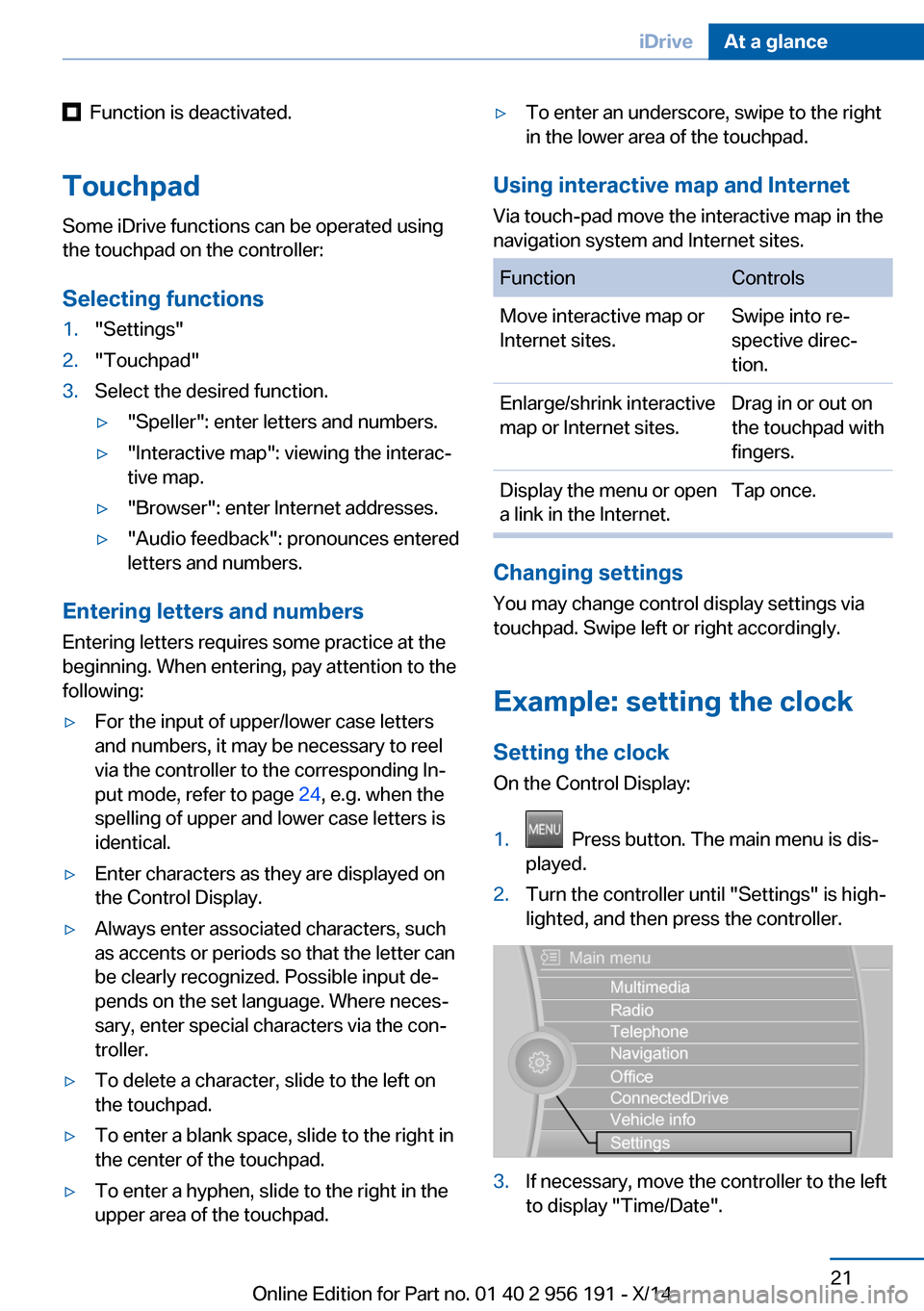
On the Control Display:
1. Press button. The main menu is dis‐
played.2.Turn the controller until "Settings" is high‐
lighted, and then press the controller.3.If necessary, move the controller to the left
to display "Time/Date".Seite 21iDriveAt a glance21
Online Edition for Part no. 01 40 2 956 191 - X/14
Page 135 of 259
Active ProtectionGeneral information
The Active Protection safety package consists
of systems that are independent of each other:▷Attentiveness assistant.▷PreCrash▷PostCrash
Attentiveness assistant
The concept The system can detect increasing lack of alert‐
ness or fatigue of the driver during long, mo‐
notonous journeys, e.g., on highways. In this situation, it is recommended that the driver
takes a break.
Note Personal responsibility
The system cannot act as a substitute for
the personal assessment of one's physical
state and may not detect an increasing lack of
alertness or fatigue or may not detect it cor‐
rectly. Therefore, make sure that the driver is
rested and alert; otherwise, risks may be de‐
tected too late and an accident be caused as a
result.◀
Function
The system is activated each time the engine
is started and cannot be switched off.
After travel has begun, the system is trained
about the driver, so that increasing lack of
alertness or fatigue can be detected.
This procedure takes the following criteria into
account:
▷Personal driving style, e.g., steering behav‐
ior.▷Driving conditions, e.g., length of trip.Starting at approximately 43 mph/70 km/h, the
system is active and can display a recommen‐
dation to take a break.
Break recommendation
If the driver becomes increasingly less alert or
fatigued, a message is displayed in the Control
Display with the recommendation to take a
break.
A recommendation to take a break is displayed
only once during an uninterrupted trip.
After a break, another recommendation to take
a break cannot be displayed until after approxi‐
mately 45 minutes.
System limits
The function may be limited in the following
situations, for instance, and will either output
an incorrect warning or no warning at all:▷When the clock is set incorrectly.▷When the vehicle speed is mainly below
about 43 mph/70 km/h.▷With a sporty driving style, such as during
rapid acceleration or when cornering fast.▷In active driving situations, such as when
changing lanes frequently.▷When the road surface is poor.▷In the event of strong side winds.
PreCrash
The concept With this system critical driving situations that
might result in an accident can be detected
above a speed of approx. 20 mph/30 km/h. In these situations, preventive measures are au‐
tomatically taken to minimize the risk of an ac‐
cident as much as possible.
Critical driving situations may include:
▷Emergency stop.▷Severe understeering.▷Severe oversteering.Seite 131SafetyControls131
Online Edition for Part no. 01 40 2 956 191 - X/14
Page 250 of 259
Condensation under the vehi‐cle 186
Condition Based Service CBS 219
Configure driving mode 140
Confirmation signal 47
ConnectedDrive, see user's manual for Navigation, En‐
tertainment and Communi‐
cation
ConnectedDrive Services
Continued driving with a flat tire 111 , 114
Control Display 18
Control Display, settings 98
Controller 18
Control systems, driving sta‐ bility 133
Convenient opening with the remote control 37
Coolant 217
Coolant level 217
Coolant temperature 92
Cooling function 164
Cooling, maximum 164
Cooling system 217
Corrosion on brake discs 186
Cosmetic mirror 171
Cruise control 148
Cruise control, active with Stop & Go 141
Cruise Control, refer to Active Cruise Control 141
Cruising range 92
Cupholder 179
Curb weight 241
Current fuel consumption 93
D
Damage, tires 207
Damping control, dy‐ namic 136
Data, technical 240
Date 92
Daytime running lights 103 Defrosting, refer to Windows,
defrosting 163
Dehumidifying, air 164
Deleting personal data 24
Deletion of personal data 24
Destination distance 97
Digital clock 92
Dimensions 240
Dimmable exterior mirrors 63
Dimmable interior rearview mirror 63
Direction indicator, refer to Turn signals 77
Display, electronic, instru‐ ment cluster 84
Display in windshield 100
Display lighting, refer to In‐ strument lighting 105
Displays 85
Displays, cleaning 236
Disposal, coolant 218
Disposal, vehicle battery 226
Distance control, refer to PDC 150
Distance to destination 97
Divided screen view, split screen 23
Door lock 39
Door lock, refer to Remote control 34
Doors, Automatic Soft Clos‐ ing 40
Downhill control 135
Drive-off assistant 133
Drive-off assistant, refer to DSC 133
Driver assistance, refer to In‐ telligent Safety 115
Driving Assistant, refer to In‐ telligent Safety 115
Driving Dynamics Con‐ trol 138
Driving instructions, break- in 184
Driving mode 138
Driving notes, general 184 Driving stability control sys‐
tems 133
Driving tips 184
DSC Dynamic Stability Con‐ trol 133
DTC Dynamic Traction Con‐ trol 134
Dynamic Damping Con‐ trol 136
Dynamic Drive 136
Dynamic Stability Control DSC 133
Dynamic Traction Control DTC 134
E ECO PRO 191
ECO PRO, bonus range 192
ECO PRO display 191
ECO PRO displays 86
ECO PRO driving mode 191
ECO PRO mode 191
ECO PRO Tip - driving in‐ struction 193
EfficientDynamics 193
Electronic displays, instru‐ ment cluster 84
Electronic oil measure‐ ment 214
Electronic Stability Program ESP, refer to DSC 133
Emergency detection, remote control 35
Emergency release, fuel filler flap 198
Emergency release, parking brake 76
Emergency Request 228
Emergency service, refer to Roadside Assistance 229
Emergency start function, en‐ gine start 35
Emergency unlocking, tail‐ gate 44 Seite 246ReferenceEverything from A to Z246
Online Edition for Part no. 01 40 2 956 191 - X/14