2014 BMW 435I COUPE headliner
[x] Cancel search: headlinerPage 14 of 236
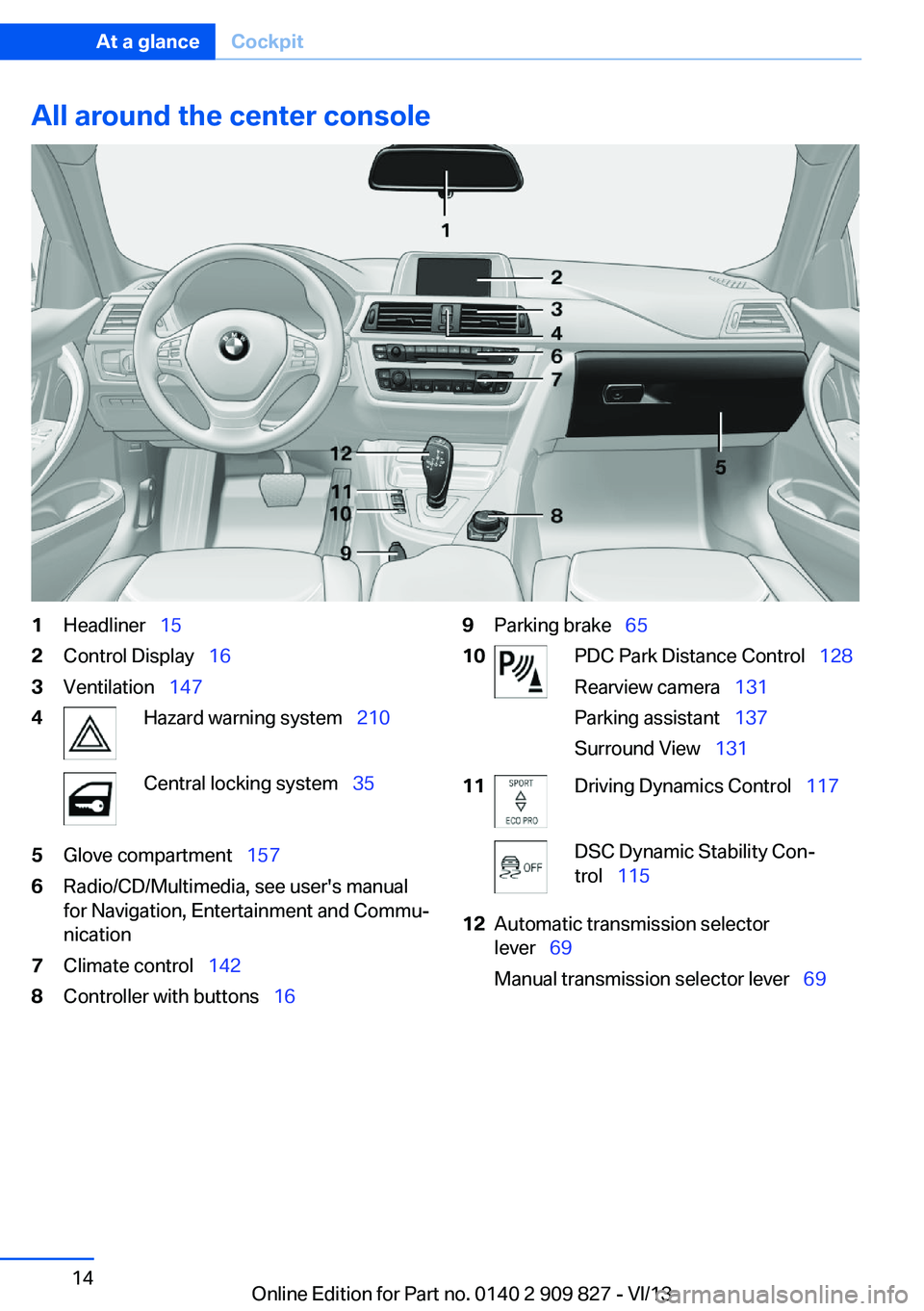
All around the center console1Headliner 152Control Display 163Ventilation 1474Hazard warning system 210Central locking system 355Glove compartment 1576Radio/CD/Multimedia, see user's manual
for Navigation, Entertainment and Commu‐
nication7Climate control 1428Controller with buttons 169Parking brake 6510PDC Park Distance Control 128
Rearview camera 131
Parking assistant 137
Surround View 13111Driving Dynamics Control 117DSC Dynamic Stability Con‐
trol 11512Automatic transmission selector
lever 69
Manual transmission selector lever 69Seite 14At a glanceCockpit14
Online Edition for Part no. 0140 2 909 827 - VI/13
Page 15 of 236
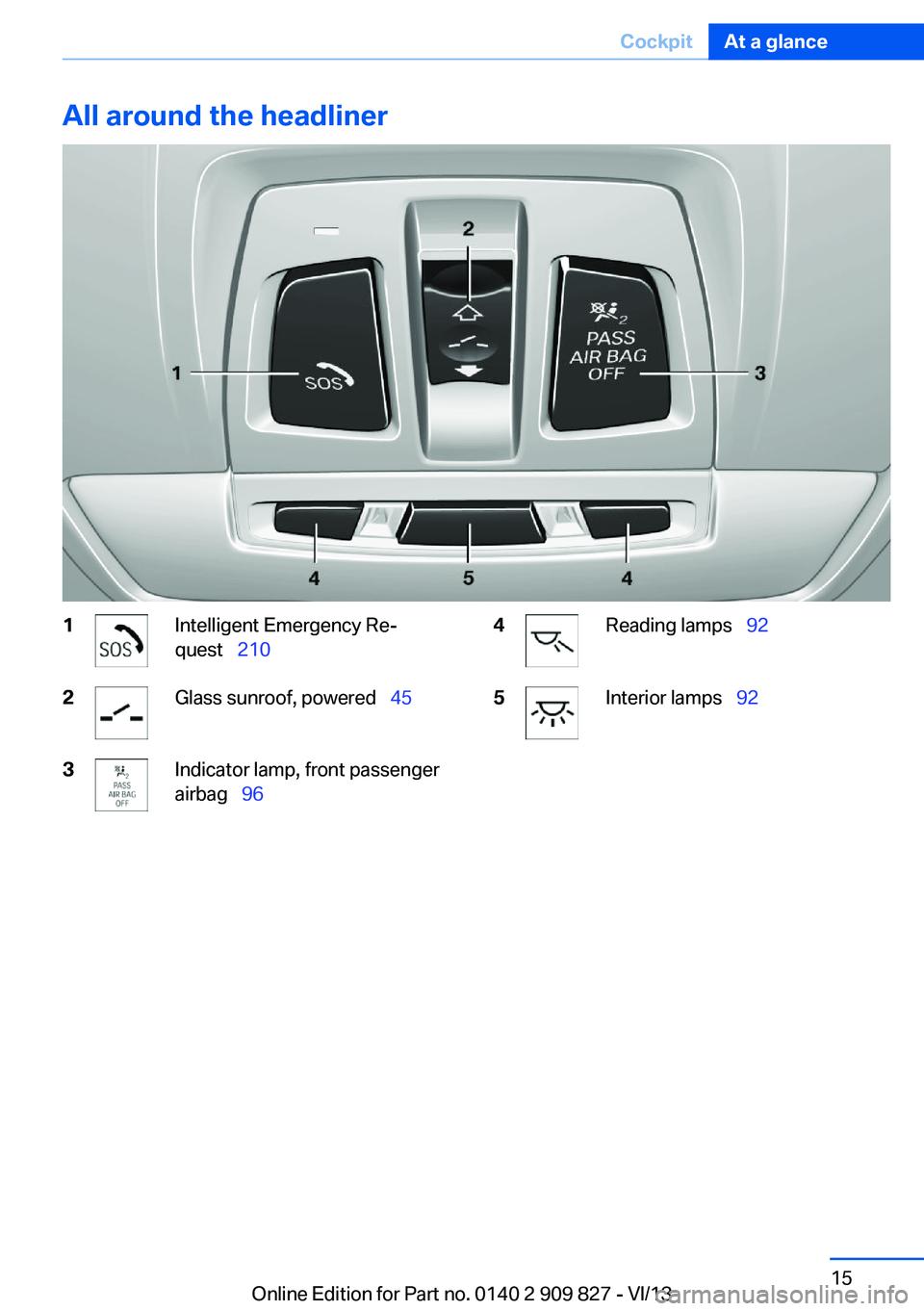
All around the headliner1Intelligent Emergency Re‐
quest 2102Glass sunroof, powered 453Indicator lamp, front passenger
airbag 964Reading lamps 925Interior lamps 92Seite 15CockpitAt a glance15
Online Edition for Part no. 0140 2 909 827 - VI/13
Page 95 of 236

Protective action
Airbags are not triggered in every impact situa‐
tion, e.g., in less severe accidents or rear-end
collisions.
Information on how to ensure the optimal
protective effect of the airbags▷Keep at a distance from the airbags.▷Always grasp the steering wheel on the
steering wheel rim, holding your hands at
the 3 o'clock and 9 o'clock positions, to
keep the danger of injury to your hands or
arms as low as possible if the airbag is trig‐
gered.▷There should be no people, animals, or ob‐
jects between an airbag and a person.▷Do not use the cover of the front airbag on
the front passenger side as a storage area.▷Keep the dashboard and window on the
front passenger side clear, i.e., do not
cover with adhesive labels or coverings,
and do not attach holders such as for navi‐
gation instruments and mobile phones.▷Make sure that the front passenger is sit‐
ting correctly, i.e., keeps his or her feet and
legs in the footwell; otherwise, leg injuries
can occur if the front airbag is triggered.▷Do not place slip covers, seat cushions or
other objects on the front passenger seat
that are not approved specifically for seats
with integrated side airbags.▷Do not hang pieces of clothing, such as
jackets, over the backrests.▷Make sure that occupants keep their heads
away from the side airbag and do not rest
against the head airbag; otherwise, injuries
can occur if the airbags are triggered.▷Do not remove the airbag restraint system.▷Do not remove the steering wheel.▷Do not apply adhesive materials to the air‐
bag cover panels, cover them or modify
them in any way.▷Never modify either the individual compo‐
nents or the wiring in the airbag system.
This also applies to steering wheel covers,
the dashboard, the seats, the roof pillars
and the sides of the headliner.◀
Even when all instructions are followed closely,
injury from contact with the airbags cannot be
ruled out in certain situations.
The ignition and inflation noise may lead to
short-term and, in most cases, temporary
hearing impairment in sensitive individuals.
In the case of a malfunction, deactivation
and after triggering of the airbags
Do not touch the individual components imme‐
diately after the system has been triggered;
otherwise, there is the danger of burns.
Only have the airbags checked, repaired or dis‐
mantled and the airbag generator scrapped by
your service center or a workshop that has the
necessary authorization for handling explo‐
sives.
Non-professional attempts to service the sys‐
tem could lead to failure in an emergency or
undesired triggering of the airbag, either of
which could result in injury.◀
Warnings and information on the airbags are
also found on the sun visors.
Functional readiness of the airbag
system
When the ignition is switch on, the
warning lamp in the instrument cluster
lights up briefly and thereby indicates
the operational readiness of the entire airbag
system and the belt tensioner.
Airbag system malfunctioning
▷Warning lamp does not come on when the
ignition is turned on.▷The warning lamp lights up continuously.Seite 95SafetyControls95
Online Edition for Part no. 0140 2 909 827 - VI/13
Page 218 of 236
To guard against discoloration, such as from
clothing, provide leather care roughly every
two months.
Clean light-colored leather more frequently be‐
cause soiling on such surfaces is substantially
more visible.
Use leather care products; otherwise, dirt and
grease will gradually break down the protective
layer of the leather surface.
Suitable care products are available from the
service center.
Upholstery material care Vacuum regularly with a vacuum cleaner.
If they are very dirty, e.g., beverage stains, use
a soft sponge or microfiber cloth with a suita‐
ble interior cleaner.
Clean the upholstery down to the seams using
large sweeping motions. Avoid rubbing the
material vigorously.
Damage from Velcro® fasteners
Open Velcro® fasteners on pants or
other articles of clothing can damage the seat
covers. Ensure that any Velcro® fasteners are
closed.◀
Caring for special components
Light-alloy wheels When cleaning the vehicle, use only neutral
wheel cleaners having a pH value from 5 to 9.
Do not use abrasive cleaning agents or steam
jets above 140 ℉/60 ℃. Follow the manufac‐
turer's instructions.
Aggressive, acidic or alkaline cleaning agents
can destroy the protective layer of adjacent
components, such as the brake disk.
Chrome surfaces Carefully clean components such as the radia‐
tor grille or door handles with an ample supply of water, possibly with shampoo added, partic‐ularly when they have been exposed to road
salt.
Rubber components Aside from water, treat only with rubber
cleansers.
When cleaning rubber seals, do not use any
silicon-containing car care products in order to
avoid damage or reduced noise damping.
Fine wood parts Clean fine wood facing and fine wood compo‐
nents only with a moist rag. Then dry with a
soft cloth.
Plastic components
These include:▷Imitation leather surfaces.▷Headliner.▷Lamp lenses.▷Instrument cluster cover.▷Matte black spray-coated components.▷Painted parts in the interior.
Clean with a microfiber cloth.
Lightly dampen the cloth with water.
Do not soak the headliner.
Do not use cleansers that contain alcohol
or solvents
Do not use cleansers that contain alcohol or
solvents, such as lacquer thinners, heavy-duty
grease removers, fuel, or such; this could lead
to surface damage.◀
Safety belts
Dirty belt straps impede the reeling action and
thus have a negative impact on safety.
Chemical cleaning
Do not clean chemically; this can destroy
the webbing.◀
Seite 218MobilityCare218
Online Edition for Part no. 0140 2 909 827 - VI/13
Page 226 of 236
Everything from A to Z
IndexA ABS, Antilock Brake Sys‐ tem 115
ACC, Active Cruise Control with Stop & Go 120
Acceleration Assistant, refer to Launch Control 71
Activated-charcoal filter 147
Active Blind Spot Detec‐ tion 111
Active Cruise Control with Stop & Go, ACC 120
Active Protection 112
Adaptive brake lights, refer to Brake force display 112
Adaptive Light Control 90
Additives, oil 193
Adjustments, seats/head re‐ straints 47
After washing vehicle 217
Airbags 94
Airbags, indicator/warning light 95
Air circulation, refer to Recir‐ culated-air mode 143, 146
Air, dehumidifying, refer to Cooling function 143
Air distribution, manual 143, 146
Air drying, refer to Cooling function 145
Air flow, air conditioner 143
Air flow, automatic climate control 146
Air pressure, tires 181
Air vents, refer to Ventila‐ tion 147
Alarm system 42
Alarm, unintentional 43 All around the center con‐
sole 14
All around the headliner 15
All around the steering wheel 12
All-season tires, refer to Win‐ ter tires 187
All-wheel-drive 116
Alternating-code hand-held transmitter 150
Alternative oil types 193
Antifreeze, washer fluid 68
Antilock Brake System, ABS 115
Anti-slip control, refer to DSC 115
Approved engine oils 193
Arrival time 85
Ash tray 153
Assistance, Roadside Assis‐ tance 211
Assistance when driving off 119
Assist system information, on Control Display 88
Attentiveness assistant 113
AUTO intensity 145
Automatic car wash 216
Automatic climate con‐ trol 142
Automatic climate control with enhanced features 144
Automatic Cruise Control with Stop & Go 120
Automatic Curb Monitor 55
Automatic deactivation, front passenger airbags 96
Automatic headlamp con‐ trol 90
Automatic locking 41 Automatic recirculated-air
control 146
Automatic transmission with Steptronic 69
AUTO program, automatic cli‐ mate control 145
AUTO program, climate con‐ trol 143
AUTO program, intensity 145
Auto Start/Stop function 63
Average fuel consumption 85
Average speed 85
Axle loads, weights 223
B Backrest curvature, refer to Lumbar support 49
Backrest, width 49
Backup camera 131
Band-aids, refer to First aid kit 211
Bar for tow-starting/ towing 214
Battery replacement, vehicle battery 207
Battery replacement, vehicle remote control 32
Battery, vehicle 207
Belt carrier 52
Belts, safety belts 51
Beverage holder, cu‐ pholder 159
Blinds, sun protection 44
BMW Assist, see user's manual for Navigation, En‐
tertainment and Communi‐
cation
BMW Homepage 6
BMW Internet page 6 Seite 226ReferenceEverything from A to Z226
Online Edition for Part no. 0140 2 909 827 - VI/13
Page 229 of 236
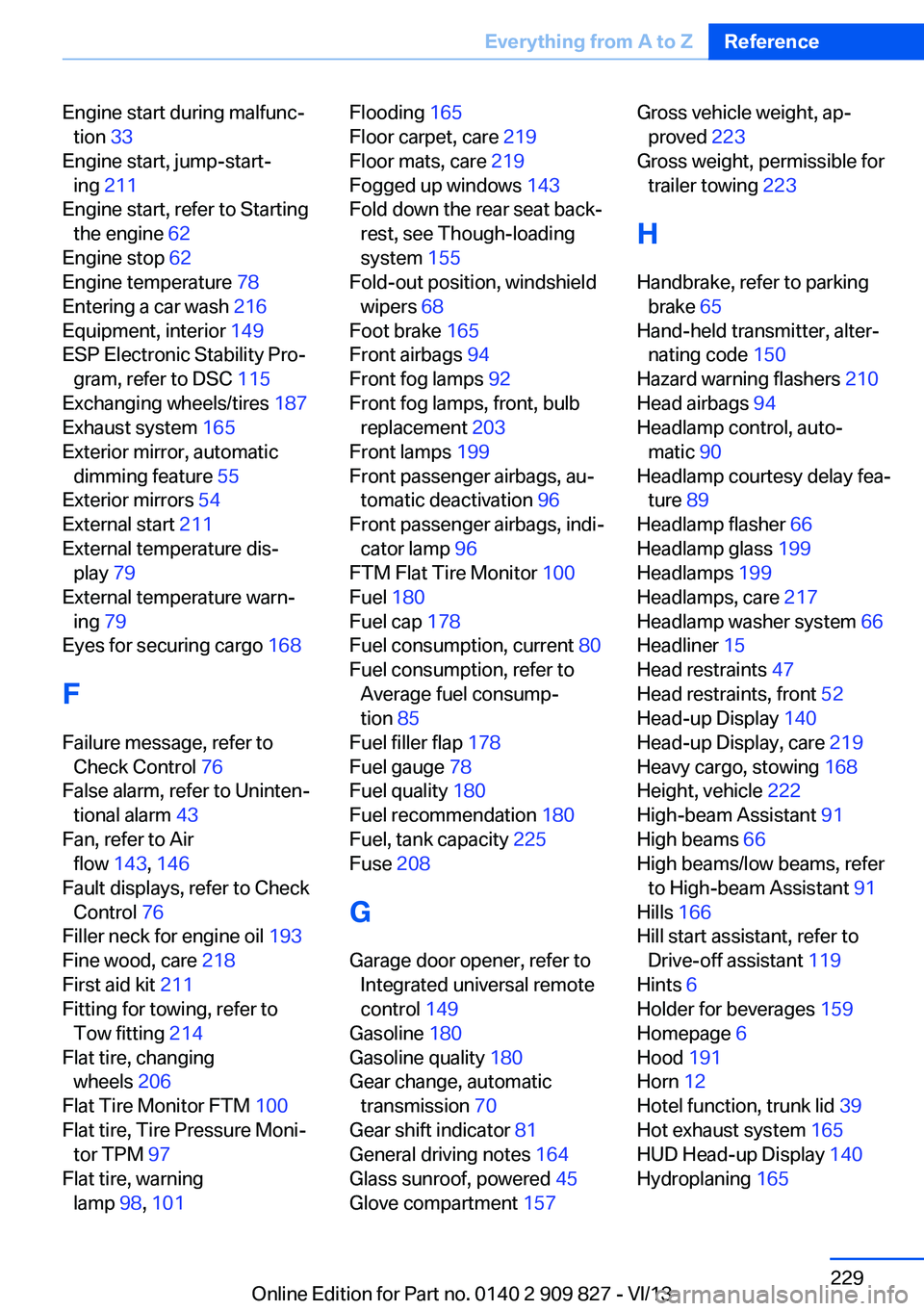
Engine start during malfunc‐tion 33
Engine start, jump-start‐ ing 211
Engine start, refer to Starting the engine 62
Engine stop 62
Engine temperature 78
Entering a car wash 216
Equipment, interior 149
ESP Electronic Stability Pro‐ gram, refer to DSC 115
Exchanging wheels/tires 187
Exhaust system 165
Exterior mirror, automatic dimming feature 55
Exterior mirrors 54
External start 211
External temperature dis‐ play 79
External temperature warn‐ ing 79
Eyes for securing cargo 168
F
Failure message, refer to Check Control 76
False alarm, refer to Uninten‐ tional alarm 43
Fan, refer to Air flow 143, 146
Fault displays, refer to Check Control 76
Filler neck for engine oil 193
Fine wood, care 218
First aid kit 211
Fitting for towing, refer to Tow fitting 214
Flat tire, changing wheels 206
Flat Tire Monitor FTM 100
Flat tire, Tire Pressure Moni‐ tor TPM 97
Flat tire, warning lamp 98, 101 Flooding 165
Floor carpet, care 219
Floor mats, care 219
Fogged up windows 143
Fold down the rear seat back‐ rest, see Though-loading
system 155
Fold-out position, windshield wipers 68
Foot brake 165
Front airbags 94
Front fog lamps 92
Front fog lamps, front, bulb replacement 203
Front lamps 199
Front passenger airbags, au‐ tomatic deactivation 96
Front passenger airbags, indi‐ cator lamp 96
FTM Flat Tire Monitor 100
Fuel 180
Fuel cap 178
Fuel consumption, current 80
Fuel consumption, refer to Average fuel consump‐
tion 85
Fuel filler flap 178
Fuel gauge 78
Fuel quality 180
Fuel recommendation 180
Fuel, tank capacity 225
Fuse 208
G
Garage door opener, refer to Integrated universal remote
control 149
Gasoline 180
Gasoline quality 180
Gear change, automatic transmission 70
Gear shift indicator 81
General driving notes 164
Glass sunroof, powered 45
Glove compartment 157 Gross vehicle weight, ap‐
proved 223
Gross weight, permissible for trailer towing 223
H
Handbrake, refer to parking brake 65
Hand-held transmitter, alter‐ nating code 150
Hazard warning flashers 210
Head airbags 94
Headlamp control, auto‐ matic 90
Headlamp courtesy delay fea‐ ture 89
Headlamp flasher 66
Headlamp glass 199
Headlamps 199
Headlamps, care 217
Headlamp washer system 66
Headliner 15
Head restraints 47
Head restraints, front 52
Head-up Display 140
Head-up Display, care 219
Heavy cargo, stowing 168
Height, vehicle 222
High-beam Assistant 91
High beams 66
High beams/low beams, refer to High-beam Assistant 91
Hills 166
Hill start assistant, refer to Drive-off assistant 119
Hints 6
Holder for beverages 159
Homepage 6
Hood 191
Horn 12
Hotel function, trunk lid 39
Hot exhaust system 165
HUD Head-up Display 140
Hydroplaning 165 Seite 229Everything from A to ZReference229
Online Edition for Part no. 0140 2 909 827 - VI/13