2014 AUDI TT ROADSTER tow
[x] Cancel search: towPage 119 of 244

restraints or occupants on the front pas
senger seat and prevent the side airbag
in the seat backrest from deploying prop
erly.
- Never use cushions, pillows, blankets or
similar items on the front passenger
seat. The add itional padd ing will prevent
the weight-sens ing mat in the seat from
accurately reg istering the ch ild restra int
or person on the seat and preve nt the
Advanced Airbag System from func tion
ing properly .
- If you must use a child restra int on the
front passenger seat and the ch ild re
straint manufacturer's instructions re
quire the use of a towel, foam cush ion or
something else to properly position the
child restraint, make certa in that the
PASSENGER AIR BAG OFF light comes
on and stays on whenever the child re
st ra int is installed on the front passen
ger seat .
- If the
PAS SENGER AIR BAG OFF light
does not come on and stay on, have the
airbag system inspected by your Audi dealer.
How the Advanced Airbag System
components work together
The front Advanced Airbag System and the side airbags s upplement the protection of
fered by the front three-point safety be lts
with pretensioners and load limiters and the
adjustab le head restra ints to he lp reduce the
risk of injury in a wide range of acc ident and
crash situat ions . Be sure to read the impor
tant information about safety and heed the
WARNINGS i n this chapter .
Deployment of the Advanced Airbag System
and the act ivat ion of the safety be lt preten
sioners depend on the dece le rat ion measured
by the c rash sensors and registered by the
e lectronic control un it . Crash severity depends
on speed and dece leration as well as the mass
and stiffness of the vehicle or object involved in the crash .
Airbag system 117
When the electronic control unit registers a
low severity cras h and the safety belt is being
used, the airbag will not dep loy. If the safety
belt is not being used, the first stage deploys,
followed by the second stage after a much lat er t ime in the crash sequence.
If the electron ic control unit registers a crash
of medium severity, the first stage of the air bag deploys followed by the second stage at a
much later time in the crash sequence -re
gardless of whether the safety belt is be ing
used or not . In higher sever ity crashes as reg
iste red by the elect roni c cont rol unit, bot h the
first and se cond s tages deploy almost at the
same t ime.
On the passenger side, regardless of safety
belt use, the airbag w ill be tu rned off if the
weight on the passenger sea t is less than the
amount programmed in the electronic control
u nit . The front airbag on the passenger side
will a lso be turned off if one of the child safe
ty seats that has been certified under Federal
Motor Vehicle Safety Standard 208 has been
recognized on the seat. The
PASS ENGER A IR
BAG OFF light comes on and stays on to te ll
you when the front Adva nced A irbag on the
passenger side has been turned off
¢ page 110, Child restraints on the front seat
- some important things to know .
_&. WARNING ~
To reduce the risk of inj ury when an a irbag
inflates, always wear safety be lts properly.
- If you are unrestrained, leaning forward,
sitting sideways or o ut o f position in any
way, your risk of injury is m uch higher.
- You will a lso receive serious injur ies and
could even be killed if yo u are up against
the airbag or too close to it when it in
f lates -even with an Advanced A irbag
¢page 109.
•
•
Page 142 of 244
140 Child Saf ety
and child against the backrest, door or
ro of.
- Always be especially careful if you mu st
ins tall a rearward facing c hild safety seat
on the front passenger seat in exception
al circumstanc es.
- Make sure that the
PA SS ENGER AIR BAG
OFF
light comes on and stays on all the
t ime w henever the ignition is switched
on.
- Never install a rearward facing child
safety seat on the front passenger seat
unless the
PASSENGER AIR BAG OFF
light comes on and stays on. If the PAS·
SENGER AIR BAG OFF
light does not
come on and stay on h ave the airbag sys
tem inspec ted immediately by your Aud i
dealer .
Activating the convertible locking
retractor
Use the convertible locking retractor to se
cure a child restraint.
A lways heed the child sa fety seat man ufactur
er's instructions when ins talling a chi ld re
straint in your vehicle . To activate the conver
tib le locking retractor:
., Place the child restrain t on a seat .
., Slow ly pull the be lt
all the wa y out.
., Route it around or through the chi ld re
stra int be lt path
c:> ,&. .
., Push the child safety seat down with your
full weight to get the safety belt rea lly t ight.
., In sert the be lt tongue into the buckle fo r
t h at seating posi tion.
., Gu ide the safety be lt back into the retracto r
u nt il the belt lies flat a nd snug on the chi ld
sa fe ty seat.
., You should hear a "clicking" noise as the
belt winds bac k into the ine rtia reel. Test the
conve rtible locking retractor by pull ing on
the be lt . You should no longer be able to
pull the belt out of the retractor. The con
vertib le lock ing retractor is now act ivated. .,
Ma ke s ure that the red release button is fac
ing away from the child rest raint so that it
can be unbuckled q uick ly .
., Pull on the belt to make sure the safety be lt
is properly tight and fastened so that the
seat ca nnot move forward or sideways more
t han one inch (2.5 cm) .
A WARNING
Using the wrong child res traint o r an i m
pr operly ins talled chi ld restraint can cause
se rious pe rsonal injury or death in a crash.
- Always ma ke sure that the safety belt re-
trac to r i s lo cked when insta lling a child
safety seat . An un locked safety bel t re
tracto r cannot hold the child safety seat
in place dur ing no rma l dr iving o r in a
crash.
- Always buckle the child safety seat firmly
in place even if a ch ild is not sitt ing in it.
A loose child safety seat can fly around
during a sudden stop or in a crash.
- Always make sure the seat backrest to
which the child restraint is installed is in
an upright pos ition. Otherw ise, the seat
back with the ch ild safety seat attached
to it could fly forward in the event of an
accident o r othe r emergency situation.
- Always read and heed all WAR NIN GS
wheneve r using a child res trained in ave
h icle is being used
c:> page 130. Special
p re ca utions apply when insta lling a child
safe ty se at on the fron t passenger seat
<=> page 110, Child restraints on the front
seat -some important things to know .
Deactivating the convertible locking
retractor
-
The convertible locking retractor for child re
straints will be deactivated automatically when the belt is wound all the way back into
the retractor.
., Press the red b utton on the safety belt buck
le . The belt tong ue will pop out of the b uck
le .
., Guide the safety be lt all the way back into
its stowed position .
Page 143 of 244
Always let the safety belt retract completely
into its stowed position . The safety belt can
now be used as an ord inary safety belt with
out the convert ible locking retractor for child
restra ints.
If the convertible locking retractor shou ld be
activated inadvertently, the safety belt m ust
be unfastened and guided completely back in
to its stowed position to deactivate th is fea
ture .
If the convertible locking retractor is not
deactivated, the safety belt will g radually be
come tighter and uncomfo rtab le to wear .
.8, WARNING
Improperly insta lled child safety seats in
cre ase the risk of ser ious personal inju ry
and death in a collision.
- Never unfasten the safety belt to deac ti
va te the convert ib le lo ck ing ret ra ctor for
child restrain ts while the veh icle is mov
ing. You would not be restrained and
cou ld be seriously injured in an accident.
- Always read and heed all WARN INGS
whenever using a child restrained in ave
hicle is being used¢
page 130. Special
precautions apply when installing a ch ild
safety seat on the front passenger seat
¢ page 110, Child restraints on the front
seat -some important things to know.
Additional Information
Sources of information about child
restraints and their use
.
There are a number of sources of additional
i n formation about ch ild restraint select ion, in
stallat ion and use:
NHTSA advises that the best child safety seat
is the one that fits your child and fits in your
ve hicle, and that you will use correctly and
consistently .
Try before you buy!
U.S National Highway Traffic Safety Admin
i s tration
Te l.: 1-888-327 -4236 ( TTY: 1-800-424-9 153)
www.nhtsa.gov
Child Sa fet y 141
National SAFE KIDS Campaign
Tel.: (202) 662-0600
www.safek ids.org
Safet y BeltSafe U.S .A
T el.: (800) 7 45-SAFE (English)
Tel.: (800) 747 -SANO (Spanish)
www.carseat.org
Transport Canada Information Centre
T el.: 1 (800) 333 -037 1 or call
1 (613) 998-8616 if you are in the Ottawa
area
http://www.tc.gc.ca/eng/roadsafety/
menu.htm
Audi Customer Relation s
Tel.: (800) 822-2834
•
•
Page 148 of 244

146 Intellig ent technolog y
gear or lower driving range. Do no t ride
t h e brakes or hold the pedal down too
long or too often. This cou ld cause the
bra kes to get hot and dimin ish braking
efficiency .
- Do no t "ride the brakes" by resting your
foot on the pedal when you do not intend
to brake . Th is may cause the brakes to
overheat, prematu re wear and inc reased
stopp ing distan ce.
- Under certain climat ic and operating
c ondit ions such as passing through wa
ter, driving i n heavy ra in or after wash ing
the vehicle, the effect iveness of the
brakes can be red uced . In winter, ice can
accumulate on the brake pads, linings,
discs and d rums . Carefully apply brakes
for a test . Brakes will dry and ice coat
ings will be cleaned off after a few care
ful brake applications.
- Driving for an extended period of time on
salt-covered roads w ithout us ing your
brakes can also affect braking efficiency .
Clean off accumulated salt coating from
brake d iscs and pads w it h a few cautious
brake appli cat ions.
- If you damage the fro nt spo iler, or if you
ins tall a different spoiler, be su re the air
flow to the fron t bra kes is not o bstr uct
ed. O therwise the brake system co uld
overheat reducing the effectiveness of
the entire brake system.
- F ailure o f one bra ke c ircuit will impair
the b raking capability resulting in an in
creased stopp ing distance . Avoid driv ing
the vehicle and have it towed to the near
est Aud i dea le r o r qualified workshop.
- Never let the vehicle ro ll to a stop w ith
the engine shut off.
- If the brake booster is not working, t he
brake pedal must be pressed considera
bly harder to make up for the lack of
booster assistance . Electro-mechanical
power assist
The electro-mechanical power assist helps
the driver when steering .
The degree of power assi st is electronically
matched to vehicle speed .
T he power steering system assists the driver
so that he can steer the vehicle with reduced
physical effor t.
Power steering will not work if t he engine is
off . As a result, the steering wheel will be hard
to turn.
A WARNING
If the system develops a problem , you
must seek qualified profess iona l assis
tance .
(D Note
-
If there is an e lectronic malfunction, ser
votronic
will still function like a conven
tiona l power steering system, providing a
constant steering support force that is no
l onge r proportionate to the vehicle speed .
This is most not icea ble whe n tu rni ng the
s tee ring w heel a t low speeds (fo r example
when pa rking), -more effort w ill be re
q uired than us ua l.
- Be aware o f the diffe rent than usual
steering response and adjust your steer
ing force acco rdingly.
- Have the problem checked and set right
by an autho rize d Aud i dealer as soon as
possible.
- If a s teer ing mal func tion occurs, this is
signa led wit h the
,'Zr~ or .• indicato r
lights and a warning tone, see.
(D Tips
- If the powe r stee ring system sho uld fai l,
or if the engine is not ru nning (fo r exam
ple, whi le being towed), you will still be
able to steer the vehicle. However, more
effort will be required to do so.
11-
Page 153 of 244

Avoid damaging the
vehicle
When you are driving on poor roads, or over
curbs, steep ramps, etc., make certain that
low-lying parts such as spoilers and exhaust
system parts do not bottom out and get dam
aged.
T his is especially true for vehicles with low
slung chassis (sports chassis) and fully loaded
vehicles .
Driving through water
on roads
Note the following to avoid vehicle damage
when driving through water, for example on
flooded roads:
- T he water must not be any higher than the
bottom of the veh icle body.
- Do not d rive faster than wa lking speed.
..&, WARNING
After driving through wate r, m ud, slush,
etc., the brakes may be slow to take effect
because of wet brake rotors and pads . Dry
the brakes first by braking carefully to re
store the full braking effect.
(D Note
Vehicle components such as the engine,
transmiss ion, suspension or electrical sys
tem can be severely damaged by driving
through water.
- Check the depth of the water before driv
ing through it.
- Do not s top the veh icle, drive in reverse
or switch the engine off when driving
through water.
- Keep in mind that oncoming vehicles may create waves that raise the water
level and make it too deep for your vehi
cle to drive through safely.
- Avoid driving thro ugh sa lt water because
it can cause corrosion.
-
Dri vin g and en vironm ent 151
Catalytic converter
It is very important that your emission con
trol system (catalytic converter) is function
ing properly to ensure that your vehicle is run
ning in an environmentally sound manner .
.,. Always use lead-free gasoline¢ page 161 ,
Fuel supply.
.,. Never run the tank down all the way to emp
ty.
.,. Never put too much motor o il in your engine
c:::> page 170, Adding engine oil 9::71 .
.,. Never try to push- or tow-sta rt you r vehicle.
The catalytic converter is an efficient "clean
up" dev ice built into the exhaust system of
the vehicle. The cata lytic conve rter bu rns
many of the pollutants in the exha ust gas be
f ore they are re leased into the atmosphere .
T he exclusive use of unleaded fuel is critically
important for the life of the catalyt ic convert
er and prope r fu nct ion ing of the engine .
A WARNING
-
- Do not park or operate the vehicle in
areas where the hot exha ust system may
come in contact with dry grass, brush,
fue l spill or other materia l wh ich can
cause a fire .
- Do not apply additional undercoating or
rustproof ing on or near the exhaust
manifold, exhaust pipes, catalytic con
verter or heat shields. Dur ing driving, the
substance used for undercoating could
overheat and cause a fire .
(I) Note
-Be aware that just one tank filling with
leaded fuel w ill already ser iously de
grade the performance of the catalytic
converte r.
- Do not exceed the correct eng ine oil level
c:::> page 170.
- Do not drive until the fue l tank becomes
completely empty . The engine could m is-
fire. Unburned fuel could also get into
IJ,,
•
•
Page 156 of 244
154 Driving and environment
Fewer short trips
Fuel consumption will always be relatively
high on short trips .
.,. Try to avo id driving short distances with a
cold eng ine.
The engine and catalyt ic converte r have to
reac h their optimal
operating temperature to
reduce fuel consumption and noxious emis
sions effect ively .
- Just after starting, a co ld engine in a m id
s iz e car burns the fuel at a poor rate of 6-8
miles per gallon (30-40 l/l00km). Half a
mile dow n the road, the m ileage imp roves
to 12 M PG (20 l/100 km) . It will take t he
engi ne no less than
two and a half mil es
(4 km) of driving to warm up to its prope r
oper ating tempe ra tur e and ope rate at an
e conomi c mileage. This explains w hy taking
t h e car for s hort tr ips is a rat her wastef ul
co nvenience.
- T he
outside temperature is also cr itica l in
t h is regard. Yo ur car consumes more fuel in
t h e winter than in t he summer .
Trailer towing
General information
Your Audi TT Roadster is not designed to tow
a trailer .
Towing a tra iler with yo ur Audi n Roadster is
n ot recommended and can ca use damage to
the car . Damaged caused by towing a t railer is
n ot cove red by your Aud i Warran ty .
Page 192 of 244

190 Tires and wheels
Determining correct load limit
Use the example below to cal
culate the total weight of the
passengers and luggage or oth
er things that you plan to trans
port so that you can make sure
that your vehicle will not be overloaded.
Steps for Determining
Correct Load Lim it
1 . Locate the statement "THE
COMB INED W EIGHT OF OC
CUPANTS AND CARGO
SHOULD NEVER EXCEED XXX KG OR XXX LBS"on your vehi
cle's placard (tire inflation
pressure label) ¢
page 185,
fig. 138.
2.
Determ ine the comb ined
weight of the driver and pas
sengers that will be riding in
your vehicle .
3. Subtract the combined weight of the dr iver and pas
sengers from
"XXX " kilo
grams or
"XXX" pounds
shown on the sticker
¢ page 185, fig . 138 .
4. The resulting figure equals
the available amount of cargo and luggage load capaci
ty . F or examp le, if the "XXX"
amount equals 1400 lbs. and there will be five 150
lbs . passengers in your vehi
cle, the amount of available
cargo and luggage load ca pacity is 650 lbs . (1400 -750
(5
X 150) = 650 lbs .)
5 . D etermine the combined
weight of luggage and cargo be ing loaded on the vehicle.
That we ight may not safely
exceed the available cargo
and luggage load capacity
calculated in Step
4 .
6. If your vehicle will be towing
a trailer, load from your trail
er will be transferred to your
vehicle . Consult this manual
to determine how this re
duces the available cargo
and luggage load capacity of
your vehic le .
... Chec k the tire sidewall
(¢ page 192, fig. 142) to de
termine the designated load rating for a specific tire .
Page 207 of 244
What do I do now? Trunk escape handle
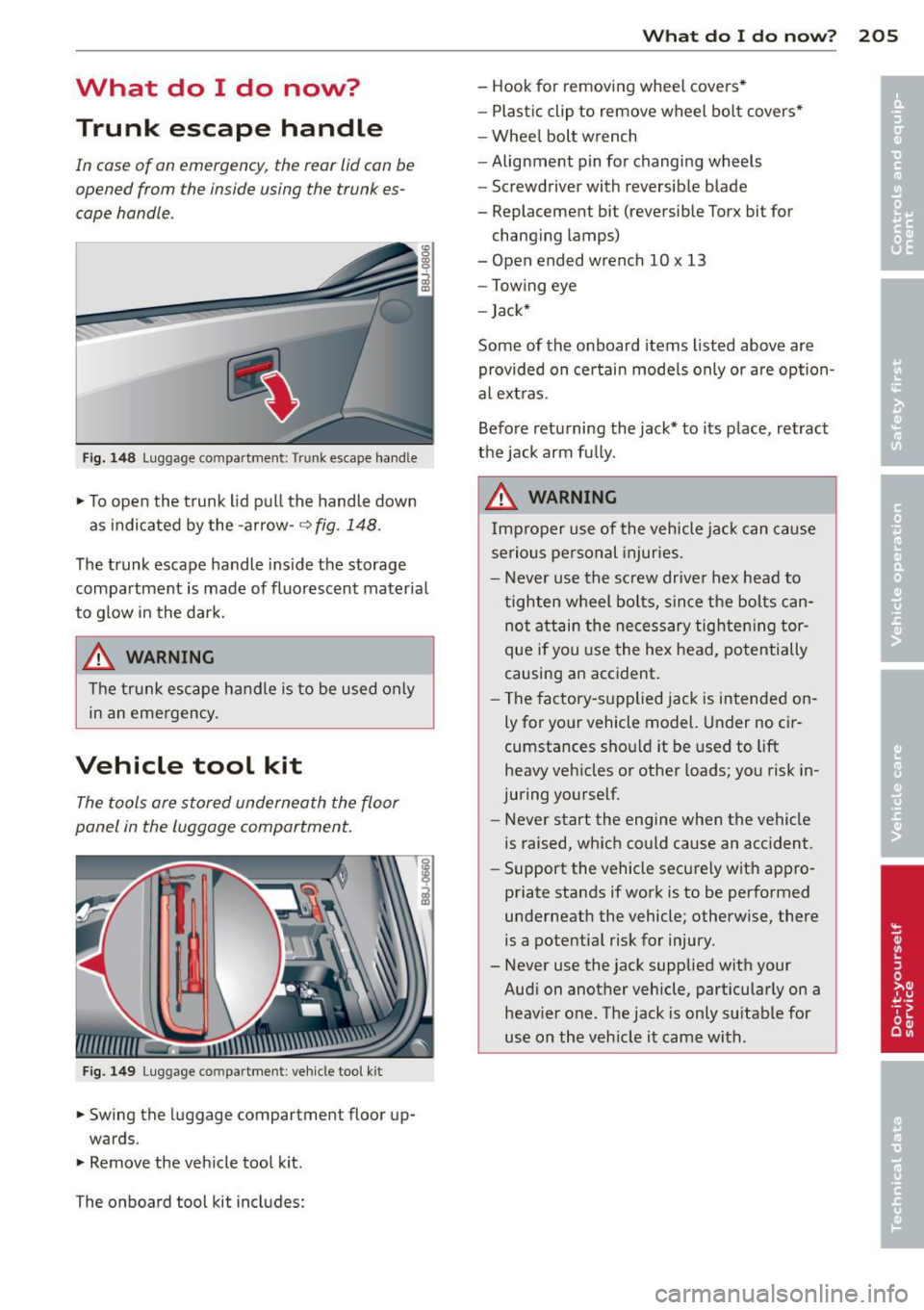
In case of an emergency, the rear lid can be
opened from the inside using the trunk es
cape handle .
Fig. 148 Luggage compa rtment: Tr unk escape handle
"' To open the trunk lid pu ll the handle down
as indicated by the -arrow-~
fig. 148.
The trunk escape handle inside the storage
compartment is made of fluorescent materia l
to g low in the dark.
& WARNING
The trunk escape handle is to be used only
in an emergency .
Vehicle tool kit
The tools ore stored underneath the floor
panel in the luggage compartment.
F ig. 1 49 Luggage co mpa rt ment : veh icle tool ki t
"'Swing the luggage compartment floor up
wards.
"' Remove the vehicle tool k it.
The onboard tool kit includes:
What do I d o now ? 205
- Hook for removing wheel covers*
- Plastic clip to remove wheel bo lt covers*
- Wheel bolt w rench
- Alignment pin for changing wheels
- Screwdriver with reversible blade
- Replacement bit (reversible Torx bit for changing lamps)
- Open ended wrench 10 x 13
- Towing eye
- Jack*
Some of the on board items listed above are
provided on ce rtain mode ls only or are option
al ext ras.
Before returning the jack* to its place, retract
the jack arm fu lly.
& WARNING
Improper use of the vehicle jack can cause
serious pe rsonal injuries .
- Never use the screw drive r hex head to
tighten wheel bo lts, since the bolts can
not attain the necessary tighte ning tor
que if you use the hex head, potentially
causing an accident.
- The factory-supplied jack is intended on
ly for yo ur vehicle model. Under no ci r
cumstances should it be used to lift
heavy veh icles or other loads; you risk in
juring yourself .
- Never start the engine when the vehicle
is raised, wh ich could cause an accident.
- Support the vehicle securely with appro
priate stands if work is to be performed
underneath the vehicle; otherwise, there
is a potential risk for injury.
- Never use the jack supplied with your Audi on another vehicle, particularly on a heav ier one . The jack is only suitable for
use on the veh icle it came with .