2014 AUDI S8 Child
[x] Cancel search: ChildPage 197 of 314

be su ppressed causing serious o r even
fatal injury to the child.
- If you must i nstall a rearward facing
child safety seat on the front passenger
seat because of exceptional circumstan
ces and the
PASS ENGER AIR BA G OFF
light does not come on an d stay on, im
med iately install the rear-facing child
safety seat in a rear seating position and
have the a irbag system inspected by you r
Audi dealer.
Installing the upper tether strap on the
anchorage
Fig. 187 Tether strap: prope r rout ing and mounting
Installing th e tether strap
• Release or dep loy the tether strap on the
child restra int according to the child re
stra int manufacturer's inst ruct ions .
• Gui de the upper tether strap
under the rear
head restraint
r=> fig. 187 (raise the head re
straint if necessary) .
• Center seating position* : Guide the upper
tether strap over the rear head restraint.
• Tilt the recess flap up to expose the anchor
bracket.
• Attach the tether strap anchorage hook into
the open ing of the tether anchorage .
• Pull on the tether strap hook so that the
spri ng catch of the hoo k engages.
• Tighte n the tet her st rap firmly following the
child restraint manufacturer's inst ruct ions .
Releasing the tether strap
• Loosen the tension following the ch ild re
stra int manufacturer's instructions.
• Depress the sp ring catch on the hook and re
l ease it from the anchorage.
Child S afety 195
(D Note
If you leave the c hild restraint with the
tether strap firmly installed for several
days, th is could leave a mark on the up
holstery on the seat cushion and backrest
i n the area where the tether strap was in
stalled. The upholstery would also be per manently stretched around the tether
strap. This app lies especia lly to leather
seats.
Using tether straps on rearward-facing
child restraints
Currently, few rear-facing child restraint sys
tems come with a tether. Please read and
heed the child restraint system manufactur
er's instructions carefully to determine how to
properly install the tether .
A WARNING ,.;; -
A child in a rearward-facing ch ild safety
seat installed on the fron t passenger seat
will be ser io usly injured and ca n be killed if
the front airbag inflates -even with an Ad
vanced Airbag System.
- The infla ting air bag will h it the ch ild
safety seat or i nfant carrier with great
force a nd will smas h the child safety seat
and child against the backrest, center
armrest, or door.
- A tight tether or other strap on a rear
ward-facing child restraint attached to
the front passenger seat can put too
muc h pressure on the weight-mat in the
seat and register a heavier weight in the
Advanced A irbag System. The heavier
weight regis tered can make the system
wo rk as tho ugh an adult we re on the seat
an d deploy the Advanced Airbag when it
m ust be s uppressed causing ser ious or
eve n fata l injury to the chi ld .
- If you must insta ll a rearward fac ing
child safety seat on the front passenger
seat because of exceptiona l circumstan
ces and the
PASSENGER AIR BAG OFF
Page 198 of 314

196 Child Safety
light does not come on and stay on, im
med iately install the rear-facing child
safety seat in a rear seating position and
have the a irbag system inspected by your
Audi dealer.
Additional Information
Sources of information about child
restraints and their use
There are a number of sources of additional
information about child restraint selection, in
stallat ion and use:
NH TSA advises that the best child safety seat
is the one that fits your child and fits in your
vehicle, and that you w ill use correctly and
consistently.
Try before you buy!
U.S National Highway Traffic Safety Admin
istration
Tel.: 1-888 -327-4236 ( TTY: 1-800-424-9153)
www.nhtsa.gov
National SAFE KIDS Campaign
Tel.: (202) 662-0600
www.safekids.org
Safety BeltSafe U.S.A
Tel.: (800) 745-SAFE (English)
Tel.: (800) 747-SANO (Spanish)
www.carseat .org
Transport Canada Information Centre
Tel.: 1-800-333-0371 or call
1-613-998-8616 if you are in the Ottawa area
http ://www .tc.gc.ca/eng/roadsafety/
menu.htm
Audi Customer Relations
Tel.: (800) 822-2834
Page 218 of 314

216 Vehicl e c are and cle aning
Vehicle care and
cleaning
General information
Regular, proper care helps to maintain your
vehicle 's value. It can also be a requirement
when subm itting warranty claims for corro
sion damage and paint defects on the body .
The required cleaning and care products can be obtained from your authorized Audi dealer
or a qualified workshop. Read and follow the
instructions for use on the packaging .
A WARNING
-Us ing cleaning and care products incor
rectly can be dangerous to your hea lth .
- Always store cleaning and care products
o ut of reach of children to reduce the r is k
of po ison ing.
@) For the sake of the environment
- Preferably use environmentally-friendly
products when buying cleaning agents .
- Do not d ispose of leftover cleaning and
ca re p rod ucts with household trash .
Car washes
-
The longer that deposits such as insects, bird
droppings , tree sap o r road salt rema in on the
ve hicle, the more the surface can be dam
aged. High temperatures such as those
caused by s unligh t increase the corrosive ef
fect.
Before washing, wet heavy deposits w ith p le n
ty of water.
A lso, wash the underside of your vehicle once
road salt stops be ing used for the season .
Pressure wa sher s
When washing your vehicles w ith a pressure
washer, always follow the operating instruc
tions provided w ith the pressure washer. Th is
is especially important in rega rd to the pres
sure and spray ing distance . Do not aim the
spray d irectly at seals on side w indows, doors, the hood, the
rear lid o r the sunroof* or at
tires, rubber hoses, insu lating material, sen
sors * or camera lenses* . Keep a d istance of at
least 16 inches (40 cm).
Do not remove snow and ice with a pressu re
washer .
Never use rota ry no zzles or high pressure noz
z les.
T he water temperature must not be above
140 °F (60 °C) .
Automatic car washes
Spray off the ve hicle before washing.
Make sure that the windows and roof * are
closed and the winds hield wipers are off . Fo l
l ow instructions from the car wash operator,
especially if there are accessories attached to
your vehicle.
If possible, use car washes that do not have
brushes .
Only use car washes where the vehicle re
mains stationary an d the washing equipment
moves aro und the vehicle when washing and
drying. Car washes that move the vehicle
t h rough the car wash using a chain are not
recommended.
Wa shing by hand
Clean the ve hicle starting from the top and
working down using a soft sponge or cleaning
brush. Use solvent-free clean ing products .
Washing vehicles with matte finish paint
by hand
To avoid damaging the paint when washing,
first remove dust and large particles from
your vehicle. Insects, grease spots and finger
pr ints are best removed with a spec ial cleane r
for matte finish paint .
Apply the product us ing a microfiber cloth. To
avo id damaging the paint surface, do not use
too much pressure.
Rinse the vehicle thoroughly with water. Then
clean using a neutral shampoo and a soft mi-
crofiber cloth. ..,.
Page 240 of 314

238 Check ing and filling
- The oil filler cap must be properly se
cured to prevent oil from being sprayed
on the hot engine and exhaust system
when the engine is running - fire hazard!
- If your skin has come in contact w ith the
engine oil, you must subsequently
cleanse it thoroughly .
(D Note
-Check the oil level. If the message
Pl ea se r educe oil le vel appears, contact
your authorized Audi dea ler or other
qualified workshop to have excess o il ex
tracted if necessary .
-Aud i do es not recommend the use of o il
addit ive s. They ma y damag e the engin e
and ad versely affect yo ur New Vehicle
Warrant y.
@, For the sake of the environment
- Under no circumstances can the oil come
in contact w it h the sewage network or
the soil.
- Observe and follow lega l regulations
when disposing of empty oil containers.
Changing the engine oil
We recommend that have your oil changed by
an authorized Audi dealer or a qualified serv
ice station .
Before you check anything in the engine com
partment,
al ways read and h eed all WARN
INGS c::> &. in Working in the engine compart
ment on page 231.
The engine oil must be changed according to
the intervals spec ified in your Warra nty
&
Maintenance book let . This is very important
because the lubricating prope rties of oil di
minish gradua lly dur ing normal veh icle use .
Under some c ircumstances the eng ine o il
should be changed more frequently . Change
oil more often if you drive most ly short dis
tances , operate the vehicle in dusty areas or
under predominantly stop-and-go traffic con
ditions , or have your vehicle where tempera -tu res remain below freezing for extended pe
riods.
Detergent additives in the oil will make fresh
o il look dar k after the engine has been run
ning for a sho rt time. This is normal and is not
a reason to change the oil more oft en than
recommended.
Because of the problem of proper disposal,
along with the specia l tools and necessary ex
pertise required, we strongly recommend that
you have your oil changed by an authorized
Aud i deale r or a qualified service station.
If yo u choo se to chan ge your o il yours elf ,
please note the fo llowing important informa
t ion:
A WARNING
To reduce the risk of personal injury if you
must change the eng ine oil in your vehicle
yourself:
- Wear eye protect ion.
- To reduce the risk of burns from hot en-
gine oil, let the engine cool down to the
touch.
- When removing the oil dra in p lug with
your fingers, stay as far away as possible.
Always keep your forearm parallel to the ground to help prevent hot oil from run
n ing down you r arm.
- Dra in the oil into a container designed
for this purpose, one large enough to hold at least the tota l amount of o il in
your engine .
- Engine oil is poisonous . Keep it well out
of the rea ch of children.
- Continuous contact with used eng ine o il
is harmful to your sk in . Always protect
your skin by washing oil
off tho roughly
wit h soap and wate r.
(D Note
Neve r mix oil additives with you r engine
oi l. These additives can damage your en
gine and adversely affect your Audi Limit
ed New Veh icle War ranty.
Page 243 of 314

~ Place a thick rag over the coolant expansion
tank
¢ page 240, fig . 204 and car efull y
twist the cap counter-clockwise ¢ ,A.
~ Add coolant mixed in the correct ratio
¢ page 239, Coolant.
~ Tw ist the cap on again tightly .
Replacement engine coolant must conform to
exact specifications ¢
page 239, Coolant .
We recommend using on ly coolant additive
G12 ++, G 13 or in an emergency G12 +. Do
not
use a different additive. In an emergency use
pla in water until you can get the correct addi
tive and can restore the correct ratio. This
should be done as soon as possible .
If you have lost a considerable amount of
coolant, then you should add co ld antifree ze
and cold water only when the eng ine is co ld.
A lways use
new engine coolant when ref illing.
D o not fill coolan t above the "M AX " mar k. Ex
cess coolan t will be forced ou t th rough the
p ress ure re li ef va lve in the cap when the en
gine becomes hot .
&_ WARNING
- The coo ling system is under press ure and
can get very hot. Reduce the risk of
sca ld ing from hot coolant by f ollowing
these steps .
-Tu rn off the engine and a llow i tto cool
down.
- P rotec t your f ace, hands an d ar ms from
escaping f lu id and ste am by cover ing
the cap with a large, thick rag.
- Tu rn the ca p slowly and very ca re fully
in a counte r-clockwise d irect ion while
app ly ing light, downwa rd p ress ure on
the top of the cap.
- To avo id being burned, do not sp ill an
tifreeze or coolant on the exhaust sys
tem or hot engine parts . Under certa in
conditions, the ethylene glyco l in en
g ine coolant can catc h fire.
- Antifreeze is poisonous. Always store an
t ifreeze in its or iginal container and well
o ut of the reac h of children .
Checkin g and fillin g 241
-If you dra in the coo lant, it m ust be
caught and safely stored in a pr oper con
tainer clearly marked "poison".
([) Note
-Coo lant poll utes the environment and
co uld cause an engine fi re . Excess cool
ant will be forced out th ro ugh the pres
sure relief valve in the cap when the en
gine becomes hot .
- If, in an eme rgency, only wate r can be
added, the correct ratio between water
and antifreeze ¢
page 239 must be re
stored as soon as poss ible .
@) For the sake of the environment
Drained coola nt should not be reused. A l
ways d ispose of used coolant while observ
i ng all env iro nmental regula tions .
Radiator fan
The radiator fan switches on automatically by
itself .
The rad iator fan is dr iven by the engine via the
V-belt. The viscous clutch regulates the speed
of the fan acco rding to the temperature of the
coolant .
An auxiliary electric radiator fan* sw itches on
and off depending on coolant temperature
and othe r vehicle operat ing cond it io ns.
After you switch the engine off, the aux iliary
fan can continue running for up to 10 m inutes
- even w ith the ignition off . It can even switch
o n aga in later by itself¢
A, if
- the temperature of the engine coo lant rises
due to the heat build- up from the engine in
the engi ne compa rtment, or
- the engine compa rtment heats up because
the vehicle is parked in intense sunlig ht.
&_ WARNING
- To reduce the risk of perso nal inj ury nev-
er touch the radiator fan .
II>-
•
•
Page 244 of 314
242 Checking and filling
-The auxiliary e lectric fan is temperature
controlled and can switch on suddenly
even when the engine is not runn ing.
- The auxiliary radiator fan switches on au
tomatically when the engine coolant
reaches a certain temperature and will
continue to run until the coolant temper
ature drops .
Brake fluid
Checking brake fluid level
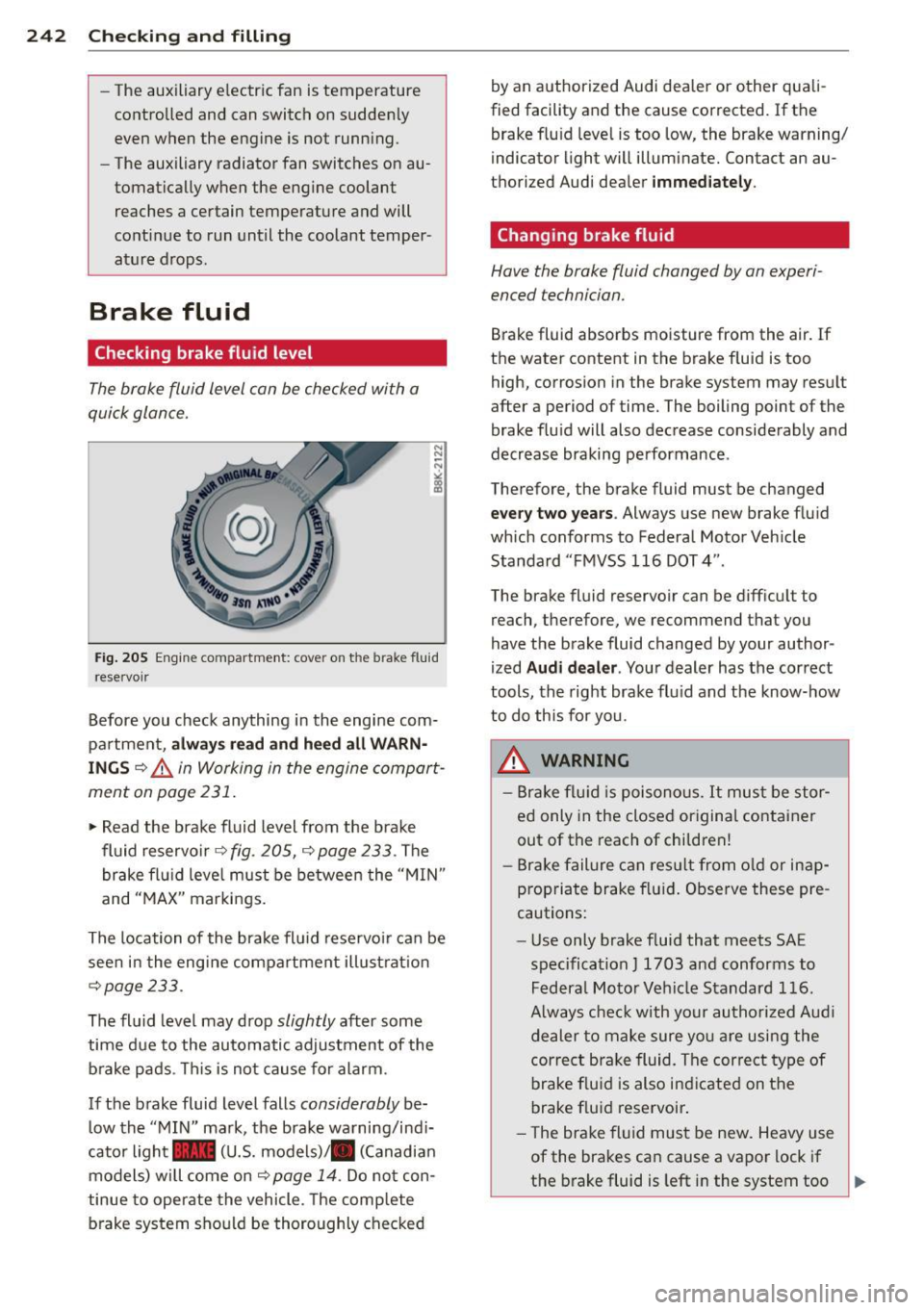
The brake fluid level can be checked with a
quick glance.
Fig . 205 E ng ine co mpartment: cove r on the brake fluid
r eservo ir
Before you check anything in the engine com
partment,
always read and heed all WARN
INGS 9 &_ in Working in the engine compart
m ent on page 231.
.. Read the brake fluid level from the brake
fluid reservoir
9 fig . 205, q page 233. The
brake fluid leve l must be between the "MIN"
and "MAX" markings.
The location of the brake fl uid reservoir can be
seen in the engine compartment illustrat ion
9 page233.
The fluid level may drop slightly after some
time due to the automatic adjustment of the
brake pads. This is not cause for alarm.
If the brake fluid level falls
considerably be
low the "MIN" mark, the brake warning/ind i
cator light
1111 (U.S. models)/ . (Canadian
models) will come on
q page 14. Do not con
tinue to operate the vehicle . T he complete
brake system should be thoroughly checked by an authorized Audi dealer or other quali
fied fac ility and the cause corrected.
If th e
brake flu id level is too low, the brake wa rning/
indicator light will illuminate. Contact an au
thorized Audi dealer
immediately.
Changing brake fluid
Have the brake fluid changed by on experi
enced technician.
Brake fluid absorbs moisture from the air. If
the water content in the brake fluid is too
high, corrosion in the brake system may result
a fter a period of time. The boiling point of the
brake fluid will also decrease considerably and
decrease braking performance .
Therefore, the brake fluid must be changed
every two years. Always use new brake flu id
which conforms to Federal Motor Veh icle
Standard "FMVSS 116 DOT 4" .
The brake fluid reservoir can be difficu lt to
reach, therefore, we recommend that you
have the brake fluid changed by your author
ized
Audi dealer . Your dealer has the correct
tools, the right brake fluid and the know-how
to do this for you .
.&, WARNING
-Brake fluid is poisonous. It must be stor
ed only in the closed origina l container
out of the reach of children!
- Brake failure can result from old or inap
propriate brake fluid. Observe these pre
cautions:
- Use only brake fluid that meets SAE
spec ification
J 1703 and conforms to
Federa l Motor Vehicle Standard 116.
Always check with your authorized Aud i
dealer to make sure you are using the
correct brake fluid. The correct type of
brake fluid is also indicated on the
brake fluid reservoir .
- The brake fluid must be new. Heavy use
of the brakes can cause a vapor lock if
the brake fluid is Left in the system too
lllJ.
Page 246 of 314
24 4 Ch eck ing and filling
Th e following WARNINGS are v ery
impo rtant when w ork ing on the b att ery :
Alway s heed t he fo llowin g WARNING SYM ·
BOLS and s afety pr ecaution s wh en w orking
on the batter y.
®
Always wear ey e prot ection .
~
Batte ry a cid contains sulfuric acid .
Al way s w ea r glo ves and e ye prote c-
tion .
@
No
· spa rks
- fl ame s
- sm oking.
~
Wh en a batt ery is c harge d, it p rodu-
c e s hy drog en g as whi ch i s e xplo siv e
a nd c ould c ause persona l injury.
®
Alway s keep the b attery well o ut of
reach of childr en .
.8, WARNING
Whenever working on the battery or on
the electrical system, there is the r is k of
inju ry, acc ident and even fire. Read and
heed the following WARNINGS:
- Always wea r eye protection. Do not let
battery acid or any lead part icles get on
yo ur skin or clothing. Shield your eyes.
Explosive gases can cause blindness or
other injury.
- Battery acid contains sulfuric acid. Sulfu
ric acid can cause blindness and severe
burns.
- Always wear gloves and eye p rotection .
Do not tilt the battery because ac id
could lea k out of the vent ilation open
ings.
- I f you get battery acid in your eyes or
on your sk in, immediately rinse with
cold water for severa l m inutes and get
medical attention.
- If you should ingest any battery acid,
seek medical attention immediately .
- Do not expose the battery to an open
flame, electric sparks or an open light .
- Do not smoke. -
Do not interchange the positive and neg
ative cables.
- When working on the battery, be s ure
not to short-circu it the terminals with
too ls or other metal objects. This would
cause the battery to heat up very quickly,
which could lead to damage or explosion and pe rsonal injury.
- When a battery is charged, it produces
hydrogen gas which is explosive and
could cause personal in jury.
-Always keep the battery well out of the reach of children.
- Before work is done on the electrical sys
tem, disconnect the negat ive ground ca
b le.
- Before performing any work on the elec trical system, switch off the engine and
ignit ion as well as any electrical equip
ment. The negative cable on the battery
m ust be disconnected.
If yo u are just go
ing to replace a light bulb, then it is
enough to switch off the lights .
- Before disconnec ting the bat tery, switch
off the anti -theft alarm system! Other
wise you wi ll set off the alarm.
- When disconnecting the battery, f irst
disconnect the negative cab le and then
the positive cab le .
- Before reconnecting the battery, ma ke
sure all e lectr ica l consumers are sw itch
ed off . Reconnect the positive cable first
and then the negative cable. Never inter
change the cables· this could start a fire!
- Never charge a frozen or a thawed-out
battery. It could exp lode! If a battery has
frozen, then it must be replaced. A dis
charged batte ry can freeze over at 32 °F
(0 °() .
-Make sure the vent hose is always attach
ed to the opening on the s ide of the bat
tery .
- Never use batteries which are damaged.
There is the danger of an explosion! Al ways rep lace a damaged battery .
Page 299 of 314

A
A/C (automatic climate control) . ... .. .. 80
ABS
refer to Anti-lock braking system .. .. . 199
Accessories .. ............. .... .. ... 294
Adapt ive a ir s uspension/sport .. .. .. .. . 110
Adapt ive cruise control ......... .... ... 94
C leaning the sensor .......... .... .. 217
M essages .. ............. .... .. ... 10 1
Request for drive r in terven tion .. .. .. .. 99
S top-and-go traffic ....... .. .. .. .. .. 98
Adapt ive Lig ht (defect ive) .... ... . ... .. 22
AdBlue . ... .. .. .. .. .. .... ... .. .. ... 227
F il ling . .. .. .. ............. .. .. ... 229
Messages in the instrument cluster dis-
p lay ... .. .. ................. .. ... 228
Adding Engine coolant . ... .... ... .. .. .. ... 240
Eng ine oi l .. ............. .... .. .. . 237
W indshield washer fluid . .. .. .. .. .. . 247
Add it ives
Eng ine oil . ..... ...... ... .. .. .. ... 237
Adjustab le steer ing column .. .. .. .. .. .. 83
Ad justing
A ir distribution (automatic climate con-
trol) . .. .. .. .. ........ ... .. ... ... .. 81
Front seats . . . . . . . . . . . . . . . . . . . . . . . . 58
Instrument illum inat ion .... ... ... ... 51
Steer ing colum n .......... .. .. .. .. .. 83
Temperatu re (automat ic climate co ntrol) 8 1
Airbag system . . . . . . . . . . . . . . . . . 153 , 172
Advanced A irbag System ....... . ... . 157
Advanced Airbag System components . 160
Ca re . .. .. .. .. .. ........... .. .. ... 166
C hildr en . .. ............. .... .. ... 178
Ch ild restra ints ........... .... .. .. . 179
Components (front airbags) . ... .. ... 160
Danger of fitting a child seat on the front
passenger seat . . . . . . . . . . . . . . . . . . . . 155
Disposal . .. .. ........... .. .. .. ... 166
Front airbags . . . . . . . . . . . . . . . . 157, 158
H ow do the front airbags work? . ..... 162
H ow many airbags does my vehicle
h ave? ... .. .. ........ ... .. ... ... . 160
H ow the Advan ced Airbag Sys tem com-
ponents wor k toge ther .... .. .. .. .. . 16 1
Inde x 297
Important sa fety inst ruct ions on the
knee airbag system .. ... .... ... .. .. 170
Important t hings to know .... ... .. .. 153
Knee a irbags . .. .. ................. 168
Monitoring .. .. .. .... ............. 164
PASSENGER AIR BAG OFF light ....... 164
Repa irs ... .. .. .. .. . .. .... .... .. .. 166
Safety instr uctions .. .............. . 166
S ide a irbags . .. .. .. . .............. 171
S ide cur tain airbags ............ .. .. 17 4
Warning/ind icator lights ..... ... .. .. . 18
Wa rning/Indicato r lights .... ... .. .. 164
Weight -sensing mat . ... .... ... .. .. 178
When must the system be inspected? 164
A ircraft
T ranspo rting yo ur vehicle
Alcanta ra 2
87
Cleaning ........ .. ............... 219
A ll Wheel Drive .. .. .... ............. 204
Winter tires . .. .. .. ............... 263
Alternator
refer to Gene rator . .. .. ..... ... .. .. . 16
Amb ience light ing ... ... ..... ... .... . SO
Anti-freeze
refer to Eng ine coolant ............. 239
Anti -lock b raking system . ..... ... .. .. 199
Warning/indicator lights . . . . . . . . . 18, 19
Ant i-s lip regu lation .... ......... .. .. 199
W arning/ind icator lights ........ .. .. . 18
Anti-theft systems Electronic immob ilizer ............. .. 32
ASR
refer to Anti-slip regulation 199
Audi braking gu ard
refer to Braking gua rd .. ..... ... .. .. . 94
Audi drive selec t
refer to Drive se lect . .............. . 110
Audi Serv ice Repair Manuals and Litera-
ture ..... .. .. .. .. .. ............... 292
A UTO
Automatic climate contro l .... ... .. .. . 80
A utomat ic head lights ....... ... .. .. . 46
A uto Lock .. .. .. .. ................. . 33
Automat ic be lt retractor ............. 148
Automatic climate control Air vents . ... .... .. . .. .. ..... ... .. . 81
Automat ic recirc ulation ............. . 82
•
•