2014 AUDI S7 air condition
[x] Cancel search: air conditionPage 203 of 306

overheat, premature wear and increased
stopp ing distance.
- Under certain climatic and operating
conditions such as passing through wa
ter, driving in heavy rain or after wash ing
the vehicle, the effect iveness of the
brakes can be reduced. In winter, ice can
accumulate on the brake pads, linings,
discs and drums. Carefully apply brakes
for a test. Brakes will dry and ice coat ings will be cleaned off after a few ca re
f ul brake applications.
- Driv ing for an extended period of time on
salt-covered roads w ithout using your
brakes can also affect braking efficiency.
Clean off accumulated salt coating from
brake discs and pads w ith a few caref ul
brake applicat ions.
- If you damage the front spoiler, or if you
install a different spoiler, be sure the air
flow to the front brakes is not obstruct ed. Otherwise the brake system could
overheat reducing the effectiveness of
the ent ire brake system.
- Failure of one brake c ircuit will impair
the braking capability resulting in an in
c reased stopp ing distance. Avoid driv ing
the vehicle and have it towed to the near
est Aud i dea ler o r q ualified workshop.
- Never let the vehicle roll to a stop w ith
the engine shu t off.
- If the brake booster is not work ing, the
brake pedal must be pressed conside ra
bly harder to make up for the lac k of
booster assistance.
Electro-mechanical
power assist
The electro-mechanical power assist helps
the driver when steering.
Powe r steering adapts electronically based on
the vehicle speed.
Indicator lights and message s
• Steerin g defective! Stop th e vehicle
Int ellig ent technolog y 201
If this indicato r light turns on and stays on
and t his message appears, the power steering
may have failed.
Do
not con tinue dr iv ing . See your au thor ized
Audi dealer or other qualified repair facility
for assistance .
'I-Y Steering: System malfun ction! You may
c ontinue dri ving
If the indicato r light turns on and the mes
sage appea rs, the stee ring may be more diffi
c ult to move o r more sens itive than usual.
Drive slowly to your authorized Aud i dealer or
qualified workshop to have the ma lfunction
corre cted.
0) Tips
If the . or 1:z;lj indicator light on ly stays
on for a short t ime, yo u may continue dr iv
i ng.
Driving with your
quattro
App lies to veh icl es: w ith all-w hee l drive
With all-wheel drive, all four wheels are driv
en.
General information
Wi th a ll W heel Drive, power is distributed to
all four wheels . This happens automatically
depending on your driving style and the road
conditions at the time . See also
~ page 196.
With the sport different ia l* , power distribu
tion to the rear wheels is variable and can be
adjusted with Audi dr ive select*
~ page 102.
Always read and follow safety precautions
~ .&. .
Winter tires
When dr iving in the winter, yo ur vehicle with
all-wheel drive has an advantage, even wit h
regular tires . In winter road conditions it may
be advisable to mount winter tires (or all-sea
son tires) for improved driveability and brak
ing: these tires must be moun ted o n
all four
wh eel s.
See also~ page 258, Winter tires. ..,.
•
•
Page 207 of 306

Catalytic converter
Applies to vehicles: with gasoline engine
It is very important that your emission con
trol system (catalytic converter) is function
ing properly to ensure that your vehicle is run
ning in an environmentally sound manner .
... Always use lead-free gasoline c::> page 218,
Fuel supply .
... Never run the tank down all the way to emp
ty .
... Never put too much motor oil in your engine
c::> page 232, Adding engine oil
The catalytic converter is an eff icient "clean
up" device built into the exhaust system of
the vehicle. The catalytic converter burns
many of the pollutants in the exhaust gas be
fore they are released into the atmosphere.
The exclusive use of unleaded fuel is cr it ically
i mportant for the life of the cata lytic convert
e r and proper functioning of the engine.
& WARNING ,~
T he temperature of the exhaust system is
high, both when driving and after stopping
the engine .
- Never touch the exha ust tail pipes once
they have become hot. This could result
in burns.
- Do not park or operate the vehicle in
areas where the hot exhaust system may
come in contact with dry grass, brush,
fuel spill or other material which can
cause a fire.
- Do not apply additional undercoating or
rustproofing on or near the exhaust
manifold, exhaust p ipes, catalytic con
verter or heat shields . During driving, the
substance used for undercoating cou ld
overheat and cause a fire.
(D Note
- Be aware that just one tank f illing with
leaded fuel will already seriously de-
grade the performance of the catalytic
conve rter.
Dri vin g and en vironm ent 205
-Do not exceed the correct engine oil level
c::>page 232.
-Do not drive until the fue l tank becomes
completely empty. The engine cou ld mis
fire . Unburned fuel could also get into
the exhaust system and this cou ld cause
the catalytic converter to overheat.
- Do not switch off the ignition while the
vehicle is mov ing .
- Do not continue to operate your veh icle
under these conditions, as otherwise fuel
can reach the catalyt ic converter. Th is
cou ld result i n overheating of the con
verter, requir ing its replacement.
- To assure efficient operation of the Emis
sion Control System:
- Have you r vehicle main tained properly
and in accordance w ith the se rv ice rec
ommendations in your Warranty & Maintenance book let.
- Lack of proper maintenance as we ll as
improper use of t he vehicle wi ll impair
the function of the emission cont ro l
system and could lead to damage.
@) For the sake of the env ironment
Even when the Emission Control System is
ope rat ing properly, the exhaust gas can
have a sulfur-like exhaust gas smell under
some operat ing states. This depends on
the sulfur content of the fuel being used .
Using a different brand of fuel may help,
or filling the tank with lead-free s uper
g rade gasoline.
Diesel particulate filter
App lies to vehicles: wit h diese l eng ine
The diesel part iculate filter filters nearly all of
the soot pa rticles out of the exhaust . T he fil
te r clea ns itself automat ica lly unde r no rma l
driv ing cond itions. If the filter cannot clean it
self (for example, because you are on ly driving
sho rt distances), the filter becomes clogged
with soot and the
Ill symbo l for the diesel
particulate filter i lluminates
c::> page 22. ..,_
•
•
Page 222 of 306

220 Fuel supply and filling your fuel tank
Winter operation
At temperatures below 20° F (-7° C), Diesel
fuel No.
2 loses its fluidity due to wax separa
tion, which may clog the fuel filter or tank fil
ter and keep the engine from running .
To help the filter from being clogged by wax,
the fue l filter in your vehicle is automatically
preheated. Preheating the fuel filter makes
operation of your vehicle possible with Diesel
fuel No. 2 down to -10° F (-24° C).
If you expect temperatures below
5° F
(-15° C)
ask your fuel dealer whether their
Diese l fuel No.
2 is sufficiently winterized for
the prevailing and expected temperatures.
If not winterized or insufficiently winterized
Diesel fuel has already thickened to the extent
that the engine will not start, warm the vehi
cle up by leaving it in a heated garage.
It is normal that the engine noise leve l (die
seling) is louder during the warm-up period in
winter. It is also norma l when whitish-blue
smoke comes out of the tailpipe after starting
and during warm-up . The amount of smoke
depends on the outs ide temperature.
Do not let your Diese l engine idle unnecessari
ly after a cold start. Driving off slowly will
shorten the warm-up period.
A WARNING
- Never use "starting assist fluids." They
may be potent ially explosive or cause a
"run-away" engine condition. This could
result in ser ious engine damage and per
sonal injur y.
- Never use fuel line anti-freeze offered for
gasoline engines.
(D Note
- Your Diesel engine has been specifically designed to operate only on Ultra Low
Sulfur Diesel fuel. Therefore, never use
home heating oil or regular gasoline. The
properties of these fuels may cause seri
ous damage to the fuel injection system
and to the engine. Using these fuels can
-
cause expensive engine repairs and will
also adversely affect your New Vehicle
Limited Warranty.
- If Diesel fuel sho uld get on any rubber
hose, it must be wiped off immediately.
Then wash the contaminated hose por
tion with soap and warm water. Do not allow D iesel fuel to remain on connect
ing hoses . They may develop leaks and
cause serious damage.
Fuel tank
Fuel filler neck
The fuel filler neck is located on the right rear
side panel behind the fuel filler flap.
If the power locking system shou ld fail, you
can still open the flap manua lly -for detailed
instructions see
¢ page 223.
You can find the fuel tank capacity of your ve
hicle in
¢ page 283.
The label on the inside of the fuel filler flap
te lls you the correct fuel for your vehicle. For
more information about fuel specifications,
see
¢ page 218.
Your vehicle fuel tank has an on board refuel
ling vapo r recovery system. This feature helps
to prevent fue l vapors from escaping from the
tank and polluting the environment while you refuel your vehicle. In order to fi ll the tank
proper ly while protecting the environment,
please fo llow this refueling procedure careful
ly.
A WARNING
-Under normal operating conditions, never
carry addit ional fuel conta iners in your car .
Gas canisters and other conta iners used to
transport fuel can be dangerous. Such con
tainers, full or empty, may leak and could
cause a fire in a collision.
If you must
transport fuel to use for your lawn mower,
snow blower, etc., be very careful and al
ways observe loca l and state laws regard
ing the use, transportation and storage of
such fuel containers. Make certain the ..,.
Page 232 of 306
230 Check ing and filling
Mo dern engine lubrication has taken a quan
tum leap in the last few years. Many synthetic
oils ava ilable today provide better engine lu
brication that can outlast traditional petrole
um-based oils, making them a smart choice
for use throughout the life of your Audi .
Whether you use synthetic or petroleum
based engine oil, the oil that you use must
conform to Audi 's oil quality standard
VW 502 00 (vehicles with gasoline engine) or
VW 507 00 (veh icles with diesel engine) to
he lp keep your vehicle's eng ine running
smoothly and help prevent the fo rmation of
harmf ul depos its , somet imes ca lled "sludge,"
that over t ime can lead to expensive repairs.
At the time of printing , engine oils availab le in
the U .S . and Canada that meet the exacting
specifi cations of A udi oi l st andard VW 502 00
(vehicles wi th gasoline engine) or VW 507 00
(vehicles with diesel engine) are synthetic en
gine oils . This does not mean, however, that
every synthetic engine oil will meet Aud i oil
standard VW 502 00 (vehicles with gaso line
engine ) or VW 507 00 (veh icles w it h diese l
engine). So always be sure that you use an ap
proved oil.
To help prevent the format ion of harmful de
posi ts use only oi l with the fo llow ing spec ifi
cations printed on the oil containe r:
- Aud i oil standard VW 50 2 00 (ga soline en
gine )
- Audi oil sta nd ard VW 50 7 00 (diesel en -
gine )
Oil container labe ls may carry the specif ica
tion s ingly or i n comb ination with other desig
nations and oil q ua lity standards.
Visco sity
Eng ine oi ls are graded according to thei r vis
cosity. The prope r viscosity grade oil for your
engine depends on climac tic or seasonal con
d itions whe re you drive. You can use oi l w ith a
viscosity g rade of SAE 5W40 across all tem
perat ure ranges for normal driving conditions .
H oweve r, if eng ine o il viscos ity grade
SAE 5W40 is not av ailable, you can a lso use viscosity grade SAE 5W-30 or SA
E OW-40 as
l ong as it meets Audi oil quality standard
VW 502 00 (veh icles with gasoline engine) or
VW 507 00 (vehicles with d iesel eng ine) spec
ifications.
Beca use engine oi l that meets the Audi oil
standard may not be availab le everywhere
when you need it, we strong ly recommend
that you a lways carry with you an ex tra qua rt
( li ter) of oil that express ly conforms to the
VW 502 00 (veh icles with gasoline engine) or
VW 507 00 (vehicles w ith d iese l eng ine) spec
ifica tion , in case you have to top off the oil
wh ile on t he road.
Applies to vehicle s with gasoline engine on
l y:
Only if the level of the o il is at or be low the
min imum ma rk on the o il dipstick - and no oi l
t h at expressly conforms to A udi o il standard
VW 502 00 spec ificat ions is available -may
yo u top off with a high quality engine oi l, pre f
erab ly synthetic-based, that meets ACEA A3
or AP I SM spec ificat ions, but even then, only
in v iscosity grades SAE 5W-40, SAE 5W-30, or
SAE OW-40. However, during the ent ire time
betwee n oil change intervals, never top off
with more than a total of 0 .5 qt/liter engine
o il that does not conform to Audi o il specifica
t ion VW 502 00.
Applies to vehicle s with die sel engin e only:
Only if the level of the oil is at or below the
min imum ma rk on the o il dipstick - and no o il
t h at expressly conforms to Audi o il standard
VW 507 00 spec ificat ions is available -may
you top off with a high quality engine oil, that meets ACEA C3 or API CF specifications, but
even then , on ly in viscosity grades SAE
5W-40, SAE 5W-30, or SA E OW-40 . However,
during the entire time between o il change in
terva ls, never top off wi th more than a total
of 0 .5 qt/liter engine oil that does not con -
fo rm to Aud i oil spec ification VW 50 7 00 .
For more info rmation about eng ine oi l that
has been approved for your veh icle, please
contact e ither your authorized Aud i dealer o r
Audi C ustome r Re lations at 1 (800) 822-2834
o r vis it our web site at www.audiusa .com or
www.aud icanada .ca. He re you w ill also find a .,.
Page 233 of 306

current list of oils (manufacturers, brand
names etc.) that conform to Audi oil standard
VW 502 00 (vehicles with gasoline engine) or
VW 507 00 (vehicles with diesel engine).
C hanging the engine oil
The engine oil and oil filter must be changed
according to the mileage (kilomete rs) and
time intervals specified in your vehicle's War
ranty
& Maintenance booklet. Do not exceed
these intervals -harmful deposits from old
engine oil can reduce engine performance and
can lead to expensive engine repairs .
Changing the oil at the recommended inter
vals is so very important because the lubricat
ing properties of oil decrease gradually during
normal vehicle use. If you are not sure when
you have your oil changed, ask your author
ized Audi Service Advisor .
Under some circumstances the engine oil
should even be changed more frequently .
Change oil more often if you drive mostly
short distances, operate the vehicle in dusty
areas or mostly under stop-and-go traffic con
ditions, or when you use your vehicle where
temperatures stay below freezing point for long periods.
Detergent addit ives in the oil will make fresh
oil look dark after the eng ine has been run
ning for a short time. This is normal and is not
a reason to change the oil more often than
recommended.
Damage or malfunctions due to lack of
maintenance
It is essential that you change your oil at the
recommended intervals using only engine oil
that complies with Audi oil standard
VW 502 00 (vehicles with gasoline engine) or
VW 507 00 (vehicles with diesel engine). Your
Limited New Vehicle Warranty does not cover
damage or malfunctions due to failure to fol
low recommended maintenance and use re
quirements as set forth in the Audi Owner's
Manual and Warranty
& Maintenance booklet.
Your dealer will have to deny warranty cover
age unless you present to the dealer proof in
Checking and filling 231
the form of Service or Repair Orders that all
scheduled maintenance was performed in a
timely manner.
Engine oil consumption
The engine in your vehicle depends on an ade
quate amount of oil to lubricate and cool all
of its moving parts.
In order to provide effective lubrication and
cooling of internal engine components, all in
ternal combustion engines consume a certain
amount of oil. Oil consumption varies from engine to engine and may change significantly
over the life of the engine. Typically, engines
with a specified break-in period (see ¢
page 204) consume more oil during the
break-in period than they consume after oil
consumption has stabilized.
Under normal conditions, the rate of oil con
sumption depends on the quality and viscosity
of the oil , the RPM (revolutions per minute) at
which the engine is operated, the ambient
temperature and road conditions . Further fac
tors are the amount of oil dilution from water
condensation or fuel residue and the oxida
tion level of the oil. As any engine is subject to
wear as mileage builds up, the oil consump
tion may increase over time until replacement
of worn components may become necessary .
With all these variables coming into play, no
standard rate of oil consumption can be es
tablished or specified. There is no alternative
to regular and frequent checking of the oil lev
el, see
Note .
If the yellow engine oil level warning symbol
in the instrument cluster
II! lights up, you
should check the oil level as soon as possible
¢
page 232. Top off the oil at your earliest
convenience
9 page 232.
.&, WARNING
Before you check anything in the engine
compartment, always read and heed all
WARNINGS ¢.&.
in Working in the engine
comportment on page 22
7.
-
•
•
Page 240 of 306

238 Checking and filling
@ For the sake of the environment
Because of the problem of proper disposal
of brake fluid as we ll as the special tools
required and the necessary expertise, we recommend that you have the brake fluid
changed by your author ized Audi dealer.
Battery
General information
Under normal operating conditions, the bat
tery in your Audi does not need any mainte
nance. With
high outside temperatures or
long daily drives we recommend that you have
the electro lyte level checked by a service fa
cility . The electrolyte level should also be
checked each time the battery is charged
<=:> page 240.
Have the battery checked when you take your
vehicle in for service . You are well adv ised to
replace a battery that is older than 5 years .
With certain types of airbag deployment, the battery is disconnected from the vehicle elec
tr ical system for safety reasons
c::> & in Re
pair, care and disposal of the airbags on
page 165.
Disconnecting the battery terminals
Some vehicle functions (power window regu
lators, for example) are lost if the battery ter
minals are disconnected. These functions have
to be relearned after the battery terminals are
connected again. To prevent this , the battery
should only be disconnected from the vehicle
e lectrica l system when absolutely necessary
for repairs.
Vehicles not driven for long periods
If you do not drive your vehicle over a period
of severa l days or weeks, electrical compo
nents are gradually cut back or switched off.
This reduces energy consumption and main
tains starting capability over a longer period
c::> page 202. Some of the convenience func
tions may not operate, such as the interior
lights or power seat adjustment. The conven- ience
functions will be available again when
you switch on the ignition and start the en gine.
Winter operation
During the winter months, battery capac ity
tends to decrease as temperatures drop. This
is because more power is a lso consumed whi le
starting, and the headlights, rear window de
fogger, etc., are used more often.
Avoid unnecessary power consumption, par
ticularly in city traffic or when traveling only
short distances. Let your authorized Audi
deale r check the capacity of the vehicle bat
tery before winter sets in
c::> page 240 . A well
charged battery will no t only prevent star ting
problems when the weather is cold, but will
also last longer .
@ Tips
If your vehicle is left standing for several
weeks at extremely low temperatures, the
vehicle battery should be removed and
stored where it w ill not freeze. This will
prevent it from be ing damaged and having
to be replaced .
Working on the battery
Be especially careful when working on or near
the battery.
The battery is located in the luggage compart
ment under the floor . Before you check any
thing in the luggage compartment,
read and
heed all WARNINGS
c::> .&,.
Always heed the safety warnings , when work
ing on the vehicle battery or the vehicle elec
trical system to prevent injury.
The following WARNINGS are very
important when working on the battery:
Always heed the following WARNING SYM-
BOLS and safety precautions when working
on the battery.
®
Always wear eye protection.
Page 250 of 306
248 Tires and wheels
Bear in mind that the tire press ure monitoring
system* can only monitor the tire pressures
you have stored . The system does not recog
n ize the load condit ion of yo ur vehicle.
T he effectiveness of the tire p ressu re monitor
ing system * will be impaired if you store nor
mal load pressures but the n operate the vehi
cle at its max imum load
c:> &. .
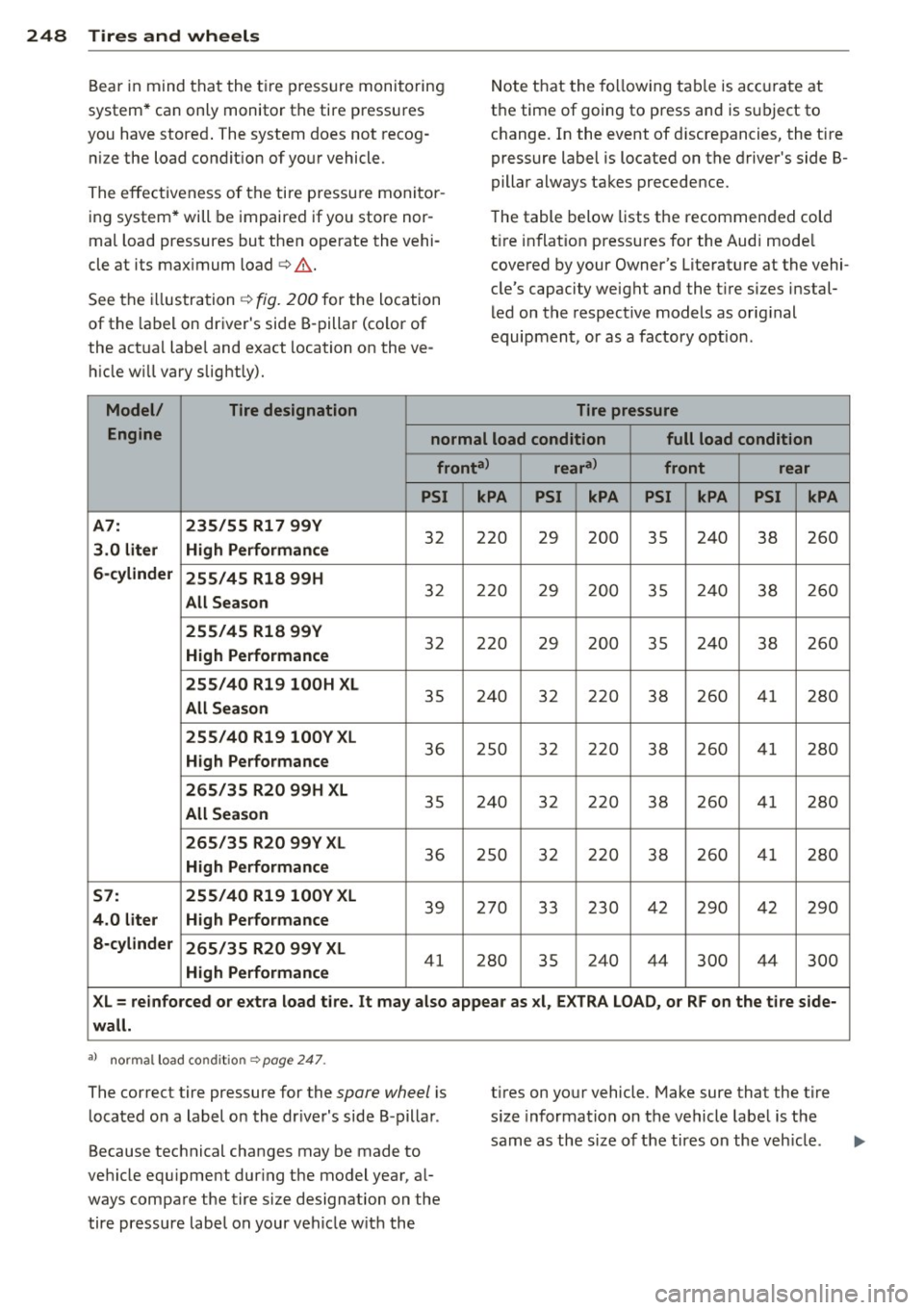
See the i llustra tion c:> fig. 2 00 for the location
of the la b el on dr iver's side B-pillar (co lor of
the act ua l labe l and exact location on the ve
h icle w ill vary slig htly).
Model / Tire designation
Note that the fo llowing ta ble is acc urate at
t h e time of going to press and is s ubject to
c h ange . In the event of d iscrepancies, the t ire
pressure label is located on the d river's side B
pillar always takes precedence.
T he table below lists t he recommen ded cold
t ir e inflat ion pressu res for the Audi mode l
cove red by your Owner's Lite rat ure at the vehi
cle's capacity weig ht and the t ire sizes instal
l ed on the respective models as or ig inal
equipmen t, or as a factory opt ion.
Tire pressure
Engine normal load condition full load condition
fronta > reara
>
front rear
PSI kPA PSI kPA PSI kPA PSI kPA
A7 : 235/55 Rl 7 99Y
32 220 29 200 35 240
38 260 3.0 liter High Performance
6-cylinder 255/45 R18 99H
All Season
3 2 2 20 29 200 35 24 0 3 8 260
255/45 Rl8 99Y 32 220 29 200
35 2
4 0
38 260
High Perfo
rmance
255 /40 R19 lOOH XL
35 240 32 220 38 260 280 All Season 4 1
255/40 Rl9100YXL
36 2 50 32 220 38 260 41 280 High Performance
265/35 R20 99H XL
35 240
32 220 38 260 41
280 All Season
265 /35 R20 99Y XL
36 250 32 22 0 38 26 0 41 280 High Performance
S7: 255/40 Rl9 lOOY XL
39
270
33 230
42 290 42 290 4.0 liter High Performance
a-cylinder 265/35 R20 99V XL
High Performance
41 280 35 240 44 300 44 300
XL= reinforced or extra load tire. It may also appear as xl, EXTRA LOAD, or RF on the tire side-
wall.
al no
rm al load co ndi tio n r:::., page 24 7.
The correct tire pressure for the spare wheel is
l ocated o n a label o n the dr ive r's side B -pillar .
Because technical changes may be made to
ve hicle equ ipment dur ing the model year, a l
ways compare the tire size designation on the
tire pressure labe l on your vehicle w it h the t
ires on you r vehicle. Make sure that the tire
s ize informa tion on the vehicle labe l is the
same as the size o f the tires on the veh icle .
Page 256 of 306
254 Tires and wheels
Unbalanced wheels must be rebalanced to
avoid excessive wear on steering, suspension
and tires. A wheel must also be rebalanced
when a new tire is installed .
Incorrect wheel alignment
Incorrect wheel alignment can cause exces
sive tire wear, impairing the safety of the vehi
cle. If tires show excessive wear, have the
wheel alignment checked by an authorized Audi dealer or qualified workshop.
All-wheel drive
Vehicles with quattro must always have tires
of the same size, construction and tread type .
For details see
~page 201.
A WARNING
Sudden tire failure can lead to loss of con
trol, a crash and serious personal injury!
- Never drive a vehicle when the tread on
any tire is worn down to the wear indica
tors.
- Worn tires are a safety hazard, they do
not grip well on wet roads and increase
your risk of"hydroplaning" and loss of control.
- Always keep chemicals that can cause
tire damage, such as grease, oil, gasoline
and brake fluid away from t ires.
- Tires age even if they are not being used
and can fail suddenly, especially at high
speeds . Tires that are more than 6 years
old can only be used in an emergency
and then with special care and at lower
speeds.
- Never mount used tires on your vehicle if
yo u are not sure of their "previous histo
ry." Old used tires may have been dam
aged even though the damage cannot be
seen that can lead to sudden tire failure
and loss of vehicle control.
New tires and replacing tires and wheels
New tires and wheels have to be broken in .
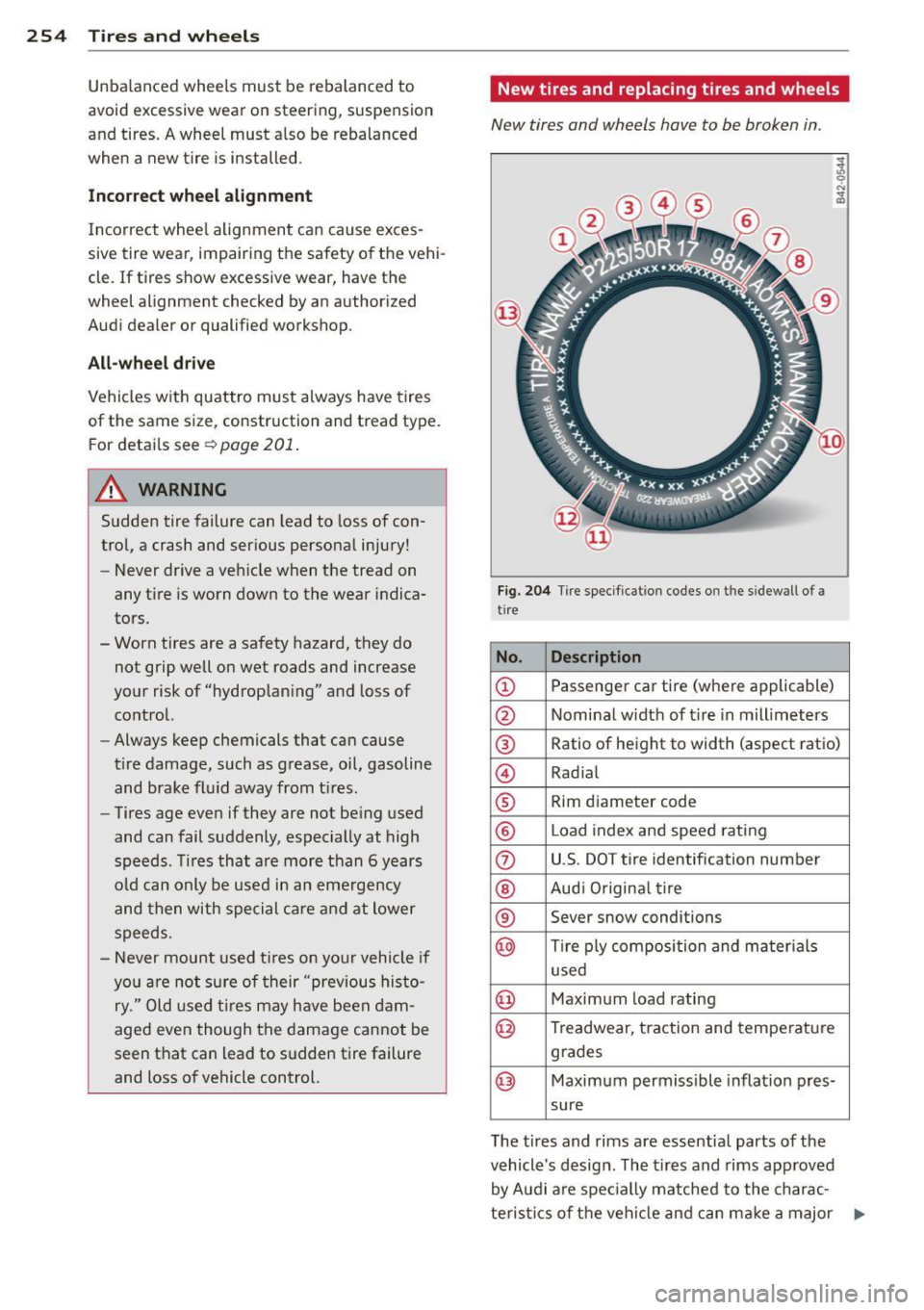
Fig. 204 Tire specificat ion codes on the s idewall of a
tire
No. Description
® Ratio of height to width (aspect ratio)
© Radial
® Rim diameter code
® L oad index and speed rating
(J) U.S . DOT tire identification number
® Audi Original tire
® Sever snow conditions
@ Tire ply composition and materials
used
@ Maximum load rating
@ Treadwear, traction and temperature
grades
@ Maximum permissible inflation pres-
sure
The tires and rims are essential parts of the
vehicle 's design . The tires and rims approved
by Audi are spec ially matched to the charac
teristics of the vehicle and can make a major .,..