2014 AUDI S6 transmission
[x] Cancel search: transmissionPage 276 of 304

2 7 4 Emergency situations
Emergency situations
General
This chapter is intended for trained emer
gency crews and working personnel who
have the necessary tools and equipment to
perform these ope rations.
Starting by pushing or
towing
Q;) Note
Vehicles w ith an automatic transmission
cannot be started by pus hing o r tow ing.
Starting with jumper
cables
If necessary, the engine can be started by
connecting it to the battery of another vehi
cle.
If the engine should fail to start because of a
discharged or weak battery, the battery can be
connected to the battery of
another veh icle,
using a
pair of jumpe r cables to start the en
g ine .
Jumper cables
Use only jumper cables of sufficiently large
cross section to carry the starter current safe
ly. Refer to the manufacturer's specif ications.
Use only jumper cables with
insulated termi
na l clamps which are distinctly marked:
plus(+) cable in most cases colored red
minu s(-) cable
in most cases colored black .
A WARNING
Batteries contain electricity, acid, and gas.
Any of these can cause very serious or fatal
inju ry. Follow the instructions below for
safe handling of your veh icle's battery.
- Always shield you r eyes and avoid lean
ing over the battery whenever possible.
- A discharged battery can freeze at tem
peratures just be low 32 °F (0 °C). Before connecting a
jumper cable, you must
thaw the frozen battery complete ly, oth
erwise it could explode.
- Do not allow battery acid to contact eyes
or skin . Flush any contacted area with
water immediately .
- Improper use of a booster battery to start a vehicle may cause an explosion.
- Vehicle batteries generate explosive gas
es. Keep sparks, flame and lighted ciga
rettes away from batteries.
- Do not try to jump start any vehicle with a low acid level in the battery.
- The vo ltage of the booster battery must
also have a 12-volt rating. The capacity
(Ah) of the booster battery should not be
lower than that of the discharged bat
tery . Use of batteries of d ifferent voltage
or substantially different "Ah" rating
may cause an exp losion and personal in
jury.
- Never charge a frozen batte ry. Gas trap
ped in the ice may cause an explosion.
- Never charge or use a battery that has
been frozen. The battery case may have
be weakened.
- Use of batter ies of different voltage or
substantially different capacity (Ah) rat
ing may cause an exp losion and injury.
The capacity (Ah) of the booster battery
should not be lower than that of the dis
charged battery.
- Before you check anything in the engine
compartment, always read and heed a ll
WARNINGS¢
page 224.
(D Note
- App lying a higher voltage booster bat
tery will cause expensive damage to sen
sitive electronic components, such as
contro l units, relays, radio, etc .
- Th ere must be no electrical contact be
tween the vehicles as otherwise current cou ld already start to f low as soon as the
positive(+) terminals are connected. .,.
Page 278 of 304

2 76 Emergency situations
-When connecting jumper cables, make
sure that they cannot get caught in any
moving parts in the engine compart
ment.
- Before you check anything in the engine
compartment, always read and heed all
WARNINGS c:>
page 224.
(D Note
Improper hook-up of jumper cables can ru
in the generator.
- Always connect POSITIVE( +) to POSI
TIVE(+), and NEGATIVE(-) to NEGATIVE
( - ) ground post of the battery manager
control unit.
- Check that all screw plugs on the battery
cells are screwed in firmly . If not, tighten
plugs prior to connecting clamp on nega
tive battery terminal.
- Please note that the procedure for con
necting a jumper cable as described
above applies specifically to the case of
your vehicle being jump started. When
you are giving a jump start to another ve
hicle , do
not connect the negat ive( -) ca
ble to the negative( -) terminal on the
discharged battery@c:>
fig. 219. In
stead, securely connect the negative( -)
cable to either a solid metal component
that is firmly bolted to the engine block
or to the engine block itself. If the bat
tery that is being charged does not vent
to the outside, escaping battery gas
could ignite and explode!
Emergency towing
with commercial tow
truck
General hints
Your Audi requires special handling for tow
tng.
The following information is to be used by
commercia l tow truck operators who know
how to operate their equipment safely.
-Never tow your Audi. Towing will cause
damage to the engine and transmission .
- Never wrap the safety chains or winch ca
bles around the brake lines.
- To prevent unne cessary damage, your Audi
must be transported with a flat bed truck.
- To load the vehicle on to the flat bed, use
the towing loop found in the vehicle tools
and attach to the front or rear anchorage
c:> page 2 76 and c:> page 2 77.
.&_ WARNING
=
A vehicle being towed is not safe for pas-
sengers. Never allow anyone to ride in a
vehicle be ing towed, for any reason.
Front towing loop
Only install the front towing loop when it is
needed.
Fig. 220 Front bumper: cover
Fig. 221 Front bumper : in stalling the towing loop
-
The towing loop fits into the threaded hole lo
cated on the right side of the front bumper
and covered by a smal l cover when not in use.
.,. Remove the towing loop from the vehicle
tool kit.
Page 281 of 304

heavy components such as the engi ne
b lock or transmiss ion are removed.
- W hen removing heavy components like
these, ancho r vehicle to hoist o r add cor
respond ing weig hts to ma inta in the cen
ter of g ravity . Otherwise, the vehicle
m ight tilt o r sli p off the hoist, causi ng
ser ious p erso na l in ju ry.
([) Note
-Be awa re of the fo llowing points befo re
li fting t he vehicle:
- The vehicle should never be lifted or
jacked up from underneath the engine oil pan, the transmission housing, the
front or rear axle or the body side
members. This could lead to serious
damage.
- To avoid damage to the underbody or
chassis frame , a rubber pad must be
i nserted between the floor jack and
the lift points.
- Before driving over a workshop hoist,
check that the veh icle weight does not
exceed the permissible lifting capacity
of the hoist.
- Before driving over a workshop hoist,
ensure that there is sufficient clear
ance between the hoist and low parts
of the vehicle.
Emergency situations 2 79
•
•
Page 282 of 304
280 Technical data
Technical data
Vehicle identification
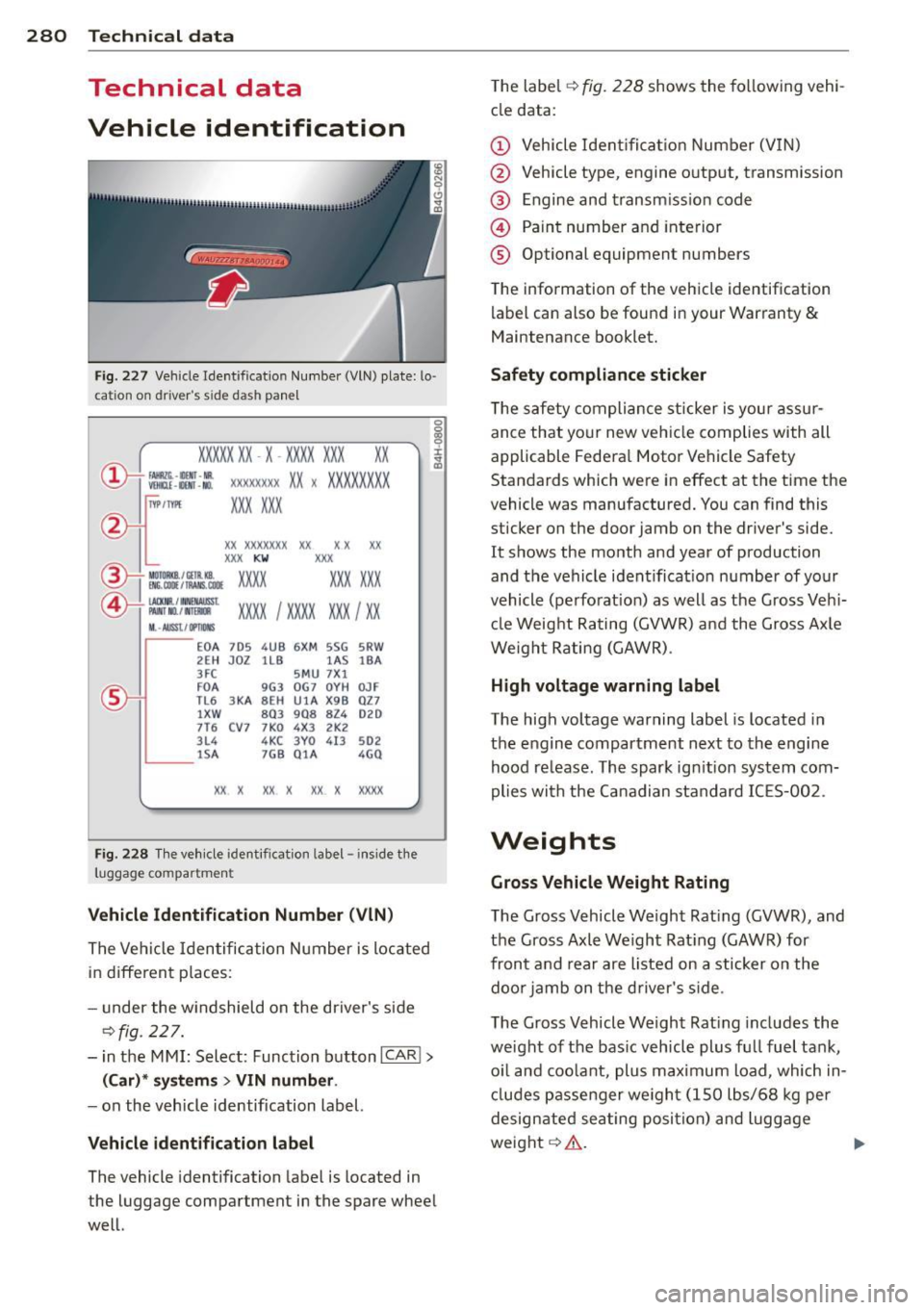
F ig. 227 Vehicle I dent ifica tion Numbe r (VlN) pla te: lo·
cat ion on driver 's side dash pane l
XXXXX XX · X -XXXX XXX xx
r,"\__l f~ -11!111 · NII. ~ V!Hlll -llllll . NO.
IYP IT'fl'E
XXXXXXXX XX X XXXXXXXX
XXX XXX
XX XXXXXXX XX X X XX
XXX
KW XXX
®i ~~:f :l~~ XXXX XXX XXX
@+ ~~r= XXXX I XXXX XXX I XX M ,. AIIISl./ lflllllS
EOA 7D5 4 UB 6XM SSG 5RW
2E H JDZ llB l AS lBA
3FC 5MU 7Xl
FO A
9G3 OG7 O
YH OJF
TL6 3
KA BEH
UlA X9B QZ 7
l XW
8Q3 9Q8 82 4 020
7T6 CV 7 7KO 4X3 2K2
3L4 4 KC 3YO 4I3 502
lS A 7GB Q1A 4GQ
XX X
XX X XX X XXXX
Fig. 228 Th e ve hicle identi ficat ion label -inside the
luggage co mpa rtmen t
Vehicle Id entification Number (VlN )
The Ve hicle Identific ation Number is located
in different p laces:
- under the w indshield on the driver's s ide
~fig . 227.
- in the MMI : Select: Function button ICAR I >
(Car )* systems > VIN number .
-on the veh icle identification label.
Vehicle identification label
The vehicle identification labe l is located in
the luggage compartment in the spare wheel
well. T
he label ~
fig. 228 shows the following vehi
cle data:
(D Vehicle Ident ificat io n Number (V IN)
@ . Vehicle type, engine o utput, transmission
® Engine and transm iss ion code
@ Paint number and inte rior
® Optional equipment numbers
T he information of the vehicle identification
label can also be found i n your Warranty
&
Maintenance booklet.
Safety compliance sticker
The safety compliance sticker is your assur
ance that yo ur new veh icle complies with all
applicable Federa l Motor Vehicle Safety
Standards which were i n effect at the time the
vehicle was manufactured. You can find this
sticker on the door jamb on the driver's side.
It shows the mo nth and year of production
and the vehicle ident ificat io n number of your
vehicle (perfo rat ion) as well as the Gross Ve hi
cl e Weig ht Rating (GVWR) a nd the Gross Ax le
Weig ht Rating (GAWR) .
High voltage warning label
The high voltage warning label is located in
the engine compartment next to the engine
hood re lease . The spar k ign it ion sys tem com·
plies wi th the Ca nadian standard IC ES-002.
Weights
Gross Vehicle Weight Rating
The Gross Vehicle We ight Rat ing (GVWR), and
the Gross Axle Weight Rat ing (GAWR) for
fron t and rear are listed on a sticker on the
doo r jamb on the d river's side .
The Gross Vehicle We ight Rat ing includes the
weight of the bas ic vehicle plus f ull fuel tank,
o il and coo la nt, plus max imum load, which in
cl udes p asse nger we igh t (150 l bs/68 kg per
designate d sea ting posi tion) an d luggage
weight ~&. - .,.
Page 296 of 304

294 Index
K
Key ... . ... ... .. .. ..... ... .. .. .... .. 3 2
Battery rep lacement master key ... .. . . 33
Emergency key . .. ..... ... .. .. .... .. 32
Key not recognized . . . . . . . . . . . . . . . . . . 76
Key replacement ......... .... .... .. 32
Master key . . . . . . . . . . . . . . . . . . . . . . . . 32
M echanical key .............. ... ... . 33
Valet key . .. .. ........ .... ... .. .. .. 32
K ick-down
tiptronic
112
K nee airbags .... .. ..... ... .. .. .... . 164
Descr ipt ion .... . ...... ... .. .. .... . 164
How they work . .. ..... ... .. .. .... . 166
Important safety instructions . . . . . . . . 166
L
Lane assist . . . . . . . . . . . . . . . . . . . . . . . . . 93
L ane Change Ass istant
refer to side ass is t . . . . . . . . . . . . . . . . . . 96
LATC H .. .. .. ............. .... .. ... 187
D .. escnpt 1on .... .... .... .. .. .. .. .. .
Install ing a child restraint ...... .. .. .
L ocat ion .. .... ............. ... ' . .
M ount ing and releasing the an cho rage
hook
. . .. .. ............. .... .. .. .
188
18 9
188
189
Launch Contro l Program . ... .. .. .. .. . 112
Leather cleaning/protection ... .. .... . 2 13
Leaving home ............. .. .. .. .. .. 45
Lift ing jack ............... .. .. .. .. .
266
Lift ing vehicle
L ight 278
Ambience lighting . . . . . . . . . . . . . . . . . . 46
Com ing/ Leavi ng home ..... .. .. ...... 45
D aytime running lights .. .. .. .. .. .. ..
4 3
Eme rgency flashers . . . . . . . . . . . . . . . . . 4 4
Exterior lighting ..... ... .. .. .. .... ..
4 3
H eadlig ht range contro l ... .. .... .. . . 43
High beam ... ........... .. .. .... .. 45
Low beam ....................... ..
43
Rear fog lights ........... .... .... .. 43
Side marker lights .. ... ... .. .. .. .. .. 43
Turn signals ................ ... ... . 45 Li
ght/ rain sensor
Hea dlights . ..... .. ... ..... ... .. .. .
43
Intermittent (w indshie ld w ipers) ... .. . 48
Sensor defective . . . . . . . . . . . . . . . . . . . . 23
Loa ding the roof ra ck ................ . 62
Locking
Power loc king switch .............. .. 37
Remote cont ro l .... ........... .. .. . 35
U si ng the key ................. ..... 3 7
Low beams
Lower universal anchorages (Cana da)
Luggage compartment
43
187
Cargo ne t . . . . . . . . . . . . . . . . . . . . . . . . . 65
En larging . . . . . . . . . . . . . . . . . . . . . . . . .
64
Load ing ... .... .. ... .. ..... ... .. .. . 63
Ski sack ... .... .. ... .. ..... .... . .. . 65
Stowing luggage ... ... ..... ... .. ..
134
Tie -downs . . . . . . . . . . . . . . . . . . . . . . . . . 65
L uggage compartment lid
Movement-act ivated open ing . ... .. .. . 39
L umbar support
Front seats . . . . . . . . . . . . . . . . . . . . . . . . 54
M
Maintenance .. .. .. ..... ....... ... .. 283
Malfunction Ind icator Lamp (MIL) . . 2 1, 30
Manua l shift prog ram ............ ....
111
Massage function
Front seats . . . . . . . . . . . . . . . . . . . . . . . . 54
Matte finish paint clea ning .. ... .. .. ..
210
Mechan ica l key .. .. ................ .. 33
Mirrors Adjusting the exterior mirrors . . . . . . . . . SO
d' . 1mmmg .. .. .. .. ... .. .. ... ..... .. . 51
Vanity mir rors . .. .......... ...... .. 47
Monito ring the Advanced Airbag System 159
Mult if u nct ion steer ing whee l ........ .. . 2 5
mult itron ic (automatic transmission) . .. 107
N
Natura l leather
Cleaning
New t ires and whee ls
N HTSA
213
251
Co ntacting .... .... ... ..... ... .. .. 136
Page 300 of 304

298 Index
Steering
Electrically adjustable steering whee l 73
Manually ad justab le steer ing whee l .. . . 73
also refer to E lectro-mechanical power
assis t ... .... ............. .. .... . 198
Steering whee l
Easy entry feature . . . . . . . . . . . . . . . . . . 7 4
Indicator light . . . . . . . . . . . . . . . . . . . . . 18
Steer ing whee l heating .... .. .. .. .. . . 72
S teer ing whee l co lumn
Adjusting e lectr ica lly . .... ... .. .. ... . 73
Adjusting manually .. ... .. .. .... .. . . 73
Steer ing whee l w ith t ipt ronic . .. .. .. .. . 111
Steps for determining correct load lim it . 249
Stopping the engine ..... ... .. .. .... .. 75
Storage ... .. ... ... ... .. .. .. .. .. .. .. 59
S tronic transmission Launch Contro l Program ... .. .. .. .. . 112
S t ron ic (automatic t ransm ission) . .... . 107
Sunroof ... .. ................ ... ... . 41
Sun shade Rear window ............... .. .... .. 4 7
Side doors ............... .. .. .... .. 47
Sun visors ... ... ... ...... .... ..... .. 47
Symbols
refer to Warning/ind icator lights .. .... 12
T
Tachometer . . . . . . . . . . . . . . . . . . . . . 12, 24
Tail lights Clean ing ... .. ... ..... ... .. .. .. .. . 211
TD ! clean d iese l
refer to Ad Blue ........... .. .. .. .. . 220
Technical data ................ ... ... 280
Tec hnical modifications ... .. .. .. .... . 286
Temperatu re d isplay ........ .. .. .. .. .. 24
Tether anchors ............ .. .. .. .. . 190
Tether strap .. .... ..... ... .. .. .... . 190
Textiles Cleaning . .. ... .......... .. .. .. .. . 213
The first 1,000 miles (1,500 km) and after-
wards . .. .. .. ............... .. .... . 201
Three-zone climate control . ... .. .. ... . 68
Tie-downs . . . . . . . . . . . . . . . . . . . . . 65 , 135
Tips for the env ironment
Saving fue l . . . . . . . . . . . . . . . . . . . . . . . . 62 t
iptron ic (automatic t ransmission) 107, 111
Tire pressure ...... ................ . 246
Tire pressure monitoring system ... .. .. 258
Loss of air pressure ............ .... 259
Malfunction . .. .. .. .. ...... ... .. .. 259
Resetting t ire pressures .... ...... ... 260
Tires .. ... .. .. .. .. .. ... .. ..... ... .. 240
Service life .... .. ............. .... 250
Speed rating let ter code ...... .. .. .. 252
Tire manufacturing date ........ .. .. 252
Tire specif ications .......... ...... . 252
Tread depth . .. .. .......... ...... . 250
Un iform tire quality grading ..... .. .. 254
Winter tires . .. .. .. ........... .. .. 255
Tires and veh icle load limits ....... .. .. 248
Tires and wheels Checking tire pressure .. ... ... .. .. .. 246
Co ld tire inflation pressure ...... .... 244
Dimens ions .... .. ............. .... 251
General notes .. .. ............. .... 240
G lossary of tire and loading terminolo -
gy . .. ... ... .. .. .. ... ... ... .. .. .. 241
Low aspect ratio tires .. ...... ... .. .. 257
New t ires and whee ls ............. .. 251
Replac ing . .. .. .. ... .......... .... 252
Snow cha ins ... .. .. .... .... ... .. .. 256
Tires and vehicle load limits ... ... . .. 248
Whee l bolts ..... .. ... ..... ... .. .. 257
Winte r tires ... .. ............. .... 255
T ire service life .. .. ............. .... 250
Too ls .. ..... ... .. ..... ........... . 262
T orn or frayed safety belts ... ... .. .. .. 141
T owing
T ow t ruck p rocedu res ........... .... 276
TPMS Tire pressure monitoring system ..... 259
Trai ler towing ..... ... .. ..... .... . .. 206
Operating instr uctions ........ .. .. .. 206
Parking system . .. ... .......... .. .. 125
Technical requirements . . . . . . . . 206, 207
Tra iler tow ing tips .......... ...... . 208
T rai n (transporting your vehicle) ... .. .. 278
T ransmission .. .. .. ... .......... .... 10 7
Transmission malfunction ( indicator
li ght) .. ... ... .. .. ... .. .. ... ..... ..
112
Transpo rt Canada . . . . . . . . . . . . . . . . . . . 136
T ranspo rting your vehicle ....... .. .. .. 278