2014 AUDI S4 oil capacity
[x] Cancel search: oil capacityPage 241 of 296

not exceeded . Vehicle load includes everybody
and everything in and on the vehicle. These
l oad limits are techn ica lly referred to as the
ve hicle's
Gross Veh icle We ight Rat ing
("GVWR").
The "GVWR" includes the weight of the basic
veh icle, all factory insta lled accessories, a full
tank of fu el, oil, coolant and other fluids plus
maximum load. The maximum load includes
the number of passengers that the vehicle is
i n tended to carry ("seating capacity") with a n
assumed weight of 150 lbs . (68 kg) for each
passenger at a des igna ted sea ting pos ition
and the tota l we ight of any l uggage in the ve
h icle. If you tow a trailer, the weight o f the
trailer hitch and the tong ue weight of the
l oaded trailer must be included as part of the
veh icle load.
The
Gro ss A xle Weight Rating ("GAWR") is
the maximum load that can be applied at each
of the vehicle's two ax les.
The G ross Vehicle We ight Rating and the
Gross Axle Weight Rating are listed on the
safety compliance sticker labe l located on the
driver's side B -pi llar . Your Audi has 5 seating
positions, 2 in the front and 3 in the rear for
tota l seating capacity of 5. Each seating posi
tion has a seat belt¢
page 138, Safety belts.
The fact that there is an upper limit to your
veh icle's Gross Vehicle Weight Rating means
that the tota l weight of whatever is being car
ried in the vehicle (including the weight of a
trailer hitch and the tongue weight of the
loaded trailer) is limited. The more passen
ge rs in the veh icle or passengers who are
h eav ier than the standa rd weights assumed
mean that less weight can be ca rr ied as l ug
gage.
The tire pressure labe l on you r Audi also lists
the maximum combined we ight of all of the
oc cu pants and luggage o r othe r ca rgo that
the vehicle can carry . For the location o f the
l abe l
¢page 234, fig. 189.
Tires an d wheel s 239
A WARNING
Overloading a vehicle can cause loss of ve
h icle contro l, a crash or other accident, se
rious pe rsonal injury, and even death.
- Carrying more we ight than your veh icle
was des igned to carry will prevent the
veh icle from handling properly and in
crease the risk of the loss of vehicle con
trol.
- The brakes on a vehicle that has been
overloaded may not be able to stop the
veh icle w ith in a safe distance.
- Tires on a vehicle that has been overload
ed can fail suddenly, incl uding a blowout
and sudden defla tion, causing loss of
contro l and a crash.
- Always ma ke sure that the total load be
ing transpor ted - incl uding the weight of
a trailer hitch and the tongue weight of a loaded trailer -does not ma ke the vehi
cle heavier than the vehicle's Gross Vehi
cle We ight Rating.
Determining correct load limit
U se th e example below to ca l
culate the total weight of the
pa ssengers and lu ggage or oth
e r thing s that you pl an t o tran s
po rt so that you can make sur e
that your vehicle will not be
o verloaded.
Steps for Determining
Correct Load Limit
1 . Lo cate th e statement "THE
COMBINED WEIGHT OF O C
CUPANTS AND CARGO
SHOULD NE VER E XCE ED XXX
KG OR XXX LBS"on your vehi-
c le 's pla card (tire inflation ..,
•
•
Page 273 of 296

This might happen, for example, when
heavy components such as the engine
b lock or transmiss io n are removed .
- When removing heavy components like
these, anchor vehicle to ho ist or add cor
responding weig hts to mai nta in the cen
ter of g ravity. Otherwise, the veh icle
m ight tilt o r slip off t he hois t, causi ng
serious p ersona l injury.
(I) Note
- Be awa re of th e fo llowing points befo re
li fting the vehicle:
- The vehicle should never be lifted or
jacked up from underneath the engine oil pan , the transmission housing , the
front or rear axle or the body s ide
members. This could lead to ser ious
damage.
- To avoid damage to the underbody or
chassis frame , a rubber pad must be
inserted between the floor jack and
the lift points .
-Before driv ing over a workshop hoist,
check that the vehicle weight does not
exceed the permi ssible lifting capacity
of the hoi st.
- Before driv ing over a workshop hoist,
ensure that there i s sufficient clear
ance between the hoist and low parts
of the vehicle.
Emergency situations 2 71
•
•
Page 275 of 296
Technical Dat a 273
Gros s Axle We ight Rating
The G ross Axle Weight Rating is the maxim um
l oad that can be applied at each axle of the
vehicle
c::> &. .
Vehicle capacity weight
The vehicle capac ity we ight (max. load) is list
ed on the d river 's side 8-p illar.
_& WARNING
- T he ac tual Gross Axle Weight Rat ing at
t he front and rea r axles sho uld not ex
ceed the perm issible weights, a nd their
combination must not exceed the G ross
Vehicle Weight Rat ing.
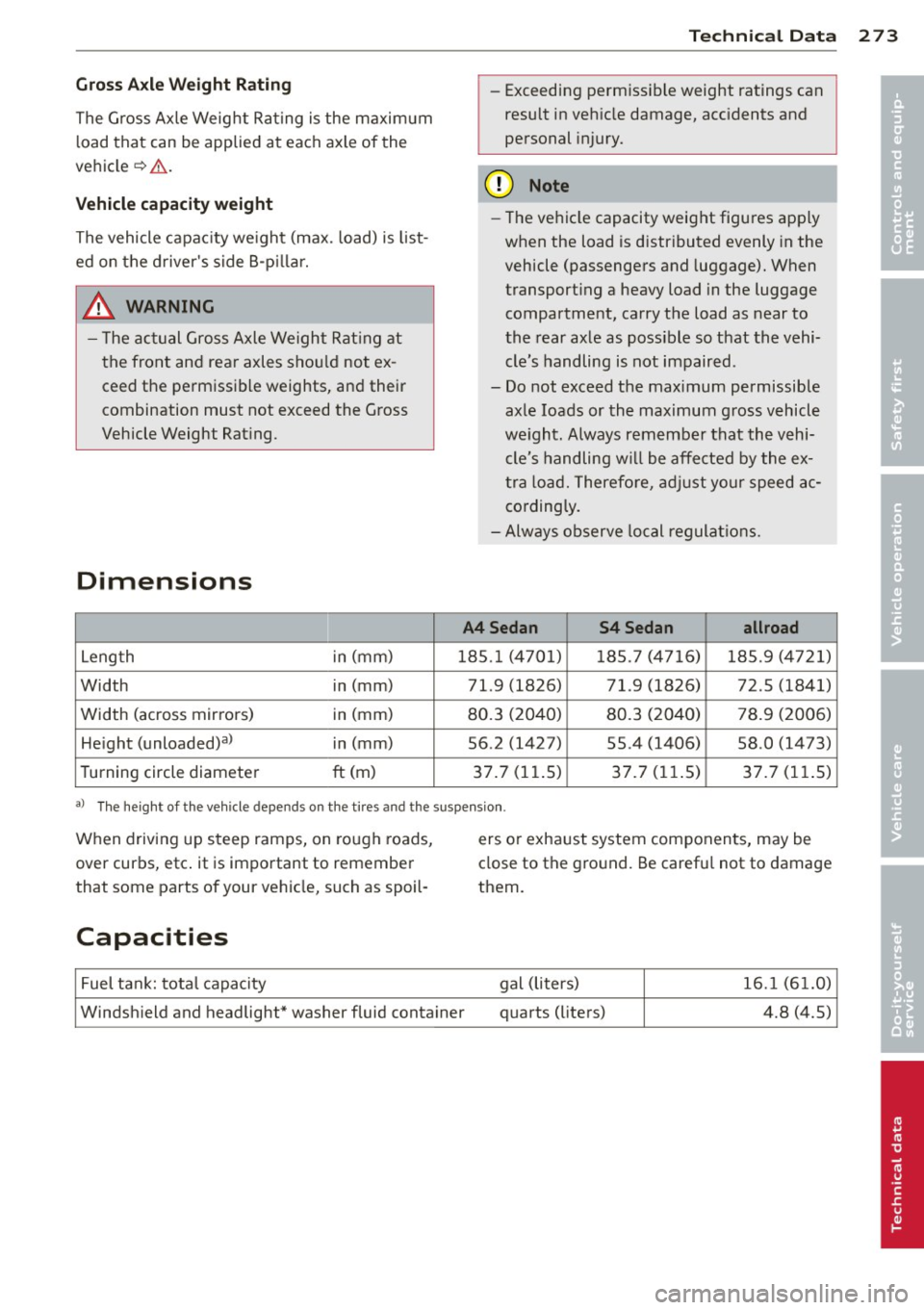
Dimensions
Leng th in (mm)
Width in (mm)
Width (across mir rors) in (mm)
He ight (unloaded)a) in (mm)
T urning circle diamete r
ft (m)
-
-Exceeding perm iss ible weight ratings can
result in veh icle damage, acc idents and
pe rsonal injury.
([) Note
-Th e ve hicl e capacity weig ht figu res apply
when the load is d istr ibuted evenly in the
vehicle (passengers and luggage). When
transport ing a heavy load in the luggage
compartment , carry the load as near to
t he rear ax le as poss ible so that the vehi
cle's handling is not impaired.
- Do not exceed t he maximum permissible
ax le loads or the maximum g ross vehicl e
we ight. A lways remember that the v ehi
cl e's handling w ill be affe cted by the ex
t ra lo ad. Therefo re, adju st yo ur speed ac
c o rding ly.
- Always o bserve loc al regulat io ns.
A4Sedan
S4Sedan allroad
1
85. 1 (4701) 185.7 ( 47 16 ) 1 85.9 (47 21)
71.9 (1826) 71.9 (1826) 72 .5 (1841)
80.3 (2 040) 80.3 (2 040) 78.9 (2 006)
56 .2 (1427) 55 .4 (1406) 58 .0 (1473)
37.7 (1 1.5) 37. 7 (11. 5) 37. 7 (11. 5)
aJ The heig ht of t he ve hicle depends on th e t ires and the suspensio n.
When driving up s teep ramps, on ro ugh roads,
over cur bs, etc . it is impo rtant to remembe r
that some parts of your ve hicle, such as spoil -
Capacities
Fuel ta nk: tota l capacity
Windsh ield and headlight* washer fluid container ers o
r exha ust system componen ts, may be
close to the ground. Be carefu l not to damage
them.
gal (liters) 16. 1 (6 1.0)
quarts (lite rs) 4.8 (4.5)
•
•